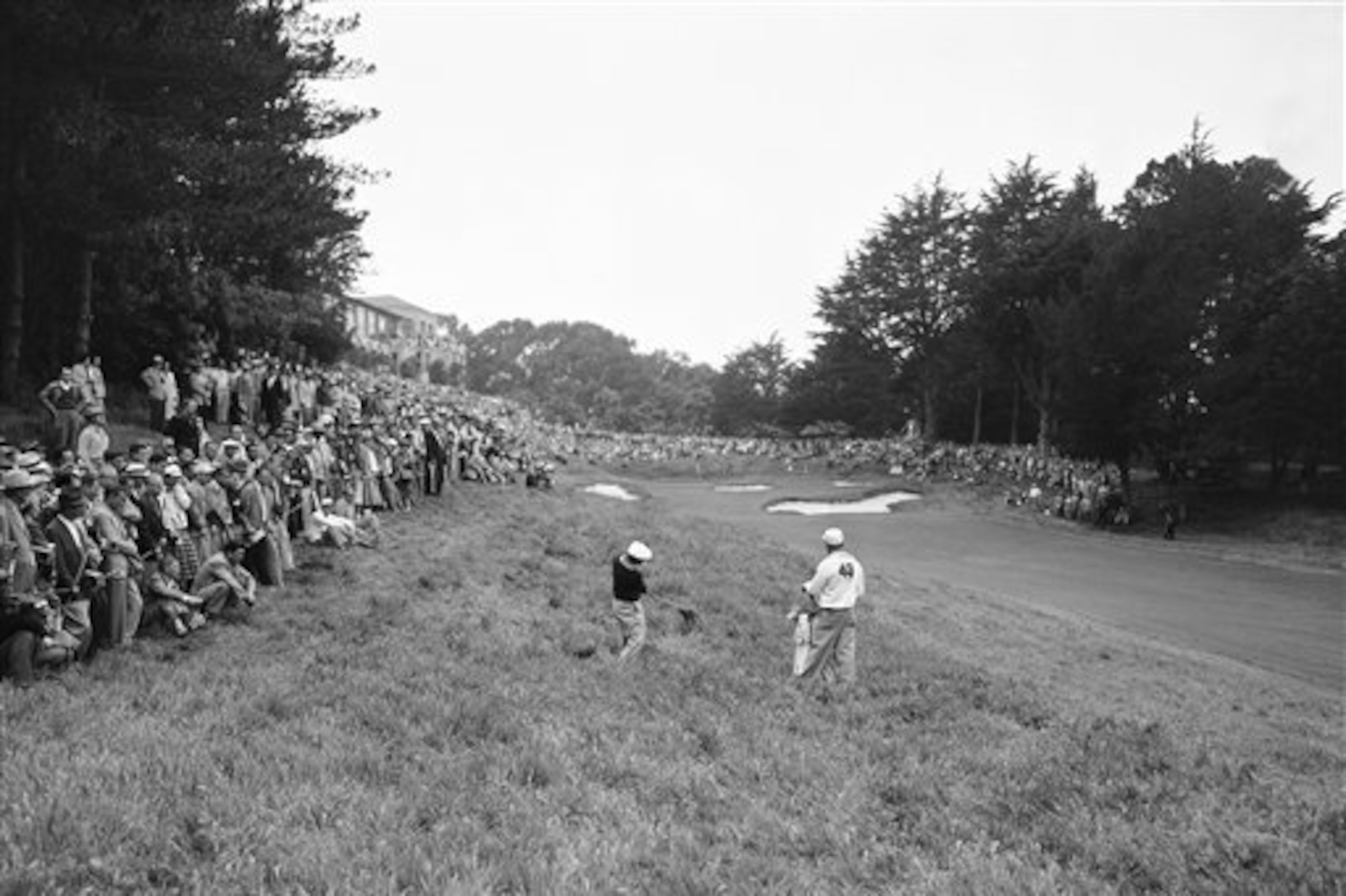

Ranking the 10 Best Shots in US Open History
With the 115th U.S. Open just days away, it is the perfect time to look back at the greatest shots from over a century of legendary golf at the year’s second major.
Whether it is Jack Nicklaus’ classy return to the top in 1980, Tiger Woods’ one-legged win at Torrey Pines in 2008 or Arnold Palmer’s incredible 1960 comeback at Cherry Hill, the tournament is not short on great memories.
But how do we determine which 10 shots out of thousands should be considered better than all the rest? For this assessment, we take into account both the technical difficulty of the shot and the competitive circumstances surrounding it to come up with the best of the best.
It is never easy to whittle down 100-plus years of shot-making into a top-10 list, but every play on here has earned its place at the pinnacle of U.S. Open history.
10. Bobby Jones, 1929, Winged Foot
1 of 10
Winged Foot hosted the first of its five U.S. Opens in 1929, but the course makes its first appearance on this list, thanks to a Bobby Jones putt worthy of the history books.
Jones was far from his vintage best when he made the turn into the final nine holes. In fact, he found himself on the 18th green, needing to drop a 12-footer to save par and force a playoff with Al Espinosa. Golf Digest’s E. Michael Johnson testified to the putt’s technical difficulty, when he described it as “downhill with a vicious left-to-right break.”
However, despite the incredible pressure of both trying to make the playoff and trying to avoid the embarrassment of a dramatic collapse at the last turn, Jones sank the putt (which lingered on the lip for just a moment before falling, naturally) and went on to win the playoff by a commanding 20 strokes.
At the time, sportswriter Grantland Rice called it “the greatest single putt I have ever witnessed.” In 1954—25 years after Jones claimed his third U.S. Open—pros Tommy Armour, Gene Sarazen, Craig Wood and Johnny Farrell (who had all competed in the 1929 Open) tried to recreate Jones’ famous putt. As a true testament to the shot’s difficulty, not one of them managed to sink the putt.
9. Corey Pavin, 1995, Shinnecock Hills
2 of 10“It was by far the biggest shot of the little man's life,” wrote Larry Dorman of the New York Times. “For too many years now, he had endured the left-handed compliment—best player never to have won a major championship. Now, if he could hit the green, he could lose the label forever and take his place among the giants of the game.”
Needless to say, the pressure was on for Corey Pavin as he stared down the 209 yards between him and the 18th pin. Knowing Greg Norman was still within touching distance, Pavin boldly launched a 4-wood and saw his ball drop behind a small hill shielding his view of the green.
He started to run up the fairway to catch a glimpse of where it had landed (see the above video), but the cheers of “Corey! Corey! Corey!” soon told him all he needed to know.
“It's the most pressure I've ever felt on a golf course,” said Pavin. “I just tried to gather myself and make a good swing. I was trying to hit a low draw, and I knew I'd hit a good shot. I just took off running then because I wanted to see it. I knew it would get pretty close.”
The ball had landed just short of the green and rolled to within five feet of the pin, leaving Pavin with a pedestrian two-putt for par and a two-shot victory for his first major championship.
8. Payne Stewart, 1999, Pinehurst
3 of 10In what Golf.com’s Alan Shipnuck called “the greatest U.S. Open ever,” Payne Stewart collected his third major at the expense of Phil Mickelson (summarized in the video above), thanks to a phenomenal putt on the last hole at Pinehurst.
The Open came down to the final two holes on Sunday. Stewart managed to pick up a birdie on No. 17 to establish the outright lead over Mickelson, who only managed par. After Mickelson narrowly missed his putt on No. 18, Stewart found himself looking at an 18-foot par putt with the trophy on the line.
“I kept my head still on that putt,” said Stewart. “And when I looked up, it was about two feet from the hole, and it was breaking right in the center, and I couldn't believe it. I couldn't believe that I'd accomplished another dream of mine.”
It had been eight years since Stewart’s last major victory, and his eruption of emotions immediately after the victory reflected that fact. Devastatingly, Stewart would die just four months later in a plane crash, but his performance in the ‘99 Open would live on forever in the memory of his peers and fans alike.


7. Hale Irwin, 1990, Medinah
4 of 10Hale Irwin was four strokes off the lead going into the final round at Medinah Country Club in Illinois, but he didn’t let that discourage him. Irwin made up the previous day’s deficit and carded a scorching six-under on the back nine to earn a playoff berth against Mike Donald in incredible fashion.
Though the playoff was exciting in its own right, it pales in comparison to the final stroke of Day 4 that earned Irwin the right to duel on Monday.
The 1974 and 1979 U.S. Open champion was staring down a 45-foot birdie putt to go eight under. It was a classic case of “win and you’re in,” but the length of the shot ensured the task was anything but simple.
Irwin set his feet, gave the target one last look and smoothly sent his ball rolling over the hump and down into the center of the cup.
As soon as it fell, Irwin took off running toward the gallery with his arms in the air, collecting high fives from the patrons before blowing them kisses as he returned to the green. Please enjoy the above video for full effect.
And speaking of lengthy putts…
6. Larry Nelson, 1983, Oakmont
5 of 10
Larry Nelson is no stranger to the title of the PGA Tour’s “Invisible Man,” despite his Hall of Fame accomplishments. He has won three major championships, and yet you would be hard-pressed to find his face in digital archives. As Golf.com’s Gary Van Sickle puts it:
"You want to watch video of Nelson winning the Open at Oakmont in 1983? You can find highlight videos for every other year, but if you want to watch clips of Nelson's win, you have to snag the 1982 U.S. Open video. There's a pathetically small amount of footage of Nelson winning the next year attached at the end.
"
Regardless of the spotty footage, Nelson did, in fact, win the 1983 U.S. Open at Oakmont (and he did it with one of the greatest major putts of all time). He barely made the cut on Friday, but found his way into contention on Sunday, thanks to a stormy weekend slowing down the blistering greens.
“I had a hard time with greens that were hard and fast, but I could play target golf,” he said, per Golf.com. “It has to be soft to shoot 65-67 at Oakmont. You're not going to do that unless it's soft.”
Nelson acclimated to the friendlier greens and sank an epic, multi-tiered, 60-foot putt for birdie on the par-3 16th. With that highlight, and the momentum it provided, he went on to win the tournament by one stroke.
5. Ben Hogan, 1950, Merion
6 of 10If there’s a club more difficult to hit than a 1-iron, they haven’t invented it yet. When asked how to avoid being struck by lightning, Lee Trevino said, per Golf Channel’s Joe Posnanski, “Stand in the middle of the fairway and hold up a 1-iron. Even God can’t hit a 1-iron.”
Try telling that to Ben Hogan.
It was with that very club that Hogan found the green on the 72nd hole at Merion and posed for one of the most iconic golf photos of all time. He settled for a two-putt to force a playoff with Lloyd Mangrum and George Fazio, but he eventually outlasted both men to earn his second of four U.S. Open titles.
The beauty of his iconic approach shot, however, almost pales in comparison to the miraculous fact he was even present to take it. The 1950 U.S. Open was Hogan’s first tournament after a car crash 16 months earlier that thankfully (though amazingly) spared his life. According to Posnanski: “He fractured his collarbone, pelvis, ankle and rib and doctors proclaimed his golf career over.”
Hogan’s 1-iron shot was the beautiful culmination of a truly amazing comeback. The above video unfortunately does not include the iconic shot, but it almost makes up for the absence with its vintage newsreel charm.
4. Jerry Pate, 1976, Atlanta
7 of 10Jerry Pate was caught in a close one approaching the end at Atlanta Athletic Club. The 22-year-old was holding onto a one-shot lead over 1975 runner-up John Mahaffey as he stepped up to the 18th tee, but his first shot found the right rough and left him with a perilous, 194-yard approach over the water.
Knowing pretty much anything but a perfect shot could spell the end of that day’s major dream, the young man collected himself and muscled a 5-iron through the rough to land his ball just three feet from the pin (as shown in the above video).
“As soon as it left the club face, I knew it was good,” Pate said in 2011, per Ian Thompson of the Birmingham News. “It was getting late in the day, and it painted the sky. It was as if everything was in slow motion. I couldn't see it land, but I knew it was good, and the crowd yelled, so I knew it was on the green.
True, the fact that his playing partner Mahaffey had dropped his 3-wood approach in the drink just before detracts a little from the tension of Pate’s shot.
However, the threat of losing the Open would still have been very real had he found the hazard—and the shot he ultimately pulled off would have been amazing under any circumstances—so Pate still deserves immense credit for keeping his nerve and bringing out his best when it mattered.
3. Geoff Ogilvy, 2006, Winged Foot
8 of 10Many will remember 2006 for Phil Mickelson’s collapse on the final hole after a wayward tee shot resulted in a double bogey, but it should not overshadow the brilliance that was Geoff Ogilvy’s par-saver on No. 17.
Mickelson had a one-shot lead over Ogilvy on the 17th tee box and was within touching distance of winning his third major of the year. Ogilvy, on the other hand, was trying to make a move with time running out and only managed to find the fringe with his third shot on the par four. Faced with a delicate decision, he decided to chip.
Lo and behold, the ball landed softly and ran all the way into the hole for an even-par lifeline going into No. 18. Ogilvy was still alive, but more importantly, he had the momentum.
In the end, Ogilvy kept his cool, came from behind and got up and down for par at the last to win his first (and only) major. Mickelson, meanwhile, gave two back and settled into a three-way tie for second place with Jim Furyk and Colin Montgomerie.
The climax of the tournament—focusing on the Mickelson combustion, naturally—is chronicled in the above video. Ogilvy’s chip-in is at the 0:30 mark.
2. Jack Nicklaus, 1972, Pebble Beach
9 of 10When talking about the greatest U.S. Open shots of all time, how could you not include at least one from the files of Jack Nicklaus?
The Golden Bear was fresh off a Masters victory and already had two U.S. Open titles under his belt when he came to Pebble Beach in 1972. However, the way he earned his third title on the par-three 17th in the final round was something to behold.
With the sea roaring and the driving wind in his face, Nicklaus slingshots the ball with his 1-iron. He watched it bounce on the green, hit the pin and settle right next to the hole. (You’ll forgive the questionable audio quality in the above video when you see the shot.)
Nicklaus tapped in for birdie on No. 17 and went on to card a three-stroke victory over Bruce Compton. He would win one more U.S. Open in 1980, but hitting the pin in ’72 still stands up as his greatest shot in the history of the tournament.
“The shot I performed,” said Nicklaus years later, per Golf.com, “I don't think I could ever do again.”
1. Tom Watson, 1982, Pebble Beach
10 of 10If Jack’s shot at Pebble Beach was No. 2, then Tom Watson’s had to be No. 1.
Watson and Nicklaus had essentially been battling each other down the stretch on Sunday—though technically the Golden Bear was already in the clubhouse by the time Watson reached the 17th (yes, that 17th). Watson missed the green on the par three and found his ball lying in the rough on a slope above the hole.
“I didn't have an impossible lie, but I had to take an awkward stance because I was on a down slope,” he said, per Los Angeles Times’ Mal Florence.
What happened next was the ultimate culmination of vision, skill and brass…uh, nerves.
“My caddie [Bruce Edwards] said, ‘Get it close,’” recalled Watson. “I said, ‘Hell, I'm going to sink it.’”
Like Babe Ruth, he called his shot. Then, like a champion, he actually made it happen. “If the ball doesn't hit the pin, it goes five or six feet past,” said Watson, explaining his mindset and the stakes at that moment. “I wouldn't want that shot again to make a par.”
Watson added to that one-stroke lead over Nicklaus with another birdie on No. 18, but the clincher was unquestionably his chip on No. 17.
When you call your major-tournament-winning shot on one of golf’s most legendary courses and actually sink it to beat the Jack Nicklaus, then your name is Tom Watson, and you’ve earned your spot atop this list of the greatest U.S. Open shots of all time. Period.


.jpg?w=2560 "Latest Peyton-Colts Rumors")