Breaking Down Dee Gordon's Surprising Start to the Season
Dee Gordon has always been a supreme athlete, but scouts, analysts, fans and even his coaches have always pondered whether he would ever truly be a "baseball player."
Well, this year Gordon has answered the naysayers with a resounding, defiant "Yes."
Traded from the Los Angeles Dodgers to the Miami Marlins in a seven-player deal this offseason, Gordon has done everything in his power to make his former team rue the day it sent him to the other side of the country.



"I think this is kind of a fresh start for him," Marlins pitcher Dan Haren, who was traded alongside Gordon, told the Los Angeles Times' Bill Shaikin. "I've been traded many times. You always kind of get a chip on your shoulder. You want to prove the other team wrong."
Gordon had a tumultuous experience during his four years in Dodgers blue. It always felt like his erratic talent was expendable, and even when he made the National League All-Star team last season, Gordon never appeared to receive the love from the front office that was showered upon, say, Yasiel Puig.
The road was never smooth for Gordon on the West Coast, despite tantalizing glimpses of what might be.
Once upon a time, Gordon was the Dodgers' top prospect, according to Baseball America. He showed great promise in his first season, finishing with a .304/.325/.362 slash line and 24 stolen bases in just 56 games.
However, his days at shortstop were numbered when the Dodgers made a move to bring in All-Star shortstop Hanley Ramirez, so Gordon honed his game at second base in Triple-A, grinding away until his time to make a permanent splash in the majors arrived.
In his 2014 season, his first as a full-time starter, Gordon seemed to reach his expected ceiling: a .289/.326/.378 slash line, 92 runs, 176 hits and a league-leading 64 stolen bases accompanied by iffy defense in 148 games.
The breakthrough wasn't enough for Los Angeles, who basically paid Miami—well, they actually paid, since they're still covering Gordon's $2.5 million salary this season—to take the then-26-year-old second baseman on, along with Dan Haren and his $10 million contract.
The Marlins are not a good baseball team. They're just 22-32 right now, 7.5 games behind the Washington Nationals in the National League East. But none of that is down to Gordon, who has been one of the best players in baseball this season.
Gordon, now 27, has taken a baseball bat to his glass ceiling this season, shattering it into millions of little pieces as he secures his spot as one of the best in the business.
It hasn't been conventional, but then, nothing about Devaris "Dee" Gordon's game has every screamed "convention."
Ichiro Lite
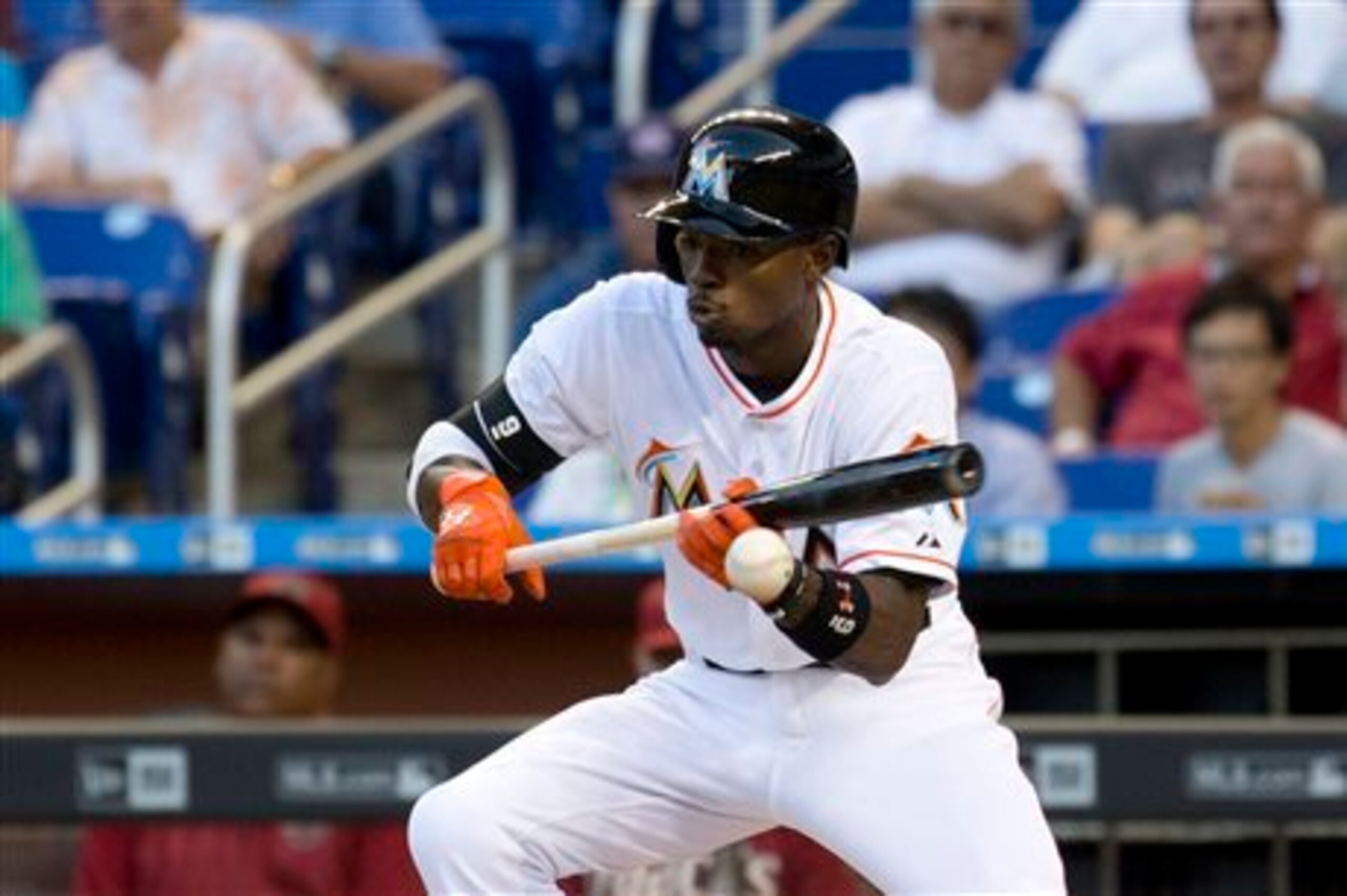
In early May, before the Marlins were to begin a three-game set against the Dodgers in Los Angeles, Gordon was asked if Miami had made any radical change to improve his game.
"They just told me to be Dee," Gordon told Shaikin. "Just go play. That's it."
If he continues producing at this rate, every manager in the MLB will be telling their players to be like Dee.
As of June 4, Gordon leads the entire MLB in batting average (.368) and hits (81) and ranks second in stolen bases (20), third in FanGraphs' Base Running (BsR) metric (3.5) and seventh in WAR (2.8).
Gordon was up above .400 for much of the season before regressing a bit, though his .368 batting average is still .013 percentage points ahead of the next-closest batter, the Texas Rangers' Prince Fielder.
Gordon's speed has always been his biggest asset, but now he's focusing more on putting the ball on the ground and just getting on base. It often looks like the ball has barely made contact with his bat when already Gordon is bursting down the line like a bullet fired from the pistol of the home plate umpire:
Though he does lead the MLB in singles (69) and is known more as a slap hitter, Gordon has also struck the ball solidly this season:
He's on pace for six triples and a career-high 30 doubles this season, six more than the previous career high he set last season with the Dodgers.
Comparing his overall numbers this year with last year, it's easy to see why Gordon has found so much success with the bat in his hand this season:
| Year | AVG | OBP | BABIP | BB% | K% | GB/FB | Contact% |
| 2014 | .289 | .326 | .346 | 4.8% | 16.5% | 3.13 | 87.2% |
| 2015 | .368 | .395 | .426 | 4.3% | 13.7% | 4.24 | 88.5% |
His batting average in balls in play sits at an unsustainable .426, by far the highest mark in the majors. Typically, that indicates a good bit of luck, and Gordon has certainly benefited from some, but you can't discount the speed factor.
Gordon's merely making contact with the ball puts immense pressure on the defense, especially the infield, which often has to go its typical movements far more rapidly and erratically than normally. It's all because of Gordon's otherworldly speed on the basepaths.
Gordon still doesn't draw many walks, and his already low walk percentage is actually down this year, even though his overall on-base percentage is up because of his tremendous hitting. But he's striking out far less, and his 4.24 ground ball-to-fly ball ratio is up over one full point from last year, while he's hitting line drives at the highest rate of his career (26 percent of all balls put in play).
This all adds up to the new and improved Gordon we've seen this year.
Obviously, you'd like to see him walk a little more, but if we're taking Gordon at his word, that doesn't appear to be in the cards, via Shaikin: "It doesn't work at all for me. Nobody is going to go out there and walk me. I have to earn my keep."
It's difficult to blame Gordon for his steadfast stance on trying to earn more walks. He's never going to be a power threat. Pitchers aren't likely to throw around him for fear of the long ball. He needs to knock his way onto the bases rather than wait for the pitchers to do it for him.
Because as soon as he gets on base, Gordon becomes an immediate threat to engage in some theft:
Essentially, his singles can immediately turn into doubles, which can then turn into runs for the Marlins. The pitcher also has to worry about Gordon's constant threat on the bags, which can really mess with his groove on the mound.
Having Gordon on the bases is like having a boogeyman on the bags, with the pitcher playing in eternal fear of what the speedy shadow might attempt next.
His season has been so remarkable that he's even drawn favorable comparisons to former MVP Ichiro Suzuki from FanGraphs' Jeff Sullivan:
"Gordon’s been swinging like prime Ichiro. He’s been running like prime Ichiro, and he’s been putting the ball on the ground and spraying it like prime Ichiro. He hasn’t slugged the occasional dinger like prime Ichiro, and he has overall hit the ball a little softer, but the results are alike, right down to the base hits on routine grounders. It’s a frustrating skillset to play against. Singles can appear out of nowhere.
"
His batting average is sure to drop this season as his sky-high average on balls in plays regresses to the mean a bit, but Gordon has a legitimate shot to lead the MLB in batting average, stolen bases and hits this season.
Not bad for a 27-year-old in only his second full year as an everyday starter.
Gold Glove Gordon?

Gordon's bat has rightfully earned most of the attention this season, but his improvement defensively at second base may be just as impressive and unexpected.
Just look at the leap in his numbers from last year with Los Angeles to this year in Miami:
| Year | UZR | UZR/150 | Fielding % | Zone Rating | Runs Saved |
| 2014 | -3.4 | -3.5 | .981 | .797 | -5 |
| 2015 | 6.7 | 20.0 | .993 | .826 | 9 |
Gordon is better statistically in every single facet of the game. Remove the names from this chart, and you'd assume you were looking at stats for two completely different players. For all intents and purposes, they are.
Gordon has a whole library stocked with gorgeous plays:
But he also makes the routine plays with no problem now, something that was an issue during his difficult transition from shortstop to second base last season.
By most metrics, Gordon has been the best defensive second baseman in the MLB this season, a far cry from the man he was in Los Angeles.
According to FanGraphs' Ultimate Zone Rating (UZR) metric, which calculates the number of runs a player has saved his team defensively, no second baseman in the league can touch Gordon. The Marlins' potential Gold Glover leads the entire MLB with a 6.7 UZR, over two points higher than second-place Jace Peterson of Atlanta.
He's projected to save Miami 20 runs this season according to UZR/150—which is simply UZR scaled to an average number of chances for a season—2.5 more than Atlanta's Peterson, who ranks second with 17.5, and 7.7 more than Detroit's Ian Kinsler, who ranks third with 13.3.
Gordon also ranks third among all positional players in defensive WAR and first among all second basemen, according to Baseball-Reference.com.
Gordon, together with shortstop Adeiny Hechavarria, might give the Marlins baseball's most imposing defensive middle infield.
"I don't see how they can't be in the Gold Glove (conversation),'' Marlins managers Dan Jennings told the Sun-Sentinel's Harvey Fialkov. "You have to watch these guys, they're on (ESPN's) Web Gems pretty much every night, and it's not by accident.''
Some credit for Gordon's miraculous one-year metamorphosis is due to Marlins infield guru Perry Hill, who began working extensively with Gordon as soon as he came to Miami.
Hill even believes that with all the improvement Gordon has made, he could succeed at the position he originally failed at, via Fox Sports' Christina De Nicola:
""If he went back knowing what he knows now about footwork and things like that, I think he could be a pretty good shortstop," Hill said. "He didn't really understand how much his feet control his upper body, his arm. I think he understands that now. I'm happy where he is. I don't even want to think about moving him."
"
Gordon has found his home at second base, and next to the rangy Hechavarria, the Marlins have one of the most potent infields in the entire league.
Now if only they could get the rest of the team up to Dee's speed.
All statistics courtesy of FanGraphs unless otherwise noted.




.jpg?w=2560 "Latest Peyton-Colts Rumors")