San Francisco 49ers: Will DeAndre Smelter Develop into an NFL Receiver?
The San Francisco 49ers surprised some by taking receiver DeAndre Smelter in the fourth round of the 2015 NFL draft. There are a couple of reasons why the pick was unexpected.
Firstly, in a deep receiving class with nine receivers going in the first 41 selections, many pundits assumed the 49ers would address their need at the position earlier than Day 3 of the draft. Secondly, Smelter was seen as a bit of a reach, with CBSSports.com listing him as a potential undrafted free agent.
Smelter is very difficult to actually grade out, however, because of the unorthodox offensive system he comes out of. Georgia Tech still uses the triple-option, the only major conference school to run a flexbone offense and the first since Lou Holtz’s Notre Dame teams in the 1980s and 1990s.
.jpg?w=2560 "Rams Raiders Football")

.jpg?w=2560 "Steelers Saints Football")
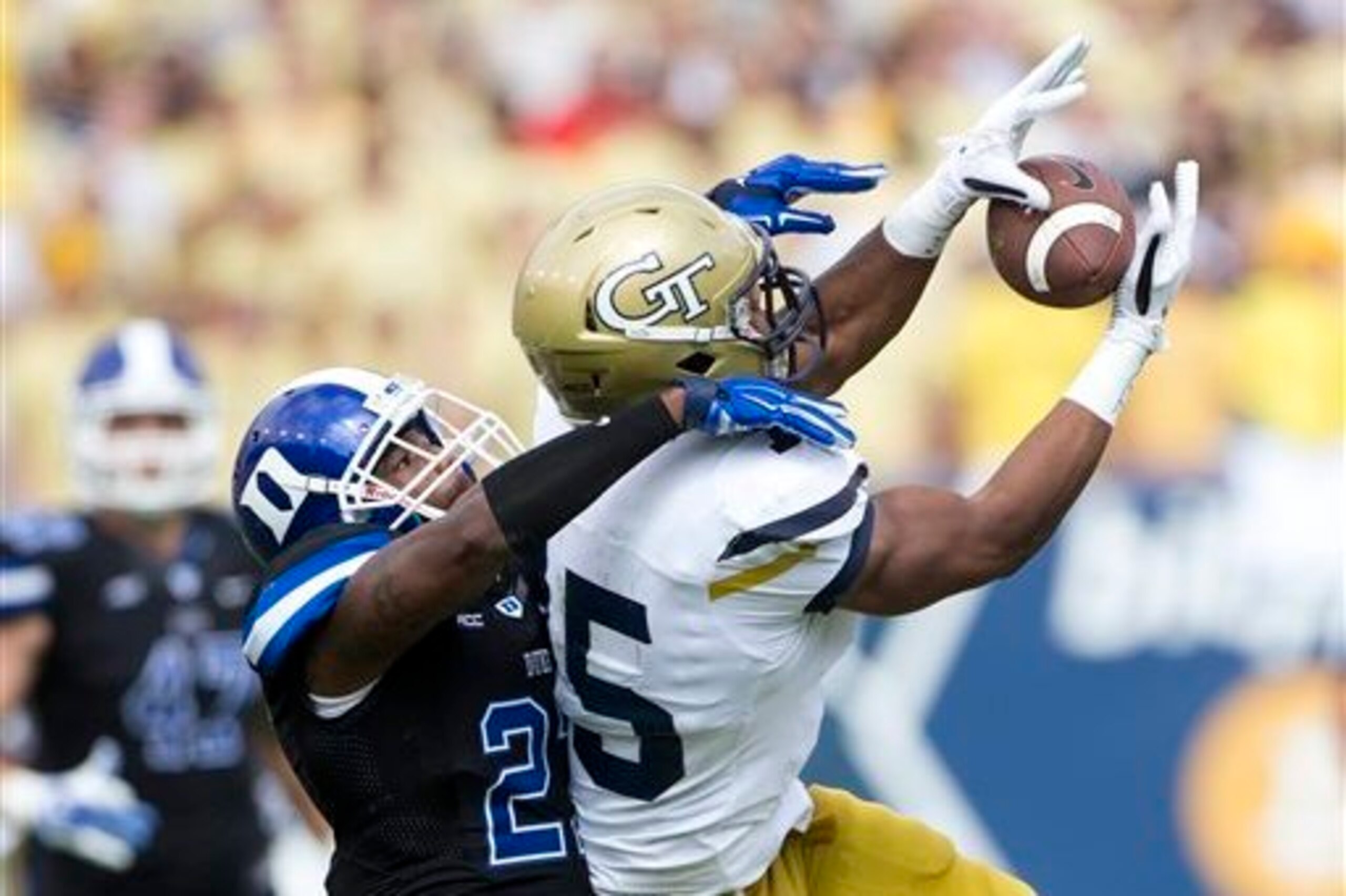
Georgia Tech runs the ball about 80 percent of the time. Last season, for example, quarterback Justin Thomas and company attempted just 201 passes, or 14.5 per game. That was the fifth-fewest in the nation, and all four teams below them also feature option-based schemes.
Their 56.4 rushing attempts per game were second in the nation, behind only Air Force. By comparison, the average college football team runs the ball about 55 percent of the time.
This definitely limits what wide receivers can expect to do. They essentially never have to worry about beating double coverage, as teams would be crazy to devote more than the bare minimum of resources needed to cover the passing game. Receivers also are not asked to run a complete route tree, because the short passing game essentially does not exist in a flexbone system.
Georgia Tech led college football with 17.7 yards per completion, because the passing game essentially consists of luring people into the box with steady runs and then burning the remaining players in the secondary with vertical routes.
Flexbone teams are looking for powerful blockers with sure hands for their receivers, rather than your traditional types and variety of players. You’re not going to find a slot receiver to go over the middle or a speedy burner from a flexbone team. Couple that with the relatively small number of reps receivers get at a school such as Georgia Tech, and you should be able to write them all off with one fell swoop, yes?
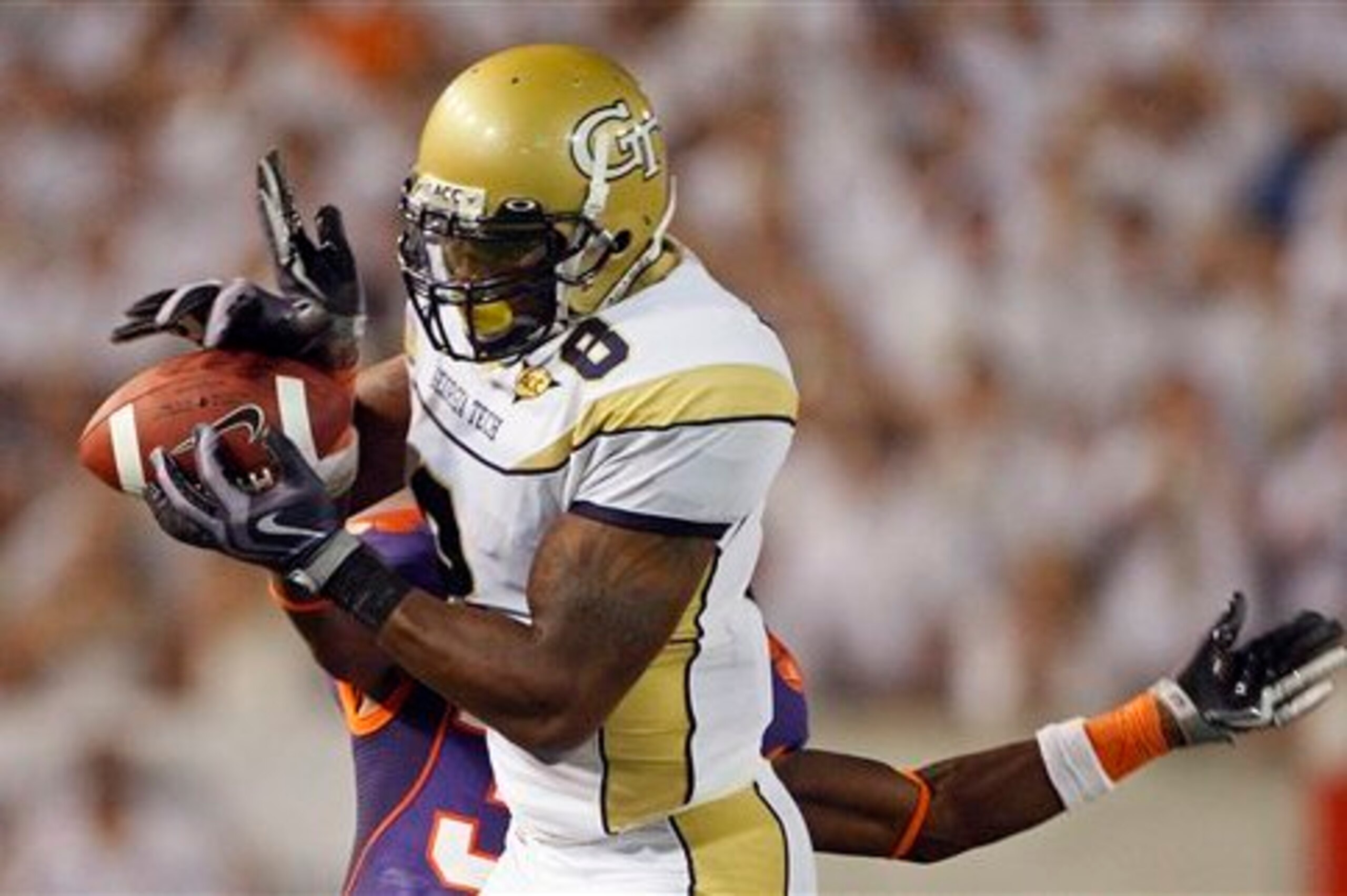
Well, no, not so much. If you just looked at the numbers, you might see a receiver with only 120 career receptions in a gimmicky offense as being a borderline prospect—a product of the system more than anything else.
Or, you could see him as a first-round pick because said player is Demaryius Thomas, who came out of that same flexbone system. Just because a receiver is limited in what he's asked to do in college doesn’t mean he can’t do more when asked to do more.
Now, Smelter is no Demaryius Thomas, or even a Stephen Hill, the other Georgia Tech receivers to be drafted since they switched to the flexbone system. He didn’t put up quite as big of numbers as either player. He has durability concerns, suffering a torn ACL. His hands, while massive, fail him sometimes, as he catches the ball with his body rather than his 11-inch mitts.
The point is that while Smelter is a product of a very specific and arcane system, that doesn’t mean he can only excel in it.
It’s not even like Smelter chose to play in a wishbone offense. Like Thomas before him—and notably unlike Hill, Smelter was not recruited to play a flexbone wide receiver. Smelter came to Georgia Tech on a baseball scholarship and was actually drafted by the Minnesota Twins back in 2010. Shoulder problems, however, caused his pitching career to come to an end, and he turned back to football.
Smelter hadn’t played football since his junior year of high school—a four-year gap before he joined Georgia Tech’s football team in 2013. The fact that he could walk on to the team and immediately lead the team in touchdown receptions says a lot about his raw talent. He also saw massive increases from 2013 to 2014 in every single statistical category.
That, in my opinion, is the biggest reason for optimism when it comes to Smelter—as he gets more and more experience under his belt, he has the potential to keep growing. He’s an unfinished product.
It also means that Smelter might not be just a flexbone receiver. One of the major benefits of running the option is that you don’t need traditional stars at quarterback or receiver.
That’s why the service academies all run it; no NFL-caliber quarterback or receiver is going to opt for mandatory military service when destined for pro football, so they’re stuck with lesser-quality athletes at the position. The triple-option allows them to succeed despite a lack of ideal talent at the position.
However, as Smelter was focusing on baseball, his ideal talent, or lack thereof, as a wide receiver never came into play. He received an offer from Georgia, according to Rivals.com, while the Georgia Tech football team originally considered him a safety. He wasn’t brought in just to be an atypical receiver.
In fact, there are signs that he could have succeeded in a more traditional offense.
His footwork, for example, is top-notch and implies an ability to make quick cuts for shorter routes. His physicality in the blocking game, coupled with his size, implies an ability to fight through press coverage and being hit at the line of scrimmage. It’s all projection at this point, but he shows some flashes of not just being a straight-line guy.
His lack of college football experience means that it’s very difficult to get a bead on Smelter, which explains why there is a great amount of dissent as to where he should have been drafted.
The less information you have about a player, the more you have to project based on measurables, body types and potential. Smelter’s four years away from football and Georgia Tech’s unorthodox style of offense make it very hard to come to a consensus of how good he will be.

The last time general manager Trent Baalke took a receiver before the consensus had him going with A.J. Jenkins in the first round of 2012, and that turned out to be a disaster of a pick.
Even in retrospect, the pick seemed odd—CBSSports.com had Jenkins as a second-rounder, while initial NFL.com scouting reports had him pegged as a fifth-rounder. It’s safe to say that, considering his track record, Baalke’s receiver analysis should be taken with a grain of salt until he drafts a player more productive than Kyle Williams.
That being said, there is potential here. Baalke’s not alone in seeing Smelter as being a potential star in the NFL. He has a lot of physical tools and quite a lot of room still to grow, considering his lack of experience at the position. He needs to learn some very basic skills, but there’s potential here. I think he’s worth more than the seventh-round grade CBS gave him.
That being said, I think he’s a risky pick, especially in the fourth round. The 49ers have plenty of receivers who could develop into stars—they used fourth-round picks the last two years on Bruce Ellington and Quinton Patton. If I was in charge of the team, and I was going to wait until Day 3 to draft a receiver, I would have gone with a more polished player with a lower ceiling.
The 49ers likely only have one year left of Anquan Boldin, so they need someone to step up and produce in a major way in 2015 in order to take that spot over next year. Maybe that is Patton or Ellington, or maybe Smelter comes back from his ACL injury and wows people in November or December.
That’s just a lot of “maybes” at this point. Eventually, one of these maybes need to become a definitely, and so far, none of Baalke’s mid-round receivers have done that.
There’s nothing wrong with taking a player like Smelter, with a high ceiling and a lot of developmental work to do, but that’s a pick I feel more comfortable with in the sixth or seventh rounds.
That’s why I was a Darren Waller fan—similar measurables, similar production when on the field as Smelter in the exact same system, yet he went in the sixth round rather than the fourth. In my opinion, that’s a better spot to take a gamble on a receiver.
Don’t write Smelter off because of his lack of experience or his presence in an unusual offense. Smelter has shown both the ability to adapt quickly and the raw tools and measurable to potentially develop into a fully-rounded receiver.
However, keep in mind that, even more so than most drafted receivers, we are talking about potential rather than certainties. It’s not a case where Smelter needs to translate what he did in college to the pros; he will have to learn an entirely new way of playing the position at the professional level.
Time will tell if Smelter is up to the challenge.
Bryan Knowles is a Featured Columnist for Bleacher Report, covering the San Francisco 49ers. Follow him @BryKno on Twitter.
.jpg?w=2560 "Cowboys Packers Football")



.jpg?w=2560 "🚨 Week 8 AP Top 25 Poll")