

Can Ameer Abdullah Finally Elevate the Detroit Lions Offense to the Next Level?
Running has become a lost art for the Detroit Lions offensively. It’s been misplaced for quite some time, buried in couch cushions somewhere alongside Matt Millen’s football simulator.
There was hope briefly in 2013, when Reggie Bush and Joique Bell became the first running back tandem to each record 500-plus rushing and receiving yards during a single season. But even then, the rushing offense of a team that’s done little with wide receiver Calvin Johnson’s prime years was league average at best—Detroit ranked 17th in 2013 with 112.0 rushing yards per game.
The Lions entered the 2015 draft needing to inject power and, more importantly, vision into their backfield. Their second-round pick, Ameer Abdullah, can do both as a smart, elusive runner and a sure-handed pass-catcher.
.jpg?w=2560 "Rams Raiders Football")

.jpg?w=2560 "Steelers Saints Football")
He has the skill set to finally give quarterback Matthew Stafford the run-game support he so desperately needs.
Stafford had some difficulty remaining in one piece at the beginning of his career because of knee and shoulder injuries. He started only 13 games over his first two seasons.
But he wriggled free of that glass grip, and he’s started 64 straight regular-season games since 2011. The run support he’s received in that time can mostly be described as utterly woeful.
| 2014 | 88.9 (28th) | 3.6 (T28th) |
| 2013 | 112.0 (17th) | 4.0 (21st) |
| 2012 | 100.8 (23rd) | 4.1 (18th) |
| 2011 | 95.2 (29th) | 4.3 (T12th) |
Detroit’s rushing offense hasn’t cracked the top 15 on a per-game basis with a healthy Stafford.
The Lions advanced to the postseason in 2014 primarily because of their strong defense combined with conservative passing, leading to a career single-season low of 12 interceptions for Stafford. But as a casualty, Stafford’s passing yards plunged—from 4,650 in 2013 to 4,257—and overall, the Lions offense sputtered while producing only 20.1 points per game (22nd).
The Lions crave balance offensively. Or at least they should, which is the point where Abdullah enters.
There’s a consequence to a heavy offensive lean toward either the run or pass. For the Lions, their distrust in Stafford developed in part because he was asked to throw so much prior to 2014. Between 2011 and 2013, he averaged an arm-numbing 674.7 attempts each regular season.
| 2014 | 602 | 5th |
| 2013 | 634 | 4th |
| 2012 | 727 | 1st |
| 2011 | 663 | 1st |
At some point, a quarterback who can struggle with ball placement is exposed by that high volume, and the burden could be eased with a remotely consistent running game.
During the Stafford era, a cycle has developed in Detroit's backfield, one Abdullah will seek to break. A running back is drafted high with the team hoping he will be that missing piece to remove some offensive weight from the quarterback’s arm. He either fails spectacularly, such as Mikel Leshoure, or has a prior history of injuries not-so shockingly cuts his career short, such as Jahvid Best.
Abdullah hasn’t had the latter problem, and he brings high-level slipperiness to combat the looming ghost of bitter disappointment among Lions running backs.
Abdullah forced a missed tackle once every 4.3 touches in 2014, according to Pro Football Focus (via Pride of Detroit). He did that while scoring 22 total touchdowns for the Nebraska Cornhuskers and accumulating 1,880 yards from scrimmage.
Of that yardage, 1,611 came as a runner. It was Abdullah’s second straight 1,600-plus-yard rushing season and also his second averaging at least 6.0 yards per carry.
In 2014, he established a new single-season high as a receiver with 269 yards through the air. That versatility is why it’s easy to nod your head in agreement after Abdullah told the Omaha World-Herald he can be an every-down back.
"I’m going to do whatever they ask me to do, but I think I’m an every-down back. A lot of guys want to put me in the category of third-down back. For those who say that, I ask them to turn on my film. I’ve never been that kind of player. I’ve never been a person who is just serviceable, who catches the ball out of the backfield, which I can do, and I feel I can do really well. But I can do a lot of things on first or second down as well, in my opinion.
"
Sure, Ameer, I will turn on your tape. It doesn’t take long to see a running back who—at 5'9" and 205 pounds—plays much larger than his size.
There’s no difficulty or hesitation when running up the middle as he glides with a low pad level. And when he gets into traffic, Abdullah first leans on his natural vision to find cut-back lanes and then his impressive lateral mobility to capitalize on them.
A fine example of that athleticism at work came during a win over Illinois in 2014, when Abdullah high-stepped merrily for 208 yards. It was one of his four 200-plus-yard games on the season.
Abdullah was called on for an interior run early in the first quarter. The blocking was designed to open a hole to his left, but the 21-year-old had to change his plans after taking the handoff and moving forward a step.
That hole was about to be filled by a linebacker. Suddenly, Abdullah found himself in a storm of swarming bodies.
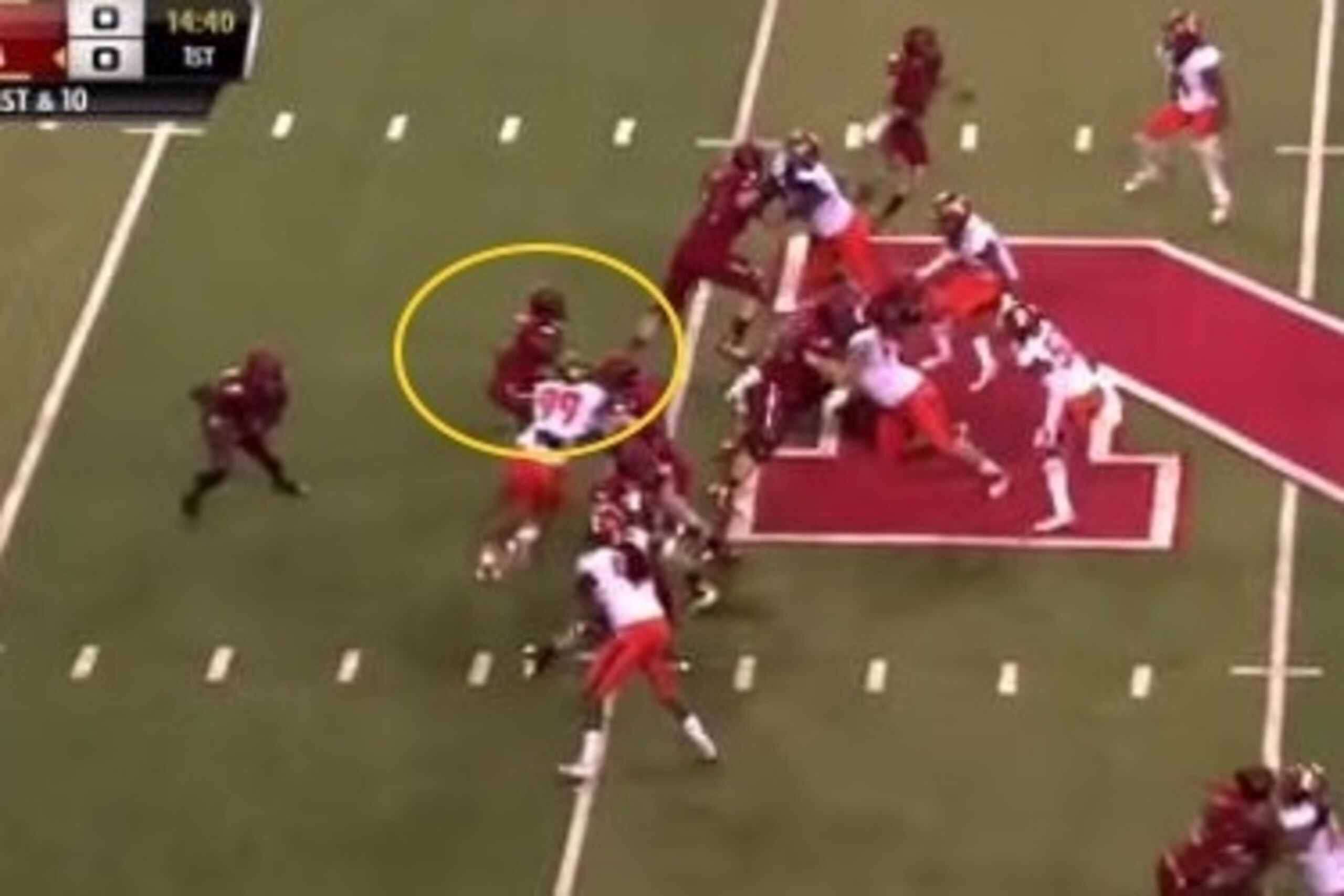
What you see there is the standard death point for many running plays.
Often, few good things follow when a running back is forced to halt his momentum in the backfield. That’s usually when the defense has won. What comes next is a runner desperately trying to push forward and make something—anything—out of nothing.
But not Abdullah. His next move was to the right and fast. After bouncing off his lineman he pivoted toward the cut-back opportunity, abruptly changing direction.
Then Abdullah flexed his power. At the 50-yard line, one defender was wrapped around his waist. Another was making contact from behind on the other side and a third was closing in.
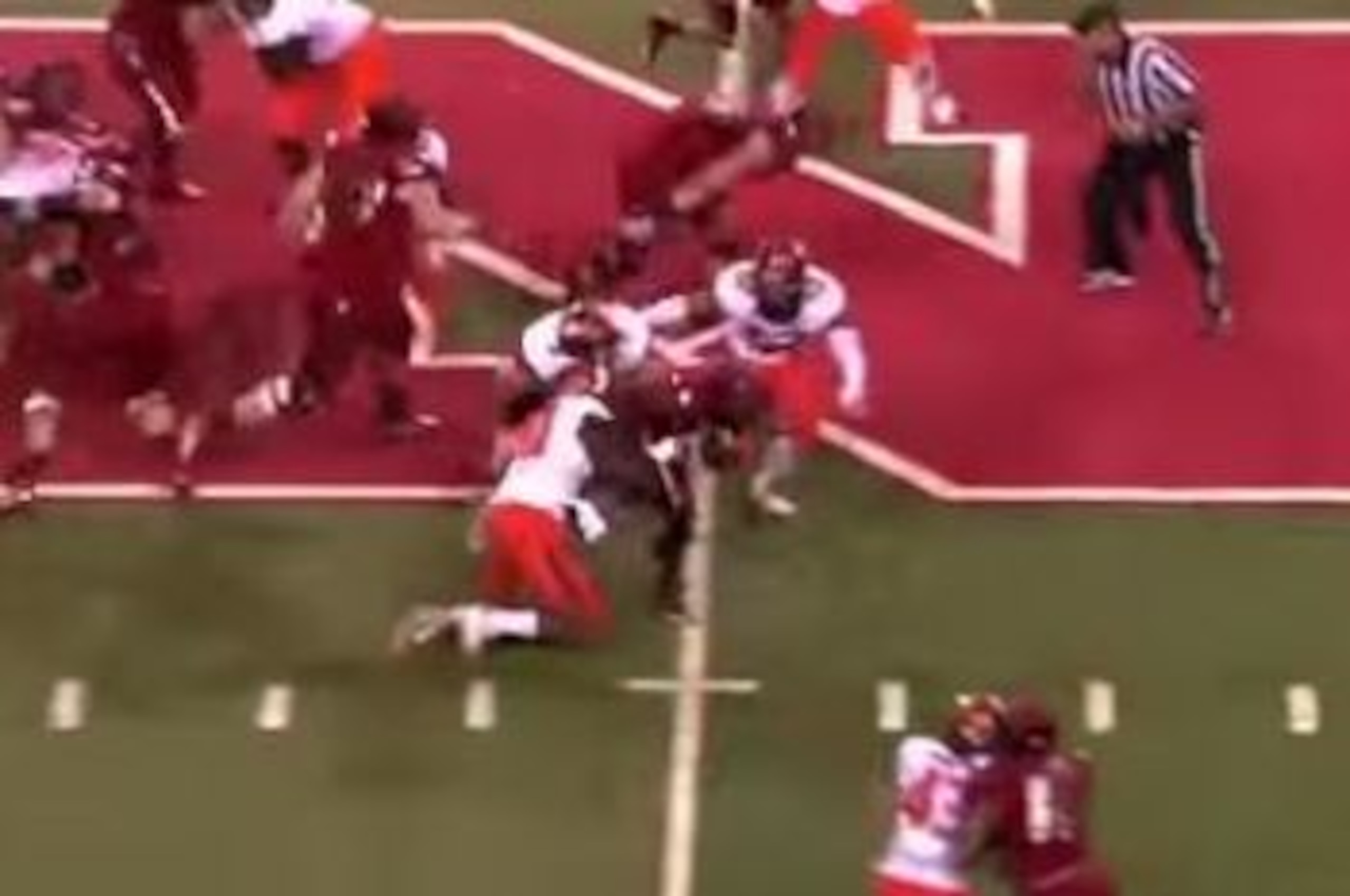
Yet he still churned his legs through the contact, falling forward for another four yards.
That wasn’t a game-breaking home run play, though Abdullah still had plenty of those on his way to an incredible 18 100-plus-yard games over his final two years at Nebraska. Instead, what will separate Abdullah is his ability to create gains from nothing through sheer instinct, as he did there.
Abdullah is truly in his element when the play calls for a designed cut back. Against Iowa he took two steps to his left, planted, scanned the field and then saw the emerging lane.
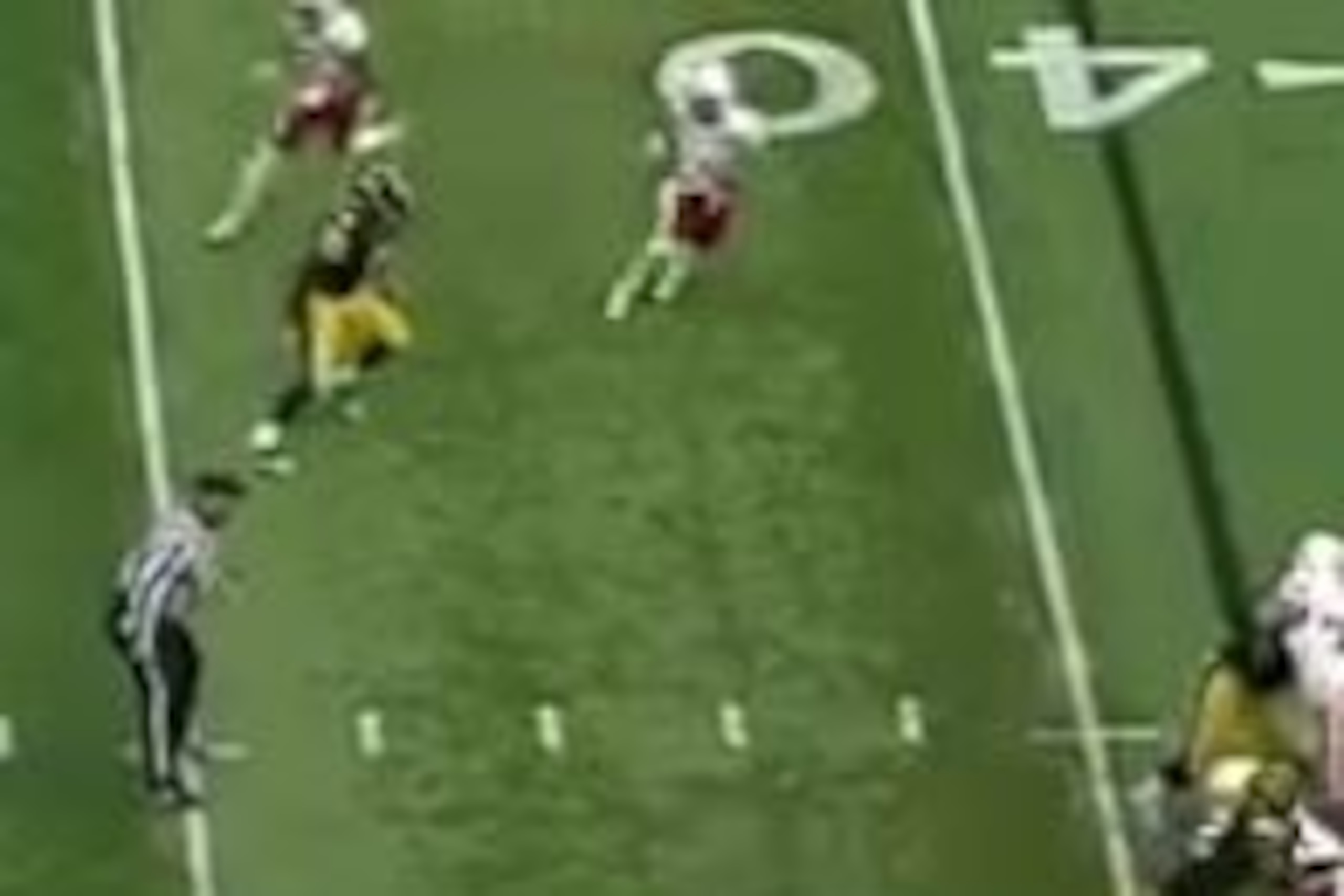
He rapidly shifted his weight without any loss of speed. He went through the hole untouched, but then he faced another decision: keep driving forward into the secondary, or cut outside? His choice would be the difference between a solid first-down gain and a deep cut clearing the fences.
He picked the outside door, reading his blockers correctly. Abdullah shifted his weight once more, slicing toward the boundary. Again, no speed was sacrificed. And again, that resulted in a show of force when Abdullah lowered his shoulder to leave another defender staggered.

The play should have ended there; Abdullah was hit squarely in a head-on collision. Instead, he kept running for another 42 yards.
As we’ve seen with Arizona Cardinals running back Andre Ellington, there are always durability worries with smaller bodies in the backfield. But NFL history is dotted with small running backs who handled a heavy workload. The most prominent of whom was 5'9", 180-pound Warrick Dunn, who averaged 222.4 carries per season over 12 years. Dunn topped the 1,000-yard rushing mark five times, doing that while recording 42.5 receptions per season.
Dane Brugler and Brandon Thorn of CBSSports.com made the Dunn comparison prior to the draft.
“Abdullah is extremely talented and polished with the ball in his hands and few run harder or with more energy,” they wrote, adding he can be a better version of Ellington while having a “Warrick Dunn-type career.”
Ball security is another concern, though it's an area in which Abdullah has improved significantly. He fumbled 23 times over his four seasons at Nebraska. But only four fumbles occured during his final year—a steep drop from eight in 2012.
The Lions fortified their rushing offense through more than just selecting Abdulllah. Prior to calling his name, they invested a first-round pick in guard Laken Tomlinson, and they took fullback Michael Burton on Day 3.
Bush has been released, and Abdullah appears to be an attempt at cloning him. But fellow running back Theo Riddick can function just fine in a pass-catching role, and after Bell averaged just 3.9 yards per carry last term, the Lions need Abdullah to be much more than a Bush duplicate.
For Stafford’s sake, they need him to be an every-down solution. And for the franchise’s sake, Abdullah needs to end a running back search that’s carried on for far too long.
.jpg?w=2560 "Cowboys Packers Football")




.jpg?w=2560 "🚨 Week 8 AP Top 25 Poll")