

San Francisco 49ers: Plotting out a Mock Draft with Trades
The convention of having no trades in a mock draft is a bit odd. People mocking picks to the San Francisco 49ers will have them use their nine picks without moving up or down the board at all, but that just isn't historically the case. General manager Trent Baalke usually trades up and down the draft board like crazy, dealing picks left and right in order to move into position to take the players they want. Just last year, the 49ers made trades that ended up resulting in Carlos Hyde, Marcus Martin, Aaron Lynch, Bruce Ellington and Kenneth Acker—not a bad haul, overall.
In fact, Baalke has averaged four trades per draft over the past few years. Last year, they made deals with the Denver Broncos, the Miami Dolphins, the Jacksonville Jaguars and the Cleveland Browns during draft day. The year before, they made trades with the Dallas Cowboys, the Tennessee Titans and the Green Bay Packers twice. In 2012, they made deals with Indianapolis Colts, Miami, the Carolina Panthers and the Detroit Lions. Baalke and the 49ers seem almost incapable of staying put and making a selection.
With that in mind, I thought I'd try to come up with a post-trade strategy for the 49ers. I decided to make four trades, as Baalke has done in recent years, and try to come up with the best possible combination of players they could add to the roster.
To do this, I used two resources. First, I used the classic draft value trade chart, originally invented by Jimmy Johnson when he was with the Cowboys. While the chart is a bit out of date these days, it still is the best rough guideline for determining how teams value their picks.
Secondly, I used Advanced Football Analytics' Draft Analysis Tool. That takes the various rankings of players and team needs around the Internet and tries to come up with a percentage chance that a player will be available at a specific pick. For example, with the 49ers' first pick, the tool estimates that receiver DeVante Parker will be available 20 percent of the time, whereas Dorial Green-Beckham will be available roughly 83 percent of the time. I used that to determine how far back the 49ers could trade and still get their man, or how far forward they would have to jump to snag a player.
Here's what I was able to come up with.
Trade One: 49ers Select Breshad Perriman, WR, UCF Knights at Pick 26
1 of 9Trade details: San Francisco trades pick No. 15 to the Baltimore Ravens for picks 26 and 58.
San Francisco's biggest need is still a game-changing wide receiver, but as the draft has gotten closer and closer, the odds of a top receiver falling back to the middle of the first round has gotten lower and lower. Mel Kiper's latest mock draft, for example, has four receivers going in the first four picks, as does Todd McShay's mock draft. If one of Amari Cooper, Kevin White or Parker fall to 15, the 49ers would be thrilled, but that seems less and less likely.
That makes a trade back to the end of the first round much more appealing. The 49ers could send their first-round pick to Baltimore, which could really use a top cornerback like Kevin Johnson or Jalen Collins, both of whom should still be on the clock here. In exchange, the 49ers move back 11 slots and pick up an extra second-round pick to play with.
Breshad Perriman is a bit raw as a player—his hands aren't great, his routes need work and he could stand to be more precise, overall. However, he is an athletic phenomenon, running a sub-4.3 40-yard dash at his pro day and generally amazing scouts with his athleticism. At 6'2" and 212 pounds, he has an amazing combination of size and speed. He will be a matchup nightmare in the pros.
If Perriman doesn't last until 26, this pick could easily be Jaelen Strong or Green-Beckham instead. The point is that there's a lot of solid receiving talent available late in round one, so the 49ers could find more value for their pick down there.
Trade Two: 49ers Select Preston Smith, DE, Mississippi State Bulldogs at Pick 43
2 of 9Trade Details: San Francisco trades picks 58 (from Baltimore) and 79 to Cleveland for pick 43.
In this scenario, the 49ers don't keep Baltimore's second-round pick for very long, dealing back up into the top of the second round almost immediately. Before these trades, the 49ers had one pick each in the first, second and third rounds. After, they have one later pick in the first round and two second-round picks. Assuming the team is happy with the player they get at the end of round one, that's a better spread for their first three selections.
The 49ers are often mocked with a defensive lineman in round one, thanks in part to the uncertain future of Justin Smith. Often, that's Oregon Ducks' Arik Armstead, as in this Kiper mock. I'm a big fan of Armstead, but he's raw as raw can be. He's not going to be an immediate contributor in 2015, making using a first-round pick on him something of a dangerous selection. I'd prefer to fill the need later in the draft.
Thus, the 49ers move up and take one of the top four or five 3-4 defensive ends in the draft in Preston Smith. Smith is built for a 3-4 system, with long arms, great hands and very solid run-stopping ability. He has played everywhere along the line, rushing from the outside and filling gaps as a nose tackle, so he has the versatility that Jim Tomsula looks for in his linemen.
He's very athletic, too, for a 270-pound man. He doesn't have the natural pass-rushing burst a 4-3 team would look for, but he's got power inside, making gaps with his long, powerful arms. He'd definitely be worth trading back up for.
Pick 46: Eric Kendricks, ILB, UCLA Bruins
3 of 9With the third top-50 pick in the draft, the 49ers would find their long-term replacement for Patrick Willis. That handles the team's top three needs with top-50 caliber players, which would have to be considered a win for the team.
Eric Kendricks doesn't have the ideal size or power, but he makes up for it with his instincts and diagnostic ability—he's always around the ball, making plays and stopping people in the run game. He has sideline-to-sideline skills and can cover tight ends and running backs in the passing game. He's a three-down linebacker, for sure, but he might start his NFL career rotating with Michael Wilhoite as he catches up to NFL game speed.
He models his own game after Willis, per College Football 24/7's Chase Goodbread, so you know he has the same sort of playstyle to fit in to the 49ers' scheme. He'd probably need to add more weight to his frame in order to play inside in the 3-4 on a regular basis, but he has the room on his frame to actually do that. Considering that their first second-round pick, Smith, is something of a projection in the NFL, getting the ultra-productive Kendricks with their second second-round pick would be a coup for the 49ers.

.jpg?w=2560 "Cardinals Giants Football")
.jpg?w=2560 "Titans Giants Football")
Pick 132: Garrett Grayson, QB, Colorado State Rams
4 of 9The downside of making those previous trades is that the 49ers would have no picks in the third round at all, missing a huge chunk of picks. In addition, I have the 49ers trading their available fourth-round pick, at number 126, to get multiple picks on the third day of the draft—we'll get to that in a moment. Going 85 picks without a selection is a fairly huge gap, but the 49ers would have already addressed their top three needs with top-50 talent, so it's an acceptable gap in this scenario.
The one pick the 49ers can't trade away is their fourth-round compensatory selection, and that's where they can strike to find a developmental backup for Colin Kaepernick. This is a make-or-break season for Kaepernick, as his contract goes to a point when he could be released without killing the 49ers' salary structure. If he has another poor season, like he did last year, there will at least be a decision to be made.
With that in mind and the fact that only Blaine Gabbert is on the roster behind Kaepernick, the 49ers could use a mid-round pick to provide potential competition in 2016, or at least a developmental guy for the long term, assuming Kaepernick bounces back.
That fourth-round comp pick, then, could go toward Garrett Grayson. Unlike many college quarterbacks, Grayson actually has experience playing under center, which is a big plus in my book. He has great touch on his deep passes and accuracy and throws a very catchable ball. His decision making isn't spectacular, and he needs to move through his progressions faster, but that's why he's a mid-round pick rather than a first-rounder. If he lasts until the 49ers' first compensatory selection, he'd be a very valuable selection.
Trade Three: 49ers Select Davis Tull, OLB, Chattanooga Mocs with Pick 157
5 of 9Trade Details: San Francisco trades pick 126 to the Cincinnati Bengals for picks 157 and 197.
Looking at the quality of players available, the fourth round seems like a bit of an off-round this year, especially for the 49ers. For example, CBS has only one inside linebacker with a fourth-round grade and just two cornerbacks. With fourth-round picks, in other words, the 49ers would likely need to either reach for a player at a position of need, or ignore the need and take a player at a position they're already set at.
As an alternative, they could trade down to pick up extra picks on Day 3. This trade would give them extra selections in the fifth- and sixth-rounds, thus giving them more flexibility at finding players to develop. A fourth-rounder isn't likely to come in and play immediately anyhow, so if the 49ers can find better value for picks later, a trade down would make sense.
The three-time Southern Conference defensive player of the year, Davis Tull would fit in quite nicely as a replacement for Dan Skuta, giving the 49ers more depth at the outside linebacker position and providing insurance for Aldon Smith. He doesn't have the world's greatest upfield burst, but he's a hard worker who uses his pursuit and play recognition to cause havoc. He needs time to adjust to NFL-level competition because he played in FCS in college and is a project to shift back to outside linebacker, but he's the type of player who could develop into a steal.
Tull will drop some because of a surgery he had in March to repair a torn labrum, as well as a tight hamstring that limited him to just one 40-yard dash at his pro day. That's fine—the 49ers could even stash him on the NFI list for a while as he develops, if they had to.
Trade 4: 49ers Select Tyler Kroft, TE, Rutgers Scarlet Knights with Pick 161
6 of 9
Trade Details: San Francisco trades pick 151 to Carolina for picks 161 and 242.
The last trade down gives the 49ers an extra seventh-round selection—Baalke loves those seventh-rounders—in exchange for dropping an inconsequential amount in the fifth round. It's even less consequential than it normally would be, as the team already had a pick at 157, thanks to a previous trade. It's all about stockpiling those picks in the sweet spots of the draft.
With Vernon Davis' contract expiring after this season and considering he had a massively disappointing season in 2014, the 49ers should use a late-round pick on a potential replacement. Tyler Kroft is a tall, athletic player at 6'6" and an aggressive blocker—very important for a team that wants to run the ball early and often. Kroft didn't have a lot of production last season, with only 24 receptions for 269 yards, but that's an issue of scheme more than potential. In a shallow tight-end pool, he's one of the most promising names out there.
Pick 190: Hayes Pullard, ILB, USC Trojans
7 of 9
With both Chris Borland and Willis leaving the team this offseason, the 49ers could use two linebackers to shore up the position. They would have already used a second-round pick on a player in this scenario to compete for a starting job, but a sixth-round pick on a solid backup and special teams contributor would be a wise plan, as well.
I'm a fan of USC's Hayes Pullard. He has lead the team in tackles in three of the last four seasons, so he has the production you're looking for. He's good in space and transition, and he's disciplined enough to not allow massive lanes in the run game—he's not going to overpursue and allow shifty backs to slip past him.
He's too small, at only 6' and 240 pounds, and Pullard isn't going to steamroll over blockers, but he could be an immediate contributor on special teams. I'm not sure if he projects to ever start in the middle, but he has some potential there.
Pick 197 (from Cincinnati): Jarvis Harrison, G, Texas A&M Aggies
8 of 9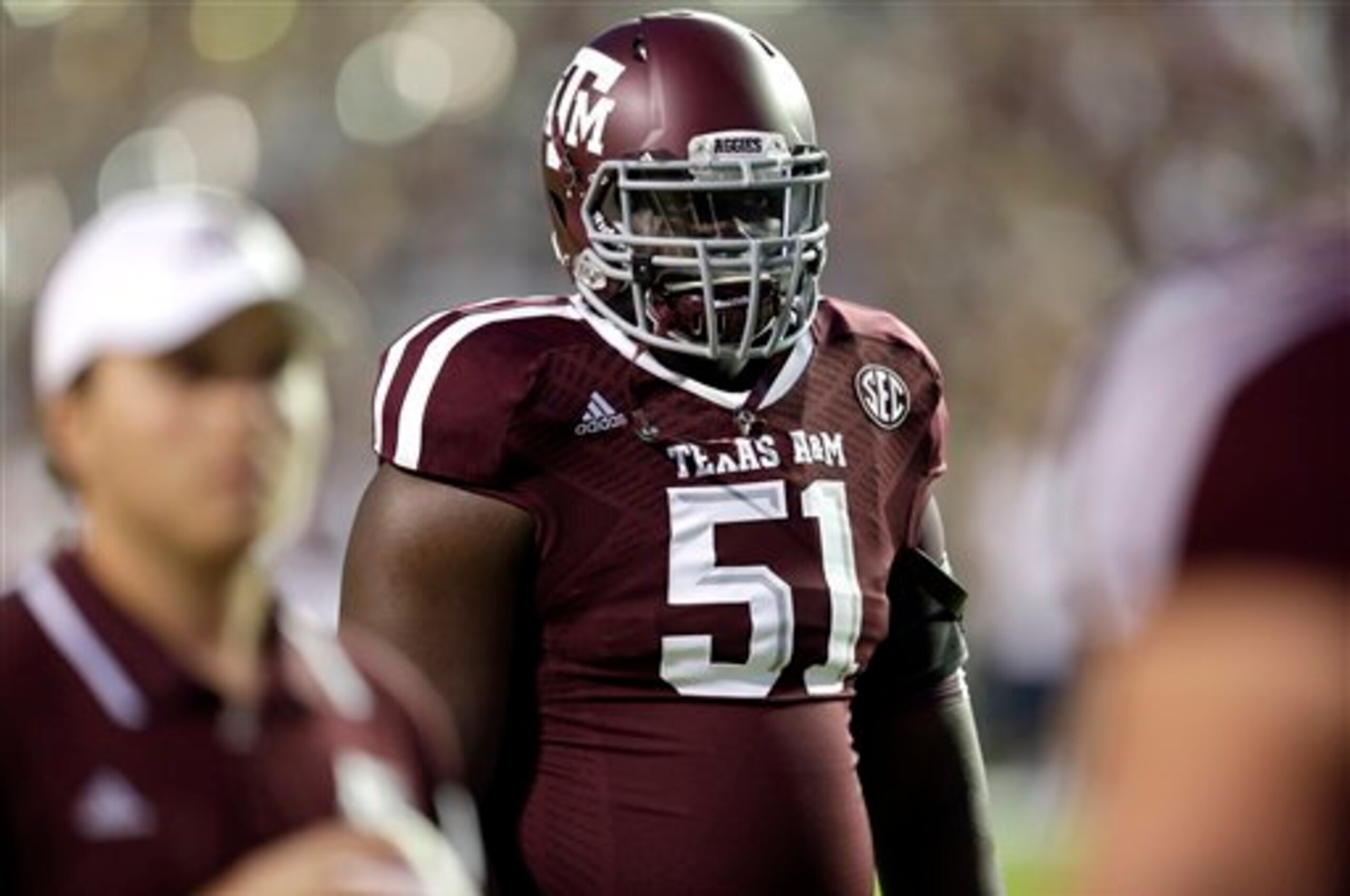
Here's a tip for anyone going to a job interview—try to show up on time. Jarvis Harrison didn't at his pro day, showing up late and claiming his wristwatch alarm did not go off on time, per NFL Media senior analyst Gil Brandt. In and of itself, that's not a huge issue, but it plays into a larger narrative of concerns about his work ethic and conditioning, which should suppress his draft stock.
That's a major issue on an early-round pick, but that's the kind of player you gamble on for a sixth-round selection. Harrison might well be the most athletic offensive lineman in the entire class. A former high-school basketball player, Harrison has remarkable foot quickness and movement for a 330-pound man.
He might have Pro Bowl-caliber talent, but he needs to be put into a situation where he earns it by showing up to the film room and working at it. That's the kind of potential you gamble on late in a draft—knowing that if Harrison doesn't live up to his phenomenal film and measurable, you haven't lost much.
Seventh Round
9 of 9
Thanks to the trade down with Carolina, as well as the compensatory pick they've received for the loss of Anthony Dixon, the 49ers would have three seventh-round selections in the draft. Seventh-rounders are, essentially, lottery tickets—occasionally, one will turn into a Marques Colston or a Scott Wells. But normally, you're swinging for potential and willing to accept that, in all likelihood, the player will turn out to be a nobody. Here's how I'd have the 49ers using their three lottery tickets in this scenario:
Pick 242 (from Carolina): Tye Smith, CB, Towson Tigers
Tye Smith, a first-team All-CAA selection and FCS All-American, is a hardworking, competitive player with some natural athleticism and solid range. He has the potential to be coached up into a valuable depth player. Smith needs to bulk up, as he's only 195 pounds, but he could at least compete for a spot at the bottom of the 53.
Pick 246: Max Garcia, C, Florida Gators
Max Garcia has experience at guard, center and tackle, making him a valuable prospect. He's a very tough player and a respected leader in the locker room. He held his own against Danny Shelton and Carl Davis, early-round defensive picks, at the Senior Bowl. He's not really athletic in any way, shape or form, but he's got some raw power. He's probably a target for a practice squad.
Pick 254: Chaz Green, OT, Florida Gators
If you're going to take one Florida offensive lineman late, you might as well complete the set. Chaz Green, like Garcia, has the potential to play anywhere on the offensive line. When healthy, he has shown very solid production, picking up advanced pass-rush moves and showing solid athleticism. Sadly, he has very rarely been healthy, missing four games in 2011, a few more in 2012 and then the entire 2013 season. If he stays healthy, he could be a seventh-round steal.
Bryan Knowles is a featured columnist for Bleacher Report, covering the San Francisco 49ers. Follow him @BryKno on twitter.
.jpg?w=2560 "Titans Ravens Football")




.jpg?w=2560 "Tyreek makes another cryptic post amid Chiefs rumors")