
San Francisco 49ers Mock Draft: Replacements to Be Found in Every Round
How will the NFL draft go down for the San Francisco 49ers? With just over three weeks to go, there’s unlikely to be any more major moves between now and draft day, so we can get a good overall picture of what might happen, and how the team can best fill all of its needs.
The last time I did a mock draft for the San Francisco 49ers was a month ago, and you could say there has been a slight tweak in the team’s needs since then. With Patrick Willis and Chris Borland both retiring, the strongest position on the team has suddenly become the weakest, with the team needing at least one, if not two, inside linebackers to shore up depth. That becomes a major concern for the team.
Other changes include the signing of Torrey Smith, reducing the need for the 49ers at the wide receiver position. While they still need a true No. 1 player, they no longer need to double-up on the position in the draft. The addition of Reggie Bush tempers the need for a running back, though that was never a high priority to begin with. And bringing in Erik Pears allows the 49ers to focus on the interior of the offensive line, rather than attempting to find a swing tackle.
With these changes, how might the draft go? The 49ers have nine picks and nine essential needs: a backup quarterback, a No. 1 wide receiver, a developmental tight end, a versatile guard, a replacement for Justin Smith, two inside linebackers to replace Willis and Borland, a safety net for Aldon Smith as a pass-rusher and depth at the cornerback position. Can they use all nine picks to fill all nine needs without reaching, or will they have to let something slide for the sake of maximizing value? Let’s find out.
Round 1: DeVante Parker, WR, Louisville
1 of 9This hasn’t changed since the last time I did a mock draft. Parker is the top receiving talent with a chance to be on the board when the 49ers are drafting; AdvancedFootballAnalytics gives the 49ers a 28 percent chance of seeing Parker on the board when they pick at No. 15.
There are rumors, passed along by Matt Miller, that the 49ers are looking at trading up to try to grab Alabama’s Amari Cooper. This would be a bold move, but a more possible one than last year’s rumored move from 30 to the top dozen to take Odell Beckham Junior. A move from 15 to, say, seven and a chance at Cooper would likely cost the 49ers their first- and second-round picks, which at least puts it in the realm of possibility.
They’ve shown the willingness to move up before if they have a player they like—they did so two years ago to grab Eric Reid. Cooper’s my favorite receiving prospect in the draft, but the team has enough holes that I’m not sure it’s the wisest idea in the world.
Could Cooper or West Virginia’s Kevin White fall to No. 15? It’s not particularly likely—AdvancedFootballAnalytics has it at only a three percent chance. I can think of scenarios where every interested receiver-needy team ahead of the 49ers goes a different way with their pick.
The Raiders could shore up their offensive line with Brandon Scherff. The Jets could take Todd Gurley to take some of the load off of Geno Smith. The Bears could focus on the defensive line with Arik Armstead. The Vikings could add pass-rushing prowess with Randy Gregory. The Dolphins could address their secondary with Marcus Peters, and so on and so forth. It’s just hard to imagine all of the teams simultaneously making those decisions and letting Cooper fall.
Considering the depth at the other positions available, I think it still makes the most sense for the 49ers to make a move for a receiver at pick No. 15.
Other players considered:
Amari Cooper, WR, Louisville
Breshad Perriman, WR, Central Florida
Jaelen Strong, WR, Arizona State
Round 2: Stephone Anthony, ILB, Clemson
2 of 9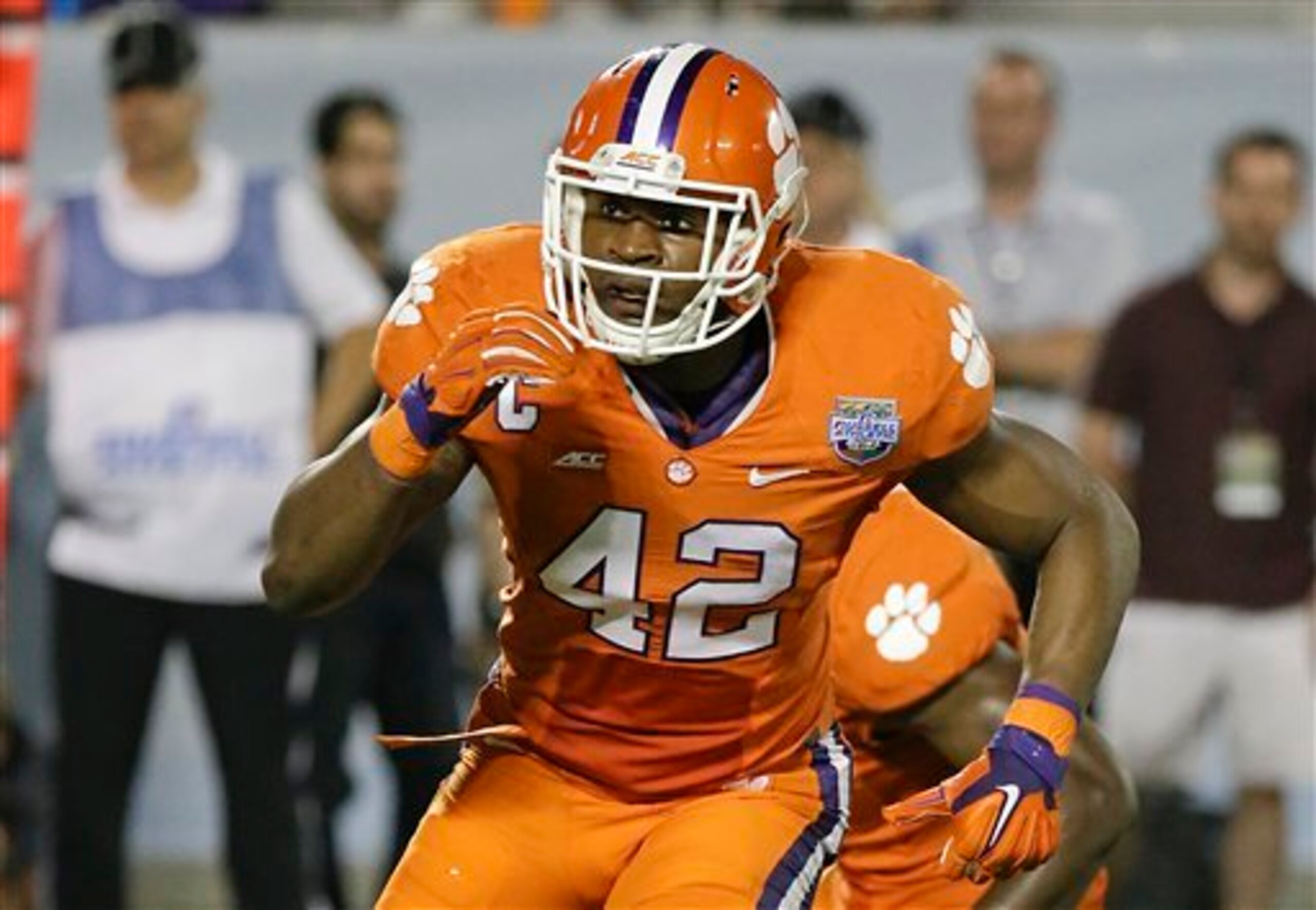
The addition of Torrey Smith and the subtraction of Willis and Borland change this pick from my last mock, which saw the 49ers double-up with Phillip Dorsett. Needs have shifted, and so has the 49ers' strategy.
That’s not to say that the 49ers should automatically fill their two biggest needs with their two top draft picks. If a talented player dropped to pick 46, the 49ers should jump, regardless of the hole at inside linebacker. If one of the top two running backs, for example, fell, the 49ers could make a strong argument for picking Melvin Gordon. If Maxx Williams, the big tight end from Minnesota, fell, the 49ers could find their eventual replacement for Vernon Davis.
As it stands, though, this is the ideal position for the 49ers to address the front seven, either with a defensive end or with an inside linebacker. I went with Anthony, who can be a sideline-to-sideline force in the NFL. He’s got great speed and the ability to change direction on a dime. He can sometimes get fooled with play-fakes and over-pursue, but that’s something he can be taught out of. His coverage skills also look very solid, which is important with the Seattle Seahawks just adding Jimmy Graham.
The Sacramento Bee reports that the 49ers met with him at Clemson’s Pro Day, so a connection has already been made.
I considered defensive end here, but the best one available on my board here, Owamagbe Odighizuwa, doesn’t really fit in a 3-4, and I’m not sure Trey Flowers quite fills as big of a hole as Anthony would.
Other players considered:
Owamagbe Odighizuwa, DE, UCLA
Benardrick McKinney, ILB, Mississippi State
Trey Flowers, DE, Arkansas
Round 3: Steven Nelson, CB, Oregon State
3 of 9
Defensive end is a bigger need position for the 49ers than cornerback is, despite the loss of Chris Culliver and Perrish Cox. The 49ers have plenty of young potential at the position already, having used four draft picks last year on cornerbacks, so they should have someone ready to go by opening day. This is why I had the 49ers taking Stanford’s Henry Anderson last time.
Well, Anderson’s still on the board at this point, and I almost kept the pick the same, but the more I’ve been studying cornerbacks, the more I feel that there’s a bunch of talent available in the third round, meaning the 49ers could get better value for their pick here by addressing the hole in the secondary.
I considered Oregon’s Ifo Ekpre-Olomu, but he’s coming off of an ACL tear. The 49ers have had enough injured players in the past couple drafts. I also considered Ohio State’s Doran Grant.
Instead, however, I’m going with the tough Steven Nelson out of Oregon State. A former high school track star, Nelson has great closing speed and ball skills to read and react to passes, getting in position to make a play on the ball. He has very good instincts, which help make up for the fact that he’s not the biggest cornerback in the world. I envision him in the nickel role in the slot going forward, battling with Jimmy Ward and Dontae Johnson for that role in 2015.
Other players considered:
Henry Anderson, DE, Stanford
Ifo Ekpre-Olomu, CB, Oregon
Doran Grant, CB, Ohio State
.jpg?w=2560 "Chiefs Giants Football")
.jpg?w=2560 "Titans Colts Football")
.jpg?w=2560 "Eagles Jaguars Football")
Round 4: Jake Ryan, ILB, Michigan
4 of 9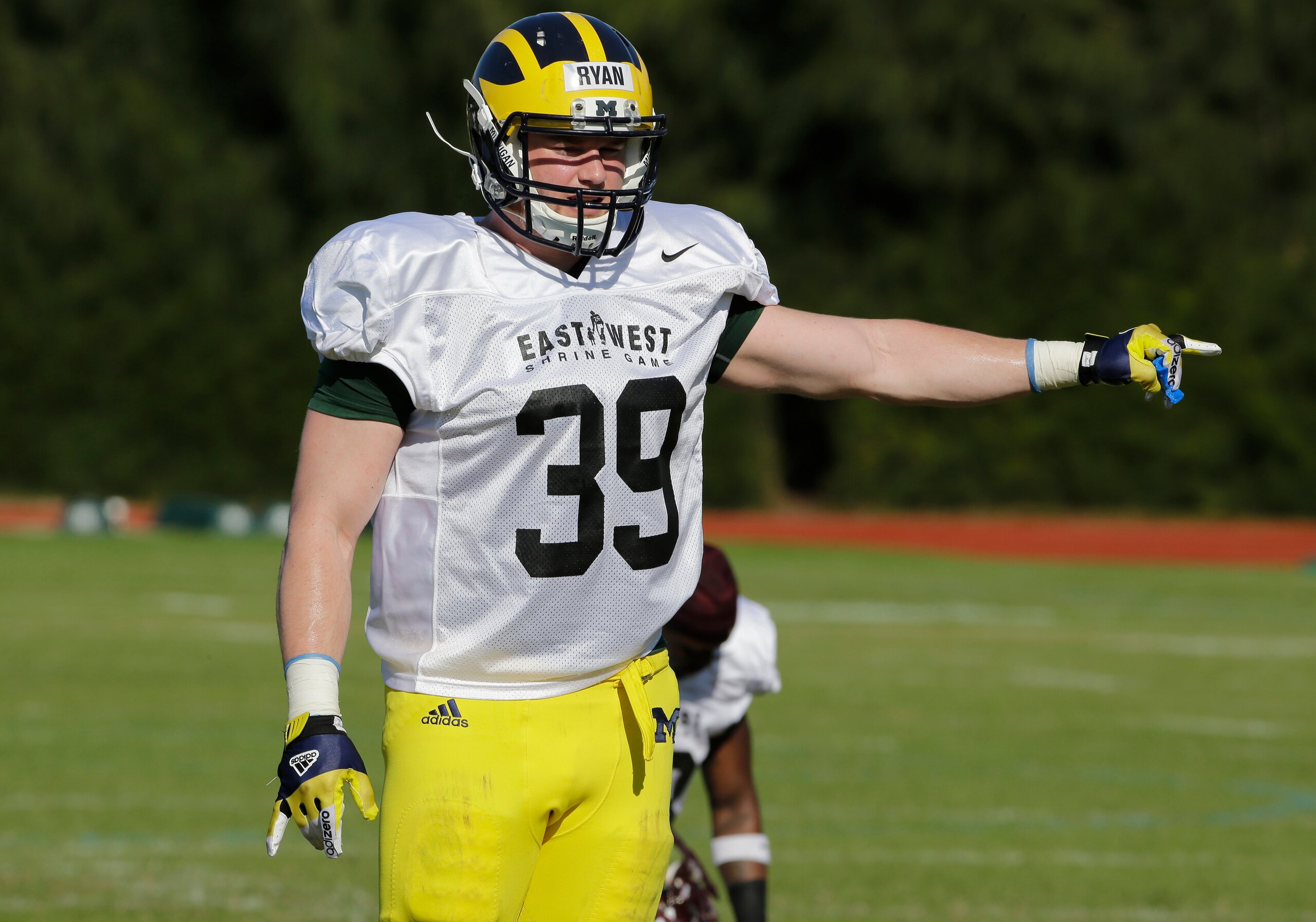
With the loss of two inside linebackers, the 49ers could really afford to use two picks to shore up the position—one to start alongside NaVorro Bowman, and one to battle Michael Wilhoite for the top backup role.
With that in mind, I’m looking for a high-energy, high-motivation guy who can contribute on special teams while working to improve at the position, and that fits Jake Ryan to a tee. His ceiling is probably as a two-down linebacker, as he’s not going to be dominant in the passing game, but he reportedly looked very solid at his pro day, according to WalterFootball, especially considering that he just moved from outside to inside linebacker this past season. He’s still working on recognition and instincts inside, but he has all the physical tools you’d want, and the work ethic to live in the film room and improve. On tape, he’s always around the ball and hustling, which is what I want here.
This would also be a time to address the offensive line with someone like Texas A&M’s Jarvis Harrison, but at least for 2015, the 49ers are set at the position with Alex Boone, Brandon Thomas, Joe Looney and the loser of the Marcus Martin/Daniel Kilgore battle at center all on the roster at the position already. It’s better to fill the need on defense than add another body to the competition at guard here.
Other players considered:
Jarvis Harrison, OG, Texas A&M
Nick O’Leary, TE, Florida State
Taiwan Jones, ILB, Michigan State
Round 4, Compensatory: Nick O’Leary, TE, Florida State
5 of 9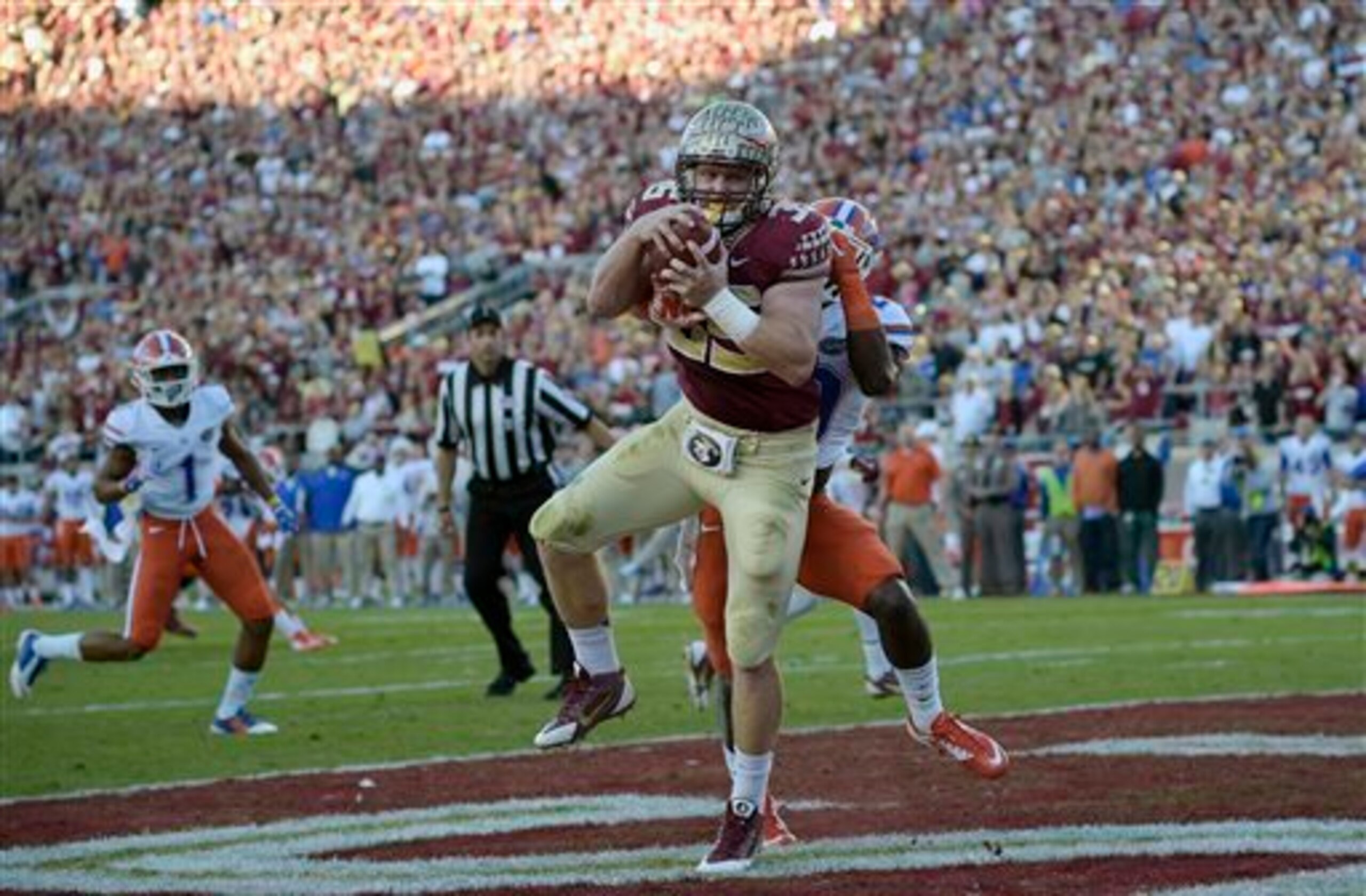
I had the 49ers taking O’Leary with their regular fourth-round pick a month ago, and still like him on the team now, even if it’s at a slightly later position.
O’Leary’s not a strict replacement for Vernon Davis; he’s more of an H-Back type in the NFL. He’s fine at catching anything thrown his way, but he’s not going to be a huge weapon down the field. His stock is fading a little bit thanks to a slower-than-expected 40-yard dash at the combine and missing FSU’s pro day with a hamstring pull, but he showed enough on tape for me to think he can line up anywhere on the field and make the sure-handed catches, even if he’s not going to turn them upfield.
In last month’s mock, I had the 49ers going with Sean Mannion here to get a developmental quarterback, but I no longer think he falls this far. There’s likely to be a run on quarterbacks in the third and fourth rounds, and the 49ers have bigger fish to fry.
Other players considered:
Geneo Grissom, DE, Oklahoma
Josh Harper, WR, Fresno State
B.J. Finney, C, Kansas State
Round 5: B.J. Dubose, DE, Louisville
6 of 9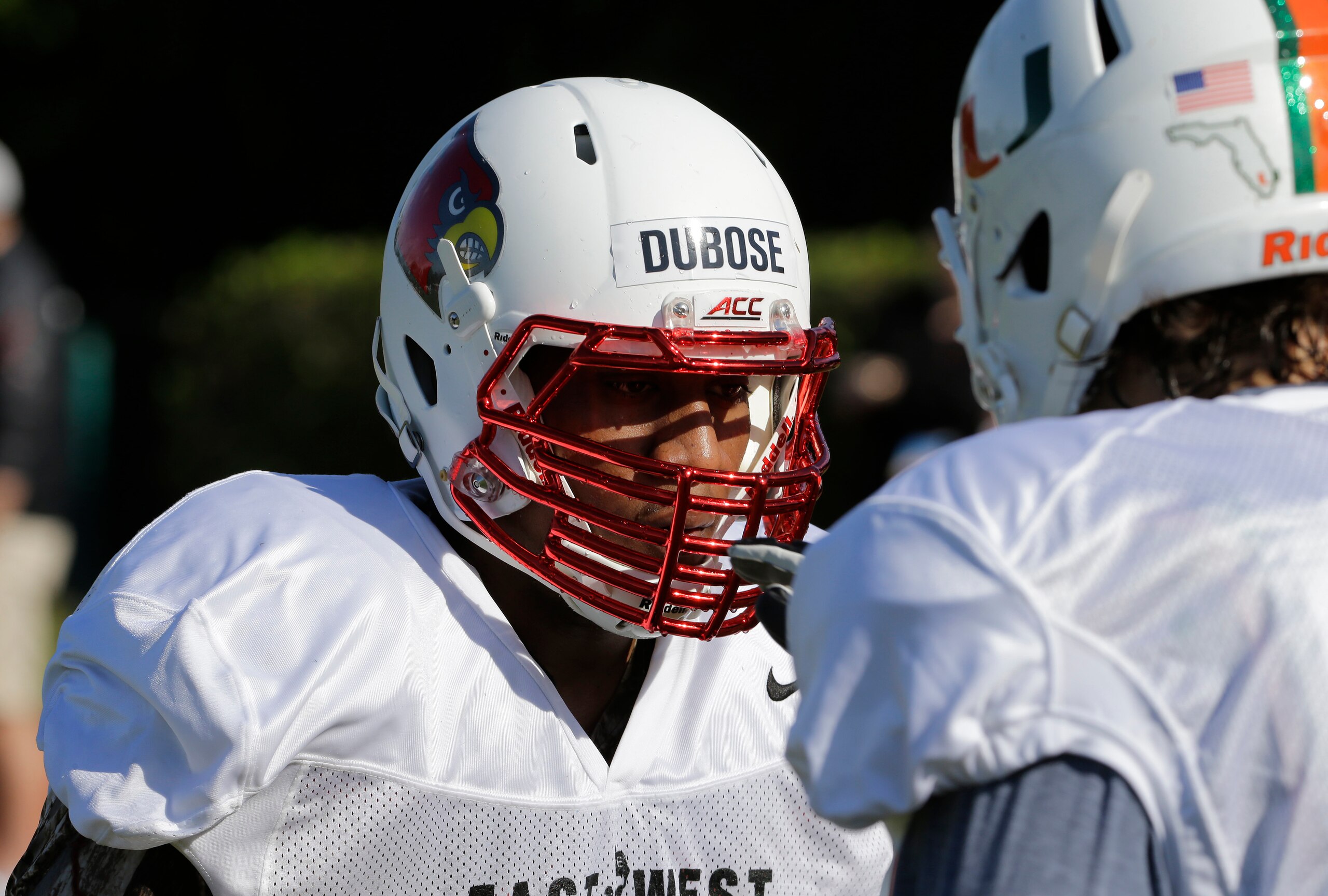
Last time out, I had the 49ers address their defensive end need in the third round and their cornerback need here in the fifth. This time, I’m flipping it around.
By this point in the draft, defensive end would be the obvious pressing need remaining for the 49ers. Yes, more depth at guard would be useful, and a pass-rusher would always be nice, but the 49ers are down Ray McDonald and might be down Justin Smith from last season. Tank Carradine should get his long-awaited shot to start at one position, with Darnell Docket anchoring a rotation at the other, but that’s not the best thing to be relying on, all things considered.
This pick, then, would almost have to be a defensive end, so the question becomes who. Anthony Chickillo of Miami is the highest rated on my board, but I’m not entirely sure he’s a 3-4 end in the NFL. He kind of falls between positions—he doesn’t have the burst you’d expect for an outside defensive end in a 4-3 scheme, nor the bulk to play inside in a 3-4. That’s a potential problem.
Therefore, I’m going down a little bit on my rankings and getting a more prototypical 3-4 end in B.J. Dubose. He can be a two-gap player, using his leverage to control ground in the running game. He’s low on overall athletic ability, but has the raw strength you need to contribute at the back end of a rotation. I’d like to see him get to work with Jim Tomsula for a year or two and see what could be made out of him.
Other players considered:
Anthony Chickillo, DE, Miami (FL)
Frank Clark, DE, Michigan
E.J. Bibbs, TE, Iowa State
Round 6: Adam Shead, OG, Oklahoma
7 of 9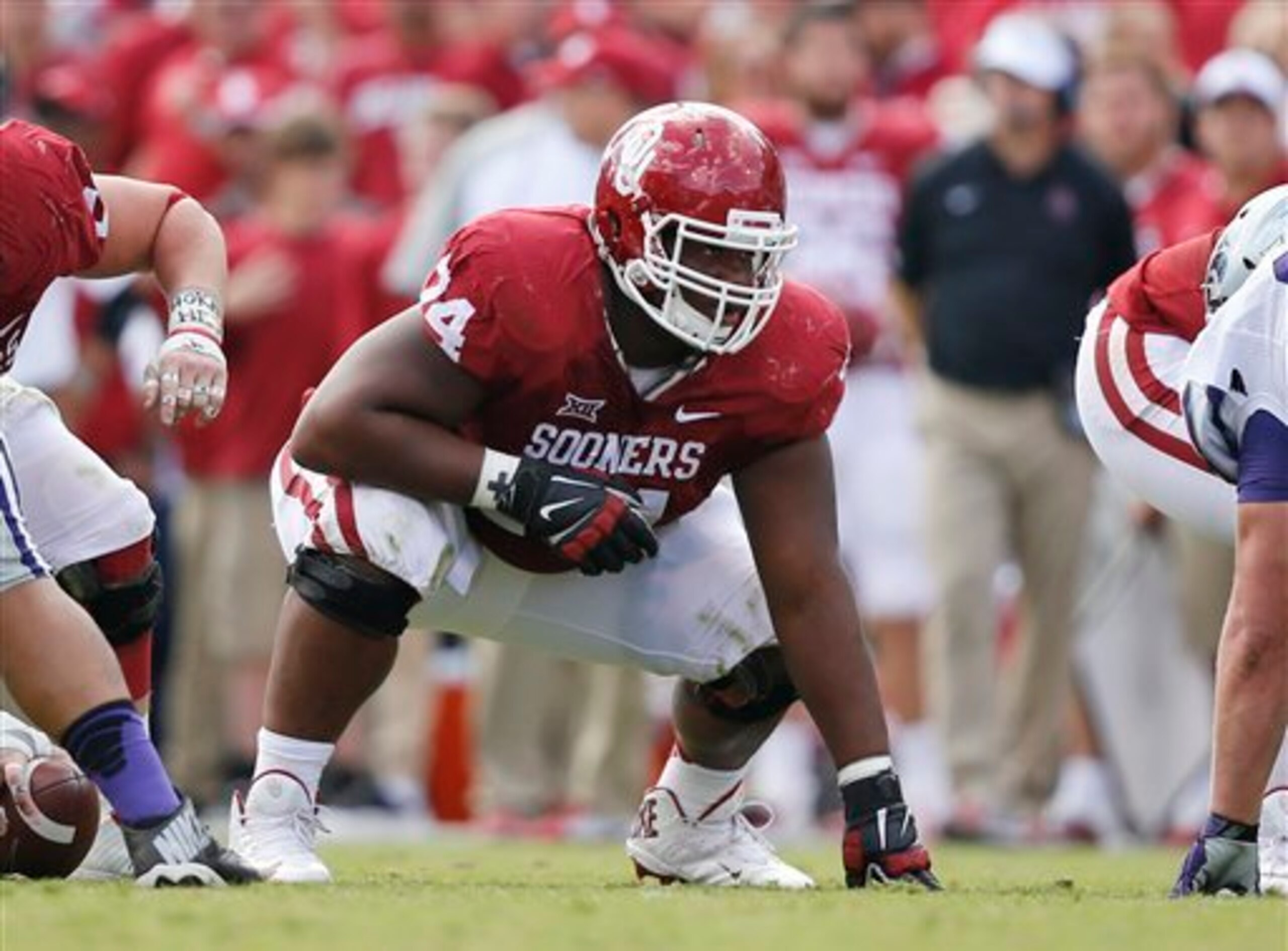
With the offensive guard position being fairly solidly filled for 2015, but a question mark in 2016 when Alex Boone’s contract is up, I like the idea of taking a guard late, stashing him at the bottom of the roster or on the practice squad for a season, and seeing what he can do in 2016. I used a seventh-round pick on such a player last month, and the theory still applies.
Shead’s a four-year starter at Oklahoma with great size and very solid arm length—general manager Trent Baalke loves players with long arms, and Shead’s 33 3/4-inch arms gives him the leverage to get underneath opposing linemen. He’s a statue out there, and he’s not going to burst to the second level and open a huge path in the running game. What he will do, however, is shove linemen out of the way and pick up twists and stunts. He’s not really a replacement for Mike Iupati or Alex Boone—he’s a replacement for Joe Looney as the primary backup guard, with room to grow and develop.
Other players considered:
Gerald Christian, TE, Louisville
Alani Fua, OLB, BYU
Zach Zenner, RB, South Dakota State
Round 7: Yannik Cudjoe-Virgil, OLB, Maryland
8 of 9
Other than having one of the best names in the entire draft, Yannik Cudjoe-Virgil has a high motor and good effort in the pursuit game. He ran a 4.6 40-yard dash at his pro day, according to the Baltimore Sun, with solid numbers in all the other various drills.
He got onto my radar originally, oddly enough, because he couldn’t compete at the NFL combine due to a knee injury. Trent Baalke does like taking injured players late in the draft and stashing them on PUP or NFI lists, essentially expanding the 53-man roster and allowing them to keep more developmental players than your average NFL team. Cudjoe-Virgil seems to be a candidate for the NFI list, which would be good for him, allowing him to continue to develop his game without being pressed into action right away.
Other players considered:
George Farmer, WR, USC
Deion Barnes, DE, Penn State
Kaleb Eulls, DT, Mississippi State
Round 7, Compensatory: Kurtis Drummond, FS, Michigan State
9 of 9
The 49ers have nine picks, and I identified nine needs at the beginning of this mock. The only need left is quarterback, so they should use this pick on the top quarterback remaining, right?
Not so much. My board has Washington State’s Connor Halliday as the best quarterback remaining; he’d be the ninth quarterback taken overall. Jameis Winston and Marcus Mariota went in the first round, as expected. The third round saw Bryce Petty, Garrett Grayson and Brett Hundley all leave the board, while Sean Mannion followed shortly at the top of the fourth round. Shane Carden slipped into the sixth round, while Bryan Bennett went towards the end of the seventh.
It’s not worth reaching for a quarterback just for the sake of having a quarterback, and I don’t fancy the idea of trying to convert a spread-system quarterback with a tiny frame coming off of a broken ankle who might have a ceiling as a third-string player. I suppose the 49ers could redshirt him as well, but I just don’t see him developing into anything.
Therefore, I just went with the best player remaining on my draft board, in Michigan State’s Kurtis Drummond. I’ve actually seen Drummond projected as high as the third or fourth round, but the Draft Tool’s overall look gave him a chance at being available this late, so I took it. The specific player doesn’t matter so much as the philosophy with these late, end-of-draft picks—no one here is going to fill a need, so you take a player with the highest ceiling you can find and see what happens, regardless of position.
Bryan Knowles is a featured columnist for Bleacher Report, covering the San Francisco 49ers. Follow him @BryKno on twitter.
.jpg?w=2560 "Colts Football")
.jpg?w=2560)