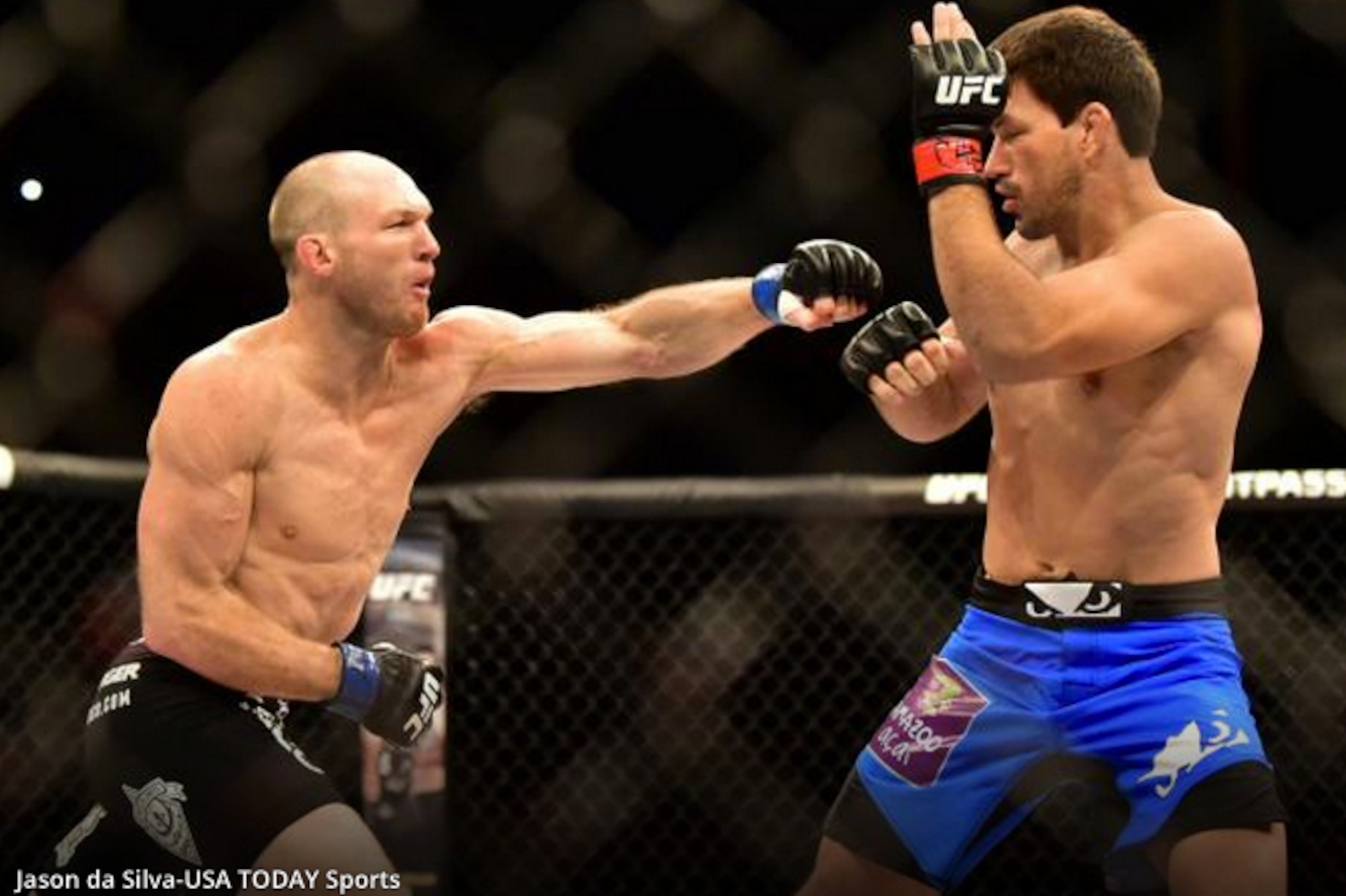

5 Rounds with Jonathan Snowden: Best and Worst from UFC Fight Night 62
Not much of consequence happened at UFC Fight Night 62 in Rio de Janeiro, Brazil. Not much of consequence could have.
It's become tradition for the UFC to travel to Brazil, find the cupboard bare of fighters with even a semblance of name recognition and simply toss together a collection of random parts and hope for the best. Sometimes it's a good time, with spectacular finishes making fans forget they are watching fighters they've never heard of. Sometimes, it's a dreadful, never-ending morass.
Sometimes, it's both.
In a new post-fight series, we'll look at the card as a whole and choose the five best and worst moments—the handful of things worth talking about on Twitter or at the water cooler if you are reading this from 1962.
Want to extend the bout from five rounds into infinity? That's what the comments are for. Make your voice heard.
Round 1: Boo This Man!
1 of 5"Oh my goodness. No way!"
Those words came from the mouth of UFC color commentator Kenny Florian. But they echoed what was being said in living rooms worldwide, sans the colorful bits.
Referee Eduardo Hendry, inexplicably, stopped the fight between Leandro Silva and Drew Dober just as Dober's head was emerging from a guillotine. In other words, the ref gave Silva a win he didn't earn. It was, arguably, the worse case of official malfeasance in recent UFC history.
Typically, when an official becomes part of the narrative, it's after a judgment call of some sort. Did he stop a fight too early? Or let it linger past the point of comfort, with some poor guy's head bouncing off the mat a few too many times? Action in a fight can come at lightning speed—forcing the referee to make a split-second decision in the heat of the moment.
This was different. Here, the action had slowed to a halt. Silva had trapped Dober in a guillotine, but Silva was in half guard, which means he wasn't able to get the leverage you'd normally need to stop the fight. There was no indication that Dober was in trouble. It was quite the opposite in fact, as he posted on his left arm and emerged from the darkness.
No, this was just an old-fashioned error. This was ignorance. In this, I'm with UFC President Dana White, who, complete with four exclamation points, spit truth on Twitter: Now there is a guy who should NEVER ref again!!!!
Round 2: Saying Goodbye
2 of 5The first time I saw Shayna Baszler, it was immediately apparent she was something special. It wasn't just the pro wrestling-style chicken wing she used to dispatch Roxanne Modafferi in Japan. It was her.
Some people just have that kind of aura about them, a way of carrying themselves that makes it apparent they are worth paying attention to. Baszler, it was immediately apparent, was someone worth following.
As women's MMA continued its long march to the mainstream, Baszler was always near the front, combining her muay thai and the catch wrestling she was learning from Josh Barnett into a particularly compelling package.
Almost 10 years later, women's MMA is now here to stay, and Baszler is still out there giving it her all, attempting to reap some of the rewards for her hard work in building this sport from the ground up. I still can't look away—unfortunately for entirely different reasons.
Watching Baszler attempt to hold off the younger, stronger and better Amanda Nunes wasn't easy. It was like watching a car wreck, but an accident where the victim not only seems to know the crash is coming but is actually resigned to it.
This wasn't a competitive fight. Baszler knew her half-hearted takedown attempts had no chance of succeeding. Nunes knew it too. Instead, this was a short but brutal dance, a legal mugging. It was a mismatch, a drubbing that seems entirely unnecessary in retrospect.
Baszler, for all she's meant to the sport, has no place in the cage. Not in 2015. That's hard to say. It's likely not fun for her to hear either.
The hardest truths never are.
Round 3: Saying Goodbye (Josh Koscheck Edition)
3 of 5Everyone remembers the fight between Forrest Griffin and Stephan Bonnar, a bout that quite literally helped keep the UFC on Spike TV and laid the groundwork for what was to become one of the fastest-growing sports in the world.
Forgotten, hidden in the shadow of that monstrous fight, was the original breakout stars from the show, Chris Leben and Josh Koscheck. Their feud and eventual grudge match were the highlights of The Ultimate Fighter's first season, redefining traditional roles in the sport.
Koscheck, he of the perpetual sneer, goofy haircut and undeniable athletic pedigree, was a new breed of MMA villain. This wasn't the hammy, cartoon villainy of Tank Abbott or Chael Sonnen. This was Koscheck, content to be himself, eschewing the mask of appropriateness we all tend to wear in public.
When the crowd booed, he didn't go into a shell of hurt feelings and shock. Koscheck embraced the hate, not so much making himself into a man that fans would pay to see get punched in the face, but doing nothing to hide his true self from the audience.
His first-round submission loss to Erick Silva, his second fight in a month, is the last on his current UFC contract. While there are significant rumblings he will take his bad-boy act to Bellator, I hope he decides, instead, to call it a career. At 37, there's simply no reason to risk continued physical and mental trauma.
He's given all he had in a career worth celebrating. It's time for him to go back home, with head held high, knowing that, while bad times don't last, bad guys do.


Round 4: Pacing
4 of 5As midnight approached in the Eastern time zone, play-by-play announcer Jon Anik sent the broadcast back to the studio, where Karyn Bryant asked analysts Brian Stann and Dominick Cruz the same questions she was asking them when the show began. My heart, if it is possible for a heart to emote aloud, groaned.
There were still two fights left. It was the night that would never end.
When it was all said and done, UFC Fight Night 62 lasted more than six hours. Six hours! If the show had been filled top to bottom with standout prospects and beloved stars, that would be a long haul. For a show filled, instead, with athletes no one would recognize on the street, it was interminable.
There was nothing wrong with the action on display. Many of the fights, if not world-class contests of skill, were at a minimum entertaining. When you reconcile yourself to the new now and think about these Brazilian cards as regional MMA with a particularly high-profile main event, they can actually be kind of fun to watch.
No, the problem wasn't the fights. It was everything happening before and between the fights. The pacing was horrid, with minutes ticking by as fans waited with dwindling patience for the next two fighters to hit the cage. This is something that has to be fixed.
You should walk away from an MMA show feeling energized, knowing you just watched a collection of men and women risk it all for glory (and money). It shouldn't feel like you just ran a marathon, with exhaustion washing over you as the main eventers take the stage.
Watching the UFC can feel like a hostage situation—with fans as the victims. As it stands, every event feels like one of those regular-season baseball games that linger into the 15th inning. By the end, we're all just hoping someone scores so we can go home.
Round 5: Demian Maia Provides More Questions Than Answers
5 of 5Last week, Fox Sport 1 analyst and former UFC bantamweight champion Dominick Cruz and I practically wrote Demian Maia's athletic obituary. We suggested that Maia was not only a one-dimensional fighter but that his time in the sport was fast coming to a close.
We were right. And we were wrong.
Nothing Maia did against Ryan LaFlare argued against the premise that he is painting from a limited palette. He dominated LaFlare for the first four rounds with his otherworldly Brazilian jiu-jitsu.
That's what he does.
Ultimately, this fight told us little about Maia, beyond making crystal clear his gas tank isn't quite up for a 25-minute fight. LaFlare, in retrospect, was in too far over his head, returning to action nearly a year after his last fight and suddenly finding himself in the deep end with a shark instead of chilling in the kiddie pool.
Can Maia, at 37, still compete with the division's best? Or will his predictable and cautious approach fail him when the man across the cage isn't blinded by his first experience with the bright lights?
It's still an open question in my book; we'll revisit it after his next fight—this time, hopefully, with a true contender.

.jpg?w=2560)

.jpg?w=2560 "Viral Rams Coach Vid 🖕")


.jpg?w=2560 "Injury-stricken Seahawks signing veteran RB")
