

B/R MMA Retrospective: Examining the Career of 'The Prodigy' BJ Penn
Anytime the career of a notable fighter comes to an end, distance is required in order to appreciate his full body of work.
Sometimes, it is an epic saga, vast and shockingly dense, as is the case for men such as Jeremy Horn or Dan Severn. Other times, it is somewhat sparse, as in the case of “The Prodigy” BJ Penn.
It has been more than six months since Penn called an end to his career as an MMA fighter. His final bout was an odd conclusion to a storied career that saw such promise go in all different directions.
To think that it all started as a kind of lark—a bout agreed to in order to please Ralph Gracie that pitted Penn against a kickboxer for the meager sum of $400.
On one hand, Penn didn’t fight as often as he could or have the success that a man of his talent and skill should have had. On the other hand, he managed to accomplish rare feats; he is one of only three fighters to win titles in two different weight classes, and his bravery and daring entertained the fans while handcuffing his legacy.
Yes, Penn is a rare man, the likes of which the sport may not see again for some time to come.
To think that a novice fighter, known only for his brilliant jiu-jitsu, could debut in the UFC for his first true fight and then get thrown against top-five competition for his weight class is shocking, even by today’s standards.
To think he would win with unimaginable ease against the elite of the lightweight division, earning a title shot in just his fourth UFC fight, is nearly mind blowing.
But that is what Penn was: a mind blowing fighter who, in the beginning, made it look so easy that one began to wonder just what kind of sport could let a relative novice make it to the top and threaten for the title in less than a year.
By the time he stepped into the ring with the reigning champion Jens Pulver, Penn had logged no more than seven minutes and 50 seconds in the Octagon. What was more shocking was that each time he stepped into the cage, he got better; it took him nearly all of Round 1 to finish Joey Gilbert, but he only took half that time to finish Din Thomas, who was ranked No. 3 or 2 in the division.
Then, he stepped in against arguably the No. 1 contender in Caol Uno and stopped him in just 11 seconds.
No fighter in the history of the UFC has accomplished so much, so fast, against elite competition as Penn did. Fighters like Jon Jones and Conor McGregor got their title shots fairly quickly but not as fast or as violently and decisively as Penn.
Such a beginning is in harsh contrast to his final fight against Frankie Edgar, where he was basically standing like a dancer, a position that seemed to diminish any punching power while making him ripe for takedowns. That version of Penn seemed to possess none of the former authority or confidence of his younger self, and the result seemed academic from the get-go.
So, now that Penn has stepped off the stage, how do we remember him? Do we criticize his career or lavish too much praise?
This is the career retrospective of Penn, a fighter who has done what few ever did while achieving less than was expected.
All quotes are taken from the book Why I Fight: The Belt is Just an Accessory by BJ Penn, unless noted otherwise.
2001
1 of 15The year that started it all for BJ Penn came early in Zuffa’s ownership of the promotion, at UFC 31.
Penn, who was riding a wave of relative stardom in the Brazilian jiu-jitsu community, debuted on the preliminary card against Joey Gilbert.
Many questions surrounded Penn, chief among them being the obvious: “Sure, he can grapple, but can he fight?”
Penn answered all those questions, earning the stoppage victory at 4:57 of Round 1 against Gilbert.
Satisfied with his first showing, the UFC yanked him out of the shallow end of the pool and threw him into the deep end with the sharks in his next fight. At UFC 32, Penn walked into the cage to face the dangerous veteran, Din Thomas. Thomas, who owned a victory over the reigning champion, Jens Pulver, was one of the top five fighters for the division; he was young, athletic, well-rounded and damn close to a title shot.
Penn blew any hopes of UFC gold out of Thomas’ mind with a brutal high knee—thrown effortlessly and without any form of thai clinch—as both men were slugging it out on their feet. Thomas hit the deck hard, Penn swarmed with hard shots to his jaw, and the fight was called at just 2:42 of Round 1.
And fans were left dumbfounded, stunned and blinking at what they had just seen.
Suddenly, Penn wasn’t just an interesting question in the lightweight division; he was now a serious contender, and the moniker “The Prodigy” was proving just as true for MMA as it was for Brazilian jiu-jitsu.
Penn got a bit of a break, sitting out UFC 33, but he got right back into the cage at UFC 34, this time against the best fighter in the division not wearing the title belt: Caol Uno.
Fans were eager to see if the past performances of Penn were a fluke. Uno was a proven warrior with advanced skills in all areas, and his fight with Pulver to crown the promotion's first lightweight champion had been an epic bout.
Then, Penn blew Uno out of the water almost before the fight had even started.
Uno came out with a running kick, which Penn avoided. They looked at each other for a moment, and then Penn advanced and Uno retreated against the cage. From there, Penn stormed forward, and Uno seemed to wilt under the aggression, perhaps sensing that he had made a tactical error by backing to the cage too soon.
Uno seemed to misjudge how much space he had, falling back in an awkward position against the fence as Penn rushed him with punches. From there, Penn unloaded on Uno, who was sprawled against the cage, one leg bent under, unable to protect himself from the tidal wave of punches.
Penn savaged Uno from above and then ran out of the cage as the fight was called in just 11 seconds. He returned and was greeted by an amazed Pulver, who promised him a title shot.
The Prodigy had found a new career and in just one year had proved a force to be reckoned with at 155 pounds.
2002
2 of 15
After Penn's dramatic entrance to the sport, the fans were coming out of the woodwork to proclaim him as the new champion, well ahead of his scheduled bout with Pulver at UFC 35. The idea that Pulver—who had lost to Thomas via heel hook and had been seriously tested by Uno—could contend with a fighter who had thrashed both men so effortlessly was laughable to the pro-Penn crowd.
Yes, even back then, MMA math was in fine and flawed form.
Penn met Pulver at UFC 35, wearing a look of intensity that spoke to the idea that he was a man about the business of finishing the champion quickly. Looking at Penn, chomping at the bit, made most feel sorry for Pulver, who stood across the ring like a man who was waiting for a judge to pass sentence.
Then the fight started, and while Penn dominated the early rounds, Pulver enjoyed far more success than anyone felt possible. After two rounds, Penn had been unable to hurt Pulver standing or submit him on the ground.
Then, between Rounds 2 and 3, Pulver’s corner lit a fire under him, and he started taking it to Penn, landing the better punches and then stepping out of range. When Penn stood still, Pulver scored; when Penn moved forward, Pulver scored and moved out of range.
Rounds 3, 4 and 5 saw Pulver outscore Penn, who seemed to lose confidence every moment that Pulver didn’t fall down.
When the judges rendered their decision, Pulver pulled off the upset and retained his title, while Penn went home with the first loss on his record.
Penn came back quickly, stopping Renzo Gracie student Paul Creighton via TKO in Round 2 at UFC 37. As the UFC belt was now up for grabs (Pulver, dissatisfied with his pay in the UFC, had decided to move on in search of greener pastures), Penn was officially back in the mix.
At UFC 39, he faced another Renzo Gracie student, Matt Serra, in a semifinal bout in a tournament that also included Caol Uno and Din Thomas. Serra was a full-fledged MMA fighter with a record of 6-1 with five finishes via submission, and given his physical power and grappling skills, many figured this would be a stern test for Penn.
And they were right. Serra fought Penn without fear, swinging hard and grappling well. Once again, Penn was fighting an opponent whom he couldn’t knock out or submit with ease, but this time he kept his head about him, fighting with energy due the moment.
It was a close fight, but the judges awarded the victory to Penn, who was now scheduled to meet the winner of Uno vs. Thomas for the vacant UFC light heavyweight title. Uno won that same night, and suddenly Penn fans were howling again; Penn destroyed Uno the first time, and with the title on the line, he would do it again.
Or so they thought…
2003
3 of 15The first fight of 2003 for Penn seemed like it was the last 10 yards of a race by a man whose greatness was long overdue the recognition of a title. He may have taken too many things for granted in his first bid for the crown, but now, with lessons learned and so much incredible talent, how could his destiny be denied?
The answer was the same then as it is now and ever shall be: poor judging criteria applied by uneducated judges.
After Penn dominated Uno for most of the bout and did most of the damage, the judges declared the bout a draw, and once again, Penn was a man without a crown.
Taking a bit of time away from the sport, Penn returned to fight outside of the UFC, at K-1 Rumble on the Rock. His opponent was the stellar Takanori Gomi, who was 14-1 with five wins by stoppage.
Gomi had never been finished in his career; his lone loss came via majority decision to Joachim Hansen in the Shooto organization.
Some felt that given the roller coaster of Penn’s career, Gomi was the wrong kind of fighter for the Hawaiian to face at the wrong time.
Then, Penn ran all over Gomi, finally stopping him via rear-naked choke near the middle of Round 3. He looked as tired as Gomi did near the end of the second frame, but he was also landing more punches, dominating the grappling exchanges and making Gomi bleed.
When the end came in the third, Penn was riding Gomi’s back, pounding away with both hands with the body triangle locked up. Gomi lost his mouthpiece and then the fight as Penn secured the rear-naked choke.
It wasn’t just a good performance—it was great, and Dana White was watching.


2004
4 of 15With the UFC lightweight division under a kind of imposed hibernation, Penn was granted a fight with then-reigning welterweight champion, Matt Hughes.
When the fight was announced, detractors of Penn came alive at the idea of seeing him beaten down by a powerhouse like Hughes, who had just notched his fifth straight title defense, choking out nemesis Frank Trigg in the first round.
The idea that a fighter who couldn’t capture the title at lightweight could just move up and dethrone the No. 1 fighter on many pound-for-pound lists was nearly blasphemous. The general consensus was that Hughes was too powerful, had too much experience and was just too big for a fighter like Penn to deal with.
Penn waded through the deep waters of public doubt and stepped into the Octagon at UFC 46 to challenge the greatest welterweight the sport had ever known, and he looked like he didn’t have a doubt in his mind.
Hughes may have had the intention to punish Penn for such insolence, but very quickly into Round 1 he found himself tossed to the floor with Penn looming above him, looking to land a heavy shot.
Hughes tried to defend himself, but eventually Penn managed to get the right angle at the right time, sweeping the legs aside before unleashing a heavy punch downward, catching Hughes in the face and stunning him.
As both men scrambled, Penn took the back and in short order had locked up a rear-naked choke. Hughes tried to defend, but he was simply out of his depth against a submission artist like Penn.
Hughes tapped out, and just like that, Penn was the new welterweight champion, reveling in the glory of gaining the belt and proving so many people wrong.
It should have been the beginning of great things for Penn, but back in 2005, the UFC was not spending the kind of money on its name fighters like it is now. Penn had the title, but his fight with Hughes was the last of his three-fight contract.
Early on, when the UFC was deciding to do away with the lightweight division, Penn began to ponder a future outside of the UFC, given that the promotion had been having a hard time finding him opponents. Now, with the title around his waist and his contract with the UFC finished, opportunity came knocking in the form of a lucrative offer to fight in the K-1 organization.
Mak Takano, a recruiter for K-1, offered Penn $187,500 to fight in K-1. Given that the UFC had allowed fighters to fight outside of the promotion in the past, Penn didn’t think it would be a problem.
Instead, when Dana White heard the news, he was shocked that one of his champions was considering fighting outside of the UFC. In his book Why I Fight, The Belt is Just an Accessory, Penn said he was happy to put K-1 on hold and negotiate a new contract with the UFC.
“This was easier said than done. As soon as the UFC realized I was considering other options, they came to me with a new contract, and quite frankly, it was laughable." Penn said that he was making “25 and 25,” while Hughes was making close to double that.
“We wanted somewhere in the vicinity of $50,000; $45,000, maybe even $40,000, would have sufficed. Dana White started at $28,000, and then made the bold move to go all the way up to $30,000. Hughes would still be getting more money than me, and he couldn’t beat me. Was I supposed to be satisfied with this?”
Penn explained that the way the UFC looked at things, increasing fighter payouts by increments, not big jumps, was the sound fiscal policy. “From 25 to 30 was normal, and in their eyes, the real opportunity for me was how they’d still be promoting me. This in turn would bring me more money through advertising on my shorts, T-shirts, or anything else I wanted. In other words, they wanted to pay me less money so I could go out and sell myself to others for more.”
Penn decided to go the route that paid him five times what the UFC would, and with the decision came the fiery phone call from White, proclaiming that Penn was “scorched earth” and his time in the UFC was suddenly over.
With the Octagon behind him, Penn made his K-1 debut on May 22, defeating Duane “Bang” Ludwig with an arm-triangle choke in just less than two minutes.
Then, with a new lease on his fighting life, Penn made a decision that would seem apt in the beginning but would later contribute for the majority of losses on his career; he moved up in weight with no thought of the consequences.
On November 20, he made his middleweight debut, defeating Rodrigo Gracie via unanimous decision. The fight was basically three rounds of Penn taking Gracie down and landing what blows he could, while the latter simply tried to hang on.
That bout brought Penn’s record to 9-1-1, with seven stoppages. He was the former UFC welterweight king, now without a court or the belt, which had been stripped from him in a court of law, where it was decided that the only place a UFC belt held any value was inside the UFC, and thus there the belt must remain.
In all fairness, Penn was given the option to come back to the UFC and work things out before he actually fought in K-1, but it came at a high price when UFC lawyer Kirk Hendrick offered Penn a deal.
“Sensing that I wanted back in, Hendrick said the only way this situation could now be resolved was if I came to the next scheduled event, walked into the Octagon with the belt, publicly apologized to White and then left the belt in the cage.”
His feelings about this offer were not surprising.
“There was no way in the world I was ever going to do it. At this point, if I did enter the cage with White standing inside of it, the only thing that’d be left on the floor would be him.”
2005
5 of 15With so much going on outside of the cage in 2004, Penn became even bolder inside the ring in 2005.
On March 26, he once again moved up in weight to challenge the undefeated Lyoto Machida at K-1: Heroes 1 in Saitama, Japan.
In front of 13,000 people, Penn, who weighed in at 191 pounds, fought the much larger Machida, who tipped that scales at over 215 pounds. For fans of Penn and fans in general, it was shocking to think that approximately 17 months prior, Penn had been fighting at lightweight.
Perhaps it was the utter ease by which he had defeated the larger Hughes, or perhaps it was nothing more than belief in self and Hilo pride, but Penn was willing to fight anyone, no matter how much larger they were. It was brave, inspirational and a little crazy in all the best ways, but above all else, it was the beginning of a mindset that would hamper his career in the future.
But on March 26, against the future UFC light heavyweight champion of the world, Penn did incredibly well; he pushed the pace, was the aggressor most of the time and landed some good shots that sent Machida backpedaling. It was easily the first time that Machida saw himself tested; everywhere he tried to look for an advantage, he found himself in a scrap instead.
When Machida tried to impose his size by tying Penn up in the clinch against the ropes, Penn pushed back and found the space needed to land knees. When Machida tried to use his size advantage in the middle of the ring, striking and moving, he was landing and eating punches in return, which led to Machida jumping back out of range while Penn pursued.
Both men were throwing serious leather, and it was shocking to see Machida being forced to back up or try for a sweep takedown, only to end up thrown on his back.
Penn clearly won Round 1 by any judging criteria; he landed the harder shots, had Machida backpedaling in most exchanges and secured a leg-sweep takedown. From there, he spent nearly the last two minutes of the round atop Machida, landing knees and keeping his opponent nailed to the mat like a butterfly rather than a dragon.
Round 2 saw Machida continuing to try to use his size advantage to tire Penn out against the ropes. In the punching exchanges, Penn was giving as good as he got, but Machida landed his own takedown and managed to do a little work. But the guard of Penn was excellent, and he quickly got the needed space to hop back to his feet. Machida probably won the round by landing shots while keeping Penn smothered with his size advantage, but it was still close. Penn was landing shockingly well for being the smaller man, and his chin looked like it was made of iron.
Round 3 was more of the same when both men were standing, until Machida scored another takedown. Then, looming above Penn, he executed a kind of jumping head stomp that partially landed, but Penn seemed unfazed. Penn got just enough room to spring back to his feet.
Machida continued to either smother Penn against the ropes or try his kick-and-move strategy on the outside, which worked more than it didn’t, given his reach advantage. That didn’t stop Penn from being the aggressor. He snapped Machida’s head back with stiff counterpunches, lefts to the jaw in clinch territory and some combinations when Machida was jumping in with knees.
In the end, the judges gave the bout to Machida, but no one could doubt it was the toughest and closest fight of his career to date. Penn’s sheer heart, desire and skill—not to mention his willingness to slug it out with a much bigger man—took him to a much higher level than we have ever really witnessed in MMA.
He had managed to render many aspects of Machida’s size advantage moot and had made it a true fight that could have gone either way.
In his next and last fight of the year, Penn dropped back down to middleweight to fight the legendary Renzo Gracie. There had been a lot of bad blood between Penn and the Gracie family, so it seemed like the bout could be a barnburner.
Of course, the way things seem is rarely how they are.
Gracie scored a takedown early in the round and maintained the top position until the bell. It was surprising and tense yet uneventful; however, Gracie was officially ahead.
Penn managed to take Round 2 with successful striking, stopping Gracie’s takedown attempts and landing the harder shots.
The third and final frame went to Penn once again. Gracie found himself swept to the floor with Penn in his half guard. Penn spent the remainder of the round roughing Gracie up with punches to the head and body. He eventually managed to pass Gracie’s guard and looked ready to rain down punches when the round ended.
Penn saw the last fight on his contract with K-1 end in victory, bringing his record to 10-2-1.
2006
6 of 15With his K-1 contract finished and his bank account enriched, he was still involved in another fight: BJ Penn vs. the UFC. With the court battle lasting the entirety of his K-1 contract, Penn and his lawyers were still trying to win a judgment against the UFC for stripping him of his belt.
After so much time spent opposite Zuffa, perhaps it was the distance between White and Penn that softened their animosity. The UFC was focusing on its biggest gamble to date, The Ultimate Fighter reality show, which had given the promotion a new lease on life. Penn, having made good money in K-1, now just wanted his UFC title back.
White and Penn hammered out their differences. The UFC welcomed Penn back, and his career in the Octagon could finally continue.
He would return to the Octagon as a welterweight, and his first opponent would be a man poised to do great things: Georges St-Pierre.
Relishing the chance to compete against a fighter who had shredded Frank Trigg and Sean Sherk, Penn met St-Pierre in the Octagon at UFC 58. Their fight would be a bloody and controversial affair that would resume at UFC 94 in one of the biggest fights the UFC had seen to date.
The first round of their fight saw Penn bloody St-Pierre with a harsh barrage of punches that left him confused and frightened at the sound of the bell. It all seemed to start when St-Pierre suffered what looked to be an accidental eye poke; from there, Penn pressured him and landed often with both hands.
As the horn sounded for the end of Round 1, St-Pierre was smiling, but he looked like a man laughing at gallows humor, unaware that he was the butt of the joke. To think that he could come back and win the fight did not seem realistic at all, but that is exactly what he did.
In Rounds 2 and 3, St-Pierre avoided stand-up exchanges as best he could, closing the distance as quickly as possible while scoring takedowns and maintaining a strong top position. He turned the fight into a wrestling match, and when the judges awarded him the victory, it may have stung Penn’s pride, but the math behind the decision was sound.
With his first fight back in the Octagon resulting in a loss, Penn got a shocking chance; he was offered a shot at the man he had beaten so easily for the welterweight title the first time: Matt Hughes.
Hughes had been scheduled to face St-Pierre in a rematch of their first fight at UFC 50, but the Canadian had suffered an injury, and thus Penn got to step in as a replacement.
It all seemed too good to be true for Penn fans, while those rooting for Hughes saw a dark cloud gathering on the horizon. Penn had proved in their first fight that his style of fighting seemed to be too much for Hughes; Penn was a far better striker and submissions grappler, while the greatest strengths of Hughes—wrestling and raw power—would give him no real advantages.
Penn didn’t resist the physical strength of others; he simply rolled with it or countered it with speed. Getting Penn to the floor would be a hard and draining task, and once there, it only put Hughes in danger of being reversed and submitted.
But Hughes wanted the rematch, which even now speaks to his championship heart. He had no intention of running from any fight, no matter how highly favored his opponent may be.
When the fight came at UFC 63, and both men were looking at each other across the Octagon, it seemed like Penn was being handed the title. He looked so confident that it didn’t seem like a fight was beginning but a slaughter.
The first round saw Penn dominate, outclassing Hughes in most aspects of the fight. Hughes came out looking like a man trying to paint a masterpiece of revenge with a brick, while Penn looked like the master about to teach some hard lessons.
When Hughes tried a takedown, he got nowhere and in fact ended up looking like he didn’t know how to take anyone down, which we all knew wasn’t true. Penn had always been terribly hard to take down; his balance was so sound and effortless that conventional means of success were rendered unsuccessful to a degree that they seemed childish and without merit.
If anything, the time Hughes spent trying to take Penn down saved him from looking like an utter novice in a stand-up fight. So, in the early minutes of Round 1, Hughes managed to avoid embarrassment by being offensive in his takedown attempts, which may sound trite, but coups have been realized on smaller tape.
With 2:49 remaining in Round 1, Penn landed a hard right behind a setup jab that rocked Hughes and sent him into desperation mode. Hughes grabbed a successful single-leg, and from there Penn went to work on his dazed yet game opponent, showing his incredible flexibility in staying to the side.
After Penn sprawled out of danger, both men stood up and Penn began to ring Hughes’ bell with both fists as the welterweight champion continued to try to jab while leaving his head floating up behind his fists like a balloon. An accidental eye-poke sent Hughes to his knees, but once the fight was restarted, Hughes went after Penn like a wounded animal.
Hughes pushed Penn to the cage and went after the takedown, but with 30 seconds left in the round, he went back to his corner on the losing end of the opening frame.
In the second frame, Penn survived under Hughes after a takedown, defending himself against the ground-and-pound of the champion and slipping around to take his back. Once again, Penn had the back of Hughes, landing punches and elbows while snaking his legs up higher, eventually locking up a triangle-leg choke from the back, up high.
Hughes survived, but by the narrowest of margins. Had there been another 15 seconds remaining, chances are he would have slipped unconscious.
In Round 3, Penn came out, fighting tired and also suffering an injury to his rib. Suddenly, Hughes had the advantage, landing punches in the stand-up as Penn seemed like nothing more than a punching bag. Hughes landed a stinging combination, while Penn stumbled about the Octagon with cement shoes.
Penn, stung from punches and wounded and tired, seemed to duck for a takedown, and Hughes locked up a headlock, pulling Penn down to the floor. From there, the champion was able to dominate the position, get Penn onto his back, lock up a back-to-mat crucifix position and rain down punches into the defenseless face of Penn until the fight was called.
After so much time spent outside of the UFC in other organizations and battling the UFC for the right to fight for more money while keeping the belt he had earned, Penn’s return to the Octagon in 2006 saw him go 0-2 for the year, bringing his record to 10-4-1.
And worse for his pride, the man he had bested for his first UFC title had just defeated him via TKO.
2007
7 of 15
After a fruitless comeback to the UFC in 2006, Penn received more unexpected good fortune; he was invited to coach the fifth season of The Ultimate Fighter.
The UFC was trying to revitalize the lightweight division, and to do so, White called upon two big names at 155 pounds: Penn and his old rival, the first UFC lightweight champion, Jens Pulver.
Accepting the role would require Penn to drop back down to lightweight, but he did so, finally seeming to realize that he belonged among other men his size. Of course, the chance to avenge his first defeat was the right sweetener needed to get him to sign on the dotted line.
Coaching opposite Pulver gave audiences a chance to see just how much Penn disliked “Lil Evil” and how deliberately harsh he could be in displaying his contempt. As soon as the fighters arrived, when it became time to choose teams, Penn asked the fighters to raise their hand if they didn’t want to have anything to do with Team Pulver.
Right off the bat, Penn was playing rough, and although Pulver smiled it off, you could tell it stung.
But Pulver wasn’t going to take anything lying down. As confrontational as Penn was, Pulver was the better coach, dominating the bulk of the competition as two members of his team made it to the finals.
Then, fans in attendance for the finale got to see Penn vs. Pulver II, sans title belt.
As good a coach as Pulver proved to be, Penn simply outclassed him, basically having his way with the former lightweight champion before finally securing the rear-naked choke midway through the second round.
It was his only fight of the year, but he was back in the win column and fighting where he belonged among the lightweights. His record improved to 11-4-1, with three of his four losses coming from the higher weight classes. When it came to 155, Penn had avenged his lone loss and looked like a man who had finally found some balance.
2008
8 of 15
Standing above and beyond the rest of the competition at lightweight, Penn was the clear heir apparent to the throne that had been stripped from Sean Sherk following a failed drug test after his victory over Hermes Franca at UFC 73.
Penn was picked to face the 28-7 Joe Stevenson, who was riding a four-fight win streak. The bout was set for UFC 80, and while Stevenson was a young, highly experienced powerhouse of a grappler, the bout seemed like a rehash of Penn vs. Hughes, but with Stevenson looking every bit like a lesser version of the latter.
Unfortunately for Stevenson, that’s exactly how it played out in England.
From the minute the bell sounded to begin Round 1 until the tapout in Round 2, Penn had his way with Stevenson, and it wasn’t even close. Everywhere Stevenson turned, Penn was there to batter him senseless with a two-fisted attack that seemed to belong more to a middleweight than a lightweight.
After a razor sharp elbow from the top, Penn sliced Stevenson’s forehead open, and the blood began to gush, looking more like a bad movie prop than anything else. Soon, both men were awash in blood, and Stevenson looked like a sailor dying for the harbor.
Stevenson finally got a reprieve as the horn sounded, but all the pep talks and Vaseline in the world weren't going to help him, and he looked like he knew it. He came out game but bled like prey, and Penn feasted on that, choking Stevenson out with ease and winning the 155-pound crown to earn his second UFC title in two divisions.
With such an easy victory, Penn should have been delighted, or so it would seem. Instead, he called out Sherk. Penn clearly wasn’t satisfied with the idea of claiming a “vacant” belt; he wanted to prove that no one could dispute his crown.
Sherk was happy to oblige him, and the two men met in Las Vegas at UFC 84: Ill Will, landing the headliner slot over such notable bouts as Tito Ortiz vs. Lyoto Machida and Wanderlei Silva vs. Keith Jardine.
Once again, Penn faced a powerful wrestler with high submission acumen, and once again The Prodigy made that type of fighter look woefully out of his depth. Penn clearly wanted to keep the fight standing so he could use his superior hands, and Sherk aided and abetted this by abandoning his greatest strength in order to engage Penn in a fistfight.
Obviously, that is a bit of a misrepresentation of what happened; clearly, Sherk knew that taking down Penn without threatening him with anything else would be hard, but in focusing on engaging Penn in the stand-up, it looked as if he was waiting for a window of opportunity that simply never came.
Penn kept Sherk on the end of his punches all night long, battering him with a slick jab nearly at will. When the end came, it was off a knee to the face and a barrage of punches as Sherk wilted against the cage.
Penn was now the undisputed king of the lightweights, with his first successful title defense leaving him untaxed and hungry for more.
Perhaps too hungry—he wasted no time in calling out St-Pierre, the newly minted welterweight king. Once again, Penn was daring to do what no one had ever done—hold one title while moving up in weight to capture another—and at the time, given how badly he had bloodied St-Pierre in their first meeting, it seemed like he just might be able to do it.
Penn was now 13-4-1, and it looked like his momentum was going to see him do the unthinkable.
2009
9 of 15Scheduled for UFC 94 on January 31, St. Pierre vs. Penn II was a special event.
History was on the line, and two excellent fighters—arguably two of the best in the sport, in addition to being pound-for-pound luminaries—were willing to put their titles on the table to match their ambitions.
But we should make no mistake about who was really making this happen; Penn was pushing to make history. St-Pierre was simply the man who was defending his title against another challenger—perhaps the most dangerous man he had ever faced in the Octagon.
The UFC was all on board for such an epic meeting, creating UFC Primetime: St. Pierre vs. Penn II in order to hype the event. It remains perhaps the best installment of the series.
Primetime gave viewers a rare glimpse inside both fighters, their camps and their rivalry, building the tension to a fever pitch come fight night.
Penn was in typical form for the promotion of the bout; in the opening moments of the first installment of Primetime, the camera found Penn, looking right at us (and St-Pierre, should he be watching), telling the welterweight champion that they were going to “go to the death," that he was going to try and kill St-Pierre and that he was not joking.
When Round 1 began, Penn learned like the rest of us that this version of St-Pierre was far better than the man he had bloodied at UFC 58.
St. Pierre crowded Penn against the fence, wearing him down with his size and power, and then began to take him down and pound on him, round after round. Penn remained game, but St-Pierre was working an excellent game plan, and to top it all off, he was intent on punishing Penn toward the end in order to make his own statement of greatness.
Of course, there was some controversy.
Between rounds, one of St-Pierre’s corner men rubbed grease first on his head, which is legal, and then on his body, which is not. This would leave a cloud over the fight that remains to this day, no matter what either side has to say on the matter.
St-Pierre would go on to win the bout after Penn’s corner threw in the towel after Round 4, and they never met again.
Instead of wallowing in despair, Penn took his lightweight title to heart and went right back to work defending it, alive with purpose and hungry to share the pain.
First on his list was a bout against Kenny Florian, a finalist in the middleweight division from the first season of The Ultimate Fighter. Florian was 11-3, riding a six-fight win streak, with five of those victories coming by way of stoppage.
Penn jumped into training camp and emerged like a lion, sleek and ready.
Florian attempted to utilize the same strategy that had helped St-Pierre claim victory over Penn, but he wasn’t up to the task. Penn had him on the defensive most of the night, landing the harder shots and winning the rounds.
When the fight hit the floor in Round 4, Penn took his back and caught Florian in a rear-naked choke, tapping him out.
Next for Penn was the man who had conquered Florian to win The Ultimate Fighter plaque, Diego Sanchez.
Sanchez was 21-2 heading into the fight with Penn, owning a four-fight win streak and a UFC record of 10-2, with victories over Nick Diaz, Clay Guida, Joe Stevenson, Joe Riggs and Karo Parisyan. Sanchez had grown into an animal in the UFC and looked like he just might be crazy enough to give Penn problems, especially if he could crowd the champion against the cage and let his hands go.
Then, every fine and well-reasoned theory about the advantages of Sanchez—power, cardio, aggression and crazy—were crushed as Penn caught him rushing forward with a shot that knocked his equilibrium somewhere into the third row.
For the rest of the fight, Sanchez tried his hardest to fight back, searching for any advantage to be had, but Penn was simply too much, all the time. His striking was smoother, and he was landing with a great deal of power, keeping Sanchez on the defensive and unsure where to look for victory.
After four rounds, it seemed a miracle that Sanchez was still upright, let alone acting like a madman who hadn’t been getting his clock cleaned all night long. Yet there he was, pumping himself up in the grand traditions of Johnny Tapia, ready for the final frame.
Penn was ready too, and midway through the round, he had Sanchez reeling just enough to catch him with a high kick to the head. His shin sliced the flesh deeply, leaving the challenger bleeding from a horrid gash above his eyes to match his other lumps and cuts.
The fight was stopped, and Penn had defended his lightweight title a third time—a first for the division.
He went 2-1 for the year and owned a record of 15-5-1.
2010
10 of 15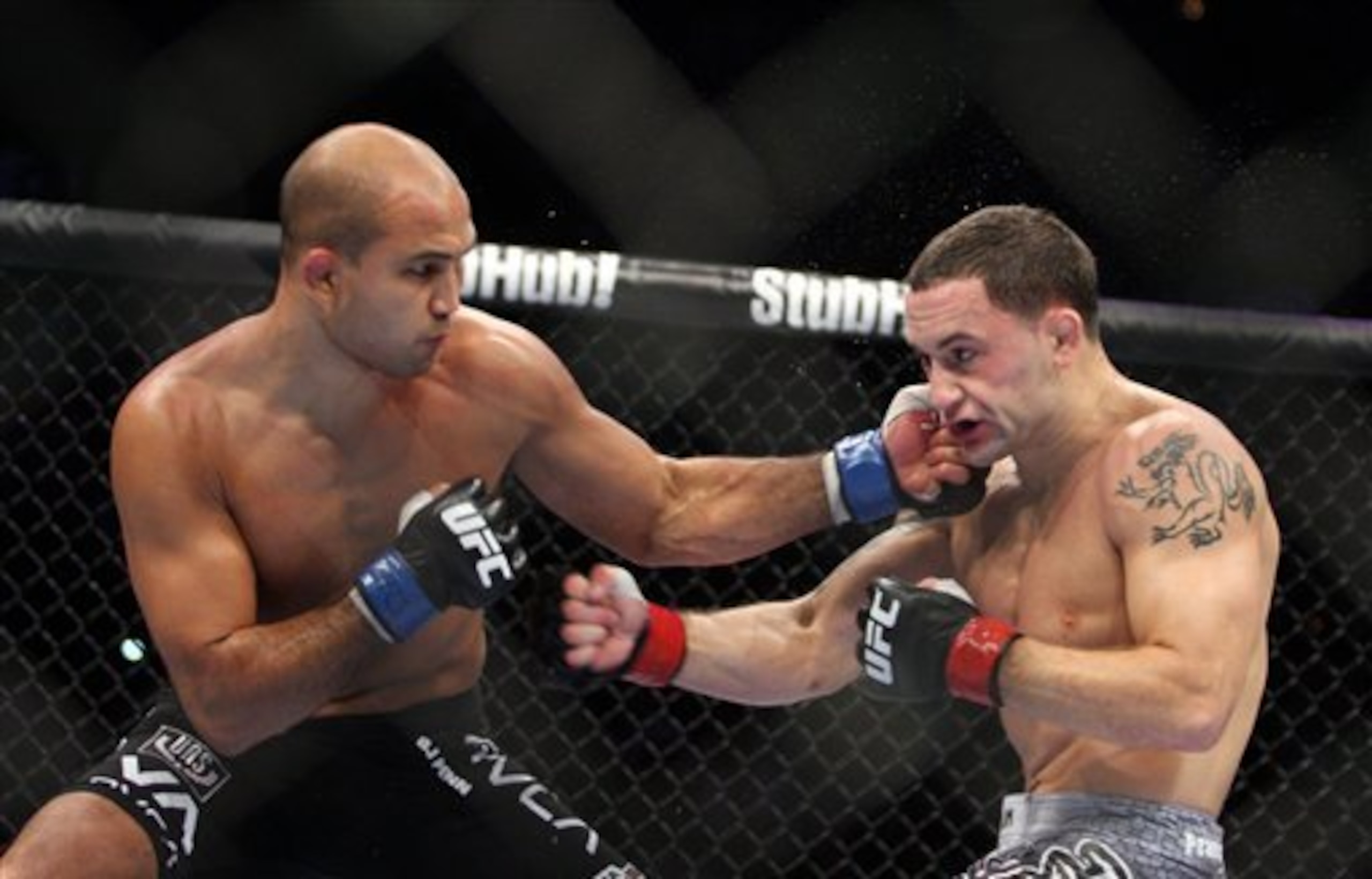
No one knows for sure how hard it is for a great fighter to stay motivated, save for other great fighters. Penn closed out 2009 looking every bit like a fighter who would no longer take anything for granted. But after coming back to lightweight, he had crushed all opposition with an ease that was anticlimactic.
Perhaps that is why he entered into his first fight of 2010, opposite Frankie Edgar, like a man simply showing up for work, assuming that where larger men had failed, a smaller man could not succeed.
In Edgar, he was facing a mobile fighter with a speed advantage, yet after the bout it looked as if Penn had never watched any tape on Edgar at all.
At UFC 112, Penn showed up to fight, game and “Hilo” as ever, but he looked like a man who was always just one small step behind. He landed some hard shots on Edgar, who looked a bit intimidated by the moment in the beginning, but simply put, Penn didn’t know how to cut off the cage, and that was his downfall.
Edgar stuck and moved all night long, scoring points and staying out of harm’s way. He earned a unanimous-decision victory, and rightfully so. Penn simply never responded with the urgency due the moment as Edgar continued to pile on the points; the rounds were close, but not so much that he shouldn’t have tried to nail his elusive opponent to the floor with some honest takedown attempts.
When time expired, Edgar had won the fight, and Penn was no longer the lightweight champion of the world.
To say it was an upset is an understatement; many thought Penn was just too smooth and powerful for Edgar to avoid all night long, but they had all been wrong.
Perhaps it was the surprise of the decision that saw the rematch booked for UFC 118 in Boston. Perhaps it just seemed wrong that a fighter of Penn’s size, or smaller, could actually beat him, and thus a recount was called for in the form of a rematch.
Whatever the case, Edgar showed up with greater confidence in the rematch, used the same game plan and beat Penn again, the same way he had the first time.
It was hard to watch a fighter like Penn lose because he didn’t look beaten—he just looked like he didn’t know the answer to the puzzle Edgar presented him with. Edgar had not beaten him down, but he had defeated Penn with an overall mastery of the art of fighting that in some ways left The Prodigy looking like anything but.
For the first time since his first attempt at the lightweight crown at UFC 35, Penn had lost at lightweight, twice, to a smaller man, and that had to burn.
If he could no longer be the champion at lightweight, Penn decided he didn’t want to be there, so he moved back up to welterweight for a rubber match against the then-greatest champion the division had ever seen, Matt Hughes.
Much had changed since the last time Penn and Hughes had fought at UFC 63. Penn had seemed to find some kind of peace with himself, and with that came a new and surprising friendship with former rival Jens Pulver. That friendship had grown to include Hughes as well, and when both men met at the weigh-ins for UFC 123, after their staredown, they were all laughs and good cheer, as if they had never disliked each other in the first place.
That good nature did not extend into the actual fight as Penn came out hot, catching Hughes cold and leaving him colder on the floor after landing a brutal right hand. The punches that followed were simply window dressing; Hughes was done, and Penn owned authority over the trilogy.
Penn went 1-2 for the year; he was now the former welterweight and former lightweight champion with an overall record of 16-7-1.
2011
11 of 15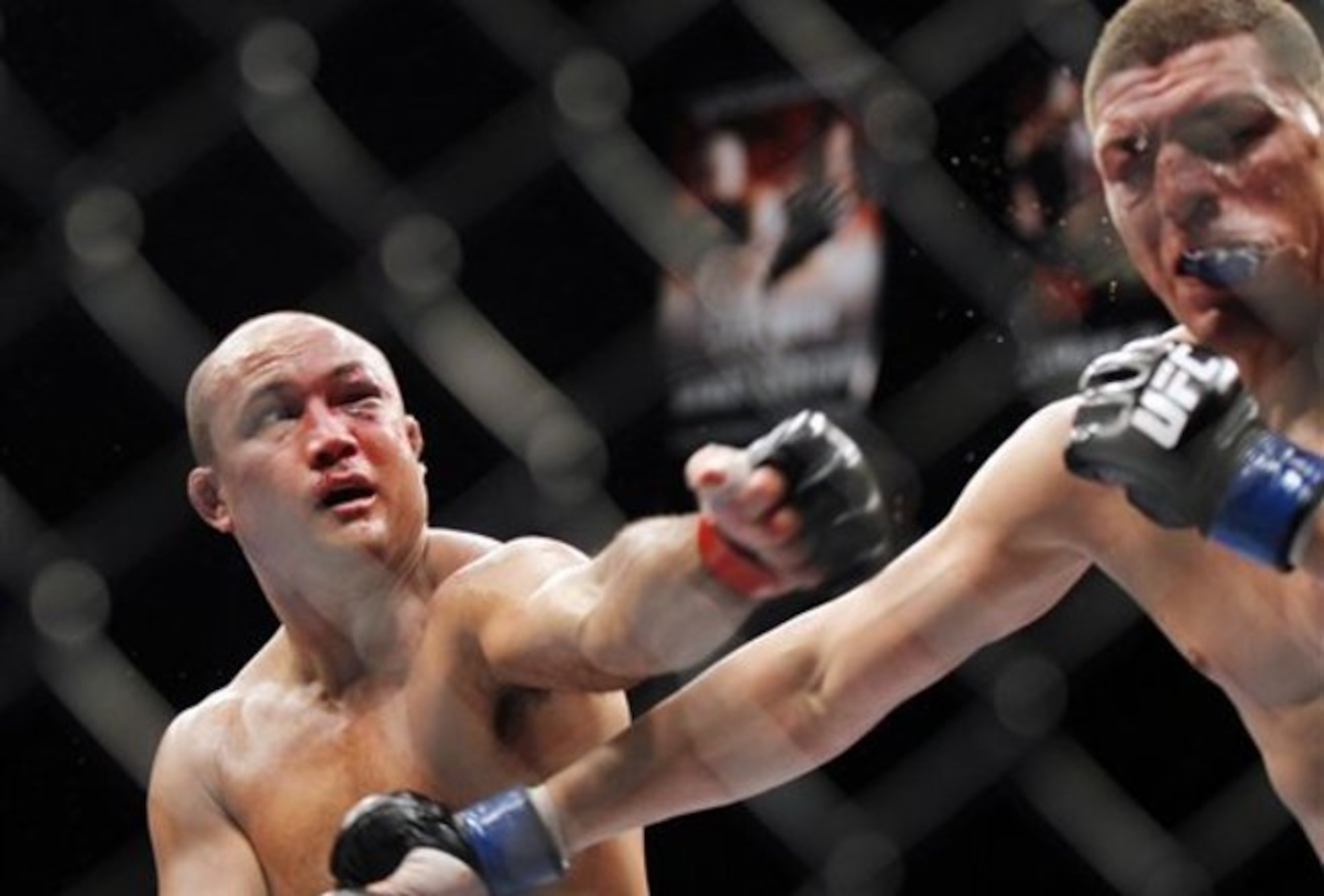
Following his blowout of Matt Hughes, Penn met the rugged grinder Jon Fitch at UFC 127.
Penn took the first round by scoring takedowns and taking Fitch’s back, looking for a choke. It wasn’t the most exciting round, but Penn looked like he was going to out-Fitch Fitch, and that would have been something in the absence of a finish.
Round 2 saw more of the same as both fighters tried for takedowns, grinding on each other as best they could. Fitch ended up with a bloody nose but scored near the end of the round, making it a close call for both fighters.
Then, in Round 3, it was all Fitch, who got the takedown and poured on the strikes, earning points and dominating. In the end, the judges scored the fight a majority draw, and Penn left Australia neither the winner nor loser.
Deciding to remain at welterweight, Penn faced Nick Diaz, who had rejoined the UFC fold after establishing himself as an action fighter to watch in Strikeforce. Diaz clearly respected Penn as the two men seemed to share common philosophies on fighting, but when they stepped into the cage at UFC 137, it was all business and fury.
Having proved that he could be a slow starter against active fighters, Diaz looked like he was content to let Penn lead during the opening frame. The Hawaiian was the busier fighter, landing punches and even getting Diaz to the mat, although it led to nothing other than points.
Then, in Rounds 2 and 3, Diaz came to life, found his range and used his reach to pick Penn apart, battering him for the first time in his career. Penn hung in as well as could be expected, but never in his career, save for his rematch against St-Pierre, had The Prodigy looked to be at such a size disadvantage.
Once Diaz got into his own groove, it didn’t seem like he could miss, and Penn didn’t know how to deal with the distance with any consistency.
Once the fight was over and Diaz earned victory, Penn told Joe Rogan that he was retiring. From the look of his face (and the shocked look on the faces of the fans, who never thought anyone could bust up Penn like Diaz had), it seemed painfully clear that the welterweight division was too big for him.
Penn road off into the sunset with a 0-1-1 record for the year and an overall record of 16-8-2, but somehow, we knew someone was going to goad him into returning.
2012
12 of 15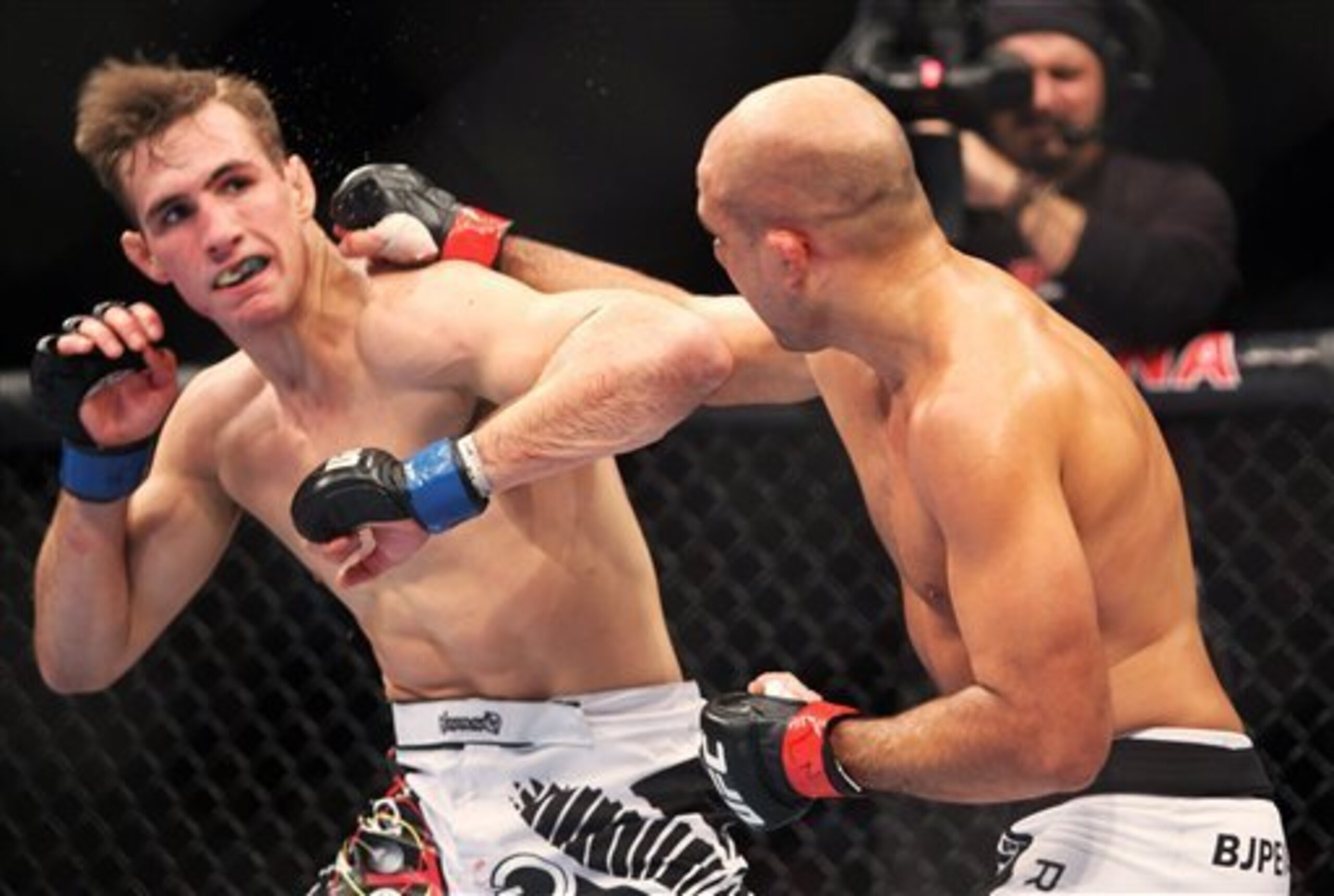
Competitive spirit is not always tempered with a rational mind; often it defies logic in favor of that which could be legendary, or in the case of BJ Penn, that which helped define his legacy.
In 2012, after more than a year out of the Octagon, Penn returned to welterweight once again—either unable to accept that the division he once conquered was too big for him or unwilling to believe that size really does matter.
His defiance of the notion that a good small man cannot beat a good large man has always been the focal point of his career when it comes to measuring success. The fact that he is arguably the best lightweight ever isn’t what his detractors point to—it’s his high number of losses.
They like to wave him off as an all-time great because of his losses, either unwilling or unable to accept, like Penn, that size matters. The bulk of his defeats came at the hands of men much larger than himself, but that isn’t a consideration they are willing to give credit to, because to do so would take the legs out of their argument.
Perhaps Penn deserves these critics, for they never give him credit for the same things he never gave himself credit for. He was never one to forgo challenges simply because they were either slightly or well north of his weight class; he never allowed his ambition to be contained in one division, and that is something special.
It is also something exploitable when fighters like Penn reach that point in their career when they should be happy with their successes but are not.
Rory MacDonald is an excellent fighter and no doubt a good guy, but like Tito Ortiz (who exploited the pride of an aged Ken Shamrock for an easy win), so MacDonald exploited the pride of Penn. Clearly, The Prodigy didn’t have to accept the challenge, but like MacDonald, we knew he would because the man has never run from a fight in his life.
To say nearly anything about Penn vs. MacDonald is to caption the obvious: a very good big man beat a once great small man—a very good young man beat a once great older man.
Once again, Penn showed heart and once again took a serious thumping. MacDonald did not get the stoppage, but for Penn fans, it was a sad sight. MacDonald used his reach expertly, and Penn was unable to land his power or get the fight to the mat, where his skills could have turned the table.
Every great fighter must endure a season of wither, and at UFC on Fox: Henderson vs. Diaz, we saw Penn endure another loss to a larger man, with his daring and hubris being exploited for the gain of another.
Penn closed out the year with a career record of 16-9-2, with six of his defeats suffered at the hands of welterweights or larger men.
2013
13 of 15
After a disappointing 2012, Penn stepped away from MMA, looking and sounding every bit like a man who had fallen out of love with the sport.
His last two bouts had seen him take some serious lumps, and for a proud fighter like Penn, who had accomplished so much and had expected that the victories would find him as easily as they had in the beginning, he just seemed like he didn’t want to be involved if he couldn’t be the best.
He had a family and money, and it looked like he was going to be looking outside of the sport to find happiness, and none would have blamed him if he had never come back.
But as we have seen countless times with great fighters, coming back to the cage is just as easy as coming home.
2014
14 of 15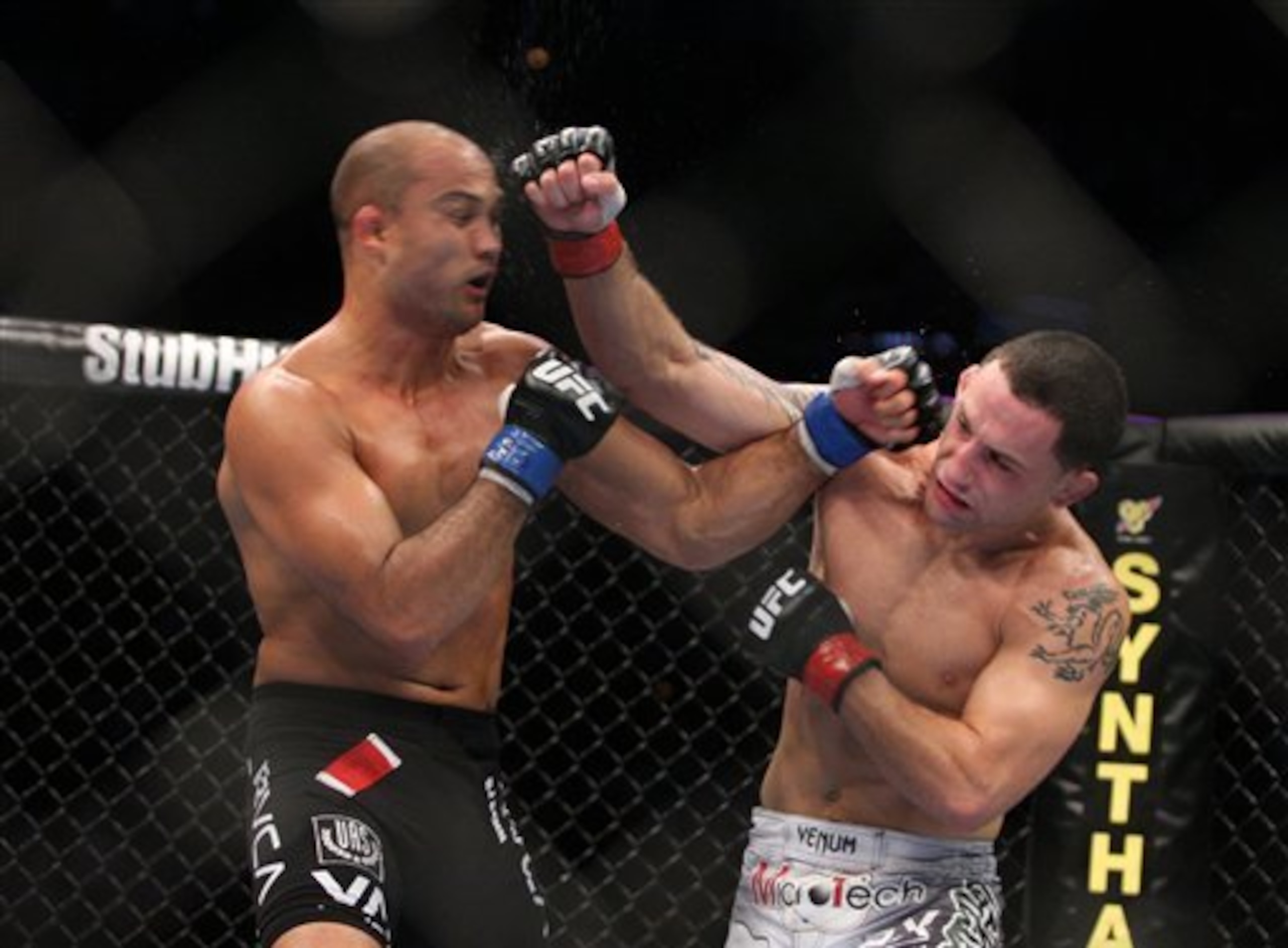
Most fighters have a foil who, for reasons they cannot identify, just seems to have their number. Indeed, on a long enough time line, all fighters will find this to be true, no matter if their names are Jon Jones, Cain Velasquez, Sugar Ray Robinson, Ronda Rousey or BJ Penn.
Taking an entire year off from MMA, Penn seemed to finally come to his senses, realizing that the lower weight classes were where he belonged. However, there was also a little of that special blend of crazy that also brought him back—the crazy that every fighter is driven to when he cannot fathom how his foil beat him.
Of all the defeats Penn suffered in his storied career, only one man seemed to have his number on an even playing field: Frankie Edgar. It was this one man, this great fighter, who pulled Penn back into the sport for the final time.
“Those two losses are a rock in my shoe,” said Penn, via Shaun Al-Shatti of MMAFighting.com. “He should’ve never beat me. That guy can’t beat me.”
And so, Penn was granted his request to return and fight Edgar, after filming Season 19 of The Ultimate Fighter as opposing coaches. It seemed to make sense; if Penn was to return, a fight in the lighter weights was the only plausible option, and who better than Edgar to finally answer the question?
Of course, we know what happened come fight night. Penn looked excellent in the weigh-ins, svelte and full of fire.
Then, he went out and employed a bizarre strategy that seemed to leave him defenseless, robbing him of his best weapons on one hand while playing to the advantages of his opponent on the other. Edgar took the gifts laid out before him, taking Penn down with ease when it suited him and punishing him at will, with nearly no fear of reprisal when the two were standing.
If Penn was to have a chance in the fight, it wasn’t going to be by using a style that took away his punching power, upset his timing and robbed him of his takedown defense. But this was the style he chose, and after the bout, Edgar seemed to sum it up best.
“It’s a bittersweet victory,” Edgar told Jon Anik.
The Present
15 of 15After taking a while to let the dust settle from the last fight of Penn’s career, we can judge him in total by appreciating the sum of so many different parts.
It is true he has many defeats on his record and that they came about of his own volition. No one held a gun to his head and made him fight larger fighters like Lyoto Machida, Georges St-Pierre, Matt Hughes, Nick Diaz and Rory MacDonald. When you dare to do great things, you take the risk of failing because the rewards are breathtaking.
As a lightweight, he was one of the greatest ever, on par with Frankie Edgar and Benson Henderson for consecutive title defenses—good company to be in, without question.
But as a fighter, the whole of what Penn accomplished must take the sting out of his defeats simply because only great fighters capture titles in two weight classes. Furthermore, only exceptionally great fighters do so at the expense of the reigning pound-for-pound king of the sport at the time.
Penn is just one of three fighters to accomplish such a feat, and one of but two to do so in the UFC; the other two fighters are Randy Couture and Dan Henderson. Penn belongs in such company because when you dare to do great things (instead of just talk about them), you make history when you succeed, and that is what Penn did.
To date, there has never been a lightweight fighter who moved up and captured the welterweight title, especially against a monster akin to Hughes in his prime.
Fighters moving up in weight and finding success is rare, yet Penn did it early in his career with shocking ability; this is the evidence in the case for Penn being considered one of the best ever.
In his prime, he was so good that he could take the conventional wisdom that says a good big man beats a good small man and turn it on its head.
I cannot think of any fighter in the history of MMA who has been able to do what Penn did during the early stages of his career. Chances are that there will not be another fighter to do this for decades, if not longer.
And yet, this is also a truth that cuts both ways; as impressive as Penn’s accomplishments were, had he fought more often during his prime and against fighters his own size as he aged, his legacy would be much greater, at least on paper.
But then we come back to the thing that makes Penn great: What’s on paper just doesn’t matter. For men like Penn, theory is fine, but it is also two-dimensional.
For men like Penn, true greatness is only ever found on the other side of battle, when talking about being willing to fight larger opponents falls utterly short of actually doing it.
If there were more fighters with the daring of Penn, the MMA landscape would be much different; Rousey would be fighting Cristiane “Cyborg” Justino, and Jon Jones would be fighting at heavyweight right now.
And that’s just the beginning.
Penn was a multi-divisional champion, that is true, but it is not the greatest aspect of his legacy. The greatest thing was that he was a true fighter who cared more about the fight than anything else.
So, just how good was Penn?
That’s simple: He was a prodigy, and MMA was lucky to have him.
.jpg?w=2560)



.jpg?w=2560 "2 NFL Officials Suspended")

.jpg?w=2560 "Viral Rams Coach Vid 🖕")