
Best Draft-Day Contingency Plans for New England Patriots
Based on their frequent draft-day maneuverings, it's clear that Bill Belichick and the New England Patriots front office enter the NFL draft with a fairly clear picture of the type of class they want to construct. New England typically constructs a smaller draft board than most teams, the result of an internal scouting system that doggedly avoids groupthink, even if its board doesn't always align with the mainstream perception.
Of course, it's rare that a draft ever goes entirely according to plan, so the Patriots will need contingency plans for the prospects they miss out on. Determining those primary targets is difficult enough—the likes of Tavon Wilson, Duron Harmon and Stevan Ridley were all surprise Day 2 picks in recent years—so it's important to realize that this simply adds another layer of speculation about the Pats' draft board.
Nonetheless, this also provides an opportunity for New England fans to learn about potential sleeper targets at positions of need. Remember, last year's most significant rookie contributor, Bryan Stork, was a fourth-round selection. Given that the Pats have four picks between Rounds 3 and 4 this year, that area once again looks like the sweet spot for a possible steal.
Projecting the Patriots' top early-round targets, here are the players who could make for viable Plan Bs if those initial plans fall through.
5. Tyeler Davison, DT, Fresno St.
1 of 5
There’s no shortage of throwback two-gapping defensive tackles in this draft class. While Danny Shelton is far out of New England’s range, the trio of Jordan Phillips, Eddie Goldman and Carl Davis all represent realistic first-round possibilities for the Patriots. With Vince Wilfork’s roster status in doubt, it’s logical to presume that the Pats might search for the 33-year-old’s successor.
However, if the Pats go another direction on Day 1, Tyeler Davison could represent a sneaky option. Coming from a wrestling background, Davison is a consistently violent initiator of contact, as he possesses surprising flexibility that allows him to use a wider array of moves than most interior linemen.
At the East-West Shrine Game, the 6’2”, 316-pound Davison stood out as one of the highest-ceiling prospects, per Sporting News’ Eric Galko:
"Versatile interior defensive linemen are of huge value to NFL teams, and Davison can play at nose tackle and 3-technique thanks to his near-elite upper body strength and lateral activeness. He shows great balance after his initial pop, and stays low through contact, constantly winning the leverage battle. His swim move and ability to split doubles at a very high level should make him a headache to block when he’s at nose tackle in practice.
"
Most intriguingly, Davison’s skill set isn’t necessarily a direct overlap with that of Sealver Siliga, who has exhibited promising strength against the run over the past two seasons. At Fresno State, Davison was a true three-down tackle, accruing 8.5 sacks and playing over 80 percent of the snaps. With long 34-inch arms, Davison’s length imbues him with some useful 3-technique traits.
Competition level was his biggest question collegiately, as Davison tended to shrink against the best competition. Still, with a rare blend of physical tools for a player of his size, Davison is the type of intriguing project who could fall into that Rounds 3-4 wheelhouse.
4. Jeremiah Poutasi, G, Utah
2 of 5
Guard is the most obvious hole in the Patriots’ starting lineup, and regardless of whether free-agent starter Dan Connolly returns, there will likely be competition along the interior this summer. With a weak draft class in that department, it wouldn’t be surprising to see Belichick skip out on poor early-round values and focus on some Day 3 targets.
The monstrously sized 6’5”, 335-pound Jeremiah Poutasi might stand out as a prime target if the Pats go in that direction. Poutasi was a 4-star recruit out of high school who chose Utah over some higher-profile schools, and while he hasn’t quite lived up to those lofty expectations, football lifer Dennis Erickson had some high praise for the Utes tackle, per NFL.com’s Bryan Fischer:
"Longtime NFL and college head coach Dennis Erickson, who is on the staff in Salt Lake City, told College Football 24/7 last year during spring football that Poutasi has the physical tools to turn into the best offensive lineman he's ever coached. That's high praise from a veteran coach who's been around the block quite a bit with some terrific pros manning the blind side.
Based on [Daniel] Jeremiah's observations, Poutasi has the skills and is rounding into form, but still has work left to do in order to live up to expectations. If he does, watch out.
"
Poutasi doesn’t possess the agility or lateral flexibility to stick at tackle in the NFL, though he did improve tremendously in slicing his hits/sacks allowed total from 27 his junior season to just 9.5 last year. However, with excellent upper-body strength and footwork to anchor, Poutasi’s body type and strengths make him a much more natural fit inside.
The ex-Ute is a bit reminiscent of Jon Halapio, last year’s sixth-round pick who failed to make the roster out of training camp. Though Halapio flopped, he did have the size and tool kit that made him a worthy late-round lottery ticket. That failure doesn’t necessarily augur ominous signs for Poutasi, who would likely be competing with the likes of Josh Kline and Jordan Devey for a developmental backup role.
3. Tyler Kroft, TE, Rutgers
3 of 5
The Rutgers-to-Foxborough pipeline has been famously active in recent drafts, and tight end Tyler Kroft could become the latest Scarlet Knight alum to join the ranks.
Given how extraordinarily weak the tight end class is this season, it probably makes more sense to squeeze more value out of a later-round pick from a familiar program rather than investing in a similarly raw prospect, such as Miami’s Clive Walford or Ohio State’s Jeff Heuerman.
The 6’4”, 246-pound prospect has “Y” tight end size, but his best season came when he largely played out of the slot in 2013. Kroft compiled 573 yards and four touchdowns on 43 receptions that year; as Football Outsiders’ Matt Waldman notes in a breakdown of Kroft’s film against Arkansas last year, the tight end’s most promising signs of development are his awareness in his routes and body positioning:
"Kroft's route savvy also includes some skill to work against tight, physical play -- a must to make consistent plays in an NFL passing game. This fourth-down play inside the final two minutes of the half is good indication of a coordinated, focused athlete. …
The adjustment to the contact earns Kroft a step, and that's all he needs to make the catch on the move, turn upfield, and earn the first down. The athleticism to also drop the pads and shed the linebacker's wrap is also a solid indication of his athleticism. He's not a special runner after the catch, but he doesn't make it easy on his opposition once the ball is in his hands.
"
Even though Waldman isolates some improved efforts in blocking, Kroft largely remains a receiving tight end better suited for an off-line role. Exempting the currently incarcerated Aaron Hernandez, Belichick has typically opted for more well-rounded tight ends in the draft like Rob Gronkowski, Daniel Graham and Ben Watson.
But the Pats minimized the need for a pure blocking tight end last season by splitting a tackle (usually Nate Solder or Cameron Fleming) as an eligible tight end. Given New England’s tackle depth, it’s conceivable it could add an “F” tight end to support its focus on creating spacing in the passing game.
Depending on the Patriots’ level of confidence in Tim Wright, Kroft’s background and skill set could make him a natural fit in New England.


.jpg?w=2560 "Cardinals Giants Football")
2. David Cobb, RB, Minnesota
4 of 5
Numerous draftniks have highlighted Todd Gurley as a droolworthy fit for New England. The thought of Gurley in the backfield for Tom Brady’s twilight years is undeniably attractive, but the Georgia back’s upside is so tantalizing that it’s conceivable the Patriots won’t get a shot at the ex-Bulldog with the 32nd pick.
But that’s not necessarily a problem in this deep class. Gurley is probably the draft’s best between-the-tackles runner, but Minnesota’s David Cobb stands out for his physical downhill consistency.
Cobb didn’t receive national recognition because of the Big Ten’s absurdly deep running back stable, but in accumulating 2,893 rushing yards on 5.1 yards per attempt over the last two seasons, he’s earned a reputation as one of the draft’s best power backs:
"Michigan LB Jake Ryan called David Cobb toughest RB he faced in Big 10: "Really good running back, downhill guy, tough guy.''
— Chris Tomasson (@christomasson) February 21, 2015"
"Gophers RB David Cobb said he "can do it all.'' He said, "I just pride myself on being confident and not being tackled by one person.”
— Chris Tomasson (@christomasson) February 19, 2015"
Cobb’s draft stock could fall a bit after he pulled a quad at the scouting combine, which led to a hobbled 4.8-second 40-yard dash time and forced him to miss Minnesota’s pro day. Still, Cobb’s one-cut running style seems like a good fit in New England’s offense.
Fittingly, his NFL.com scouting profile lists his pro comp as Stevan Ridley, as both are big backs without breakaway speed but with the decisive vision and forward lean to pick up yards regardless.
With Ridley seemingly destined to leave in free agency, Cobb could be an interesting replacement. Current power backs LeGarrette Blount and Jonas Gray are relatively uninspiring options, and if the Pats trust James White enough to hand over Shane Vereen’s third-down role, we could see a new, younger (and cheaper) backfield in New England next season.
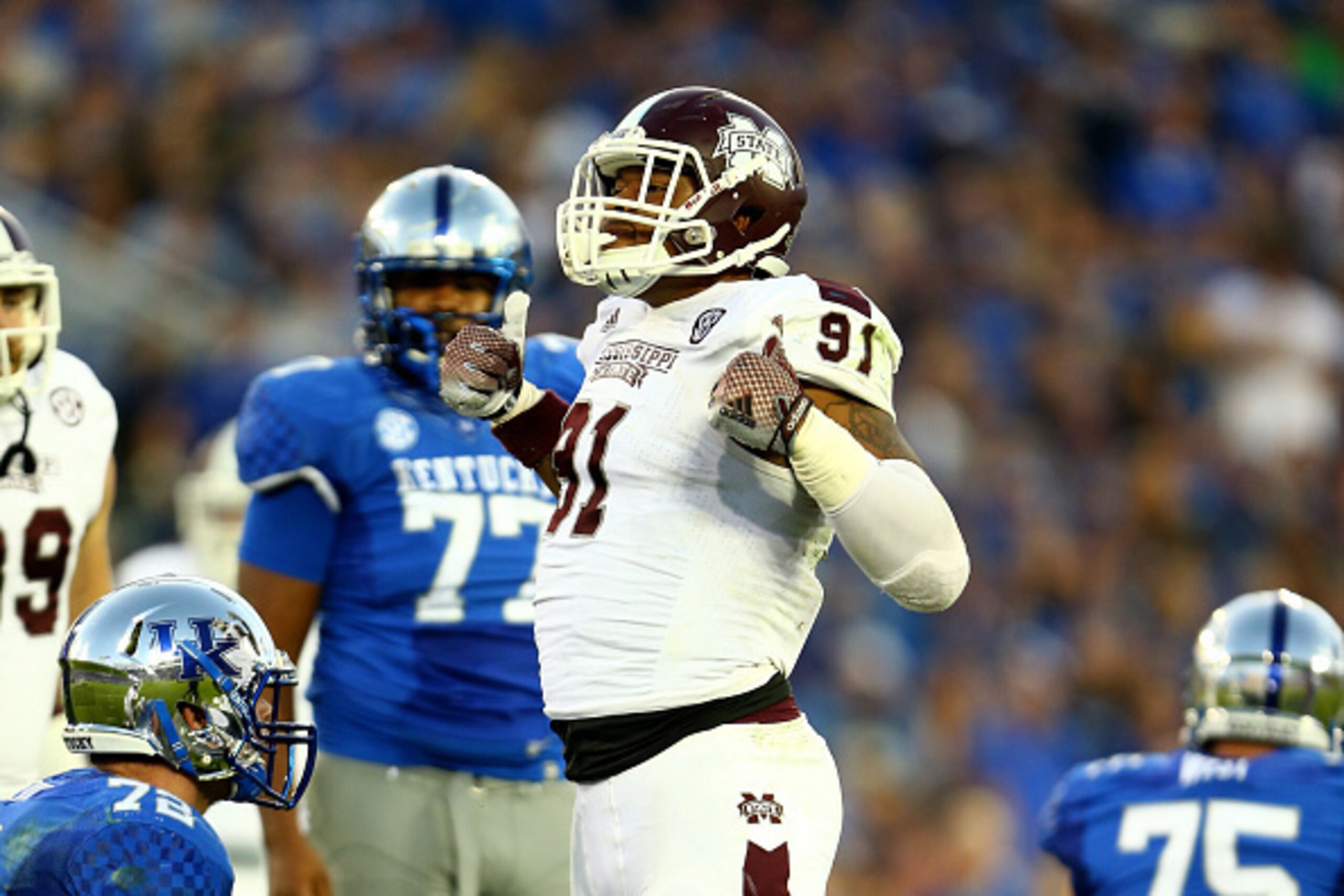
1. Preston Smith, DE, Mississippi St.
5 of 5
Unlike the other players on this list, Preston Smith isn’t necessarily a replacement for one prototype, but rather any defensive linemen in which the Patriots might otherwise invest. Versatility has always been a key buzzword in identifying future Pats targets, a mold that Smith embodies.
At Mississippi State, Smith was essentially a “Joker” chess piece along the front seven, rushing the passer from virtually every gap and even dropping into coverage on occasion. Thus, the ex-Bulldog wouldn’t experience as steep a learning curve transitioning to New England’s hybrid defense as many prospects. In fact, Smith’s measurables already mirror that of a current Patriots edge defender:
"Preston Smith's Measurables and Combine Performance are freaskishly close to those of Chandler Jones. Here's the breakdown..
— Mike Loyko (@NEPD_Loyko) March 1, 2015"
"Jones vs. P.Smith 6050/6047 266/271 35.5/34 4.87/4.78 22/24 10'/10'1" 35"/34" 7.07/7.07 4.38/4.28
— Mike Loyko (@NEPD_Loyko) March 1, 2015"
Smith was disruptive during his final season at Mississippi State, tallying nine sacks and 15 tackles for loss, but he doesn’t appear to possess the explosive get-off to consistently penetrate the backfield at the NFL level. Nevertheless, while one-gapping 4-3 defenses may overlook him, Smith’s fundamentally sound tackling and lane discipline make him a nice fit for the Patriots.
Admittedly, this could be a bit of a luxury pick, and after a strong combine, there’s a chance Smith won’t be around for the Patriots’ second-round selection. However, if New England trades out of its first-round pick and accumulates more Day 2 ammo, look for Smith to become one of its prime targets because of his ostensible fit in its system.
*All combine stats and measurables via NFL.com.
.jpg?w=2560 "Jets Dolphins Football")
.jpg?w=2560 "Ward Nearly Walks Out of Presser ▶️")
