

AB De Villiers and Chris Gayle's Innings Should Be Enjoyed Not Explained
AB de Villiers struck 162 not out from 66 balls against the West Indies. Chris Gayle struck 215 from 147 balls against Zimbabwe three days before.
Together they both broke all kinds of records.
De Villiers scored the fastest-ever ODI 150 at a strike rate of 245. He hit more sixes than he played dot balls. He contributed to the second-highest World Cup team total.

.jpg?w=2560)
Gayle’s innings was the first double hundred in World Cup history. It was the third-highest ODI score of all time. His partnership of 372 with Marlon Samuels was the highest-ever ODI partnership.
Two remarkable innings in the space of a week. Yet there are still doubts in some people’s minds.
In an era which has seen ODI batting records regularly tumbling there has been a growing tendency to try and qualify these achievements.
The evolution of ODI cricket and the frequency of these innings is such that the more prudent observers have become spoilt.
Previously insurmountable targets and records have been reeled in. Shahid Afridi’s 36-ball hundred record had stood for 17 years before New Zealand’s Corey Anderson and De Villiers broke twice it within a year.
India’s Rohit Sharma hit two ODI double centuries within the space of 12 months—something never previously done before in 39 years of the format.
Cricket is a game based on numbers; everything is documented and trends are spotted.
"162 - Here is a statistical comparison of Chris Gayle's 215 and AB de Villiers' 162 not out. Detail. #CWC15 #SAvWI pic.twitter.com/tIK6dVYcpy
— OptaJim (@OptaJim) February 27, 2015"
Therefore we can’t merely appreciate these audacious feats. Reason, statistics and logic dictate that we must attempt to explain them first. And there have been any number of ways to try and do just that.
It is all down to the size of modern bats isn’t it? Well ICC chief executive David Richardson thinks modern bats have “shifted the balance” in favour of batsmen, per Cricinfo.
Except bat maker Chris King told Jon Hotton of Cricinfo a few months beforehand that "It's a common misunderstanding that the size of a cricket bat makes a difference."
But if it is not the bats, then it is the short boundaries. It is no wonder that De Villiers hit more sixes than dot balls when the boundary rope is so close.
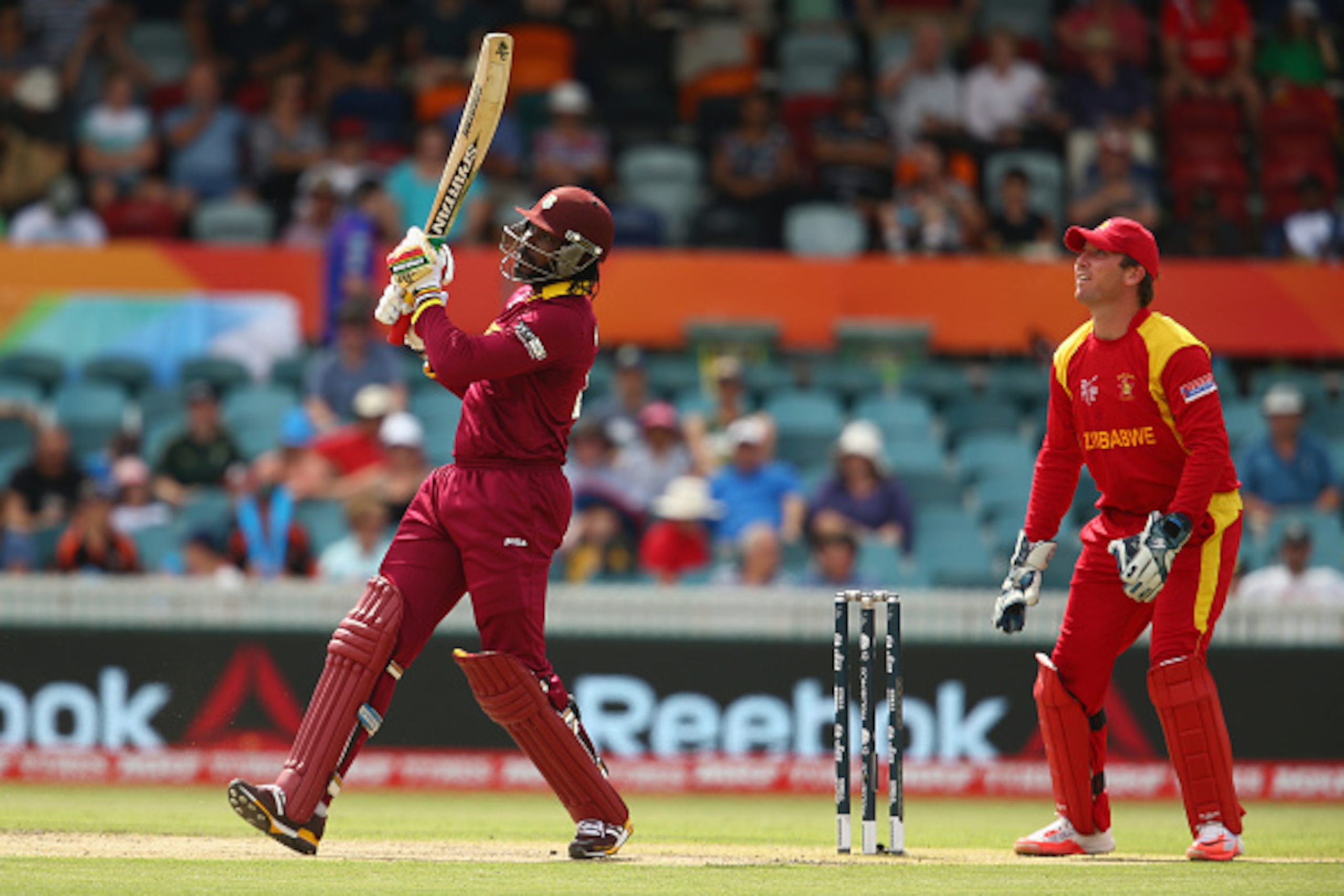
This argument similarly misses the point. Yes the boundary at fine leg is short, but that does not make it easy to hit to—De Villiers shuffles outside off-stump, gets down on one knee and sweeps seamers in that direction. Not an easy thing to pull off.
Gayle regularly hits 90-metre sixes. Push the rope back all you like—he will still reach it.
The third commonly asserted argument is that poor bowling is to blame for these quick-fire mammoth scores. There is some truth in this.
The West Indies captain Jason Holder went for 104 runs from his 10 overs against De Villiers. Gayle scored many of his runs swatting Zimbabwean long hops and full tosses over the leg side.
But bowling is a difficult skill. With a genius like De Villiers or a brute like Gayle at the other end of the wicket it becomes a lot harder. Pressure forces mistakes. Batsmen earn their bad deliveries.
"AB de Villiers. Needs to pick it up a bit more at the start. 12.122..1111212114114411116442.2.444114411226.4114624442641266266 #cwc15
— Simon Caney (@simoncaney) February 27, 2015"
ODI cricket is undoubtedly a batsman’s game, but that does not mean we can’t enjoy it.
The lazy swing of Gayle’s bat connecting with ball after ball is something to behold, no matter what the bowling is like.
The quick thinking and audacious shot selection of De Villiers is second to none. When on-song he can hit the ball anywhere he pleases, regardless of who is bowling at him.
These types of innings are going to become more frequent. Not because of the bat size or the dearth of quality bowlers, but because batsmen are stronger, more inventive and more daring. Twenty-20 cricket will continue to exert influence.
This does not make these achievements any less impressive.
Let’s continue to be shocked when a batsman does something miraculous: Our sensibilities don’t need to qualify everything we see.


.jpg?w=2560 "Viral Rams Coach Vid 🖕")

.jpg?w=2560 "Injury-stricken Seahawks signing veteran RB")
