2015 NFL Draft: Prospects Who Need Solid Pro Days to Lock Down 1st-Round Status
With the scouting combine nearly a week into the rearview mirror, pro-day discussions have already begun in earnest. Not every major university has set a date for its workout showcase, but buzz is already high about players who need to prove themselves over the next month.
The likes of Jameis Winston, Marcus Mariota and Leonard Williams can breathe easy. Their combine performances put them in mortal lock status for the top 10. The same very likely goes for Randy Gregory, Amari Cooper and Dante Fowler Jr.; one of them may fall come April, but it's unlikely.
As for the remainder of the class, most will spend the next month-and-a-half straddling a line of uncertainty. Even for those whom we consider first-round locks now, things start getting murkier outside the truly elite. Team needs force reaches, and positional overload causes players to slide; soon, you're the sad dude sitting in the green room, trying not to cry while awkwardly staring at your phone.
.jpg?w=2560 "Cardinals Giants Football")
.jpg?w=2560 "Jets Dolphins Football")

The best way to avoid seeing yourself in those highlight montages for years to come is to perform at your pro day. With that in mind, let's take a look at a few first-round prospects who need impressive outings to solidify their status.
Shane Ray, DE/OLB, Missouri
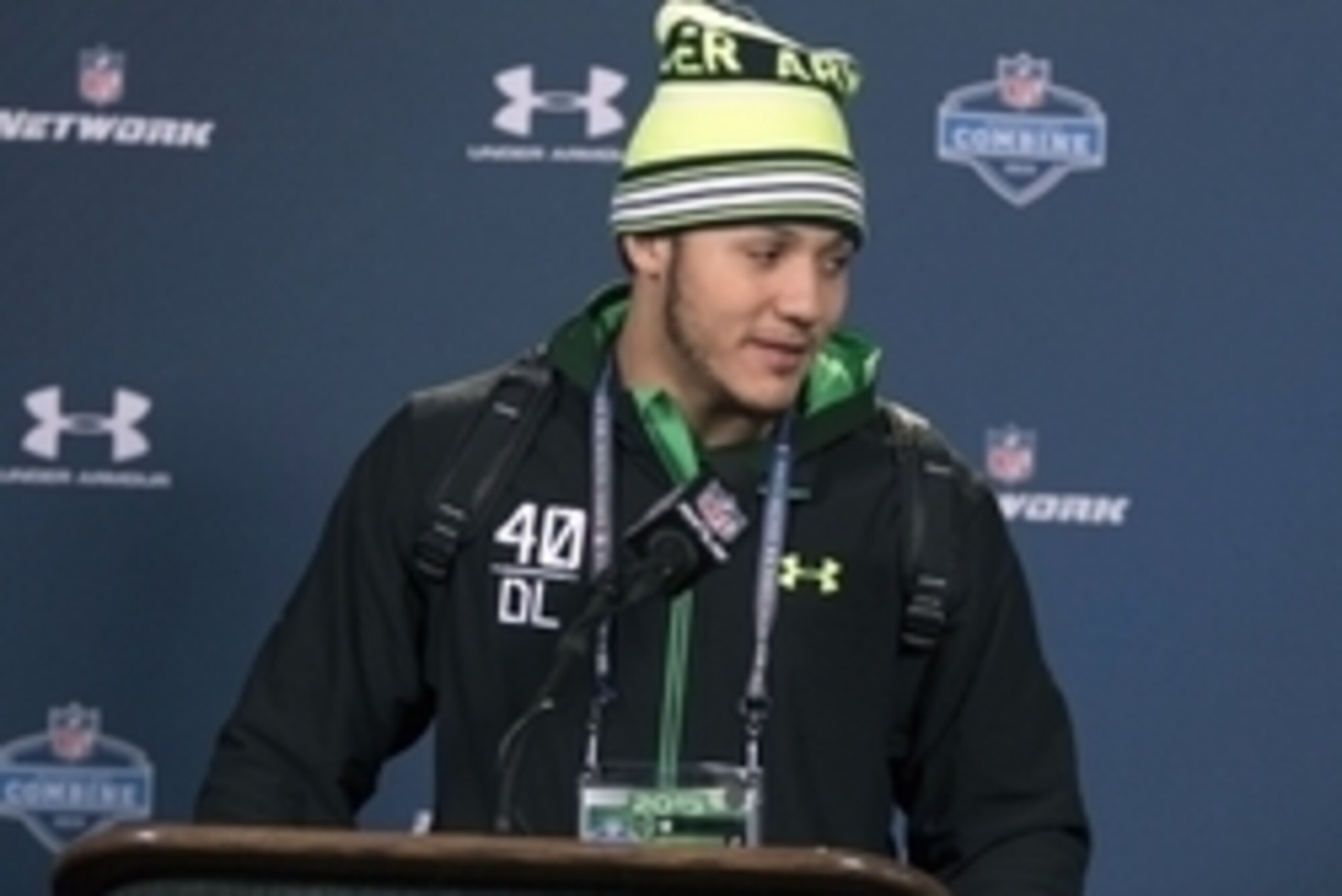
Viewed as a top-10 selection coming into Indianapolis, Ray was a late scratch for combine workouts due to a foot injury suffered during Missouri's Citrus Bowl win over Minnesota. The severity of his injury is unclear, but a massive spotlight was thrust on his pro day by the sheer product of his absence.
It also didn't help Ray was less than impressive in ways he actually could participate. His 21 bench-press reps were among the worst for defensive linemen. Even if you consider him a hybrid player, only Fowler did worse on the bench among Ray's contemporaries.
With Ray also measuring in right around his listed playing weight (6'3", 245 pounds), there are going to be increased questions about his ability to play defensive end. That, of course, is a problem, since some scouts view him as being incapable of switching to outside linebacker.
"I don't like him," a scout told Bob McGinn of the Milwaukee Journal Sentinel. "People see who he is, they're going to fall off him quick. The body structure. No way in hell he can be an outside backer. Competitive, smart and reliable. Wins with effort, urgency and great first step. He has a degree of stiffness. He's got to win with quickness because of his lack of size and strength."
Ray's tape shows an explosiveness and first-step quickness that should make him a formidable pass-rusher regardless of position. But he's also in the draft's most loaded category. Fowler, Gregory, Alvin Dupree and Vic Beasley are all competing with Ray for the same general spot. Each of those four players participated in Indianapolis to varying degrees of success.
Ray's decision to sit out means he'll need to make the most out of his one opportunity to change people's minds.
Shaq Thompson, OLB, Washington
Outside linebacker or safety—that's the question for Shaq Thompson. The answer, apparently, is no one has any clue. Thompson sees himself as an outside linebacker.
“That’s where I feel the most comfortable,” Thompson told reporters. “I like to be up by the line of scrimmage. I feel like I’m physical enough. I’m not the biggest guy, but I have a lot of heart.”
Two NFL scouts, who spoke with NFL Network's Gil Brandt, disagree. They told Brandt they see Thompson settling long-term at strong safety.
The numbers from Indianapolis tell an equally uncertain story. From a size perspective, Thompson is without a doubt a safety. He measured in at 6'0" and 228 pounds, the exact same size as Alabama safety Landon Collins. When they stand next to each other, the two look almost like carbon copies, with Thompson boasting a two-inch arm length advantage and an extra one-eighth of an inch in hand size.
From an athletic perspective, Thompson is clearly a linebacker. His 4.64-second time in the 40 would have ranked fourth-worst in the class, barely ahead of Michigan State's Kurtis Drummond, whom nearly everyone agreed had a miserable athletic performance. His 20-yard shuttle time (4.08 seconds) was more promising; his 60-yard shuttle (11.78 seconds) was less so.
The numbers seem to indicate Thompson has an excellent first burst but loses steam when asked to cover more ground. For a linebacker, that's typically not an issue. He in fact would rank among the more athletic outside linebackers in most categories. For a safety, it could mean he's getting destroyed over the top.
I've long viewed Thompson as a spiritual successor to Thomas Davis, who carved a successful career by providing Carolina the best of both worlds. But the longer that NFL teams are confused about what position he plays, the more the pressure will ratchet up.
Devin Funchess, TE/WR, Michigan
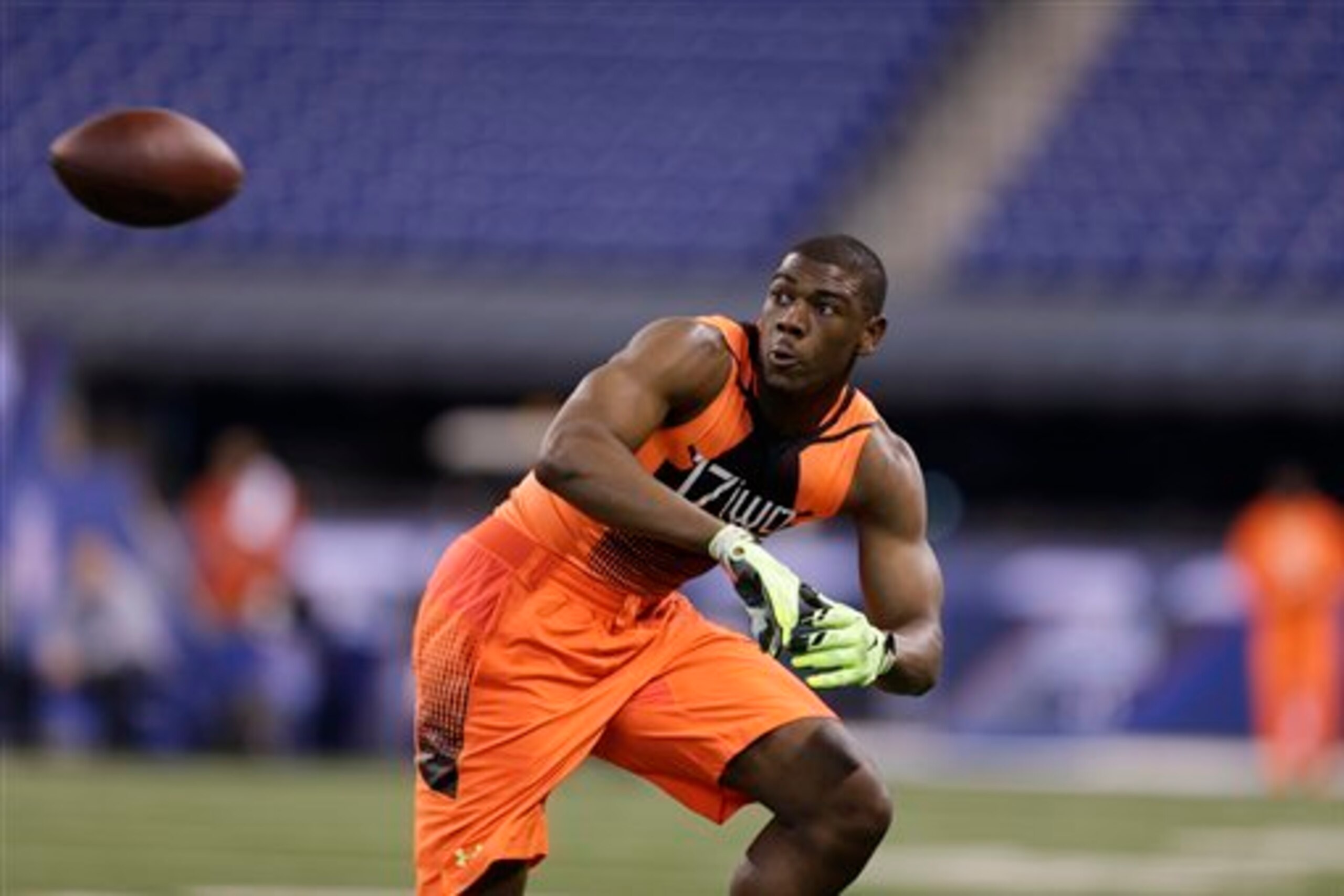
Word of advice, Mr. Funchess: Give up on being viewed as a wide receiver. You are jamming a giant square peg into the smallest round hole. It did not work last season at Michigan. It did not work at the combine.
It will not work in the NFL.
Funchess, working out with wide receivers in Indianapolis, came away as one of the most disappointing skill-position players. His 4.70-second time in the 40 was worst among all receivers. He then straight-up refused to participate in either the shuttle run or three-cone drill.
Optimists can point to his 38.5-inch vertical leap and 122-inch broad jump, but the 40 alone confirmed what some have long expected: Funchess is not fast enough to play wide receiver. It was apparent at Michigan as he averaged 11.8 yards per reception after making the switch—a disappointing number even after accounting for his season-long injury issues.
The best move for Funchess is to pivot now and market himself as a tight end. That change alone would alter the narrative, automatically taking him from disappointment to athletic freak. At tight end, his 40 time isn't a detriment; it's a positive. It would have been third-best among tight ends, a full 0.08 better than fellow first-round prospect Maxx Williams. No other tight end would have touched his broad or vertical leaps.
Post those numbers while running with the tight ends, and perhaps we're talking about an Eric Ebron-esque rise. Instead, it's all negativity coming from scouts who are quickly realizing Funchess is better suited for a Jimmy Graham-esque role than being a full-time wide receiver.
None of this is a bad thing for Funchess' pro prospects, but it's all bad for his chances of sticking around on Day 1.
Others in need of a boost: Dorial Green-Beckham, WR, Oklahoma; Breshad Perriman, WR, UCF; Paul Dawson, LB, TCU.
All combine results via NFL.com.
Follow Tyler Conway (@tylerconway22) on Twitter
.jpg?w=2560 "Titans Ravens Football")
.jpg?w=2560 "NFL investigating 2 referees for separate viral exchanges")