

Post-Sochi, US Athletes Find Contentment, Pain, Celebrity and Challenge
Nerves settled in for Olympic ice dancer Charlie White. He had been on big stages before, chased butterflies in his stomach before. But nothing like this—nothing so pressure-packed, so far outside of his comfort zone.
A full studio audience plus millions of people at home watched as he sat at the round table, next to his ice-dancing partner Meryl Davis. As the moment approached, he worried about blowing it.
What if he started laughing and couldn’t stop?

.jpg?w=2560)
What if he started babbling, as he does when he’s nervous?
Then Stephen Colbert introduced the gold medal-winning pair, flitted over from his “news desk” and shook their hands, and the interview was on. White laughed often and sometimes seemed to teeter on the edge of losing it, but he held it together, even when Colbert accused White’s hair of doping.
Soon, the most nerve-wracking moment of White’s gold-medal victory lap was over, and he had survived.
“It was one of those things that felt like a pipe dream,” White says. “You have so much respect for the people he has on the show. They’re usually very influential and very important people. To be able to be on the show was really surreal. Even to this day, I can’t believe that I got a chance to meet him.”
In the year since the Sochi games, the thrill of victory and the agony of defeat only scratch the surface of post-Olympic life for American competitors. They have met the rich and the famous, signed endorsement deals, dealt with fame, retreated to anonymity, found contentment, struggled with self-doubt and questioned their futures in the sports they love.
Davis and White are still basking in the glory of their moment.
Julie Chu, a U.S. women’s hockey player whose team blew a two-goal lead in the third period of the gold-medal game, had to get over losing in hers.
Joss Christensen, an unlikely gold medalist in slopestyle, is searching for that next big moment to validate the first.
And ski jumper Sarah Hendrickson, a former world champion battling to regain her best-in-the-world status, wonders if her moment of glory will ever come again.
Embracing the Now

The last chapter of Davis and White’s old lives began as they stepped onto the ice at Sochi. After dominating international ice-dancing competitions in 2012 and 2013, they were favorites for the gold. They knew if they nailed their performance that they would win the first gold in U.S. history.
It is not a peaceful memory. It makes The Colbert Report look like a walk in the park.
“It was all of my nerves from my whole life put into a couple minutes. Reliving it, just thinking about it, it makes you nervous just remembering how nervous you were,” White says.
From the moment their world-record score went up on the board, their lives haven’t been the same. A year later, they are still delighting in their accomplishment, even as the aftereffects remain overwhelming.
Davis and White won silver four years prior, and that made them temporarily famous to the extent they thought about winning gold. They thought it would be like winning silver, only a little more gratifying.
But the difference between silver and gold turned out to be the difference between a model Porsche and the actual thing. Magazine covers, cereal boxes, Dancing with the Stars, The Colbert Report—they were everywhere in the weeks after the Games.
“We were so totally unprepared to deal with the idea of being Olympic champions,” White says. “To this day, we continue to try to figure out where it fits. As an athlete especially, your mental take on it was you just prepared the best you can. You don’t consider what it will be like if you win. You don’t consider how it will change your life. So when it finally happens, you’re totally unprepared.”
The first sign of their new lives came a few days after they left Sochi and arrived in New York City for interviews. They were accustomed to being recognized on the street by ice-dancing fans, but this was different. This was businessmen on the streets of Manhattan congratulating them.
“One of the things we’re most grateful for is the warmth of the reception we received,” Davis says. “People really opened their arms to us.”
That has died down. White jokes they are recognized now more for their appearances on Dancing with the Stars than for being Olympians. Davis won and swears she has uttered not a word about the fact White lost in the semis.
In June, White got engaged to Tanith Belbin, a 2006 silver medalist in ice dancing. Davis is taking an independent-study class this semester at the University of Michigan, where Davis and White both have studied over the years. They haven’t skated competitively this year and don’t know yet whether they will try to defend their title in 2018. They are touring with Stars on Ice.
Their lives haven’t returned to normal because they weren’t normal before.
“The biggest change is going from being hungry, working every minute of every day, where it was like, you’re going to sleep thinking about whether you’ve done enough during the day, if you’re going to get enough sleep, if you ate right, to a feeling of satisfaction, of completion, of earning something, working hard for it and being able to enjoy it,” White says.
“I think that’s something we’ve really been able to enjoy. As we move forward, we’ll find new things to attach ourselves to, to move toward. But for so long, we were so focused singularly on achieving this one goal. To achieve it and move forward from it is really transformative.”
Says Davis: “Post-Sochi, I think for the first time ever, we were excited to just be in that place and just enjoy it, without looking too far ahead. We’re really allowing ourselves that moment, still, to just embrace the now and embrace what’s coming our way, as opposed to sitting down and figuring out the years ahead.”
Fighting with a Sport She Loves
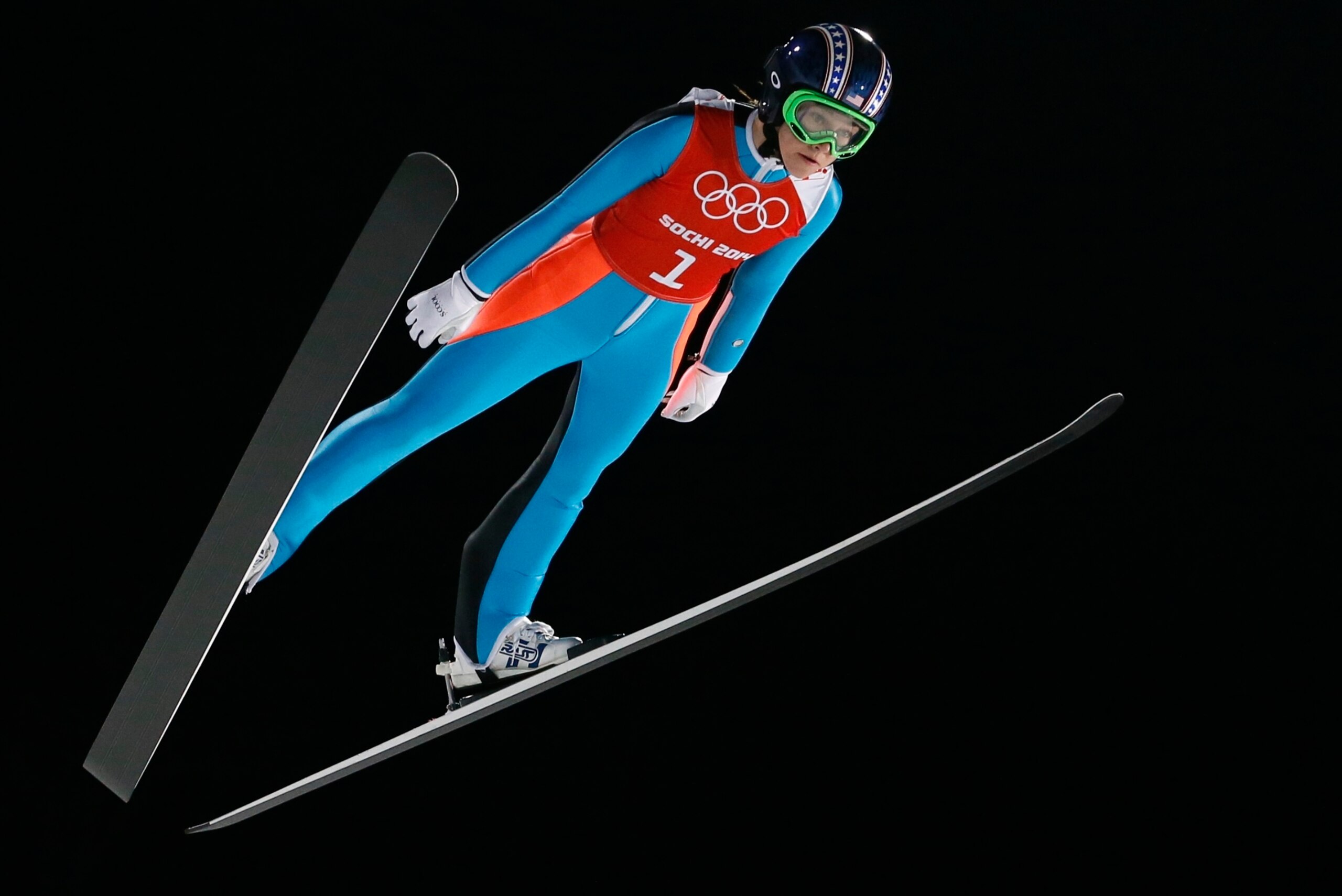
In 2013, Sarah Hendrickson won the world championship in ski jumping. And then disaster. While training in Oberstdorf, Germany, in August 2013, she blew out her knee. While she recovered in time to compete in Sochi last February, she wasn’t 100 percent and finished 21st.
She’s still fighting to get back to a world-champion level. Her two third-place finishes over the weekend give her momentum going into the World Championship this week. Those strong finishes come amid her fears that she’ll get hurt again, as she recounts here in a diary-like dispatch that she wrote prior to this weekend.
It was a perfect day in Germany. I took three jumps, and they were all 130-to-135 meters, which is pretty far but still safe. On my fourth jump, a little bit of wind picked up at the bottom. At about 100 meters, I caught the wind. It created lift, and I landed at 148 meters—five meters past the record there.
My knee just exploded—the MCL ripped off the bone. I was screaming at the bottom of the hill.
I flew home and had surgery. My doctor told me it was possible to make Sochi, and from that minute, that was my goal. The next four months I spent every single day in the gym, working on strength and range of motion. The pain meds were pretty rough on me. I was nauseous and didn’t eat. I dropped down to 89 pounds. It was brutal. Looking back on it, I have no idea how I got through it.
But I dreamed of walking in the opening ceremonies—that’s what I was striving for. It was monumental to be one of the first 30 women to ever compete in the Olympics in ski jumping. Walking to the opening ceremony was a special feeling for anyone, and even more for us, considering the fight to get us in there.
It was frustrating as an athlete and world champion to go into a competition knowing I wasn’t at my highest level. I had about 20 jumps going into the event. That’s maybe a 10th of what everybody else had.
After Sochi, I had my knee scoped and rehabbed again. I didn’t take that much time off from jumping. I really missed it. I just wanted to get back into it. I wanted to be normal again. I think I pushed it a little too far, because I’m worn out right now. But that’s what you learn as an athlete.
Physically, I’d say I’m 100 percent. I still have rough days with my knee—but the damage was so bad, I’ll probably have rough days for the rest of my life.
The challenge is the mental side of things. I hurt my knee because I jumped really far—which is the objective of ski jumping. So I’ve been having trouble trusting my knee and trusting my strength to jump that far without the fear of hurting myself again. That’s been a huge challenge.
I worry about jumping in wind again. I’m quite light. Even the smallest bit of wind can affect me more than other jumpers out there.
Every day is a step in the right direction, but my results have been up and down. I have had a handful of top-10s. I was satisfied with that, considering everything I’ve been through. But I don’t like being satisfied with a top-10.
Last week, I jumped again at Oberstdorf, only this time from the K90, not the K120, which is where I got hurt. It was weird being back at that venue and looking at that hill, because that place really changed my life.
I’m stronger in a lot of ways. Five years from now, I’ll look back and be thankful for these hard times. But right now, it’s hard not to hate that place because of the hard times it’s given me.
And it’s not just the injury. I’ve also been fighting with ski jumping. Everything I do in my entire life is for ski jumping. It breaks my heart when I end a day really unhappy because of the sport that I love so much. I question, why am I doing this, if this is so hard? That’s what I’m facing right now. How much do I push past? What’s my breaking point?
I won’t quit. But it’s tempting some days. Yesterday was a really rough day. What if I just booked a ticket and went home? I would never do that because I love it way too much.
I’m a perfectionist, and I want to be the best again. I’ll push through these hard times to be there, to reach what I want. I want to find happiness with the sport again. I want that feeling that I’ve overcome the barriers that the injury set up.
It’s hard right now. But I want to win gold in Korea. I have three years to build myself—my character, my emotions, my strength and my mental abilities—in order to get back where I want to be.
The Great Cereal Box Mystery

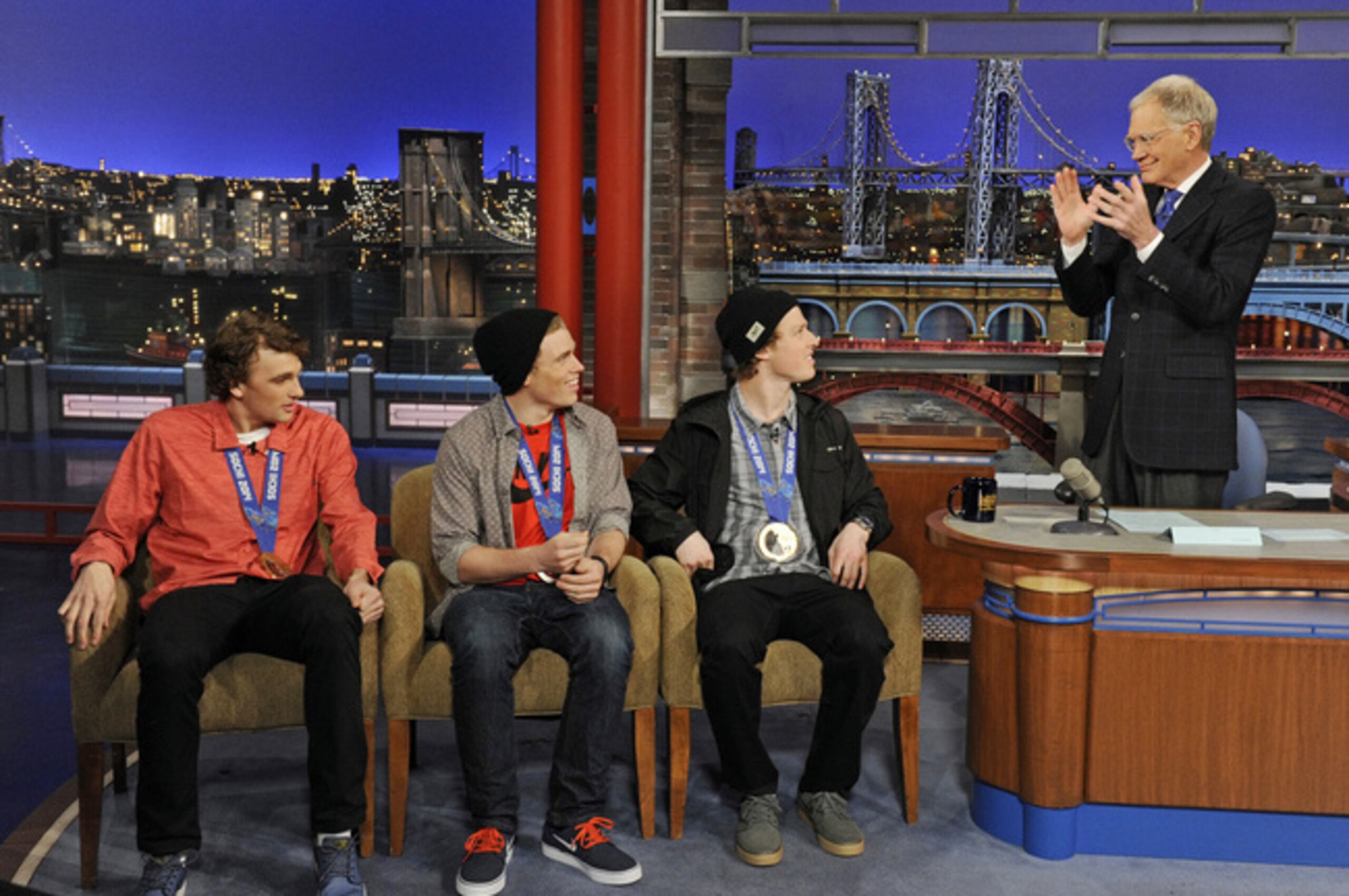
After he won the gold medal in slopestyle in Sochi, Joss Christensen went from unknown to celebrity. He met the president, got his picture in Rolling Stone and bought a black Silverado and a piece of land in his home state of Utah upon which he one day hopes to build a cabin.
Of all of his appearances, his favorite was the Late Show with David Letterman.
“He was really interested in our sport. He was really interested in me as a human being. He was really easy to talk to,” Christensen says. “He made it fun, which was cool, because a lot of the media we did after the Olympics was kind of baloney, in my opinion. They just focus on stuff beside our sport, take the People magazine route.”
For a gag on the show, Letterman recreated a Corn Flakes cereal box featuring a picture of Christensen, Gus Kenworthy (silver) and Nick Goepper (bronze) (the U.S. swept the podium). The only difference was an image of Letterman was Photoshopped in the background.
“They meant to keep the box and give it to Letterman’s son. But someone along the way snagged the box and took it. It was a really cool box. Now no one really knows where it is,” Christensen says. “There was only one of them. It’s out there somewhere.”
That’s not the only mystery of Christensen’s post-Sochi life. The other one is more pressing: Can he follow up his Olympic success?
That’s not an easy question to answer. He was named Freeskier magazine's Skier of the Year for 2014, but he says he has been frustrated with his results since the Games.
While Christensen has a gold medal and newfound celebrity status in common with Davis and White, their ascension was quite different from his. Davis and White were the favorites. Christensen only made the Olympic team as an alternate and won the gold by nailing a trick (the triple cork) he added just a few days prior.
While Davis and White view their gold as the consummation of their years of hard work, it wasn’t long after Christensen won that he started feeling pressure to prove his win wasn’t a fluke, that he’s not a one-event wonder.
He finished second in the X Games in January, a key step toward validating the gold he won in Sochi. And he’s not done. He wants another gold in Korea. That would get his face on another cereal box, too.
‘Right Now, None of Us Are Paid’
The U.S. women’s ice hockey team led 2-0 with just over three minutes left. But Canada scored twice to tie the game and won it in overtime—the fourth straight gold for the United States’ biggest rival. Julie Chu, a forward for the U.S. who has won three silvers and a bronze, spoke with Bleacher Report about playing “pro” hockey for free, how far the sport has advanced and coming to grips with the pain of losing that game.
Q: How tough was that loss?
A: It’s always tough to lose in the Olympics in the gold-medal game. We set our sights to be the best in the world and to reach our dream of getting a chance to win our final game and take home the gold medal. It’s definitely one of those weird experiences, because at the same time you’re losing that game, you’re also winning the silver medal, or getting awarded a silver medal.
It definitely takes a little bit of digestion time. But as time has passed, I’m incredibly proud of our team and the preparation we made throughout that whole four-year cycle, as well as the character we showed not only in the tournament but afterward in the way we conducted ourselves.
Q: You play for the Montreal Stars in the CWHL—the Canadian Women’s Hockey League. What’s the level of competition?
A: It’s great. This year, especially, as women’s hockey continues to grow, we have now a solid league that players can play in post-graduation. There’s only a couple points from one team to the next throughout the board. It’s really fun for us now to have this league that’s incredibly competitive. Every game, every day, any team has the ability to win—that’s not something that was the case even two or three years ago with this league.
Q: Do you see yourself as an advocate for women’s hockey, pro hockey in particular?
A: I like to think so. I think that all of us have that ability to be ambassadors for our game, especially because women’s hockey is in such a growth phase, still. I think it’s part of our job as elite athletes, whether it’s coming out of college or the national-team program, to stay involved in the growth of our game. That’s at the young level, as well as at the college level, and definitely as we move forward, we want to have opportunities to have a fully paid professional league. Right now, none of us are paid.
Q: So what do you do for work?
A: I love to coach. I coached three years at the NCAA level for Union College. I absolutely loved it. I run a lot of hockey camps throughout the summer. Right now, I’m working for Concordia University in Montreal. I’m one of the assistant coaches.
Q: What are the obstacles women’s pro hockey has to overcome to become more prominent?
A: I think the biggest thing is getting fans to come to games, to have that excitement last beyond just an Olympic year. The Olympic year, there’s a ton of attention for the women’s teams. We can have a Canada-U.S. game in Canada or New York and have sold-out crowds. Same thing for the Olympic Games.
Q: Can you compare and contrast “little girl” hockey from when you started to what it is now?
A: It’s day and night. I just watched our U18 team play Canada’s U18 team. It was unreal watching that hockey, the high pace, what they were able to do, the way they read the game, their skill level, both programs. We weren’t that good at that age.
Q: Are you going to play in 2018?
A: I’m not sure. This past year, I needed a break from the really focused, high intensity, being on the road all the time. I’m still within the program, but I’ve taken a step back from international competition. We’ll figure out as the end of the season comes along what my next steps are.




.jpg?w=2560 "2 NFL Officials Suspended")
.jpg?w=2560 "Viral Rams Coach Vid 🖕")
