Mitchell Starc's Excellence Highlights India's New-Ball Problem for World Cup

Prior to this Carlton Mid Tri-Series, if you'd been asked to describe what Shikhar Dhawan, Ian Bell and James Taylor had in common, you'd have likely been left scratching your head until you'd rid your scalp of every last hair follicle.
Dhawan, of course, is the one-day specialist, a flamboyant dasher and the prototypical modern opener. Bell is the classic stroke maker possessing the most graceful of games. And Taylor is the diminutive and plucky accumulator who continues to surprise.
From styles to height and career records to facial hair, the trio—before this World Cup prelude—had little in common. If anything at all.
.jpg?w=2560 "Seahawks Chiefs Football")


But they do now: In the space of three days, each has been dismissed in the first over of a match in this series by Mitchell Starc.
Two afternoons, two opening overs, 12 balls, three wickets, two ducks dished out and two contests seized within minutes.
For the left-armer, it's a huge boost. For George Bailey—and possibly Michael Clarke later in the summer—it's a huge advantage.
Yet, for MS Dhoni and India, as made evident in Melbourne on Sunday, it's a huge headache. And it's an example of what's missing in their own bowling stocks, underlining the new-ball deficiencies that exist within team India.

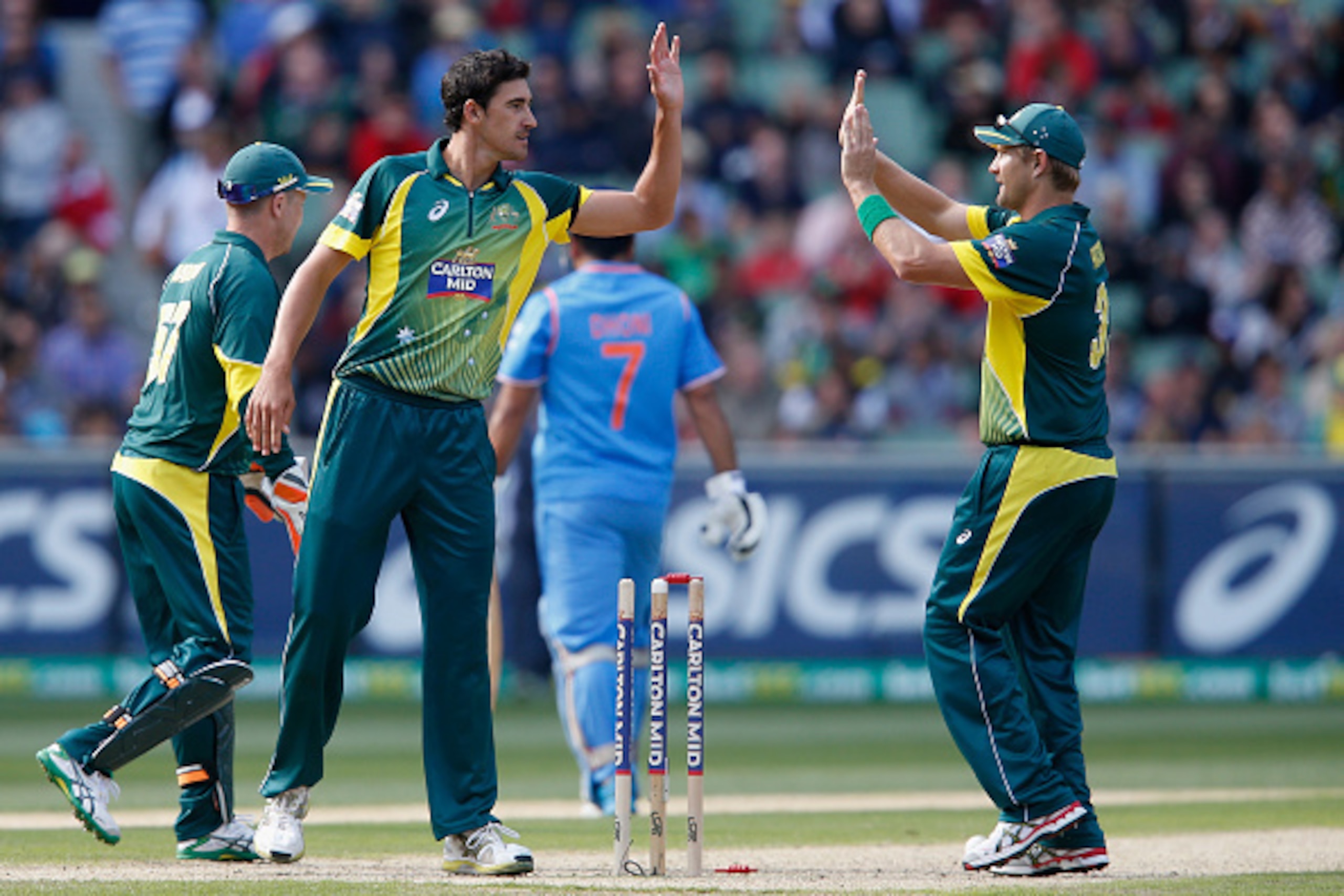
At the MCG, like it had been against England in Sydney on Friday, Starc's new-ball excellence was the catalyst in Australia's four-wicket triumph over India.
Five balls into the match, he had Dhawan—India's one-man launch button in 50-over cricket, who, despite his Test limitations, averages almost 45 in this format and collects them at a strike rate of 90.
When facing India, his wicket is among the most prized; he sets the tone and is something of a barometer for this side. And Starc had the concoction to do something out it: pace (lots of it), hostility and late movement in the air. Basically, a wrecking-ball blend.
India had been immediately pegged back. And in truth, they never really broke free after that—not helped by Starc's return later on to finish the innings off and claim figures of six for 43. It was the latest in a long line of fine one-day performances, taking his career figures in the format to 59 wickets from 30 games at an average of 20.11. With five hauls of four wickets, four hauls of five or more and a strike rate under 25.
In coloured clothing (forget the Test arena for the moment), the 24-year-old is as good as it gets. He might even be Australia's trump card.
"Mitch [Starc] bowled really well, Rohit played brilliantly," Dhoni said after the loss, per ESPN Cricinfo. "But what was crucial was bowling with the new ball."
Dhoni, speaking about both his own team and the opposition on Sunday, clearly recognises the issue. But it's whether he can do anything about it that is the real concern.
After Starc's impressive spell, Umesh Yadav and Mohammed Shami neatly illustrated India's problem. With his first over—the second of the innings—Yadav conceded 13. Taken out of the attack for the next over from that end, Shami replaced his team-mate and gave away nine more.
Two overs, fourteen balls (some short, most wide), two wides, four boundaries and 22 runs essentially donated to Australia.
Starc's first over had snatched the initiative; Yadav and Shami's first overs simply handed it away.
In one-day cricket, where the margins are as tight as they are, that, right there, is what separates the sides ahead of the World Cup.

Of course, the counter argument is that, in 50-over cricket, India's fortunes so often rest with the nation's array of explosive batsmen—not the practically forgotten bowlers.
When Australia visited the subcontinent for a seven-match ODI series in 2013, the home side consistently proved too powerful with the blade. Dhoni, Virat Kohli and Rohit Sharma all went through the series with averages and strike rates above 100.
But such examples aren't applicable here. Not ahead of this World Cup in Australia, anyway.
India get away with their new-ball problem at home because the subcontinental pitches are a leveller of bowling ability; on a flat, lifeless surface in Mumbai, the difference between players such as Starc and Yadav is dramatically reduced.
Australian pitches, however, have the opposite effect. Fast, lively and offering a touch of assistance to those skilled enough to use it, they accentuate the discrepancy in ability between international bowlers.
Thus, the resulting contest takes on a vastly different complexion. Whereas in India—where the limitations of the hosts' seam attack in comparison with that of their visitors aren't exposed—Dhoni's men can enjoy the relative comfort of a batting slug fest, the conditions Down Under reward balanced outfits capable of thriving in either discipline.
As Starc has done in consecutive games against England and India, matches can effectively be won in the opening five overs if the new ball is utilised to full effect.
India, worryingly, look devoid of that ability. They've spent the large part of an Australian summer showing us so.
And in Australia, away from the comforts of home, their explosive batting strength can't truly compensate for it.
Starc's excellence on Sunday reinforced exactly that.