

Rick Spielman's Vision for Vikings' Future Taking Shape
The 2014 season turned the Minnesota Vikings’ fortune in the right direction, as numerous developments indicated that general manager Rick Spielman’s vision for the team is finally coming together.
Spielman first joined Minnesota before the 2006 season as vice president of player personnel. He then earned a promotion to the GM role in January 2012. That means neither drafting Christian Ponder nor hiring Leslie Frazier fall directly on his lap.
Instead, Spielman’s first true head coaching hire became Mike Zimmer in 2014, whose team went 7-9 and exceeded expectations right off the bat.
.jpg?w=2560 "Seahawks Chiefs Football")


The initial success of Zimmer sets up Spielman’s plan for the future. Minnesota now has a coach who specializes in player development. Numerous defensive players' immediate growth in 2014 and Zimmer’s track record with the Cincinnati Bengals shows that. Spielman and Zimmer also assembled a competent coaching staff to fill out the team’s leadership positions.
Fortunately enough, Zimmer's strengths align perfectly with Spielman's.
More than anything else as a GM, Spielman is a supplier of young talent. He has been committed to rebuilding the roster through the draft, not looking for quick fixes in free agency or via costly trades. Spielman has also built a reputation as a masterful trader when it comes to draft picks, turning Percy Harvin into a haul of picks and climbing up and dropping down the board in each of his three drafts.
Spielman and his posse of decision-makers in the front office spent those picks wisely. The 2012 draft marked a turning point for Minnesota’s roster. A massive chunk of the team was built from then on. In relation to other NFC North teams, Spielman milked his picks over those three classes for all they were worth in 2014.
| MIN | 12,302 | 21 |
| GB | 9.428 | 14 |
| CHI | 7,976 | 15 |
| DET | 7,154 | 13 |
These numbers tell us a few different things.
First, Minnesota clearly relied on youth in 2014 with players Spielman handpicked over the last three years. The team’s young players have picked up valuable experience.
Spielman wasted no time in restocking the team with young talent either.
Despite the disappointing turn Matt Kalil’s career has taken, the Vikings’ 2012 draft class accounted for almost 6,000 snaps in 2014. Spielman pulled off an unbelievable haul of third-day successes in Jarius Wright, Rhett Ellison, Robert Blanton, Blair Walsh and Audie Cole in his first draft in charge, building on the success that first-round pick Harrison Smith has found.
Most importantly, Minnesota was highly competitive in 2014 while playing so many young players. From Week 7 on, Minnesota never lost by more than a single score, going toe-to-toe with teams such as Green Bay and Detroit that fielded veteran, playoff-caliber teams. That bodes awfully well for Minnesota’s future.
Young players, ones Spielman's scouting staff identified and ones he ultimately selected, are playing big snaps counts and performing well.
But why is it important for teams to draft well, beyond the obvious idea that having good players is better than having bad players?
Continuity is one reason. When a team can develop its own players within a program that teaches team-specific skills, its young players will fit perfectly into roles already envisioned for them.
The most important reason is money. The recently implemented rookie wage scale dramatically deflates the salaries of players on their first NFL contracts, whereas free agents can seek out the best deals available to them, leading to higher figures.
With inexpensive, yet effective young players, teams can then allocate freed-up money elsewhere. For example, Everson Griffen’s 2014 cap hit fell barely short of the combined hit from Harrison Smith, Sharrif Floyd, Xavier Rhodes, Cordarrelle Patterson and Teddy Bridgewater combined, per Spotrac. The success of young players allowed Minnesota to shell out the money to bring Griffen back.
The spine of both units, but especially the defense, is built through players Minnesota drafted and developed. Some of the team’s best players leave tiny dents in the cap in 2015 and beyond.
| Barr | $2.90 (2.0%) | $3.48 (2.3%) | $4.05 (2.5%) |
| Floyd | $2.20 (1.5%) | $2.57 (1.7%) | OPTION |
| Rhodes | $2.13 (1.5%) | $2.48 (1.7%) | OPTION |
| Smith | $2.27 (1.6%) | OPTION | |
| Projected Cap | $145.72 | $150.00 | $160.00 |
*Percentage of salary cap in parentheses
Because of Spielman’s aggressive drafting style, one that has led to the Vikings bringing in seven first-round picks during his reign as GM, the team is afforded fifth-year options on Anthony Barr, Floyd, Rhodes and Smith.
Per Andrew Brant of The MMQB, that means Floyd, Rhodes and Smith (as well as Bridgewater and Patterson) could be extended an extra season with a salary equal to that of the average figure of players at their position ranked No. 3 to No. 25 in salary. Barr (as well as Kalil) have a fifth-year option equal to the price of a transition tag, which is cheaper than franchising the player.
Spielman’s accumulation of quality first-round players has given Minnesota an abundance of young talent performing at a high level for a fraction of the cost. And because they were first-round picks, Minnesota can tack on another year of those benefits.
Then when Minnesota’s best young players reach the end of their rookie contracts, the goal is for Spielman and company to have continued to draft well enough to keep funds open that can be used to re-up those players. It creates a self-sustaining football team built with players groomed in a well-oiled machine that keeps its top players and sustains depth.
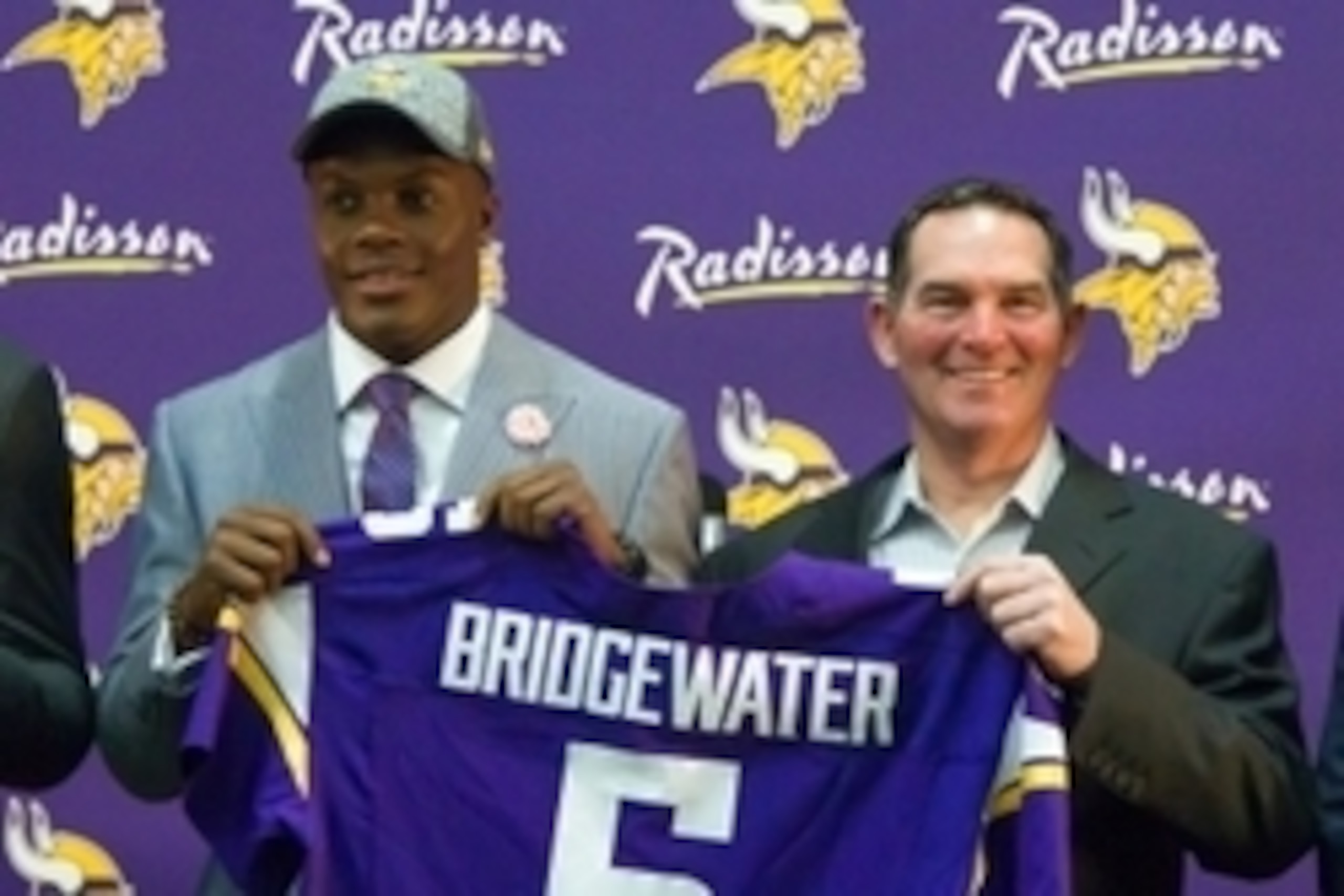
All of these plaudits for Spielman’s work still mean little without a hit at the most important position in professional sports: quarterback.
Bridgewater is the first QB selection with a path of responsibility that leads straight to Spielman’s desk. A season into the young passer’s career, Spielman seems to have hit a home run.
This is the key that unlocks his entire plan. The savings at other positions pale in comparison to those at the QB position, where starting passers on their second contracts can earn 10 times as much as Bridgewater. In comparing to other quarterbacks who recently signed deals and other quarterbacks within the division, it becomes clear just how big of a financial coup it is for the Vikings to have Bridgewater for the next three or four years.
| Bridgewater | $1.56 (1.1%) | $1.87 (1.2%) | $2.18 (1.4%) |
| Alex Smith | $15.6 (10.7%) | $17.8 (11.9%) | $16.9 (10.6%) |
| Andy Dalton | $9.6 (6.6%) | $13.1 (8.7%) | $15.7 (9.8%) |
| Colin Kaepernick | $15.27 (10.5%) | $16.77 (11.2%) | $19.37 (12.1%) |
| Matthew Stafford | $17.72 (12.2%) | $22.5 (15.0%) | $22.0 (13.8%) |
| Aaron Rodgers | $18.25 (12.5%) | $19.25 (12.8%) | $20.3 (12.7%) |
| Projected Cap | $145.72 | $150.00 | $160.00 |
*Percentage of salary cap in parentheses
Quarterback salaries have soared so high in recent years, teams with effective passers on their first contracts have a big financial advantage. With its savings from having Bridgewater under center and its savings from getting Adrian Peterson and Chad Greenway off the books, Minnesota will not be forced to let its most prized possessions walk in free agency.
Overall, the plan Spielman drew up when he took the GM job has now begun coming together, with relatively few hiccups.
He moved on from a floundering coach and filled the spot with Zimmer, a respected coach who gets the most out of players. Those two moves set the team up for success in the coaching ranks.
Then Spielman took to the draft, where he supplied Minnesota with numerous quality starters and solidified the roster with plenty of depth players over the course of three years. Even in a 2014 season that saw starters dropping like flies, the Vikings were more than competitive down the stretch. A majority of the credit falls on Spielman’s building of the roster from the top to the bottom.
The QB spot was the final piece to the puzzle. If Bridgewater improves upon an already-stellar first season as expected, the Vikings will be in great hands.
For the first time in years, Minnesota seems set up in a sustainable way in terms of player acquisition and the assembly of a coaching staff. The team has a backbone of young players to build around with a coaching crew that specializes in doing just that.
Spielman is rewarding ownership and fans for their patience. His persistence and his plan should soon pay off.
Player salaries and salary cap information via OverTheCap.com unless noted otherwise. Snap counts via Football Outsiders.
.jpg?w=2560 "Raiders Saints Football")



