
Winners and Losers of the 2014-15 College Football Bowl Season
Next bowl season can't come soon enough.
Sunday night's crazy GoDaddy Bowl served as a fitting finale to two weeks of wild and wacky action, during which we saw comebacks galore and enough trick plays to wonder what football was like before teams realized they could throw it twice or put the ball in the hands of large individuals.
Now that the dust has settled and all we have left is next week's championship game between Ohio State and Oregon—which, technically, is not an actual bowl game—it's time to take stock of what we've just witnessed. There was a whole lot of great, as well as a sizable helping of not so good.
Here are the biggest winners and losers from the 2014 college football bowl season. Come along for the ride down (recent) memory lane.
Winner: Pac-12
1 of 10
Even if Oregon loses the title game to Ohio State on Jan. 12, it won't take away from what the Pac-12 accomplished this bowl season. With a 6-2 record, the league that kept us up late on Saturday nights each week finished with the best mark of all the power conferences.
"The Pac-12 postseason performance surely validated what everybody thought most of this season: That the Pac-12 was no worse than the second-best conference in the season," wrote Bud Withers of The Seattle Times, stopping short of calling it the league's best effort ever.
Withers wrote that just after Washington fell 30-22 to Oklahoma State in the Cactus Bowl, the second of two eight-point losses suffered by Pac-12 teams. The other came in the Fiesta Bowl, when Arizona was downed 38-30 by Boise State.
The rest of the results were all on the plus side, and most were quite dominant.
Oregon (over Florida State in the Rose Bowl), Stanford (over Maryland in the Foster Farms Bowl) and Utah (over Colorado State in the Las Vegas Bowl) all won by more than 20 points. USC held off a late Nebraska rally to win the Holiday Bowl, Arizona State outlasted Duke in the Sun Bowl and UCLA knocked off Kansas State in the Alamo Bowl.
The Pac-12 didn't register the most bowl wins—the SEC won seven, though it sent 12 to bowls compared to eight for the Pac-12—but it did have the best overall body of work of any conference.
Loser: SEC West
2 of 10
So, is there a return policy on all those plaques and statues saying "World's Greatest College Football Conference" that were ordered by teams in a portion of the southeastern part of this country?
The mighty SEC West, which dominated the regular-season narrative thanks to having six of its seven teams spend at least some time ranked among the top 10 teams in the country, fell flat on its face when the calendar shifted to bowl season.
While outgoing SEC commissioner Mike Slive wasted little time Saturday (after Florida beat East Carolina in the Birmingham Bowl) to praise the league for tying its own FBS record with seven bowl victories, that doesn't tell the real story of how late December and early January went for the nation's self-proclaimed best league in the game.
The conference, as a whole, went 7-5, but the mighty West Division won only two of those games, against five losses. And the wins came from Arkansas—which was in last place in the division and didn't win a league game until mid-November—and second-to-last Texas A&M. And those victories came against a Texas team that hardly looked like a 6-6 squad and West Virginia, which was playing without its starting quarterback.
Move further up the SEC West ladder, though, and the results just got worse. Not so much in terms of final score, but in overall impact.
LSU lost to Notre Dame in the Music City Bowl, falling to a school that most SEC fans felt would have finished last in their conference. Ole Miss and Mississippi State, the division's breakout stars, lost by a combined 54 points on New Year's Eve.
And then came the New Year's Day downfall of the state of Alabama, the mightiest football republic of them all. First Auburn lost to Wisconsin in the Outback Bowl, and then top-seeded Alabama fell to Ohio State in the Sugar Bowl semifinal game.
"As a whole, the SEC West was a paper tiger that lived off its reputation rather than its merit this year," Bleacher Report SEC writer Barrett Sallee wrote. "In 2014, the SEC West was more sizzle than steak."
Winner: Boise State
3 of 10
When (not if) the talk of realignment in college football comes up again, the schools most likely to get involved in the discussion are mostly situated in the central part of the country. But the one most deserving of a football upgrade plays on blue turf during the regular season and keeps knocking off power teams in bowl games.
Boise State won its third Fiesta Bowl in the past eight seasons, knocking off Arizona 38-30 in a game that showed not only how the Broncos got there but also why they're a program that's here to stay—and one that would make a great addition to a power league (cough, Big 12) in need of more teams in order to add a conference championship game.
Despite going through a coaching change—longtime head man Chris Petersen slid over to Washington last December—Boise State didn't miss a beat in 2014. It went 12-2 under former quarterback and assistant coach Bryan Harsin, its 13th 10-win season in the past 16 and eighth year with at least 12 victories. And while trickery once again played a role in the bowl triumph, as Boise pulled out its famed Statue of Liberty play for a first-quarter touchdown, the win was as much a testament to the program's development into a true power than through smoke and mirrors.
Quarterback Grant Hedrick led the FBS in completion percentage, at 70.8 percent, while running back Jay Ajayi set school records with 1,823 yards and 28 touchdowns and also had 535 receiving yards with four scores.
Both of those guys, along with injured wide receiver Matt Miller, figure to be drafted in the spring. That will add to the school's impressive haul the last few seasons, a group that includes the late hero of the Dallas Cowboys' playoff win against Detroit, rookie defensive lineman Demarcus Lawrence.

Loser: Florida State
4 of 10
The fall from the top of the mountain is never easy, but the final 30 minutes of Florida State's reign looked more like a tragic tumble than a gradual descent.
The Seminoles' 29-game win streak ended with a pronounced thud, as the defending national champions lost 59-20 to Oregon in the Rose Bowl. By the time it was over, it didn't even seem that close, not with FSU seemingly turning the ball over on every possession, though in actuality it was only on five of its first six drives in the second half, followed by three three-and-outs in garbage time.
In a year that saw the champs deal with far too much off-the-field turmoil and nearly as much on-field strife—trailing in more than half its games only to make late comebacks over and over—FSU got into the playoffs on the merits of its past successes but showed afterward it was the least worthy of a semifinal bid.
TCU would tend to agree with this.
Jameis Winston's legacy in college, assuming he turns pro as expected, won't end with a perfect record but instead has one loss and an embarrassing finish. The 2013 Heisman winner committed two of FSU's five turnovers, including a Benny Hill-like fumble with which the Internet had a field day.
FSU's two-year run will go down as one of the most memorable in college football history, but now that will be as much for how it ended as everything that happened along the way.
Winner: Big Men Moving the Ball
5 of 10Football is a big man's game, but the largest of those lads tend not to get much attention except for when one is called for a penalty. But bowl season served as a coming-out party for those large gentlemen, many of whom not only got involved in the scoring but also provided some of the best offensive plays of the past two weeks.
Following a regular season that seemed to have more so-called "fat guy" touchdowns than ever before, teams upped the ante in the bowls by throwing to, handing off to and even using big men as ball-carriers on fake punts. These plays almost always worked, and even when they didn't, they were still glorious.
The biggest of them all, in more ways than one, came in the Cotton Bowl. That's when Baylor, the team known for speed and sexiness, flipped the script and sent 6'7", 390-pound guard LaQuan McGowan on a seam route and had Bryce Petty hit him for an 18-yard touchdown pass.
The next night, in Oklahoma State's Cactus Bowl win, the Cowboys turned to 295-pound defensive lineman James Castleman not once but twice. First, he took a direct snap for a one-yard TD that became known as the "WildFat" play, and then on a critical third down late in the game, he went in motion and caught a short swing pass before rumbling for a 48-yard gain. After the game, he said "the check engine light came on" during that play, per the Associated Press (h/t ESPN.com).
Missouri didn't score off its fancy fat-guy play, but it was still awesome to see nose guard Harold Brantley gain 19 yards on 4th-and-17 after taking a direct snap on a punt.
And we haven't even talked about all of the traditional scores that the super-sized tend to be involved in on defense. Sunday's GoDaddy Bowl, the last of 38 bowl games, included 275-pound Allen Covington catching a fumble in midair and returning it 67 yards for a touchdown.
We'll never forget you, Fat Guy Touchdowns.
Loser: Defensive Coordinators
6 of 10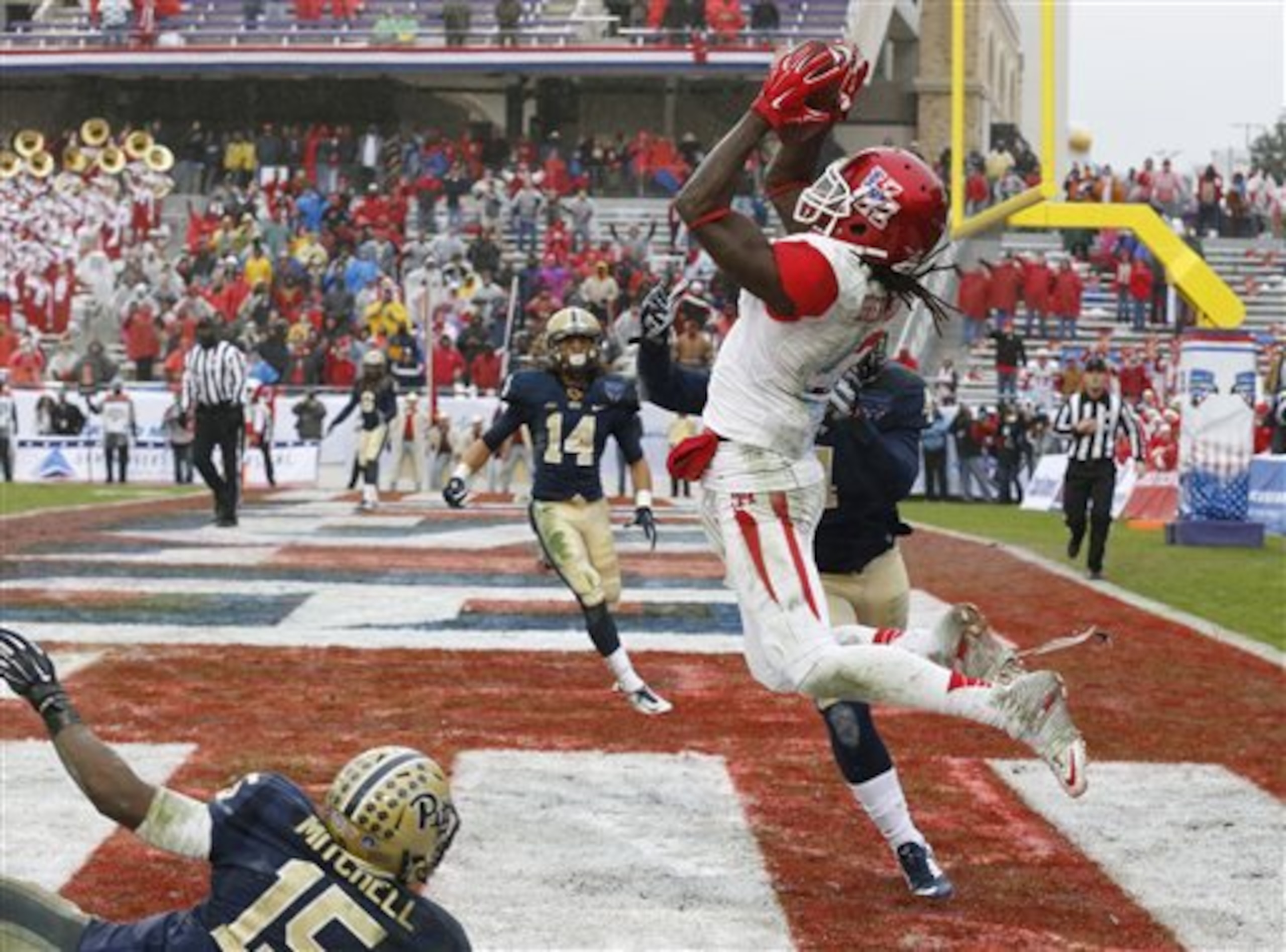
College football has become more and more skewed toward offense in the past decade, making the job of defensive coaches harder on an annual basis. The bowl games didn't change this trend, making the already stressful job of a defensive coordinator the kind that should be endorsing heartburn and ulcer medication.
The average points scored in the 38 bowl games was 62.3, with a dozen games topping 70 total points. And it wasn't just a matter of perpetual shootouts, as many games involved massive comebacks where after three-or-so quarters of defensive dominance, those same units suddenly couldn't make a stop.
Michigan State trailed Baylor 41-21 before scoring three touchdowns in the final 12:09 to win 42-41. Houston trailed Pittsburgh by 25 points early in the fourth quarter, but three TDs in the last 3:41 gave the Cougars a 35-34 victory in the GoDaddy Bowl. And Central Michigan made the most of its final quarter of football in the Bahamas Bowl, rallying from down 49-14 only to lose by a point to Western Kentucky after failing on a two-point conversion.
The offensive explosion wasn't just limited to the side bowls, as both semifinal games had final combined scores in the upper 70s.
Six quarterbacks threw for 400-plus yards, led by Baylor's Bryce Petty going for 550 yards in a loss. There were five 200-yard rushers, with Ezekiel Elliott's 230-yard, two-touchdown effort helping Ohio State knock off Alabama in the Sugar Bowl. And 10 receivers had at least 150 yards.
There were some impressive defensive performances, such as Arkansas holding Texas to 59 total yards and Clemson shutting out Oklahoma until the final seven minutes. But for the most part, offenses ruled bowl season. Five of the top 10 scoring defenses in the country allowed 30 or more points in bowls this year.
Winner: Big Ten
7 of 10
At 5-5, the Big Ten's overall bowl record wasn't that imposing. But considering the reputation hit the conference took all season and what its best teams were able to accomplish in their bowls, a .500 record is quite impressive.
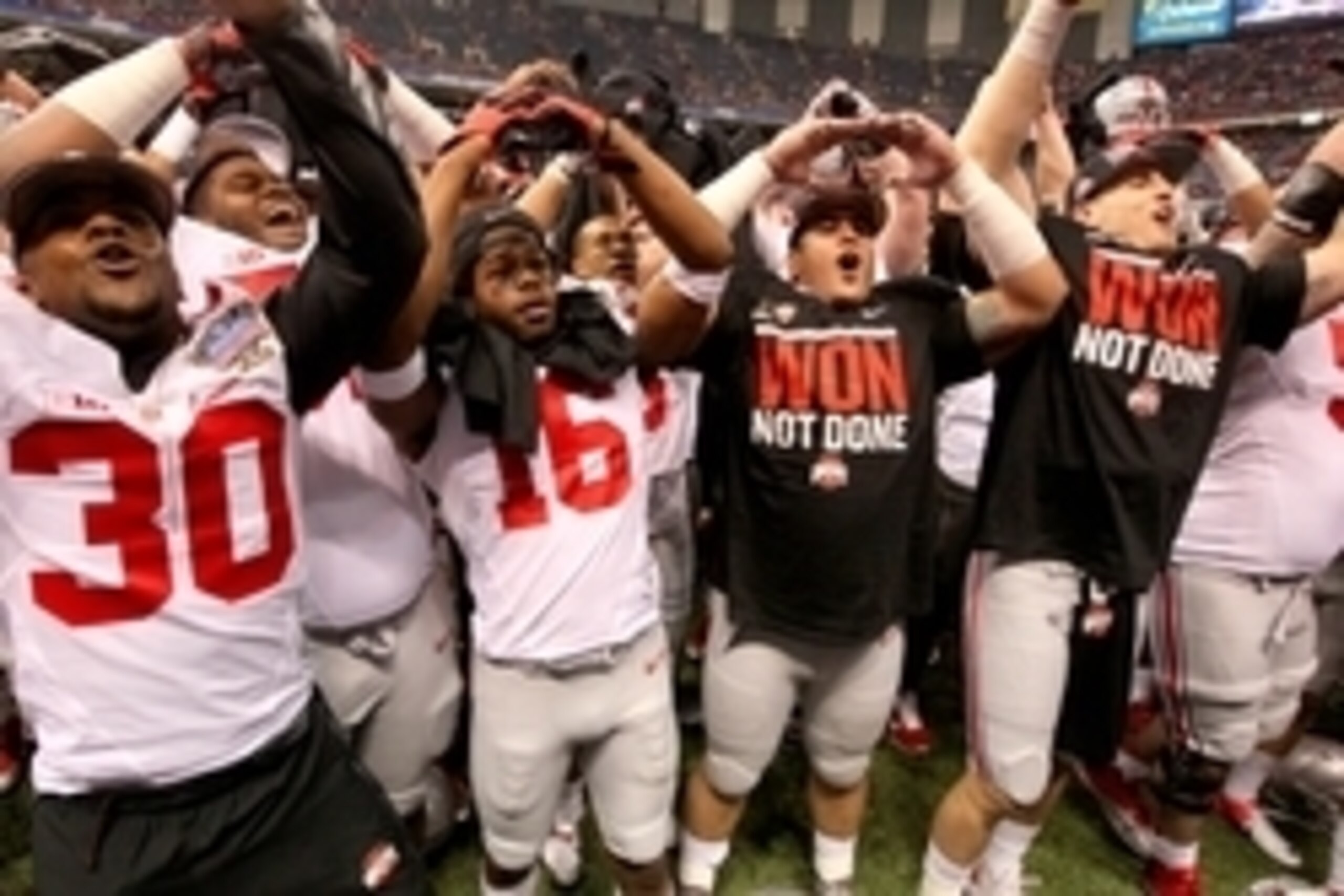
Ohio State played its way into the playoffs with a strong charge late in the season, and the Buckeyes justified that invitation by downing Alabama in the Sugar Bowl. That came on the same day that Michigan State mounted a furious comeback to beat Baylor in the Cotton Bowl and Wisconsin edged out Auburn in overtime at the Outback Bowl.
Those kind of victories were what OSU coach Urban Meyer had been referring to before bowl season, when he said it was necessary for the league to do well in the postseason to help its reputation.
"Maybe the Big Ten isn't that bad," Meyer said, per Jon Solomon of CBS Sports. "Maybe the Big Ten is pretty damn good, or certainly getting better."
No one is saying the Big Ten is the best league in FBS right now, not when its other bowl results included four losses by 16 or more points. But it's not a dead-in-the-water conference, either.
Loser: Big 12
8 of 10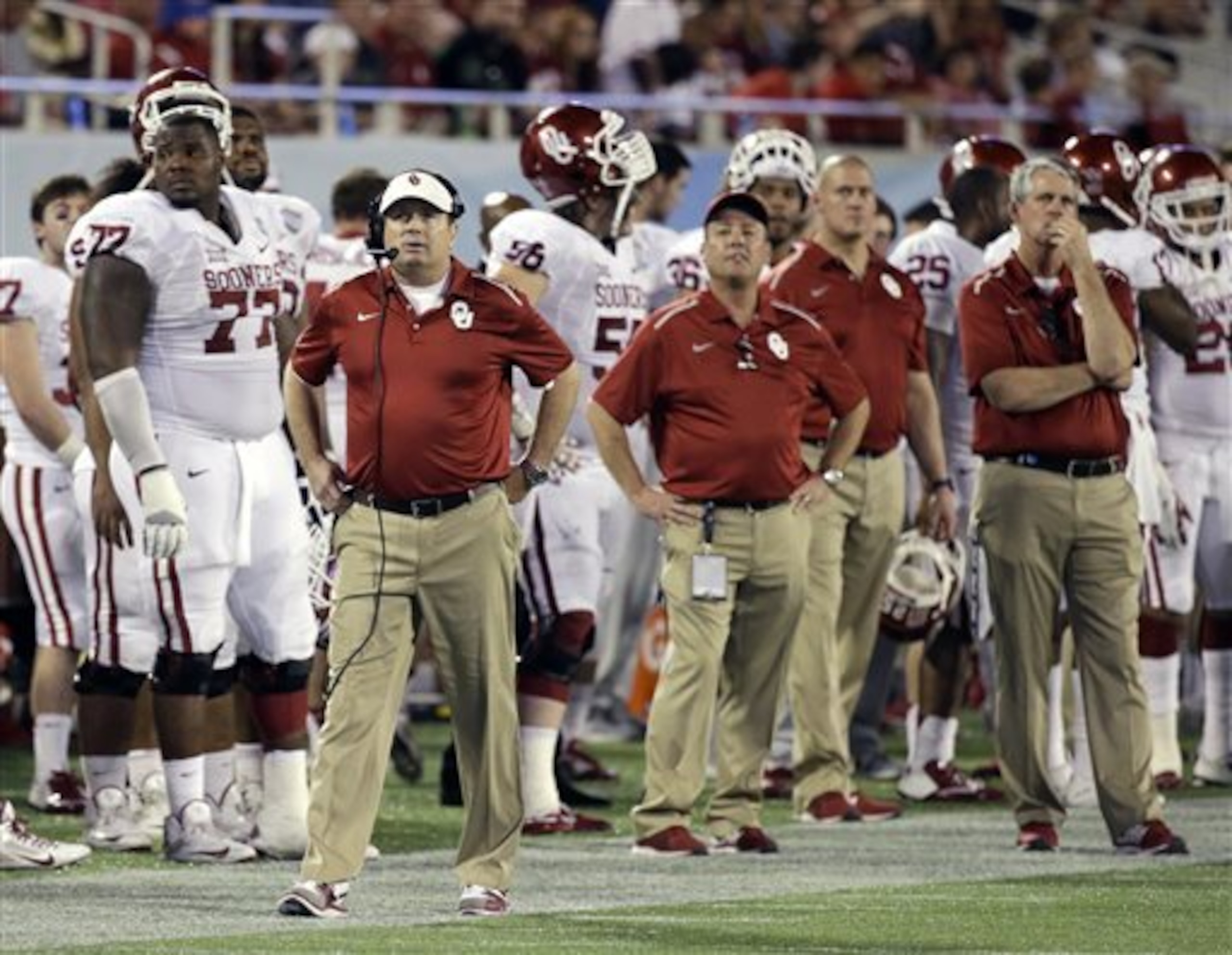
With five power conferences feeding into a four-team playoff, at least one league was going to get left out of the party. That ended up being the Big 12, despite two worthy qualifiers but also a lack of a consensus in determining how that league would declare a champion in lieu of a title game.
When the Big 12 failed to get one-loss Baylor or TCU into the playoffs, it provided great motivation for the conference to use their bowl matchups as a chance to take out some frustration. TCU did just that, crushing Ole Miss 42-3 in the Peach Bowl. But Baylor and the rest of the bunch?
Well, until Oklahoma State held on to beat Washington in the Cactus Bowl, the Big 12 was staring at a 1-5 bowl record that prompted critics to change the league's motto from "One True Champion" to "One Bowl Champion," as ESPNDallas.com's Tim MacMahon tweeted.
Baylor's failure to hold a 20-point fourth-quarter lead against Michigan State dropped the Big 12 to 1-11 the past 12 Cotton Bowls, one of the nation's signature bowl games. Oklahoma lost by 34 to Clemson in the Russell Athletic Bowl, and Texas erased any momentum it had after making a bowl in Charlie Strong's first season by scoring just seven points and gaining 59 yards in a bowl with its own state name on it.
Winner: Bowl Proliferation Proponents
9 of 10
With the addition of several new games this season, there were spots available for 76 of the 128 FBS teams to play an extra game. Next year, the Cure Bowl in Orlando will pit a team from the American Athletic Conference against a Sun Belt team.
Keep 'em coming, we say.
The entire 38-game lineup this season wasn't without some stinkers, as well as some mismatches and a few teams that looked like they had no business playing in anything remotely close to a postseason competition. But aside from the semifinal games, the remainder were essentially exhibition games, and many teams treated these contests as such.
That did make for a few schools that looked completely disinterested to be there, but that was the exception and not the rule. Instead, in most cases, the bowls pitted a pair of schools that were more than happy to get a few extra weeks of practice and then wrap up the season by going somewhere like Hawaii, south Florida or the Bahamas to play one more time.
Some of those new games provided some of the best finishes, too. BYU and Memphis went to double overtime at the inaugural Miami Beach Bowl (though a postgame brawl marred that ending), Bowling Green scored 16 seconds after losing its lead to beat South Alabama in the first Camellia Bowl and Central Michigan's furious rally from down 35 against Western Kentucky in the Bahamas Bowl made up for the fact that it seemed like only a couple hundred people were actually at the game.
Too many bowls? Tell that to the seven schools that were bowl-eligible but didn't get an invite because of a lack of spots, including Georgia Southern. The Eagles went 9-3 and won the Sun Belt, but because they were in their first season of FBS play, they were not granted a waiver to play in a bowl.
Loser: Playoff Haters
10 of 10
After 16 seasons of letting computer rankings and a convoluted formula choose two teams to play for a national championship, we finally got a playoff system for college football. The anti-playoff critics stayed vocal throughout the 2014 season, arguing that the four-team tournament would devalue the regular season, while the weekly playoff rankings and their many inconsistencies provided fuel for much debate.
But after the ratings came out for the Rose and Sugar bowls, which served as this year's semifinal games, there's not much momentum left in that anti-playoff argument.
According to ESPN, each game drew more than 28 million viewers, making them the most-watched cable broadcasts in TV history. The Sugar Bowl's ratings were 130 percent better than the Jan. 1 prime-time game from a year ago, despite not starting until 9 p.m. ET.
And the ratings were hot for more than just the playoffs, as the New Year's Six games on Dec. 31 and Jan. 1 helped contribute to a 78 percent increase in ratings for the same six games played last season, per ESPN.
Considering that TV (and the money that colleges get for having their teams on the air) pulls most of the strings in football, the playoff is here to stay.
Follow Brian J. Pedersen on Twitter at @realBJP.
.png?w=2560)
.png?w=2560)
.jpg?w=2560 "Chiefs, Steelers Eye WR Trades")