How Lou Holtz Stumbled into His Second Career as a Television Folk Hero
In your post-football zombie hours—a time when deep night is slipping away and morning is creeping uncomfortably close—the last voice you hear before finally settling into something resembling sleep is that of Lou Holtz.
Technically, it’s Sunday. But during the college football season, these days seem to mesh into one marathon occasion, especially if you see each Saturday through its conclusion. (You should really see each Saturday through its conclusion.)
Once the final game has come to a close, Lou Holtz—Notre Dame legend-turned-ESPN analyst—goes to work.

_0.png?w=2560)
“It’s a long day,” Holtz told Bleacher Report. “But it goes by so quickly.”
This wasn’t by design, of course. In fact, it’s one of the few items in Holtz’s professional career that played out by chance. When ESPN called the coach 10 years ago and asked him to fill in in the wake of some on-camera personnel changes, he reluctantly accepted. Even then, he didn’t see this as a viable long-term option.
“I didn’t want to do television,” Holtz said. “This was going to be one day of work.”
Regardless of his intentions, Holtz headed to Bristol for what he thought was one weekend. When he took the set with Rece Davis and Mark May—two men he had never worked with prior to this opportunity—his mindset stayed firm.
And then, with one outlandish statement, it changed in an instant.
As soon as Mark May—now Holtz’s on-camera nemesis and off-camera friend—made a point that he vehemently disagreed with, a team was born, along with a ritual of passionate, boisterous debate.
“I can’t let Mark get away with that,” Holtz said to himself as May made his point. “That’s just not right.”
From that moment, Holtz’s second career flourished. For the past decade, the coach—and he had made stops in many other places along the way, including the NFL—has made a living as an analyst for ESPN, usually bantering with his set-mates over various items throughout college football Saturdays.

His day begins late morning, right before the first games kick off at noon eastern. Although Holtz, Davis and May aren’t scheduled to hit the air for a while, the three have to be on call in case of a weather delay in one of the early ESPN games.
Once the games roar into action, Holtz appears at halftime throughout the day, offering his CliffsNotes-style thoughts on scores, injuries and meaningful developments. When he isn’t on air with Davis and May, he’s watching as many football games as the masterful multi-television setup will allow.
“You have a full bank of TVs, they bring in food for you, and you have nice, comfortable chairs,” Holtz said. “And they pay me to do this?”
After the last ESPN game has concluded, Davis anchors the coverage of College Football Final with Holtz and May by his side. This 60-minute show typically runs well past midnight, and it can—if the moment calls for it, and it usually does—turn strange.
The 77-year-old has no issue playing a critical role in this late-night nuttiness. After a long, exhausting day, one can’t help but embrace props and ridicule, especially if it comes at the expense of the man who put him in this chair in the first place.
“He was a player. I was a coach,” Holtz said on May. “He made suggestions. I made decisions. He showered after work. I showered before work. He signs a paycheck on the back. I sign it on the front. We just have a difference of opinions, but I respect him tremendously.”
Respect is a thought-provoking term in this industry, one that has to be earned. Holtz earned respect as a head coach over time, through a national championship and a gaudy 249-132-7 record. It came naturally for him through results and accolades, something that was never much of an issue in this field.
But as an analyst, another field entirely, Holtz essentially started from scratch. Given his expertise and successes, he was already speaking from an elite perspective reserved for a select few. Still, the transition has not been easy despite his natural comfort in front of cameras.
While others who have had better training are seemingly more equipped to speak naturally in a public setting, Holtz has succeeded in this field—by his own admission—with his array of football wisdom.
“You try and give an insight that someone younger, better looking and more versatile with their vocabulary cannot [give] you,” Holtz said. “You have an insight of what’s going on in the locker room and what’s going on in the coach’s mind.”
For 10 years, Holtz has helped close out each Saturday on ESPN, working on his craft, just like he did as a coach. He analyzes the game he loves, watching it undergo its various transformations. While it’s been more than a decade since he coached a team, it certainly doesn’t feel that long.
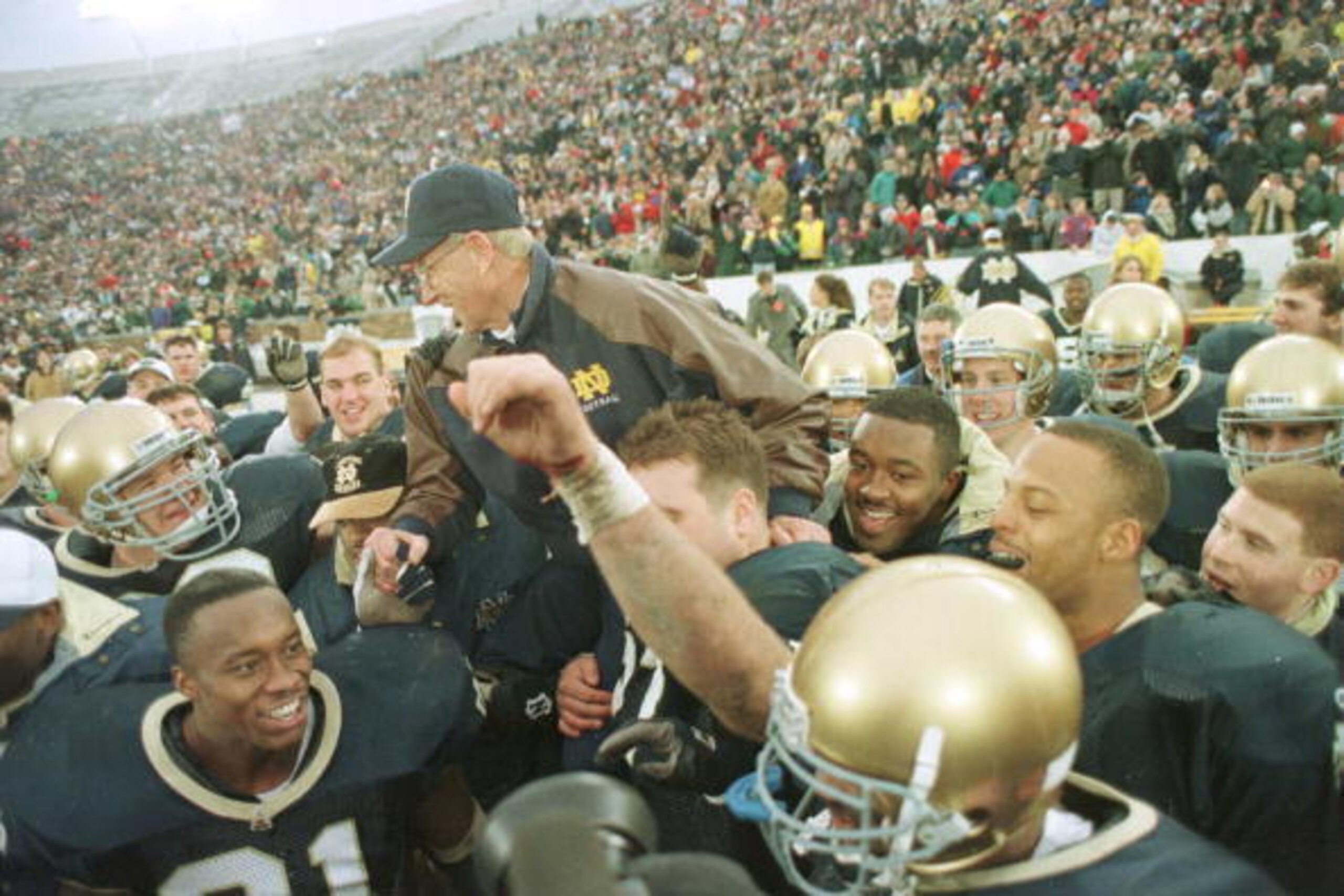
Holtz still cheers on Notre Dame, often times leaving his comfortable ESPN chair as a perplexed and somewhat unsurprised May looks on.
On camera, he isn’t shy about his passion for the program, either. It’s something you’ve likely noticed while watching Holtz operate. In a world and profession where favoritism is frowned upon, Holtz is unafraid of the connection. It's where he came from. It's who he is.
“There’s a statue of me there,” he’s said of Notre Dame. “I had three children graduate from there, and I coached there for 11 years.”

His emotional ties to the program are forever. He still has close friends in South Bend, and he can't help but care. This, in many ways, is how he satisfies his itch rather than return to the sideline, not that this has ever entered his mind in recent years.
“You always miss coaching, but not the wins or the losses,” Holtz said. “You miss the relationships with the players. I think you always miss that. That’s the great thing about coaching.”
What he doesn’t miss, however, is the most obvious, stomach-churning part of a profession that has only amplified its nausea-including ways since he left.
Ballooning paychecks have translated to ballooning pressure to win consistently for coaches in all positions, but especially at some of the high-profile places Holtz worked at not long ago. Instead of worrying about his own job security, Holtz is now paid to address these situations from a more relaxed distance.
Having been through the other side of this process—the agonizing expectations dissection and the inevitable fate to follow—Holtz can sit back without personally investing into an emotionally taxing process.
“I think I reached the same point that an Urban Meyer or a Nick Saban reaches, and that’s when you’re used to winning,” Holtz said. “It gets to a point where the alumni take things for granted and consequently you can’t even celebrate a win. You get a win and it’s a relief. When you lose, it’s an absolute disaster.
“Now when Saturday’s over, you don’t have that depth of depression or the exhilaration of victory.”
There is still pressure to perform on Saturdays. After 12 hours of football consumption, Holtz still has to be sharp on national television at a time when most are only starting to wind down. Others have long been asleep, choosing not to take our advice and see the Saturday through.
For a 77-year-old who no longer needs the paycheck, he doesn’t have to take on this grind. Holtz could contently watch football at his home, cheering on Notre Dame in private, embracing everything the sport has to offer without having to justify his opinions to a late-night football audience.
In recent years, he’s even thought about this scenario. In fact, Holtz has openly discussed the likelihood with his employer. It's practically ritual.
“I’m celebrating the fifth anniversary of my last year,” Holtz said. “For five years I told them no more. Each year I end up coming back.”
He goes back because he can’t stay away. And although Holtz no longer patrols the sideline—experiencing the agony and ecstasy that came with the title—his new occupation allows him to celebrate the sport he loves at a different dose.
Maybe 2015 will finally be the year Holtz cashes in on his anniversary promise, choosing to walk away rather than celebrate another long Saturday with a cowbell after hours. Or, perhaps, the allure of the zombie football hour will be too much to turn down once more.
The Allstate AFCA Good Works Team® is now in its 18th season to present the award. College Football Hall of Fame coach and ESPN personality Lou Holtz will once again serve as the spokesperson for the 2009 Allstate AFCA Good Works Teams®.
Unless noted otherwise, all quotes obtained firsthand.
.jpg?w=2560 "OBJ Calls Out Giants After Release")




.jpg?w=2560 "NFL investigating referee after viral exchange with player")