Perfect Storm Creates the Rarest of Days for Packers QB Aaron Rodgers
A perfect storm of variables and errors—both of the forced and unforced kind—helped create a rare afternoon for Green Bay Packers quarterback Aaron Rodgers.
The NFL's leader in passer rating and the MVP front-runner entering Week 15, Rodgers completed just 17 of 42 passes for 185 yards, zero touchdowns and two interceptions during a 21-13 defeat to the Buffalo Bills Sunday at Ralph Wilson Stadium. Never before has Rodgers, a football deity, looked so mortal.
However, it stands to reason that the critical combination of variables faced Sunday isn't likely to work against Rodgers anytime soon.
.jpg?w=2560 "Commanders 49ers Football")
.jpg?w=2560 "Colts Football")
.jpg?w=2560 "DOLPHINS-AIKMAN")
Certainly credit the Bills defense, a top unit that executed the clearly defined blueprint for frustrating Rodgers and the Packers. But also credit the passer, pass-catchers and play-caller of the Green Bay offense, three typically dependable groups that all failed to varying degrees in the humbling loss.
The result was a 34.3 passer rating for Rodgers, his lowest in any game he's started and finished by over 20 points. He completed just 40.5 percent of his 42 attempts (new career low) and threw 25 incompletions (new career high), while averaging 4.4 yards per attempt (new career low) and throwing multiple interceptions without a touchdown for the first time in his career.
Rodgers wasn't himself in any situation.
According to Pro Football Focus (subscription required), Rodgers completed only 44.1 percent of his passes against no pressure (36 of 46 dropbacks). The Bills only blitzed him six times, but when they did, Rodgers managed only two completions for 13 yards. Typically, Rodgers is the most clinical and deadly quarterback in the game when given zero pressure or blitz situations.
He also completed only 2-of-15 passes over 10 yards, and 0-of-5 over 20. Rodgers generally makes a living attacking down the field with accuracy and precision.
Take away the plays he couldn't control—the batted passes, dropped throws and throw aways—and Rodgers still only completed 17 of his 39 attempts. The surgeon's steady hand was shaky and erratic.
| Cmp % | 40.5 | 44.1 (vs. NYJ, 2010) |
| Incompletions | 25 | 22 (vs. PIT, 2009) |
| Passer Rating | 34.3 | 55.9 (vs. TB, 2008) |
| Yards per Attempt | 4.4 | 5.0 (vs. NYJ, 2010) |
| INTs w/0 TDs | 2 | N/A |
Many were to blame for the numbers listed above. Let's start with Rodgers.
He started the game completing just one of his first seven passes. He missed on three straight back-shoulder attempts in the first quarter alone, and later overthrew Jordy Nelson and Davante Adams on third downs. His accuracy never seemed to recover.
Rodgers threw behind receiver Jordy Nelson on a first down and high for Randall Cobb on a later third down, nearly tossed interceptions to cornerbacks Stephon Gilmore (quick pass to Nelson) and Nickell Robey (out-breaking route to Cobb) and then was intercepted by safety Bacarri Rambo on a ball he didn't locate well. On his first interception, Rodgers had Nelson breaking wide open to his right and just missed him.
He made obvious mistakes throwing the football and seeing the field that Rodgers doesn't generally make on a week-to-week basis. He was clearly off.
His receivers gave him no assistance.
Tight end Andrew Quarless dropped Rodgers' first pass on the game's fourth play from scrimmage, forcing a punt.
Two series later, Nelson had a catchable ball go off his hands (with the assistance of a potential defensive hold) on third down inside the Bills' 20-yard line. One possession later, Nelson saw another good throw go through his hands in the end zone on a free play (the Packers would eventually score a touchdown on Eddie Lacy's one-yard plunge).
Running back James Starks dropped a second-quarter dump-off pass that was likely going to net 10 or more yards and a first down. On the next series, Rodgers threw slightly behind Adams on third down and the ball once again hit the turf.
On Green Bay's final possession of the first half, Cobb had a short throw clank off his hands for a near-interception.
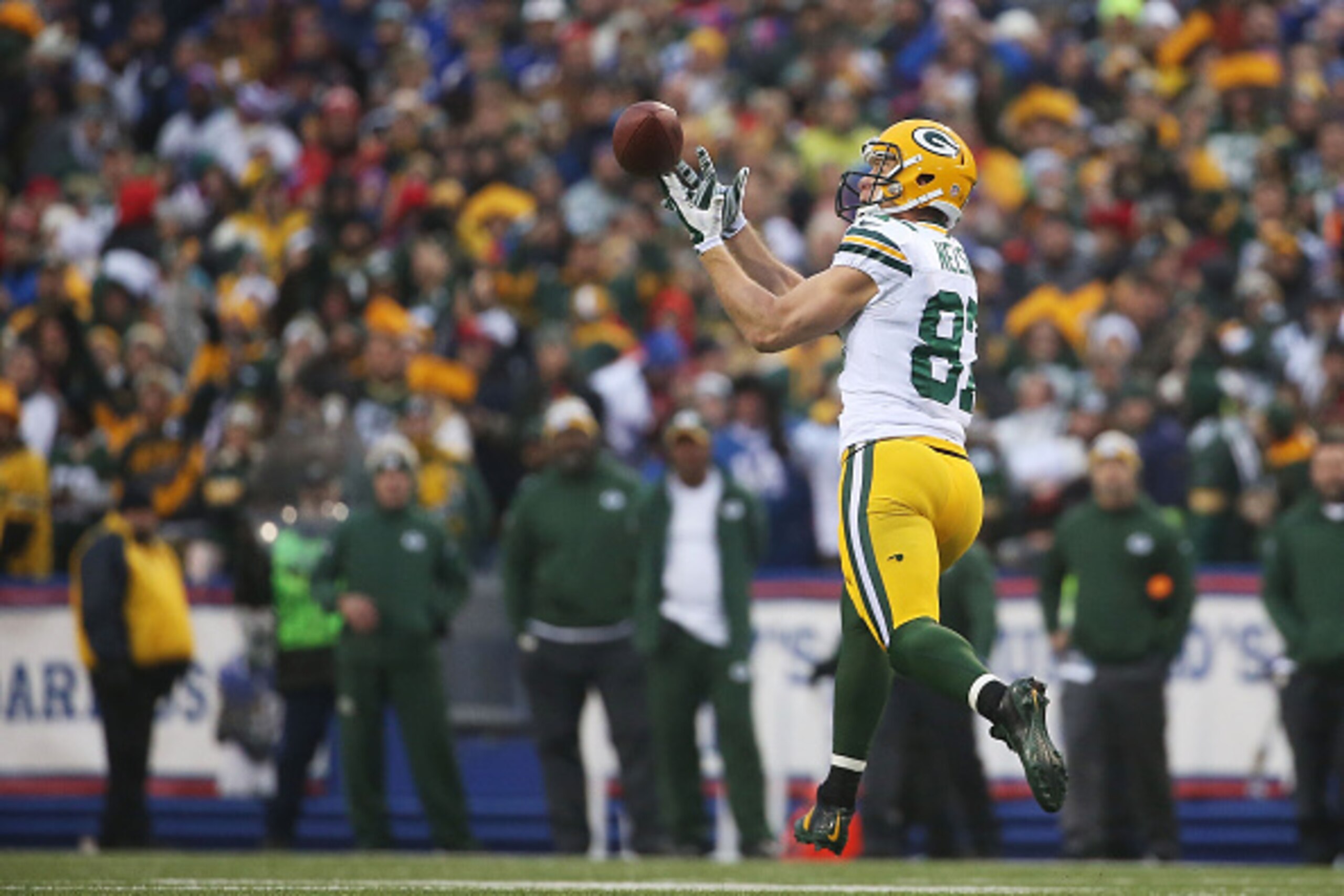
The biggest drop came near the end of the third quarter, when Nelson had one of the easiest catches of his season go off his fingertips. He was behind the coverage and only needed to outrun Bills safety Duke Williams to complete the 94-yard touchdown.
Instead, the Packers' drive ended nine plays later, when Rodgers' fastball bounced off the hands of Jarrett Boykin and into the waiting arms of Rambo for a second interception.
Finally, Rodgers' low throw to rookie tight end Richard Rodgers was unable to be completed on Green Bay's second-to-last drive.
Eliminate all the drops, and Rodgers likely throws for at least 150 more yards and at least one score. And, more importantly, the Packers likely win the football game. It still would have been a below-average overall performance under Rodgers' ridiculously high standards, but 300-plus yards, one touchdown, one interception and a probable win isn't so hard to stomach.
The play-calling from the sideline and checks at the line also helped spawn the disaster.
The Packers ran 22 designed runs—15 with Lacy, four with James Starks and three with Cobb. Those 22 runs produced 131 yards, good for 5.95 yards per carry. Lacy had three runs of 15 or more yards (with a long of 22), while Starks and Cobb both had 12-yard scampers.
The Packers offensive line mostly had its way with Buffalo's highly touted front four, and the running game was working. On Green Bay's lone touchdown march, Lacy busted off runs of 15, 17 and 22 yards—before finishing the drive with a one-yard score. It was clear that the Packers came into the contest wanting to run the football, as 11 of the first 27 plays were runs.
| Pass Plays | 26 | 19 | 45* |
| Run Plays | 14 | 8 | 22 |
The balance just didn't continue.
The Packers ran just 11 more designed runs over the next 41 plays. Lacy, who continually ripped the Bills and had 73 yards at halftime, received just five official carries in the second half. Starks saw none. No rational explanation was provided.
In a game where the score remained close, Rodgers was uncharacteristically inaccurate and the receivers weren't making plays, the Packers all but abandoned a productive running game. The contest was begging for Green Bay to grind it out with Lacy and Starks, while putting Rodgers and the passing game in the backseat. It worked for the Denver Broncos against the Bills a week earlier. It was either head coach Mike McCarthy's play calls or Rodgers' checks at the line that kept the Packers stubbornly pass-happy and paddling up river.
All the contributing factors make for a difficult loss to comprehend. Essentially, if Rodgers had been anything near his normal accuracy, his receivers at all sure-handed and his offense more balanced, the Packers likely walk out of Buffalo with a comfortable win.
And that's not to take too much away from the Bills defense. While the Buffalo front four was mostly neutralized by the Packers offensive line, the confident Bills stuck to the blueprint and rightfully won the contest.
Defensive coordinator Jim Schwartz rarely blitzed Rodgers, choosing instead to rely on his stable of pass-rushers for pressure. He then played coverage with seven defenders, using his athletic linebackers to smother everything underneath and his physical secondary to disrupt the timing routes Green Bay's offense relies on. The Bills cornerbacks provided no space, and when the officials allowed the game to be physical down the field, the windows to throw became smaller and smaller.
It's a developed formula that—when executed properly—has successfully short-circuited the firepower of Rodgers and the Packers time and time again.
| at SEA | 69.7 | 189 | 5.7 | 1/1 | 80.1 |
| at DET | 59.3 | 162 | 6.0 | 1/0 | 88.8 |
| at BUF | 40.5 | 185 | 4.4 | 0/2 | 34.3 |
| TOTALS | 54.9 | 536 | 5.3 | 2/3 | 64.0 |
There exist other teams that can pull off the plan, including those standing directly in Green Bay's Super Bowl path. The Seattle Seahawks and Detroit Lions both proved plenty capable earlier this season, and it's possible the Arizona Cardinals could also emulate parts of the blueprint.
One could also argue that the "perfect storm" of events described above—where Rodgers is off, the receivers struggle and a top defense sticks to the script—has already occurred in Seattle and Detroit in 2014. Lightning struck for a third time in Buffalo. Is there a fourth bolt waiting for the Packers in Week 17, when the Lions visit Lambeau Field, or possibly in January, during the postseason? Maybe.
But it's also hard to believe the Packers offense will play another game as poor as the one seen Sunday.
Rodgers hit new lows for accuracy and efficiency that he may never reach again. The Packers receivers may never again leave as many yards on the field. And maybe now McCarthy and Rodgers will finally take a serious look at how impactful Lacy and the running game can be over 60 minutes.
The disastrous performance in Buffalo is concerning. It has to be.
But maybe this latest letdown will provide the Packers with a belief that if Rodgers and the offense plays up to snuff, any kind of defense can be beaten. The perfect storm need not happen again. Change the variables, change the result.
Zach Kruse covers the NFC North for Bleacher Report.
.jpg?w=2560)
.jpg?w=2560 "NFL Paris Football")


.jpg?w=2560 "Malik Beasley Negotiating Plea Deal (AP)")