Amir Khan exceeded expectations on Saturday night with a near-shutout win over former world champion Devon Alexander in Las Vegas.
After predicting Khan to win on points with a score of 116-112 or 117-111, he actually only lost one round on my card, also splitting the ninth, for a total of 119-110. The official cards were similar: 120-108, 119-109 and 118-110.
The pre-fight fear that this could turn into a boring fight with few clean shots landing proved unjustified, as Khan connected virtually at will with dazzling combinations in the first half of the fight.
Admittedly, the action did slow in the second half when it became clear that Khan would have to settle for a points win and he paced himself more, whilst Alexander clearly had no answer for Khan's speed and accuracy and was unable to make telling adjustments during the fight.
Khan certainly put on a much more impressive show than the hyped American contender Keith Thurman, who struggled to land his power shots while winning a decision against the awkward and underrated European champion Leonard Bundu.
Across town, things went even worse for Timothy Bradley who, controversy or not, was sufficiently underwhelming to only draw with Diego Chaves, a man Thurman stopped 18 months ago.
This means that unless the Manny Pacquiao-Floyd Mayweather fight can finally be arranged, and provided Mayweather doesn't make a shock move to fight light-middleweight Erislandy Lara or middleweight Gennady Golovkin, Mayweather-Khan is probably the most viable contest for the "Money" man.
While Mayweather would be a clear favourite to beat Khan, there are good reasons to consider the Englishman to be the boxer at welterweight, other than Pacquiao, with the best chance of inflicting a defeat on Floyd.
And here are the six reasons why.
1. Speed Kills
1 of 6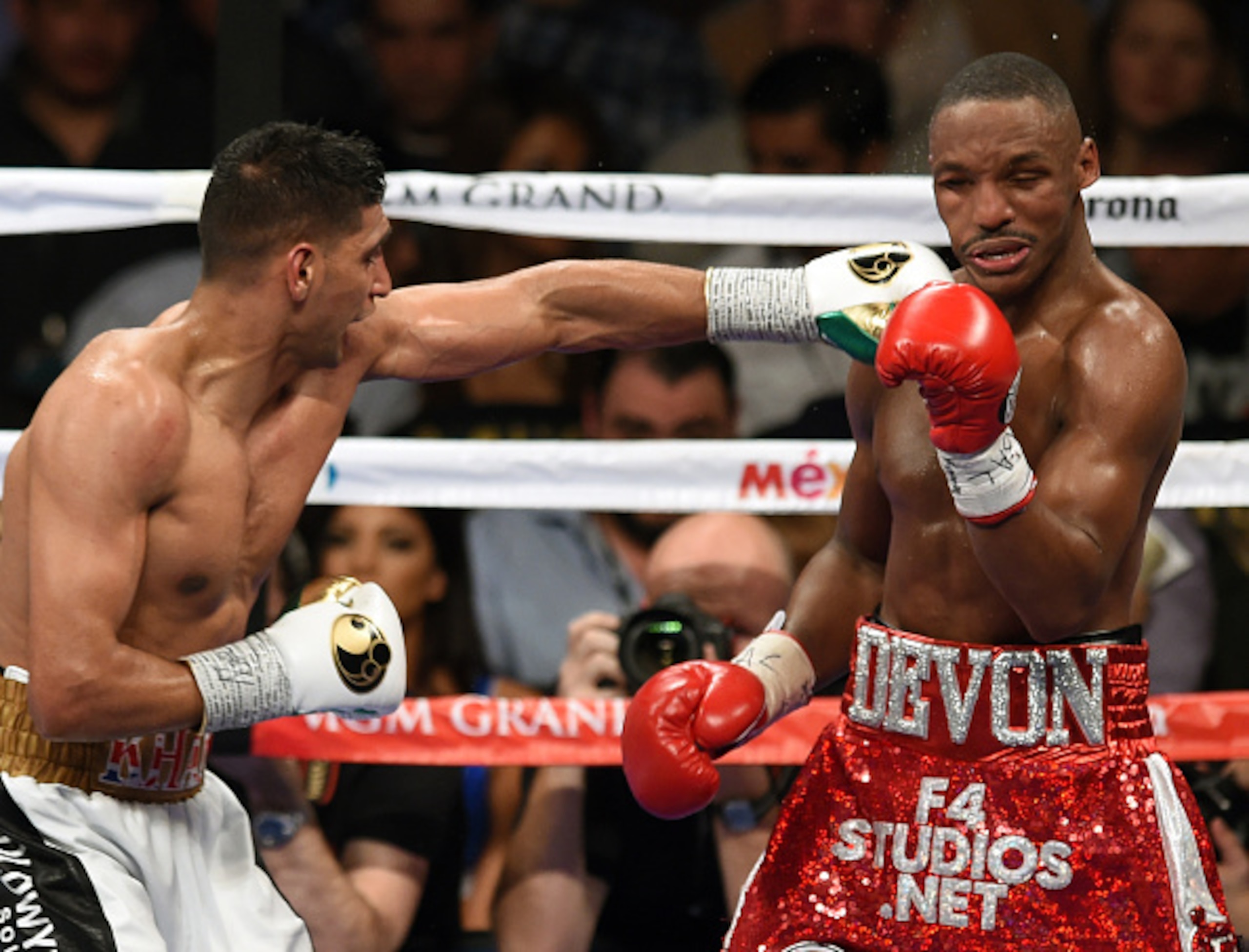
Devon Alexander is a relatively quick fighter, faster than several top welterweights such as Robert Guerrero, Marcos Maidana and Juan Manuel Marquez, and yet he was overwhelmed by the speed of Amir Khan.
Khan has some of the pound-for-pound fastest hands in the sport—last year, Bleacher Report's Kevin McRae ranked him second overall, behind only Floyd Mayweather.
Ignoring the smallest fighters below bantamweight, Khan is arguably now No. 1—and to my eye, he looks quicker than Mayweather these days, especially when leading the action rather than counter-punching, when anticipation and reaction time also come into account.
This means that Khan immediately takes away one of Mayweather's biggest advantages, a significant boost when compared to recent Mayweather opponents such as Guerrero and Canelo Alvarez, against whom the champion's edge in speed basically won him the fight on that attribute alone.
The last time Mayweather faced an opponent of similar speed was Zab Judah back in 2006. Judah was highly competitive in the first half, maybe winning three of the first four rounds—and he should have scored a knockdown in Round 2 when Mayweather's glove touched the canvas as he reeled back from a counter right, but the referee missed it.
Mayweather, in his customary style, made adjustments and turned the tables on Judah, ultimately winning a unanimous decision. All the same, the fight showed that Mayweather is susceptible to speed.
Khan is at least as fast as Judah was and Mayweather has definitely slowed a little since 2006, so Khan would benefit even more from speed than "Super" Judah did.
The Bolton fighter should be able to win early rounds through his quickness and create a lead on the scorecards to put the pressure on Mayweather, who would need to adjust to swing matters back in his favour.
2. 10 Years Younger
2 of 6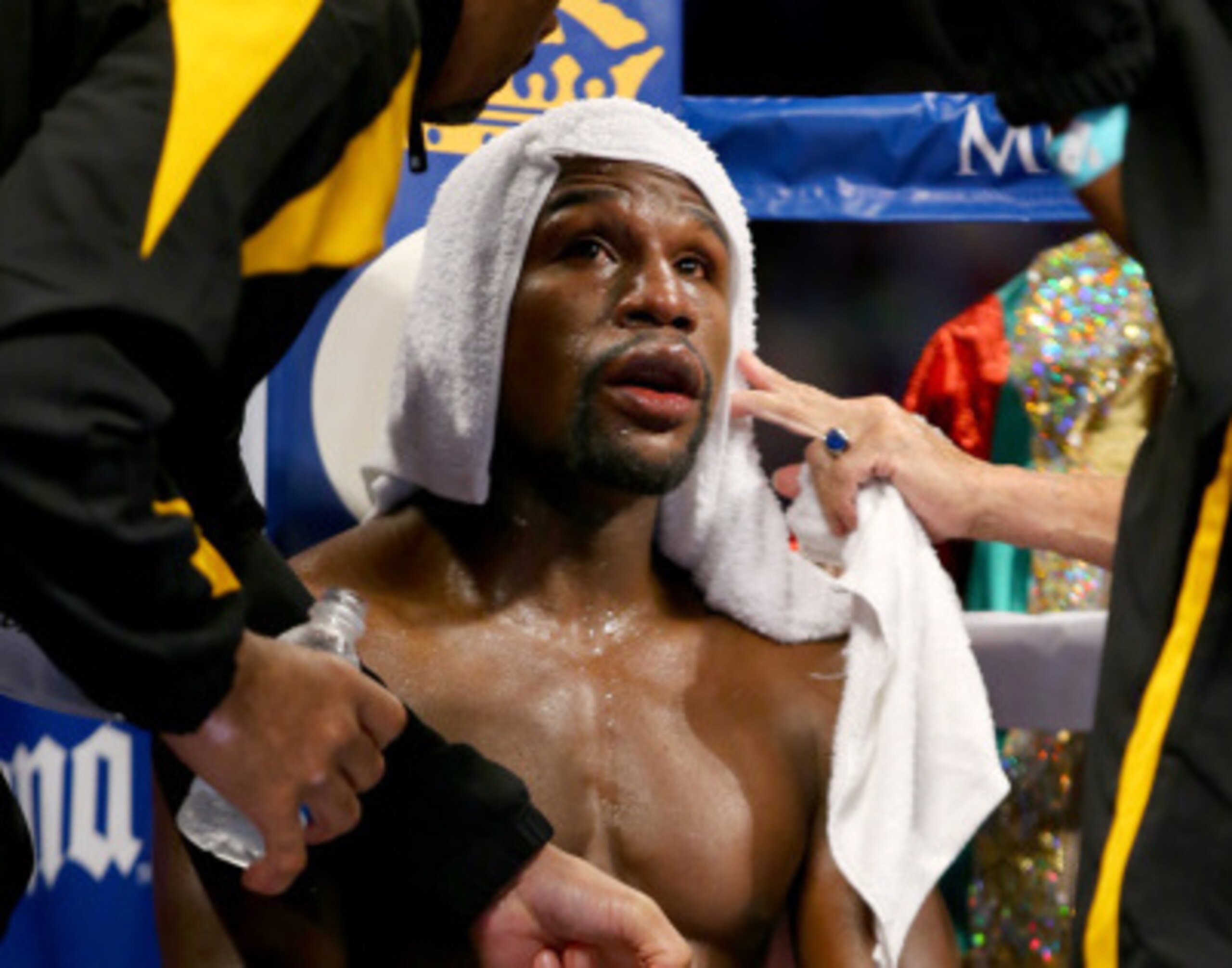
Amir Khan turned 28 in December, whereas Floyd Mayweather turns 38 in February, three months before an expected return to the ring in May 2015.
You would have expected Father Time to catch up with Mayweather sooner, but as recently as September 2013, he looked highly commanding against top opposition in the shape of El Canelo.
Mayweather has benefited from his safety-first style, which means he has taken very little damage in his career, as well as his extremely high levels of professionalism outside the ring, never getting out of shape or neglecting his conditioning.
Ultimately, however, as even Bernard Hopkins discovered this year against Sergey Kovalev, everybody gets old.
In his first fight with Marcos Maidana in May, the Money man finally began to look his age, getting bullied back to the ropes and messed about by the relentless and brave Argentinian who is seven years younger. In his corner in between rounds, Mayweather looked tired and old for the first time.
Maidana couldn't keep up his work rate for 12 rounds, which allowed Floyd back into the fight. Then in the rematch, the younger man bizarrely fought a less intense style, allowing Mayweather an easier night and a clearer victory.
Although Khan is not as busy as Maidana, he is significantly more accurate. In their 2010 fight, Maidana landed with 20 percent of his punches while Khan had success with 45 percent, according to CompuBox.
In his first fight with Floyd, Maidana threw 858 punches to Mayweather's 426; in the second, it was 572 to 326, with Floyd pacing himself carefully.
Mayweather was therefore throwing far fewer punches than his second toughest fight since his 2009 return, the 2012 match with Miguel Cotto. That night, Cotto threw 506 and Mayweather 687 (i.e. Floyd's output more than halved between May 2012 and September 2014).
On Saturday, Khan (via ESPN) threw a respectable 563 punches without really extending himself. That's not as high an output as Maidana, but it is almost certainly more than Mayweather can match at the age of 38.
Khan will have an advantage in busy-ness and should be able to put the champion's aging body to the test with his work rate and youth.
3. Parity of Reach
3 of 6
Commentators never tire of extolling the boxing genius of Floyd Mayweather, but they rarely acknowledge his great natural advantage in terms of the length of his arms.
Against his listed (and probably generous) height of 5'8" (68 inches), Mayweather has an arm-span of 72". The average person's arm-span is the same as their height, so Mayweather has an unusual physique which is perfectly suited to his trade.
The last time Floyd fought British opposition, his rival Ricky Hatton could only boast an arm-span of 65", a massive disadvantage that ultimately cost Hatton the fight as he struggled to close the distance.
Hatton's aggressive come-forward performance—and he actually caused Floyd problems early on—was dismissed as that of a technically deficient fighter against a maestro, but in reality, it was the only choice he had against a much longer-limbed opponent.
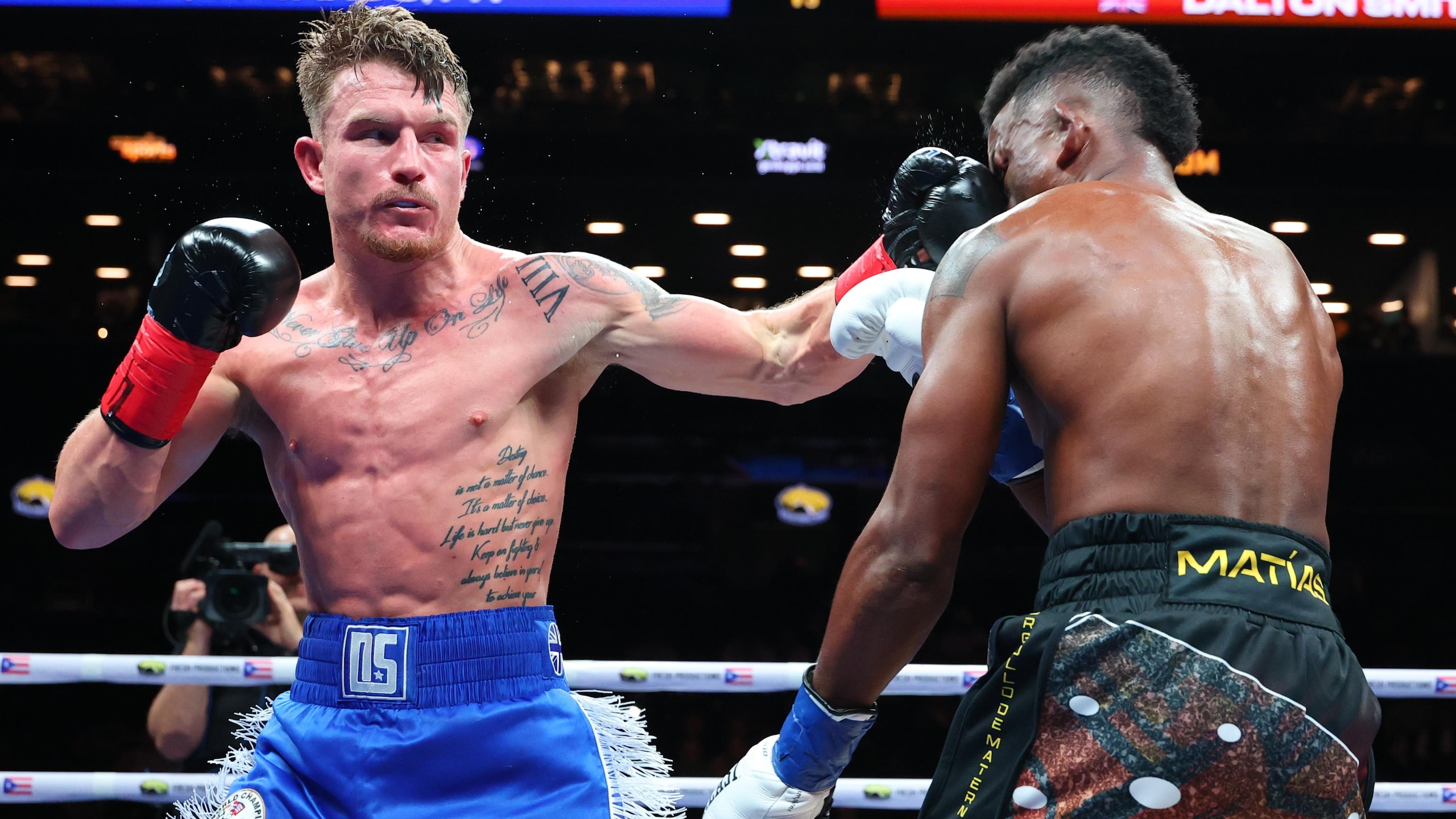
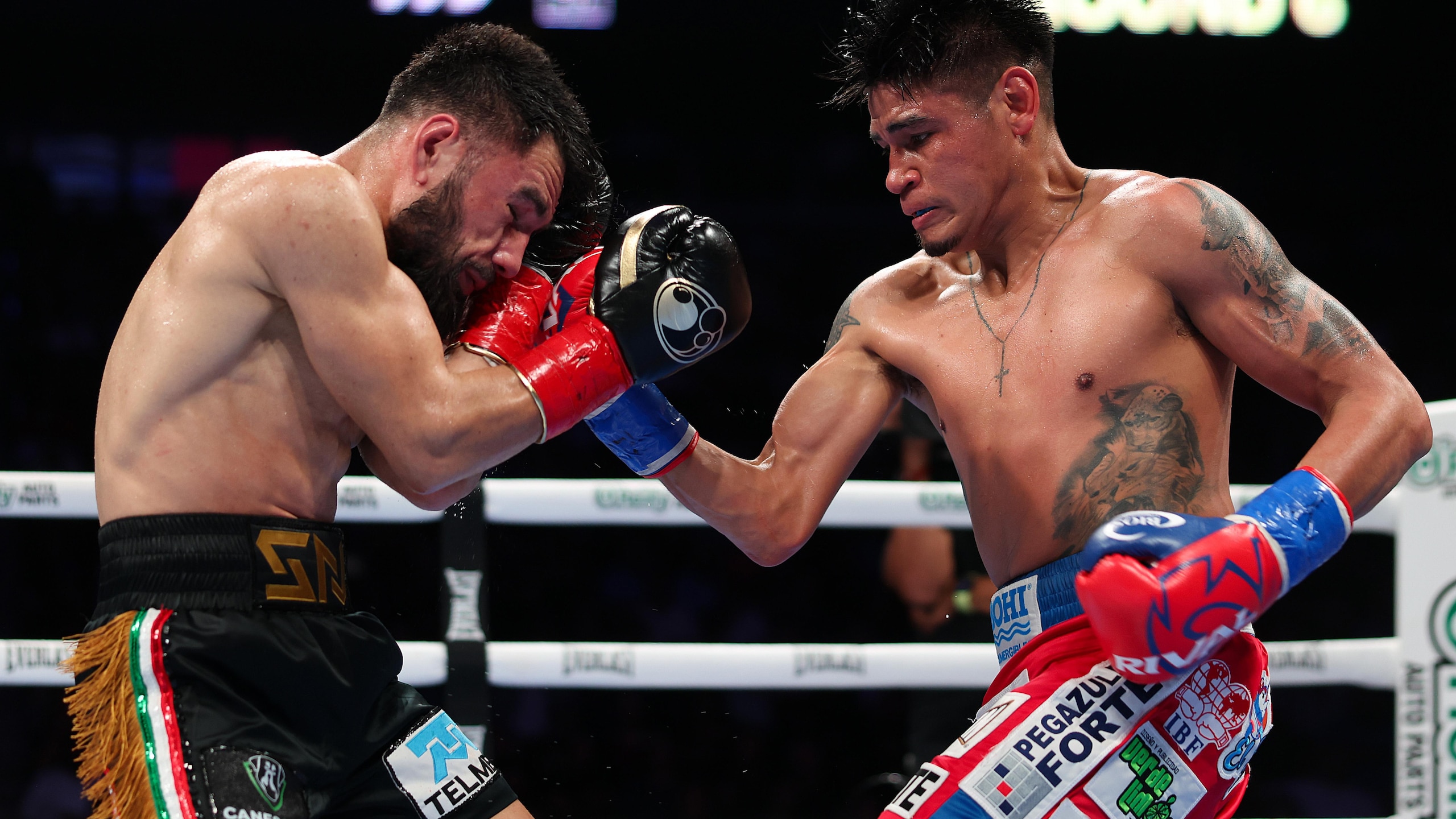
Amir Khan is listed at 5'8.5", but realistically he is at least an inch taller than Mayweather, and he has good reach, with his arm-span recorded at 71". That is just one inch less than Mayweather, a negligible difference of half an inch per arm.
Back in 2007, Oscar de la Hoya actually had a slightly longer reach than Mayweather, and he won several rounds, even taking the fight on one card in a split decision.
Oscar had major success early on with his jab and that is arguably Khan's best punch. Mayweather managed to counter the jab as the fight wore on, which dissuaded de la Hoya from throwing it, but some people still think Oscar might have won had he stuck to his early fight plan.
Khan has a significantly longer reach than Marcos Maidana and even a slight advantage over Canelo Alvarez in that respect, who you might assume to be the bigger man.
Mayweather is undoubtedly a master boxer, but it is much easier to outbox someone against whom you have longer arms.
Without an advantage in speed or reach, Mayweather will find himself in very different territory, and Khan could win rounds with his jab alone by popping it and getting out of range. Mayweather is the king of making adjustments in fights, but there are no easy answers for this particular challenge.

4. Power Vacuum
4 of 6
Amir Khan's greatest weakness is no secret—his punch resistance is worse than average, and he has twice been badly knocked out, first as a novice against Bredis Prescott in 2007 and again by Danny Garcia in a light-welterweight title fight in 2012.
He was even knocked down somewhat embarrassingly last year by the veteran Julio Diaz at a 143-pound catch-weight, but perhaps he has bulked up to the 147 welterweight limit.
In his two most recent fights at that weight, Khan never looked seriously hurt by either Luis Collazo or Devon Alexander, although neither of those men is a feared puncher.
When Khan does not have to worry overly about his opponents' power, as against Alexander, Collazo and Paulie Malignaggi, he tends to win very comfortably. The question is whether Floyd Mayweather has enough power to KO Khan and expose his greatest frailty. In his 13 fights at welterweight or above, Mayweather has only scored three knockouts.
The first of those was against the over-matched Sharmba Mitchell in 2005, who had already been stopped four times before—the second was late on against an exhausted Ricky Hatton fighting above his natural weight in 2007, and the third was the infamous cheap shot against Victor Ortiz in 2011.
In fairness, Mayweather does not really push for the KO, settling to win fights on points and refusing to take chances to pursue a crowd-pleasing ending.
Floyd almost certainly does not have one-punch KO power at welterweight, even when measured against Khan's susceptible chin (And Khan has never been stopped by a single punch, anyway).
As he has grown older, Mayweather has grown less aggressive—in his first nine world-title fights from 1998 to 2001, he scored six stoppages.
These days, he rarely throws damaging three-, four- or more punch combinations, being content to pop opponents with a disheartening but not conclusive one-two.
Maybe he can still unload those combinations, and he'd showcase them once again to end Amir Khan. It's a maybe at best, though.
What is certain is that unlike power-punchers Garcia or Prescott, Mayweather's greatest strengths do not align with Khan's greatest weakness. Mayweather would have to change his gameplan to KO Khan, and it may be that his days of throwing devastating combinations are long gone.
5. Body Punches
5 of 6
Your memory might not immediately recall why Marcos Maidana is writhing in agony in the picture above. Amir Khan had just caught him with a devastating left hook to the body in Round 1 of their 2010 encounter.
Maidana just, just made the count or Khan would have recorded a spectacular KO win. And they don't come much tougher than Maidana.
On Saturday night, Khan neglected his bodywork, but he was landing so freely to the head of Devon Alexander that you can hardly blame him, not least when eye-catching head shots tend to impress the judges more.
Perhaps tellingly, in Alexander's best round, the eighth, Khan did land a big body shot that winded the American briefly. Again in Round 10 as he retook control, Khan connected hard to Alexander's midriff, which gave him the opportunity to follow up with a combination to the head.
Floyd Mayweather is famously elusive with very few fighters over the years being able to land clean punches up top.
In their first fight, Maidana resigned himself to that reality and simply went for volume, being content to connect to arms and shoulders, trying to wear down the champion.
It wasn't a bad plan and he had plenty of success. Khan is a more accurate puncher, although he would not be able to commit to such a reckless strategy.
Nonetheless, it would make sense for him to take a cue from Maidana and switch up his attack, taking focus away from the head shots that Mayweather is so expert at avoiding.
It is not likely that Khan can score a KO win over Mayweather, but nor did it seem likely that Bernard Hopkins could finish Oscar de la Hoya inside the distance in their 2004 megafight—until Hopkins found a perfect body shot.
The left hook to the body is probably Khan's best power-punch and matches up well to Mayweather's style. Were he to catch the Money man with a sneaky one unexpectedly, it is not beyond the realm of possibility that he could close the show.
More generally, Khan's fast, accurate and sharp body punches will stand him in good stead, even against the expert defence of Mayweather.
6. The Underdog Effect
6 of 6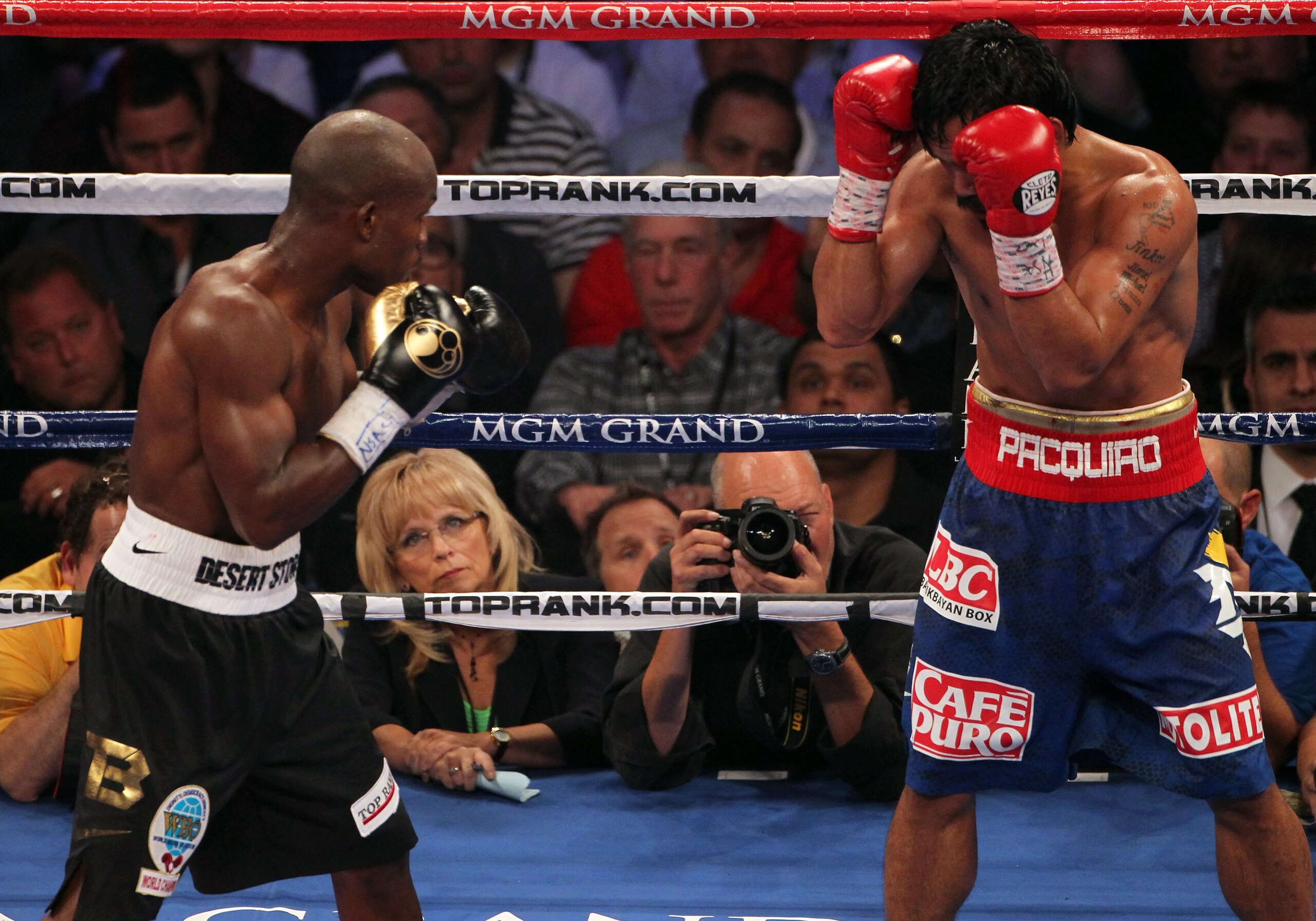
Everyone will expect Floyd Mayweather to beat Amir Khan, with many people anticipating an easy night for the pound-for-pound supremo against an opponent with three defeats on his record.
Whatever happens, it is highly likely that the fight goes the distance, as all three of Khan's fights at welterweight have, along with eight of Mayweather's last 10.
And that means the result will be in the hands of the three ringside judges.
Even though Mayweather is seen as the "money" fighter who brings huge amounts of revenue to his hometown of Las Vegas when he fights, two of his last three fights have been majority decisions (i.e. one judge has scored it a draw).
That was reasonable in the case of judge Michael Pernick's card for Mayweather-Maidana I, not so much in the case of C.J. Ross's card for Mayweather-Canelo.
But it shows that not even Mayweather is guaranteed to have things all his own way when it goes to a decision.
You can see C.J. Ross in the picture above. She is the blonde woman just beneath Timothy Bradley's gloves. A somewhat infamous figure in boxing, hers was one of the two scorecards in favour of Bradley in his 2012 upset win over Manny Pacquiao.
That is generally seen as a bad decision, and Pacquiao was eventually able to set the record straight in a rematch this year.
But although Bradley probably didn't do enough to deserve the win over Manny on the first occasion, he certainly did better than expected—and maybe that's what swung the judges in his favour. Call it the "underdog effect."
If you go in believing Floyd will win easily, and Amir Khan can frustrate him with his speed, long reach and in-and-out movement, maybe you end up scoring close rounds to Khan because he exceeds expectations.
Provided Khan can stay on his feet for 12 rounds, then he only needs seven rounds in which he sticks to his gameplan and utilises his advantages to go home the winner. It's certainly possible, especially if the judges give him the benefit of the doubt as the underdog.
All fighter records from BoxRec.
.jpg?w=2560 "NBA Gambling Charges")


.jpg?w=2560 "Aikman Blasts Cowboys WR 🫣")

.jpg?w=2560 "Jonathan Taylor Landing Spots")