Have Phoenix Suns Watered Down Offense with Too Many Point Guards?
The Phoenix Suns may have stockpiled too much of a good thing this summer.
Having acquired Isaiah Thomas from the Sacramento Kings via sign-and-trade and reached a five-year, $70 million contract extension with Eric Bledsoe, the club now boasts three starting-caliber point guards coming off career-best seasons.
The third part of that trio is Goran Dragic, a highly skilled shooter and distributor who put up 20.3 points and 5.9 assists last season en route to his first All-NBA Third Team honors.
TOP NEWS
Giannis' Warning to NBA ⚠️

NBA Power Rankings Entering Preseason 🔢
Wizards Guard Admits Tanking 😨
The 28-year-old posted just seven points in a blowout 122-97 loss to the Denver Nuggets on Friday night, Phoenix's second straight game without Thomas.
Through 17 games this season, Dragic is averaging just 14 points and 3.2 assists in 30.2 minutes per contest, a potentially costly regression in advance of his free agency next summer. It's the consequence of reduced playing time and fewer touches.
Dragic's 20.5 usage rate now trails Thomas, Bledsoe and swingman Gerald Green—and represents a steep drop-off from his 24.1 mark a season ago (per Hollinger Stats).
When asked why the new, guard-heavy rotation has yet to fully find its groove, the seventh-year veteran cited a sometimes forgotten fact of basketball life.
"Because there's only one ball and we're all point guards," Dragic told reporters this month. "That's an easy answer.
"It's hard. That's sacrifice. If Isaiah's playing well, he's going to stay in. Me and Eric, it depends who is playing better and who is going to be on the court. The other guy is going to be on the bench. It's the way it is. We need to embrace that."

Perhaps there's a reason teams typically have just one point guard on the floor. There's no denying the value of multiple playmakers lining up alongside one another, but some are more complementary in nature—creating a shot or making a pass after taking one or two dribbles.
But the Suns are blessed and cursed by a trio of primary ball-handlers who tend to do their best work when initiating offense and operating as the focal point.
The abundance of point guard riches isn't entirely without logic, and there's certainly some evidence that it works.
Amassing 108.4 points per 100 possessions, the Suns rank 10th in offensive efficiency through their first 16 games, according to Basketball-Reference. The deployment of multiple floor generals quickens the pace, facilitates ball movement and forces opponents to respect multiple points of attack.
Last season, Phoenix learned that it can be successful with two point guards on the floor at the same time—frequently teaming starters Dragic and Bledsoe, at least for the 43 games in which the latter wasn't sidelined by injury. The Suns' 48 victories marked a 23-win increase from the preceding 2012-13 campaign.
Something was working.
There are even occasions when it may make sense to play Dragic, Bledsoe and Thomas at the same time. Sports Illustrated's Rob Mahoney noted the lineup's limited usage in a 94-89 victory against the San Antonio Spurs and offered a pretty enthusiastic endorsement—at least when the right situations present themselves.
"A third ball-handler allowed the Suns to move the ball up the floor quickly, even in crunch time," wrote Mahoney. "Thomas' go-ahead layup, for example, came as a result of a snap outlet pass and a fearless sprint through a one-on-three fast break.
"On one possession, Bledsoe executed a dribble handoff to Dragic, who then handed off to Thomas—a sequence that had the look and feel of a double reverse. With three skilled creators on the floor, Phoenix went seven minutes against the Spurs (and two against the Jazz on Saturday, for that matter) without committing a turnover. The potential of this trio is so clearly evident."
It's also true that a third point guard gives head coach Jeff Hornacek options.
Dragic sat for the final 13 minutes of a recent 104-100 loss to the Toronto Raptors, posting just six points in 21 minutes on a night when he never found the range.

"Obviously, Goran is one of our best players," Hornacek told reporters after the game. "But when things are going like that, you kind of have to let it go. Down 17 in the fourth quarter, to make that comeback, it'd be a little tough to put a guy in there who's cold when those other guys are playing well."
Bledsoe and Thomas combined for 41 points in their effort to pick up the slack, demonstrating the undeniable value of depth at such a pivotal position.
So it's not as though the Suns have an unmitigated disaster on their hands.
At the moment, however, they're 10-7 in a conference that allows precious little margin for error. Phoenix won't have an easy time claiming the No. 8 seed from the Sacramento Kings and New Orleans Pelicans—both of whom also reason to be in the running.
The Suns know all too well how pivotal one or two games may be in what's destined to remain a three- or four-team race for the last postseason spot. Despite the significant strides they've already made, the Suns are in no position to settle.
Put in that context, Phoenix's offense could be better. And with a middle-of-the-pack defense that currently ranks 11th in efficiency, this offense probably needs to better.
It ranked eighth in efficiency a season ago, churning out 109.5 points per 100 possessions and demonstrating an ability to keep up with high-volume-scoring teams like the Spurs and Los Angeles Clippers.
Coming off a 120-112 win against the Denver Nuggets this week, we're reminded this team's offensive upside is impressive. Thomas missed the game with an ankle contusion. Dragic and Bledsoe tallied a combined 41 points and 74 minutes in the contest, making 14 of 23 field-goal attempts in the process.
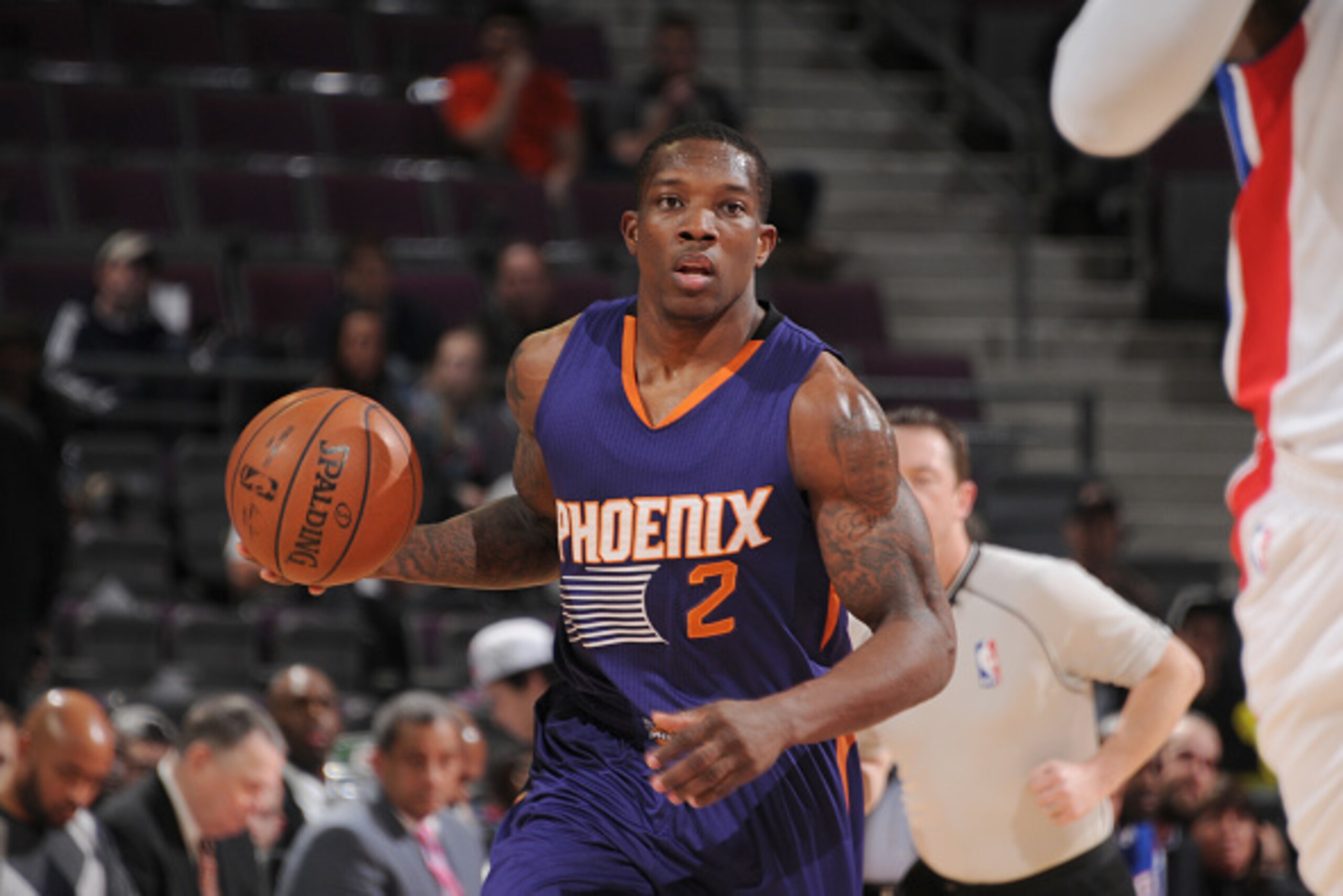
Maybe that's what happens when guys have the requisite minutes and touches to find their rhythms—much as Bledsoe and Thomas did when Dragic struggled against the Raptors.
It may prove more difficult to get all three point guards going for long stretches at a time. Without the touches and opportunities to develop their comfort zones, one wonders whether this trio can live up to its full potential.
Much will depend on how they adjust to new roles.
"It's still a lot of getting used to for those guys because they're all point guards who have handled the ball a lot," Hornacek told media this month. "So now they all have to handle it a lot less for all three of them to have a chance at it. They're still working on how to be off the ball and still be involved.
"Really, we want to do the same thing we did last year. Just get the ball side to side where they are all touching it each play and they feel like they're involved."
If they don't feel involved, there's a real risk that this club's chemistry and commitment will suffer as a result. There have already been signs of frustration, and that doesn't bode well after just one month of the experiment.

"It's a tough situation," Thomas recently said, per CBSSports.com's James Herbert. "But you've just got to be ready for whatever circumstances coach puts you in. You gotta be ready when your name is called, but I'm not going to sugarcoat it. It's tough.
"It's not what I expected. But coach has a tough job. Putting all of us on the floor and trying to mix up the minutes, it's tough for him. So it's not just tough for us as players, we just gotta be ready when our name's called and just know, I mean, coach is trying to do what he thinks is best for the team to put us in a position to win. But the key word is it's a tough situation. For all of us."
The numbers and public opinion won't count for much if the players themselves don't buy in. A few more wins might sell them on the possibilities, but any onset of adversity would almost certainly have the opposite effect.
This is the most talented the Suns have been in years, but questions about their roster makeup will persist throughout another season when 48 wins probably won't be enough to crack the playoffs.
Unless Dragic, Bledsoe and Thomas lead the way to improved results, their time together may prove short-lived.
.jpg?w=2560 "Every Trade's Best Trade Asset 🔁")
.jpg?w=2560 "Insiders: Cowboys Overpaid for Porter")
.jpg?w=2560 "Top NFL Trade Targets")