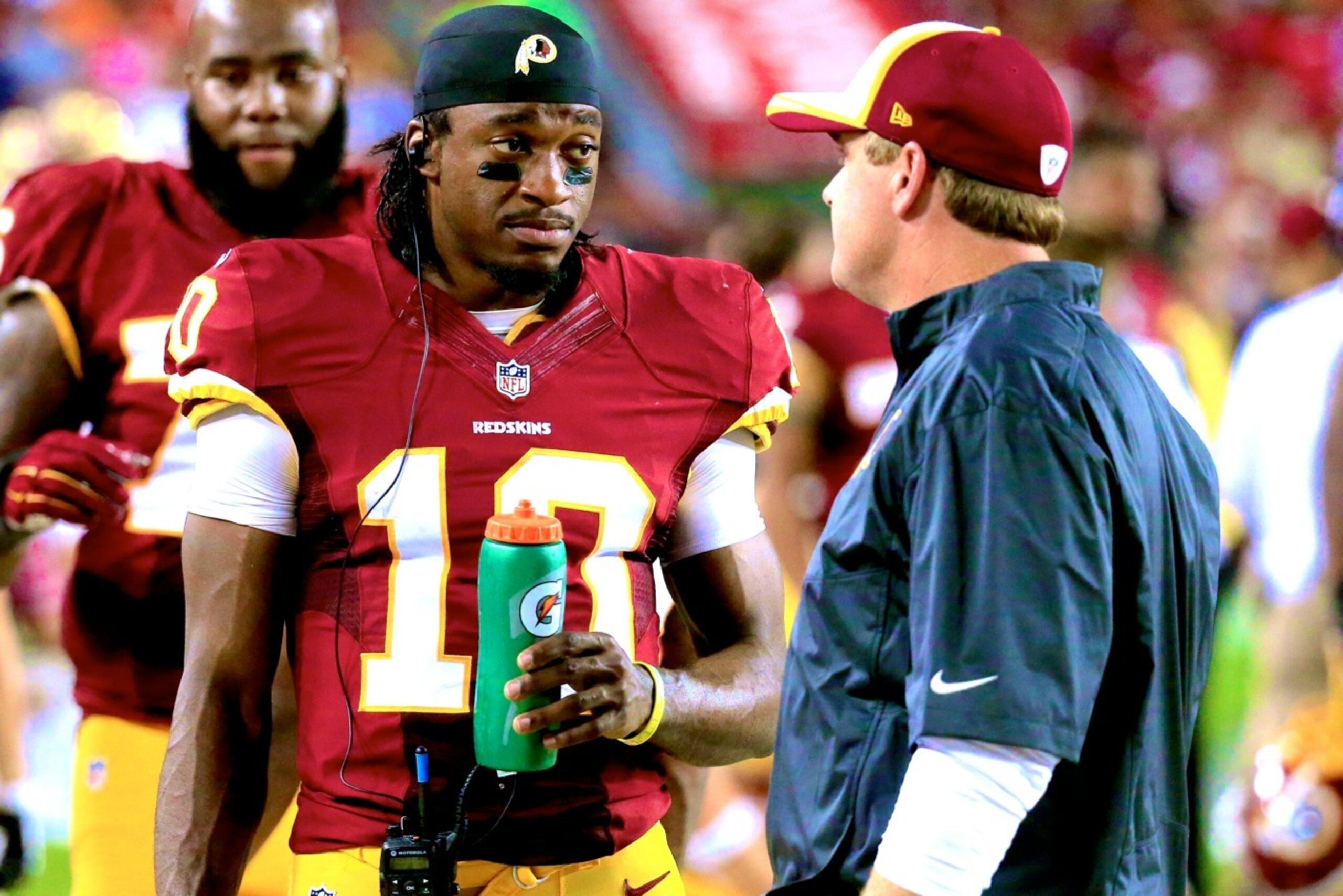

With RG3 on the Outs, It's Time to Clean House and Rebuild in Washington
No more half measures.
Washington owner Daniel Snyder has been fiddling while his empire burned around him for too long—fooling around with half measures, trying to keep his team afloat without realizing the damage done was permanent.
Last year, after an atrocious 3-13 season that led to the benching of quarterback Robert Griffin III, Snyder allowed general manager Bruce Allen to hire head coach Jay Gruden over plenty of other equally (or more) qualified candidates for one primary purpose: to save RG3.
TOP NEWS
Bears' Santos Wanted to Kick 58-Yarder
Picking Each NFL Division Winner 🔮
.jpg?w=2560)
B/R's Expert Week 7 NFL Picks 🔮
Gruden is now benching RG3 because he's failed at that primary job, and that's an indictment of Allen as well.
Yes, Gruden is the coach of the entire team in Washington, but as a supposed offensive guru and quarterback specialist, his impact on this team was supposed to be salvaging the player that Washington had mortgaged its future for in the 2012 NFL draft.
In four full games this season (plus an injury-shortened start against Jacksonville), RG3 has completed 69.7 percent of his passes, but only for 7.3 yards per attempt, two touchdowns and three interceptions. Those low numbers with such a high completion percentage showcase an inability to pass to the perimeter and intermediate-to-deep areas of the field.
One look at the advanced stats—a 26.7 QBR (one of the worst among qualified starters) and a negative Pro Football Focus rating (23rd in league, paid link)—and it's just another piece of evidence in the mounting case against RG3 as the franchise's savior.
Former Washington tight end Chris Cooley offered this assessment on ESPN 680, as written up by The Washington Post:
"What we are going to do is we are going to give incomplete to the entire offense. Because I don’t know how to grade them…I can’t grade the pass game. Our quarterback does not allow a proper grading of the pass game, because there was something I’ve never seen go on on a football field before.
"
The team is now turning to 28-year-old journeyman Colt McCoy, who started the year as the team's third-string passer. According to NFL Media's Albert Breer, McCoy will be given "every chance" to keep the starting job, and the team is not planning on a return to the RG3 era, which looks officially dead.
Jay Gruden Hasn't Made Good on His Potential Either
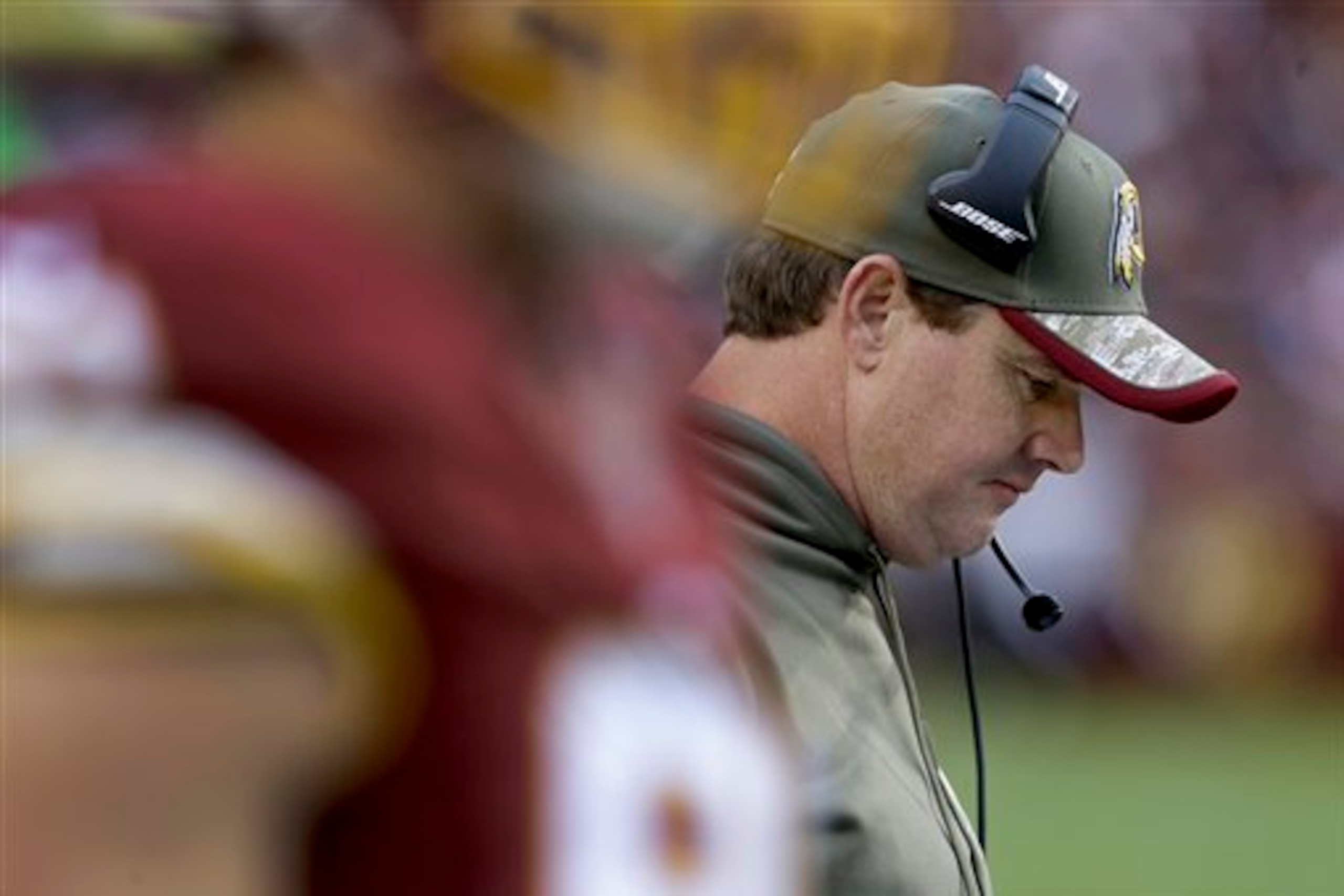
It's clearly time to move on from the quarterback, and that's also an indictment on the coach.
Mike Jones of The Washington Post wrote as much in a column on RG3's benching:
"Shanahan got fired, and general manager Bruce Allen hired Gruden to fix Griffin and return him to his former glory, and surpass that.
Gruden gave Griffin more responsibility, including having him more extensively read defenses and make calls at the line. And the coach installed an offense that relies heavily on timing and precision. But with Griffin struggling with anticipation and an ability to read defenses, the offense went nowhere as Griffin frequently held on to the ball too long, waiting for receivers to come out of their breaks rather than leading them with his throws.
"
Think about it: The reason RG3 was so successful in his rookie year was twofold. First, offensive coordinators were seeing him in the NFL for the first time. They were learning his tendencies, learning ways to bait him.
The second, bigger, reason was that former head coach Mike Shanahan and his son/offensive coordinator Kyle Shanahan allowed Griffin to succeed in a non-sustainable college-style offense that utilized the Shanahans' preferred zone-blocking scheme and created huge running opportunities both for RG3 and for running back Alfred Morris as defenses struggled to stop both.
In turn, that success running the ball enabled the Washington passing game to create wide-open windows for RG3 to pass into. He was putting up huge numbers passing to receivers who were more wide open than all other teams' pass-catchers. He was doing so without much anticipation, touch or understanding of NFL defenses, but the statistical success was overwhelming enough to mask those flaws.
RG3's knee injury expedited the death of that success, but it was inevitable demise regardless.
In his second year, the Shanahans asked RG3 (during an injured offseason no less) to learn the intricacies of the West Coast passing offense. In way of analogy, that's like asking a student accustomed to third-grade addition and subtraction to start doing high-level calculus without any sort of learning curve.
In hindsight, it's easy to see now, but back then it was pretty realistic to understand the Shanahans' plan. A simplistic offense wasn't going to work forever, and Griffin was known as a smart guy who would be coachable in the pros. They gave him the crutch to support himself but hoped he'd have learned to walk on his own when it was time to open up the playbook and institute their preferred offense.
In many ways, this is similar to Washington's division rival, the Philadelphia Eagles, and their quarterback Nick Foles, who enjoyed similar success in a Chip Kelly-styled, fast-paced offense that opened up similar gigantic windows for him to complete passes into. When the Eagles opened up their playbook a bit more this season—and when tilted against the run and enticed to pass—Foles had a similar decline.
Gruden has made the same mistake as the Shanahans, and he's done so trying to teach RG3 the same West Coast principles the quarterback never learned the first time around.
As bad as Gruden has handled tutoring his quarterback, he's handled the other parts of his job just as poorly. He started the year notoriously bad at utilizing the NFL's play-challenging system. He has struggled to keep his locker room together as news of rifts started leaking out back in August when our own Matt Miller reported that Griffin was alienating teammates.
Gruden has handled the media even worse, having to apologize after criticizing his now-benched quarterback. Rather than showing restraint by not criticizing him in the first place or showing toughness by allowing his public critique to stand, Gruden came off as clueless and desperate for answers.
He's not ready to be running an NFL team.
After this debacle, he might never be.
Bruce Allen Put This Circus Together

If a building project is crumbling, one can blame the building materials, but ultimately the person constructing with the faulty materials is culpable as well.
So, while it's time for RG3 and Gruden to go, the guy who drafted one and hired the other can't escape blame either. Snyder gave him the keys to this franchise and has had a (mostly) hands-off approach (by Snyder's standards) during Allen's reign, but the damage has clearly been done.
Couldn't we have seen this coming?
Again, this is entirely in hindsight, but look back at Allen's resume before joining Washington. He started with an Oakland team whose owner, Al Davis, was famous for doing almost all of the final decision-making in both player scouting and player acquisition.
The Raiders had some success while Allen was there, but it was short-lived, and when we consider how uniquely terrible the Raiders have been in the aftermath of that success, many of the lessons learned from Davis as a boss probably aren't lessons worth emulating at future stops.
Allen then moved on to Tampa Bay for one primary purpose: He had worked with then-head coach Jon Gruden before, and the two worked well together. Gruden was coming off of a Super Bowl victory, and it was assumed this power tandem would lead the Buccaneers to long-term success for years to come.
False.
That Super Bowl Gruden won was done primarily with players acquired by former general manager Rich McKay for former head coach Tony Dungy. With Gruden and Allen at the helm (sound familiar), the Buccaneers deteriorated into a team that was average at its best moments and laughable at its worst.
Allen's first-round draft picks while he was in Tampa: wide receiver Michael Clayton, running back Cadillac Williams, offensive guard Davin Joseph, defensive end Gaines Adams and cornerback Aqib Talib.
That's three busts, a cornerback who didn't really flourish until he left Tampa and whose off-the-field problems contributed to Allen's later firing, and one quality player the Buccaneers actually saw some positives from (Joseph).
That is the entirety of Allen's resume prior to being hired to run Washington.
That makes this a Snyder problem too, but I can't exactly advocate for the firing of the man who runs the team and makes all the decisions. I can advocate for the man to admit his mistakes and correct them before more damage is done, and that's exactly what Snyder has to do.
Allen's half measures before this season make this so much larger than just an RG3 problem.
Jay Gruden was hired this season on the basis of his short tenure in Cincinnati. Other than having the last name Gruden, his only other contribution to the game of football is his time spent in the Arena Football League and the United Football League. Still, the Bengals offense steadily improved under Gruden, so it couldn't have been all bad.
Yet, when one talks to Bengals players (as I did here with Andy Dalton and here with Gio Bernard), the players aren't exactly lamenting the loss of Gruden and are really excited to work with new Bengals offensive coordinator Hue Jackson.
Neither player threw Gruden under any buses, but both painted Jackson as both a more hands-on coach and someone who demanded a lot more accountability than Gruden.
Accountability has been in short supply in the Washington organization for a while now.
Last season, the Washington defense finished 30th overall at 29.9 points per game. More than just that stat, the fact that its defense continuously made mistakes and was out of position made it clear that defensive coordinator Jim Haslett was a huge piece of the problem.
Haslett was held over onto Gruden's staff.
In fact, the whole staff-building process before this season reeked of NFL favoritism and "good ole boys" networks, as Sean McVay was promoted from tight ends coach to offensive coordinator.
In 2009, the Florida Tuskers of the UFL won all six of their games before losing to the Las Vegas Locomotives in the league's first season of operation. Their head coach was Jim Haslett. His offensive coordinator was Jay Gruden. The wide receiver/quality control coach was Sean McVay. Current Washington wide receivers coach Ike Hilliard held the same position for the Tuskers.
It's amazing that what worked in a single year of UFL play didn't have the same success in the NFL.
Wait, no it's not. It's not at all.
Gruden and McVay (and Allen for that matter) have all gotten to where they are in Washington at least in part because of their respective last names. Haslett, who has been coaching in the NFL in all but that one UFL year since 1993, has gotten to where he is largely due to strong resume points from a decade ago.
These weren't the best men for the job; these were just the people who had the right connections and "pedigree."
Allen is the person who put this staff together, and he is the guy who used three high draft picks to secure the rights to draft RG3. He is the person who has, time and again, steered this ship in the wrong direction, toward its current 3-8 record and quarterback quandary.
He is not the person that should be given any kind of third chance to ruin this team any further.
According to another report from NFL Media's Albert Breer, RG3 might have some trade value left, as other teams could be looking for "one man's treasure" from Washington's trash. Teams with simpler offenses more connected to the air-raid scheme that RG3 ran at Baylor should at least be curious about the former first-rounder as a backup.
In an upcoming 2015 draft filled with quarterbacking potential, Washington should be looking for another quarterback to take the reins of the franchise, and putting that new quarterback onto a team led by Gruden and built by Allen seems like just another half measure.
There is nothing about this current team's makeup or long-term viability that is salvageable at this point. It is not time to tweak anything or put a fresh coat of paint on the crumbling ruins of a once-proud franchise.
It's time to start over.
It's time to clean house.
Michael Schottey is an NFL National Lead Writer for Bleacher Report and an award-winning member of the Pro Football Writers of America. Find more of his stuff on his archive page and follow him on Twitter.