Serge Ibaka's Role as Thunder No. 1 Will Pay Off When Durant, Westbrook Return
Following years of dreams deferred, the 2014-15 campaign quickly became a nightmarish one for the Oklahoma City Thunder.
First came Kevin Durant, derailed by a foot injury in early October. Then it was Russell Westbrook, beset by a broken hand mere minutes into the second game of the year—a pair of converging thunderclaps that cast the team’s very future into tempestuous doubt.
Through it all, though, one silver lining has shone through brightest: the transformation of Serge Ibaka from fine third fiddle into five-tool superstar.
TOP NEWS
Giannis' Warning to NBA ⚠️

NBA Power Rankings Entering Preseason 🔢
Wizards Guard Admits Tanking 😨
It’s a metamorphosis that could wind up saving OKC’s season.

And what a climb it’ll be. At 3-12, the Thunder stand in sole possession of the Western Conference basement. They rank 29th in offensive efficiency (94.7), 28th in true shooting percentage (49.8) and 27th in assist rate (15.0)—a trifecta of futility rivaled only by those performance artists of woe, the Philadelphia 76ers.
Messieurs Durant and Westbrook will doubtless bring order to the OKC court. But it’s in how head coach Scott Brooks plans to parlay Ibaka’s ever-expanding game that the Thunder may find their most potent long-term punch.
On the surface at least, Ibaka’s production has pretty much held steady:
| Season | Points | Rebounds | PER | USG% |
| 2012-13 | 13.2 | 7.7 | 19.4 | 18.1 |
| 2013-14 | 15.1 | 8.8 | 19.6 | 19.8 |
| 2014-15 | 15.6 | 7.9 | 15.3 | 23.1 |
Save, of course, for that rightmost number: usage rate, which denotes the percentage of plays used by a particular person while they’re on the floor.
Rest assured, the return of OKC’s reigning duo is bound to send that number tumbling. Still, Ibaka’s emergence as an offensive focal point is one sure to yield lucrative long-term dividends. Chief among them: three-point shooting, something in which the Thunder could use a bit of a boon.
Last season, OKC finished in the middle of the pack in both three-point attempts per game (14th at 22.4) and overall percentage (14th at 36.1), per NBA.com (media stats require subscription).
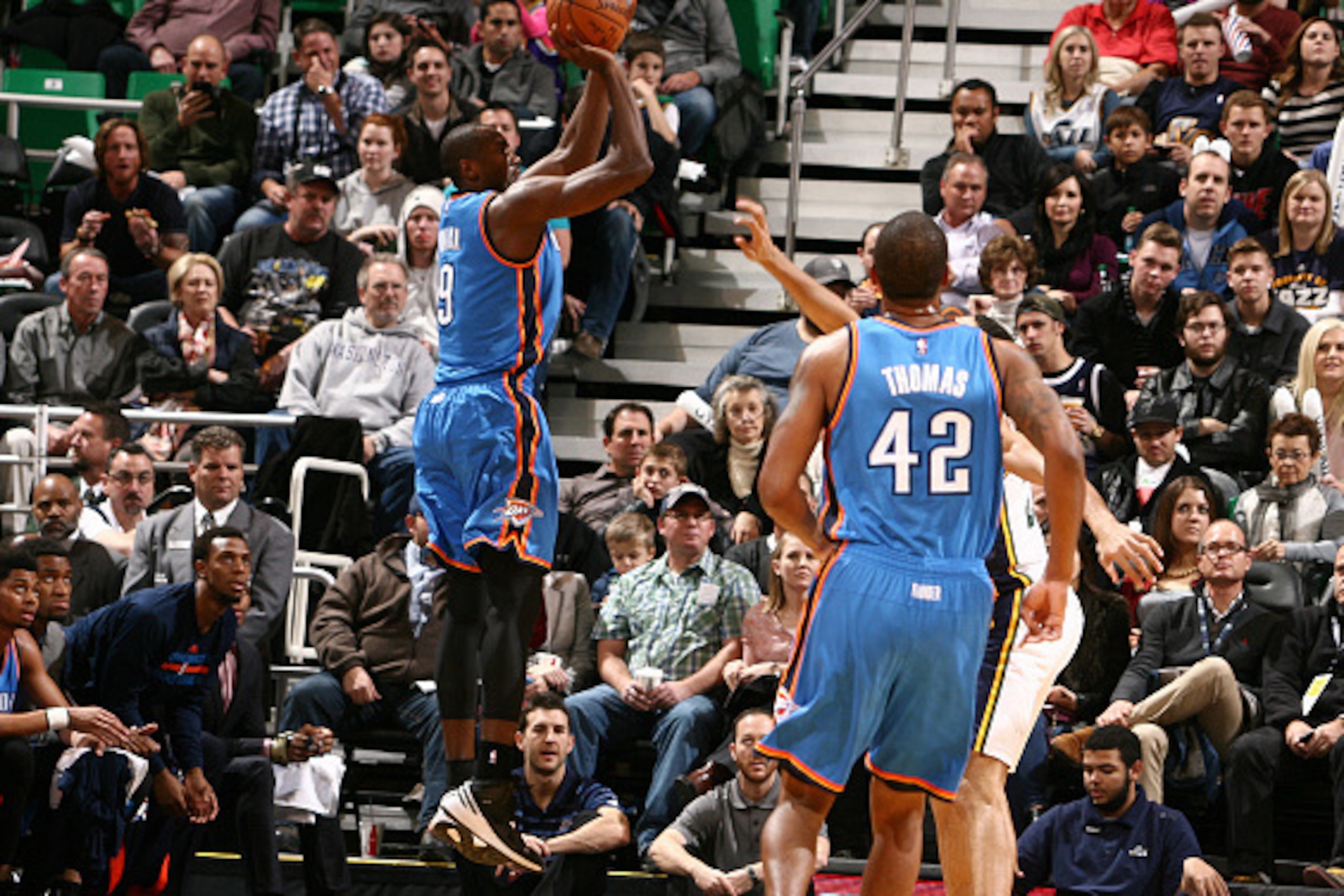
Here’s where Ibaka comes in. After attempting just 60 three-pointers all of last season (0.7 per game, of which he made 38 percent), Ibaka has already hoisted 62 through his team’s first 15 games, for an average of 4.1 per contest.
More importantly, Ibaka has drastically expanded his perimeter comfort zone. To wit, here’s last season’s shot chart:
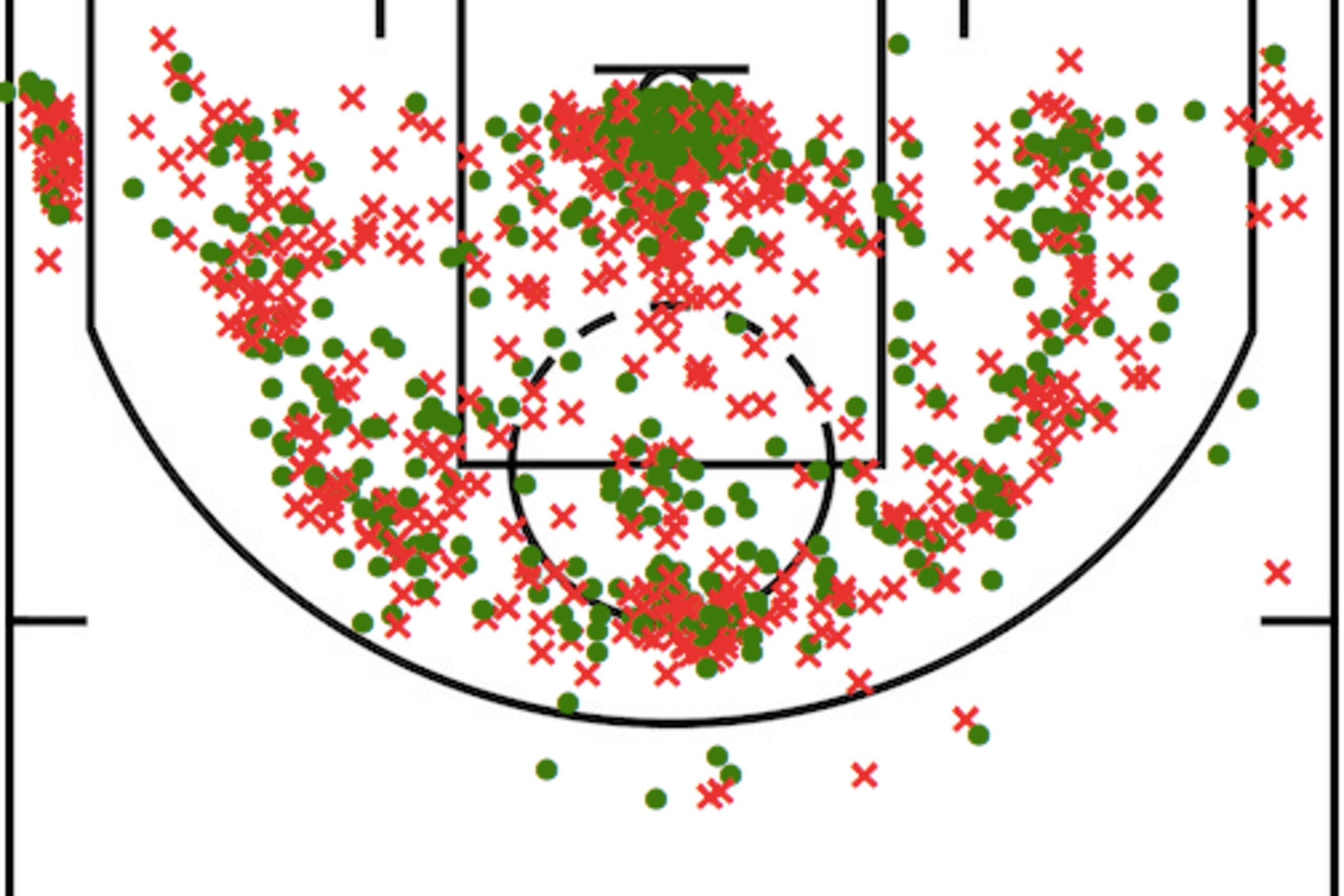
Note the abundance of corner threes, along with the glaring dearth of attempts from the wings. Now take a gander at this year’s chart—again, through only 15 games:
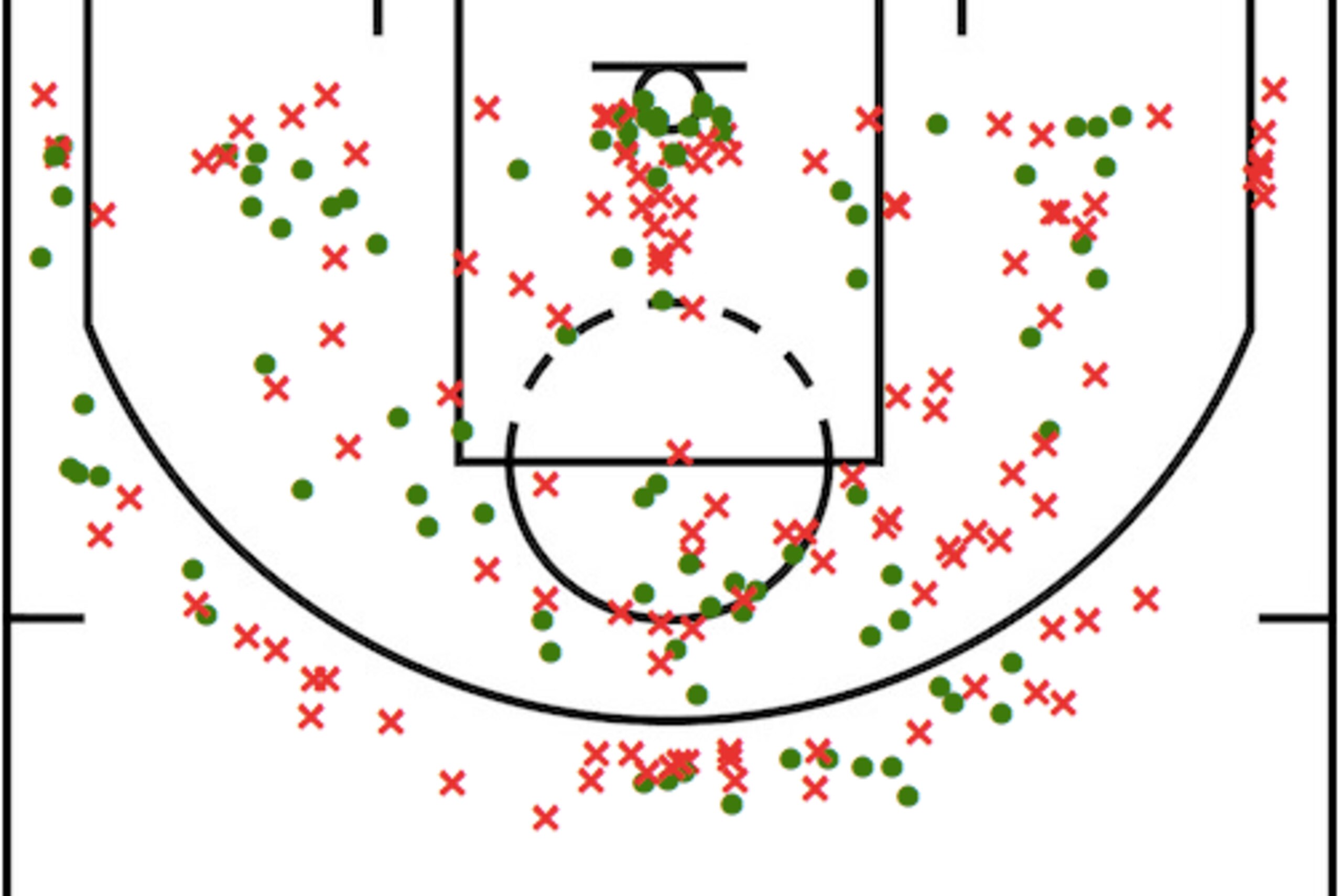
That right corner leaves a bit to be desired, but credit Ibaka for taking what has long been a sneaky strength, percentage-wise, and using it in broader, more effective strokes.
It’s a trend Brooks only hopes to perpetuate, even with Durant and Westbrook eating up half the team’s possessions.
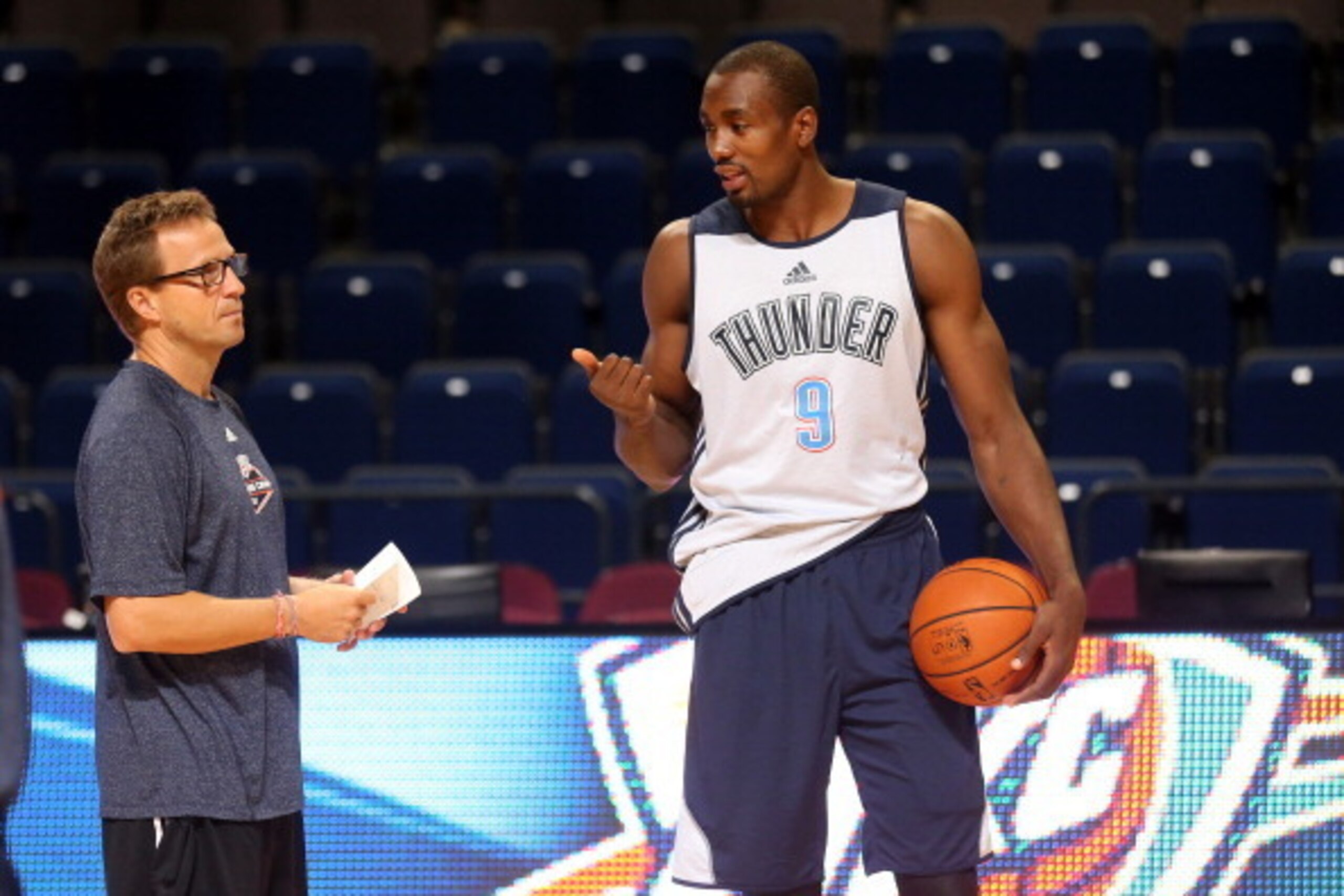
“I think it continues,” Brooks recently told The Oklahoman’s Anthony Slater. “He doesn’t necessarily have to live out there and shoot 10 a game. But three or four a game is a good number for him. He’s a great shooter. He’s not just a great big-man shooter.”
The benefits go well beyond merely bolstering Ibaka’s box score.
For a player already considered one of the best pick-and-pop players in the game, being able to step out further on either wing not only gives OKC a more potent offensive punch but also allows the team’s speed-demon guards—Westbrook and Reggie Jackson—to initiate those sets higher up, where breaking down the defense becomes a much more dynamic proposition.
The importance of Ibaka to the Thunder’s offense cannot be overstated. Per NBA.com, last year OKC registered its third-highest true shooting percentage (minimum of 200 minutes) with Ibaka on the floor (57.3 percent). By contrast, that number dropped all the way to 55.2 percent—the team’s second lowest, based on the same criteria—when Ibaka was on the bench.

And that’s before we even get to Ibaka’s value as a rim protector, long the Congo native’s calling card. He flashes like a fury from the weak side, can guard up to four positions in a pinch and has improved as a one-on-one post defender every year he’s been in the league.
Back in October, Mark Bruty of Thunderous Intentions synthesized the essentials of Ibaka’s value to the Thunder cause:
"Ibaka is the Thunder’s best low post presence, he can space the floor right out to the three point arc (especially in the corners), he defends the rim, protects the paint, is a pressure valve on offense and he is an integral part of the rotation and system. When opposing defenses lock into Russ and KD, he provides a viable offensive option without demanding the ball. When opposing teams run the pick and roll, Ibaka is the guy that can stop the ball or meet the roller at the rim.
"
It’s probably a pinch over-simplistic to suggest the absence of Durant and Westbrook has somehow made Ibaka a better player. In basketball, neither stardom nor struggles are the province of one’s abilities alone. Which is why, to truly thrive, Ibaka needs his foremost allies back in the fray.
All the same, there’s something to be said for being thrust into prominence—the testing of mettle that comes only in knowing you, after years of being seen as a mere tertiary concern, are the marked man.
To climb their way back to contender status, the Thunder will need Durant and Westbrook’s reintegration to be as seamless as possible—to recapture the unique gestalt that's helped make them an ever-looming Finals threat.
Thanks to Ibaka, that whole may have grown both bigger and bolder in scope.
All stats courtesy of NBA.com and current as of November 25, unless otherwise noted.
.jpg?w=2560 "Every Trade's Best Trade Asset 🔁")
.jpg?w=2560 "Insiders: Cowboys Overpaid for Porter")
.jpg?w=2560 "MHJ's Potential Trade Value 📉")