How the New York Giants' Reconfigured Offensive Line Fared vs. Dallas
On Sunday night, the New York Giants unveiled a new-look offensive line partially necessitated due to injuries (right tackle Justin Pugh, quad) and partially due to performance (left guard Weston Richburg).
In case you missed the new lineup because you were blinded by the awesomeness of receiver Odell Beckham Jr.’s amazing fingertip catch (sorry folks, but the video is just mesmerizing), the shuffled Giants offensive line included Will Beatty at left tackle, Adam Snyder at left guard, J.D. Walton at center, John Jerry at right guard and Geoff Schwartz at right tackle.
.jpg?w=2560 "Chargers Mack")
.jpg?w=2560 "Green Bay Steelers Football")
.jpg?w=2560 "Giants Football")
“I wanted to try to create some spark and be able to run the ball a little bit,” Giants head coach Tom Coughlin told reporters after the game when asked why he made multiple changes.
“In last week’s game (against the San Francisco 49ers), there wasn’t any run. I wanted to be able to have some balance to our offense and if that’s what it took, then so be it.”
So how did this new-look offensive line do? Is this combination, the first such change since the original lineup of Beatty, Richburg, Walton, Jerry and Pugh was unveiled back in Week 1, here to stay?
The Group Performance
In a conference call with reporters on Monday afternoon, I asked quarterback Eli Manning what he thought of the new-look offensive line.
“I thought they performed well. I thought we did a good job running the ball, getting some positive yards,” he said. “[Dallas] They got a little pressure at times and got a couple sacks, but that is going to happen in a game. I thought that guys competed and played hard and did a good job. We had a lot of plays, and we were going up-tempo, and they responded well to that.”

Schwartz agreed with his quarterback’s opinion.
“I’m pretty proud of our effort and that we played hard with some new guys in there,” he said following the game.
Statistically speaking, the official game book had the Giants' offensive line allowing two sacks and four quarterback hits. In addition, Pro Football Focus has the offensive line allowing just nine hurries in Manning’s 40 pass attempts.
However, where the offensive line didn’t deliver is in the very same area that prompted Coughlin to try to get a spark: the running game.
New York averaged 2.8 yards per carry in the running game, its second-lowest average of the season behind their Week 1 performance in which the Giants averaged just 2.4 yards per carry.
Even more alarming is that Dallas managed to record seven tackles for a loss against the Giants, the second-most allowed by the offensive line this season, behind the 10 given up to the Philadelphia Eagles in Week 6.
Does that kind of performance warrant sticking with this combination moving forward? If running the ball is the reason why Coughlin made the changes he did, then the answer is no. Let’s explore why in more detail.
The Running Game Production
According to data compiled from multiple PFF pages, the Giants have had more success running to the left side of their formation, where they are averaging 3.6 yards per carry versus the 3.4 yards per carry when running to the right side.
This should come as no surprise as Beatty (3.2 PFF run-block grade) has been the line’s best run-blocker all season.
So how did Snyder, inserted in left guard, do in his first start as a member of the Giants?
Per PFF, he finished with a minus-1.1 run-blocking grade, a grade that no doubt was a result of a few missed chances to cut off a linebacker filling a hole to create one of the seven tackles for a loss mentioned earlier in this article.
However, when it becomes apparent that one side of the line is the stronger when it comes to run blocking, then it makes it a little easier to anticipate what to expect if you’re an opposing defense.
That was the beauty of Schwartz going in at right tackle, as his presence helped boost the run blocking on the right side of the line, which as previously mentioned, wasn’t very good thanks to Jerry’s performance.
Per PFF, Schwartz earned a 3.4 run-blocking grade playing right tackle in place of Pugh, which was the best run-blocking grade on the team this week.
In its Dallas postgame review, Inside Football (subscription required) had this to say about Schwartz’s run blocking:
"Even Schwartz’s run blocking was solid, which includes some very adept positioning on wide runs that the big man easily gained and sustained, thanks to the long arms and his great strength. He was also quite powerful collapsing down on runs to this side. In fact, most of the offense’s best plays came running and throwing right.
"
Per PFF, 60 of the Giants’ 89 rushing yards against Dallas came from the right side. Those yards included Andre Williams’ three-yard touchdown run.
The Offensive Line’s Future
There are probably fans out there who look at Dallas’ offensive line which fields three No. 1 draft picks, and who want the Giants to follow the same path.
That probably won’t be the case, though, and to be honest, it probably doesn’t have to be. With a few tweaks using people already under contract, the offensive line can potentially improve by leaps and bounds starting as soon as next year.
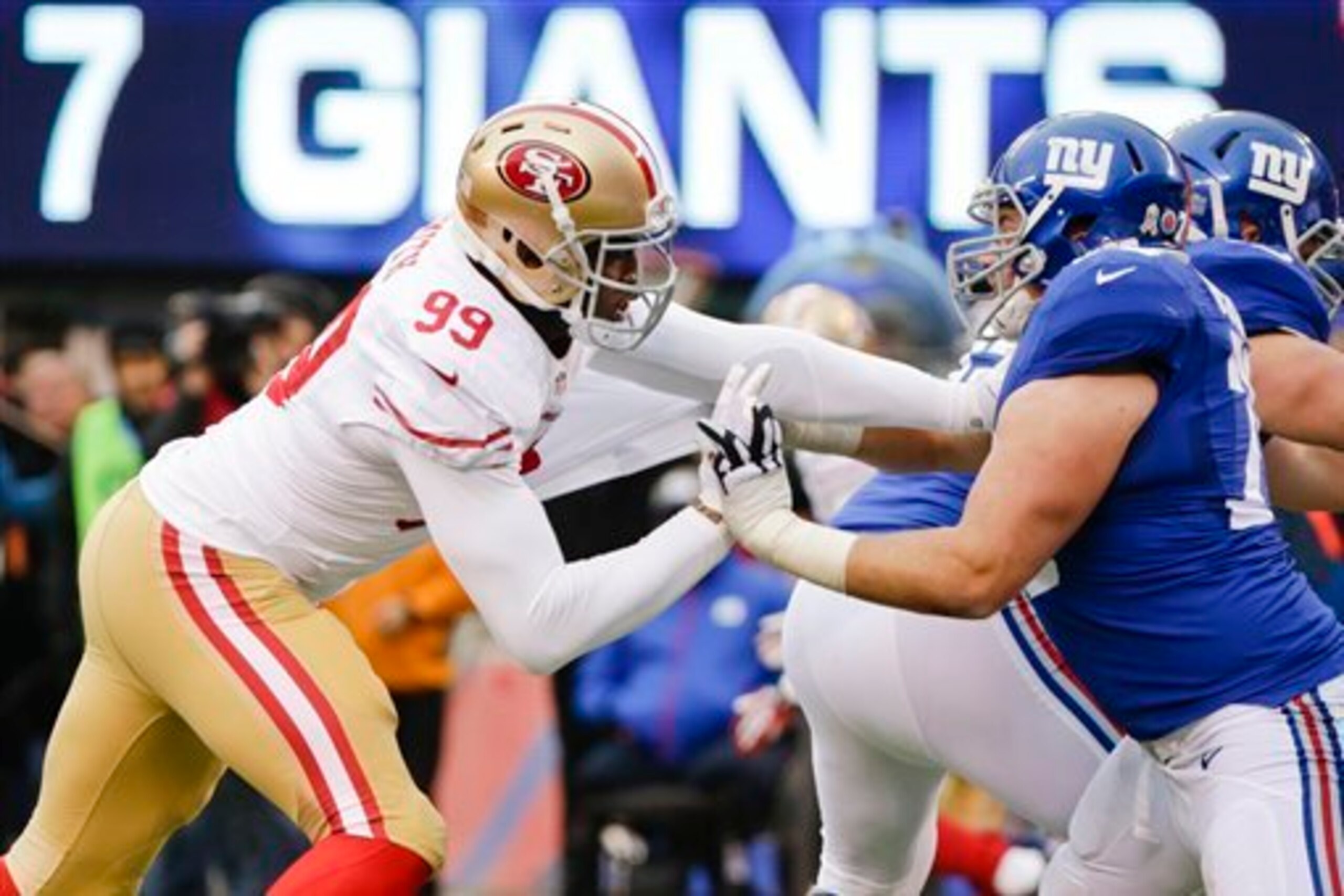
The first move that will be made is to insert Richburg at center. Prior to his benching, Richburg had been playing out of position at a spot where he really didn’t have much prior experience playing.
He also showed that he doesn’t quite yet have the requisite strength to hold up in the trenches. However, that’s nothing that an offseason in the team’s weight-training program can’t fix.
Richburg has demonstrated that he has the intelligence to play at this level. Moving to center next year shouldn’t be too overwhelming for him in his second season now that he has gone through an entire year as an apprentice of sorts to learn what goes into making the protection calls.

The other move that makes sense is to leave Schwartz at right tackle and push Pugh inside to right guard in place of Jerry.
Schwartz has a longer wingspan than Pugh, the latter of whom by the way has struggled this year at right tackle. Schwartz also has quicker feet for the position, which allows him to get set and to get into his blocks a lot faster.
Beatty, who has mainly rebounded from last year’s horror show, will continue at left tackle. That means there will be an opening at left guard for a prospect.
If the Giants can pick up a mauler to play that position—a high draft pick is always preferred, but if there’s a solid free agent worth signing, that wouldn’t be a bad option—the Giants' offensive line will improve significantly next season.
Advanced statistics courtesy of Pro Football Focus unless otherwise noted (subscription required).
Patricia Traina covers the Giants for Inside Football and The SportsXchange. All quotes and information obtained firsthand unless otherwise sourced. Follow me on Twitter @Patricia_Traina.
.jpg?w=2560 "Seahawks Cardinals Football")
.jpg?w=2560 "Commanders Cowboys Football")