
What Happened to the Once-Feared New York Giants Defense?
Hard as it might be to believe given the meltdown in Seattle last week, there was a time when the New York Giants run defense was one of the better units in the business.
These days, that’s not the case, as Perry Fewell, who has been the Giants defensive coordinator since the 2010 season, has seen his one-time top-10 run defense morph into the 32nd-ranked run defense in the league.
| 2014 | 144.7 | 32nd |
| 2013 | 108.9 | 14th |
| 2012 | 129.1 | 8th |
| 2011 | 121.2 | 19th |
| 2010 | 101.2 | 8th |
TOP NEWS
.jpg?w=2560 "Chargers Mack")
Every Trade's Best Trade Asset 🔁
.jpg?w=2560 "Green Bay Steelers Football")
Insiders: Cowboys Overpaid for Porter
.jpg?w=2560 "Seahawks Cardinals Football")
MHJ's Potential Trade Value 📉
Just how bad has it been for the Giants run defense, a unit that this past Sunday gave up a ridiculous 350 rushing yards?
The Giants are 1-4 this year, and 5-12 dating back to last season, in games where they have allowed 100 or more rushing yards.
With Sunday’s meltdown against the Seattle Seahawks, the Giants have now allowed at least 423 yards in four consecutive games for the first time in their franchise history, according to Mike Eisen of Giants.com.
What has been behind the struggles on the run defense and how do they fix it?
The first step is to understand what the problems were. Former NFL quarterback Hugh Millen, now a special contributor to The Seattle Times, offered this opinion about the Giants run defense's showing on Sunday:
"During Russell Wilson’s career, no team has defended the read-zone worse than the Giants did Sunday. Their defensive-end contain was asleep, and the recognition and gap integrity by weak-side linebacker Jacquian Williams was awful.
And when the Giants brought safety Stevie Brown down into the “alley” area Wilson exploited, Brown seemed to forget why he was there and merely filled gaps occupied by teammates.
"
We are going to look at some of the issues that popped up on Sunday. Before we do that, we are going to flash back to last year when the Giants, despite a 23-0 loss to Seattle, held running back Marshawn Lynch and quarterback Russell Wilson to under 47 and 50 rushing yards respectively.
Giants vs. Seattle, 2013: Smart, Disciplined Play Stops the Run
Let’s look back at a play from last year’s matchup that demonstrates how the Giants should have played the run.
The play chosen is from the first quarter, a run for minus-two yards by Lynch, tackled by safety Ryan Mundy.
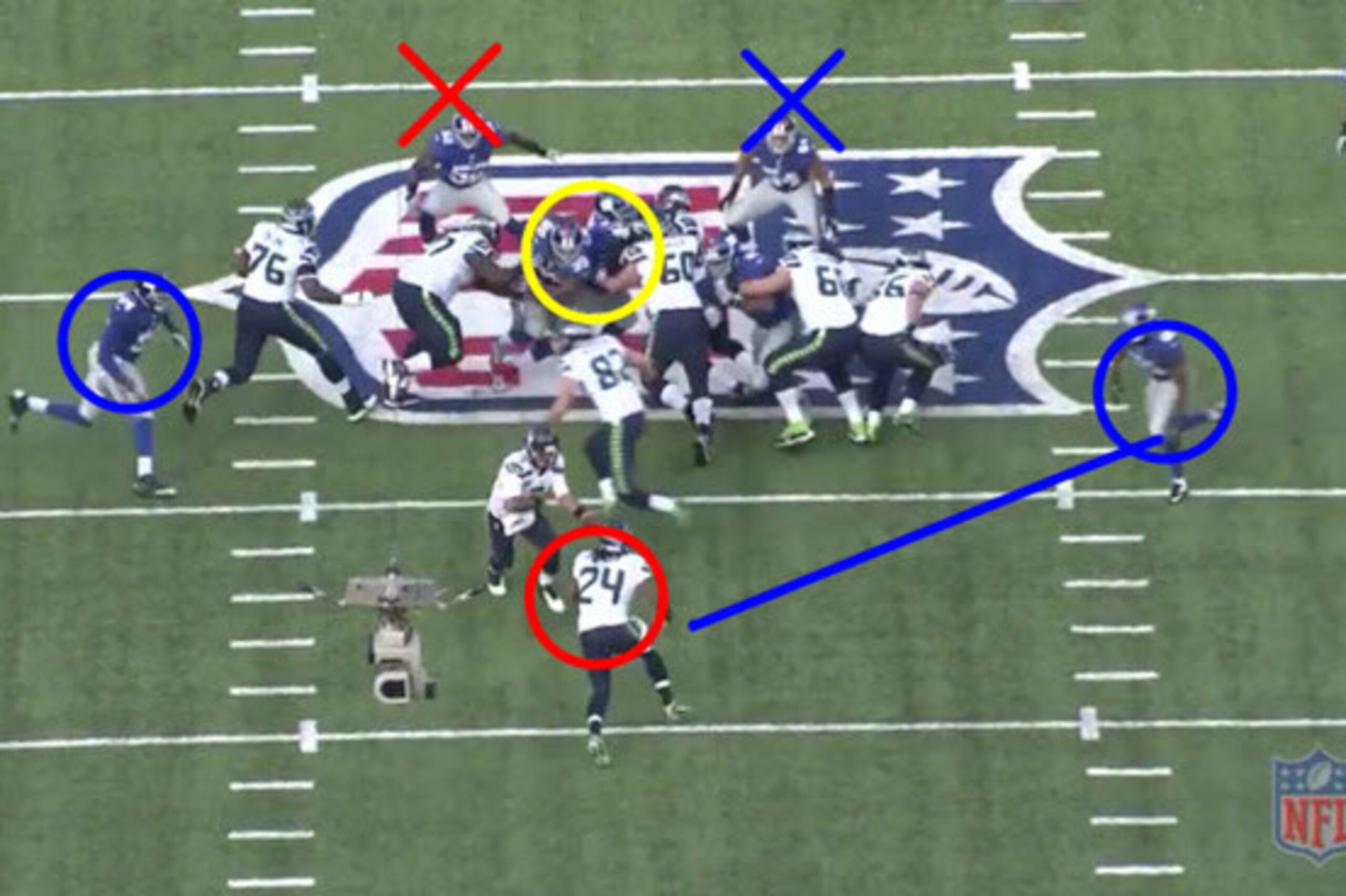
The first thing that jumps out regarding how the Giants defended this play is that both Mundy and defensive end Mathias Kiwanuka (blue circles) secured the edges before Lynch had a chance to take the handoff.
Meanwhile in the inside scrum, defensive tackles Linval Joseph and Cullen Jenkins (yellow circle) have successfully created congestion to take away the inside running lanes.
At the second level, the linebackers, Jon Beason (red X) and Spencer Paysinger (blue X), patiently waited for the play to develop rather than wildly charging straight ahead as soon as the ball was snapped.
By being patient, they were in good position to fill any creases on either side that might have opened up had the Giants lost the battle in the pit or chase down either Wilson or Lynch had one of them gotten past the first level.
Giants at Seattle, 2014: Out of Control
Problem No. 1: Inability to Shed Blocks
At the end of the day, football is all about who wants it more.
Often times it just didn’t seem as though the Giants wanted it more than the Seahawks as they lost more of their one-on-one battles than they won.
On a first quarter run by Lynch that went for 14 yards through the left tackle, no Giants, circled in blue, were able to shed their blocks to take away the rushing lanes.
That included the Giants defensive interior of Johnathan Hankins, who had his worst run-blocking performance of the year per Pro Football Focus (subscription required), and linemate Cullen Jenkins, who returned from a calf injury.
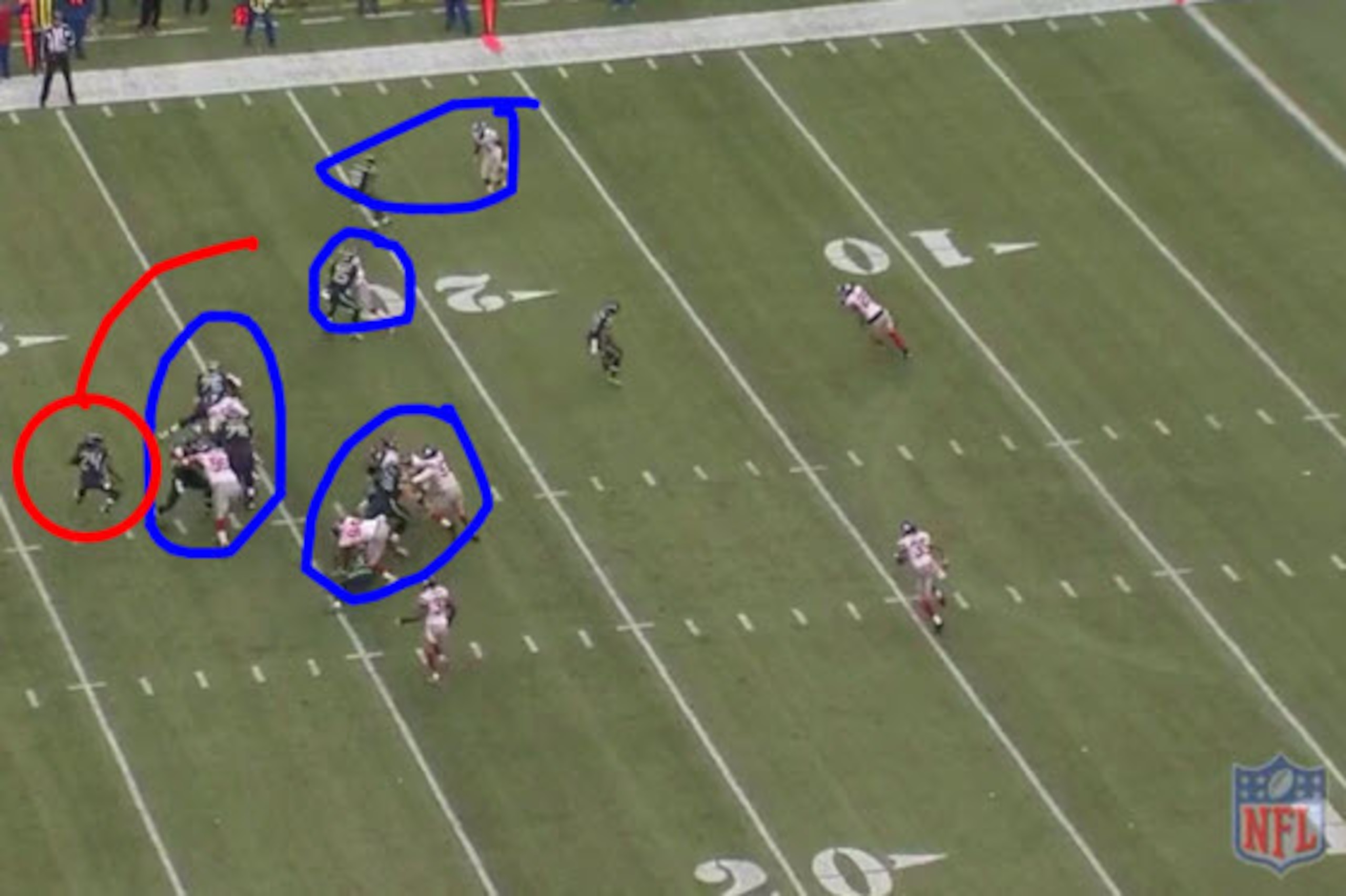
Why did they have such trouble disengaging from blocks?
“We just didn’t play sound football. People weren’t where they were supposed to be, myself included,” linebacker Jameel McClain said via conference call. “We really didn’t play solid football. That is it in a nutshell.”
Problem 2: Jagged Edges
The biggest problem with the Giants run defense by far has been its inability to defend the edges. This was the case on Wilson’s second-quarter run up the gut for 13 yards when the Giants, as they all too frequently did in this game, lost contain.
The first frame shows the pre-snap look. Note how many Giants defenders—three to be exact—are in position just outside the hash marks, which is the area Wilson exploited.
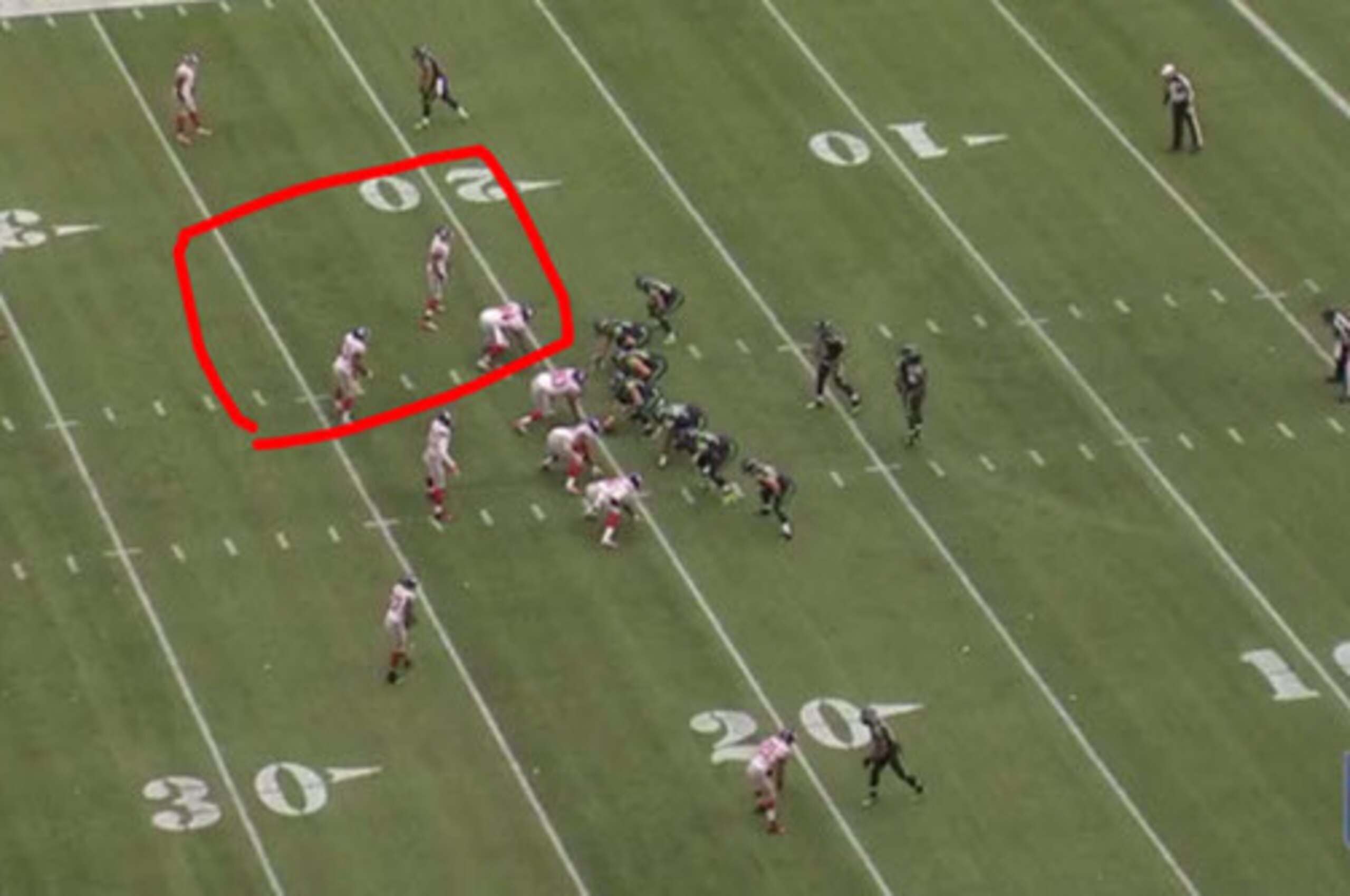
Once the ball was snapped, note where the Giants we marked with the red box in the previous picture shifted. Because they all immediately started to flow to their right, they left Wilson with a gap big enough to accommodate both the quarterback and Mount Olympus.
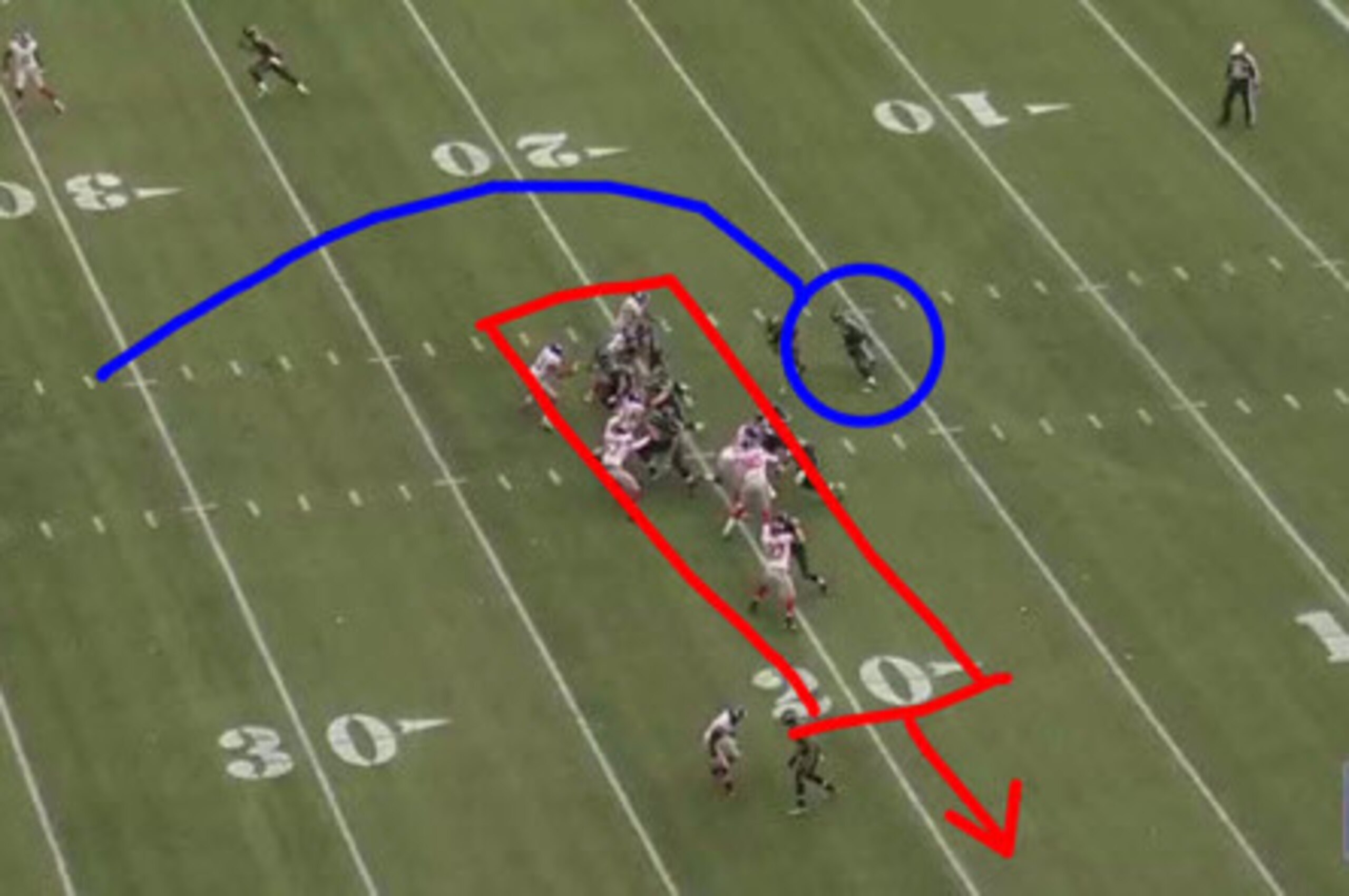
Why did they have so many of these breakdowns? Read on for the final problem.
Problem No. 3: Confusion
Last week, Fewell spoke to reporters about how he was looking to simplify the defense to accommodate the new faces he anticipated having on defense because of the injuries.
"We have to simplify our package," Fewell said. "Obviously, when you have new faces, you can’t, you will not, do as much as you have done in the past, and you have to quickly find out what the strengths of the new faces are, and how much terminology they can digest in a short amount of time."
Well, so much for that intention.
In his weekly radio spot on WFAN, Giants safety Antrel Rolle spoke about how, at times, there was confusion and some communication issues regarding what the defense was supposed to do.
"It’s up (to) the players. If you don’t understand something, you make sure you get with the coaches so you can understand. And if the coaches, you know, if you don’t see a player doing something the right way, it’s up to the coaches to make sure that the player understands his assignments so he can get it done right.
"
McClain, in a conference call with reporters, said the same thing when asked if the issues were correctable.
“It is more communication. It is more attention to detail,” he said. “It is more [if someone doesn’t know], ask a question.”
Here is an example where a defender either fell asleep at the switch or just wasn’t sure what to do.
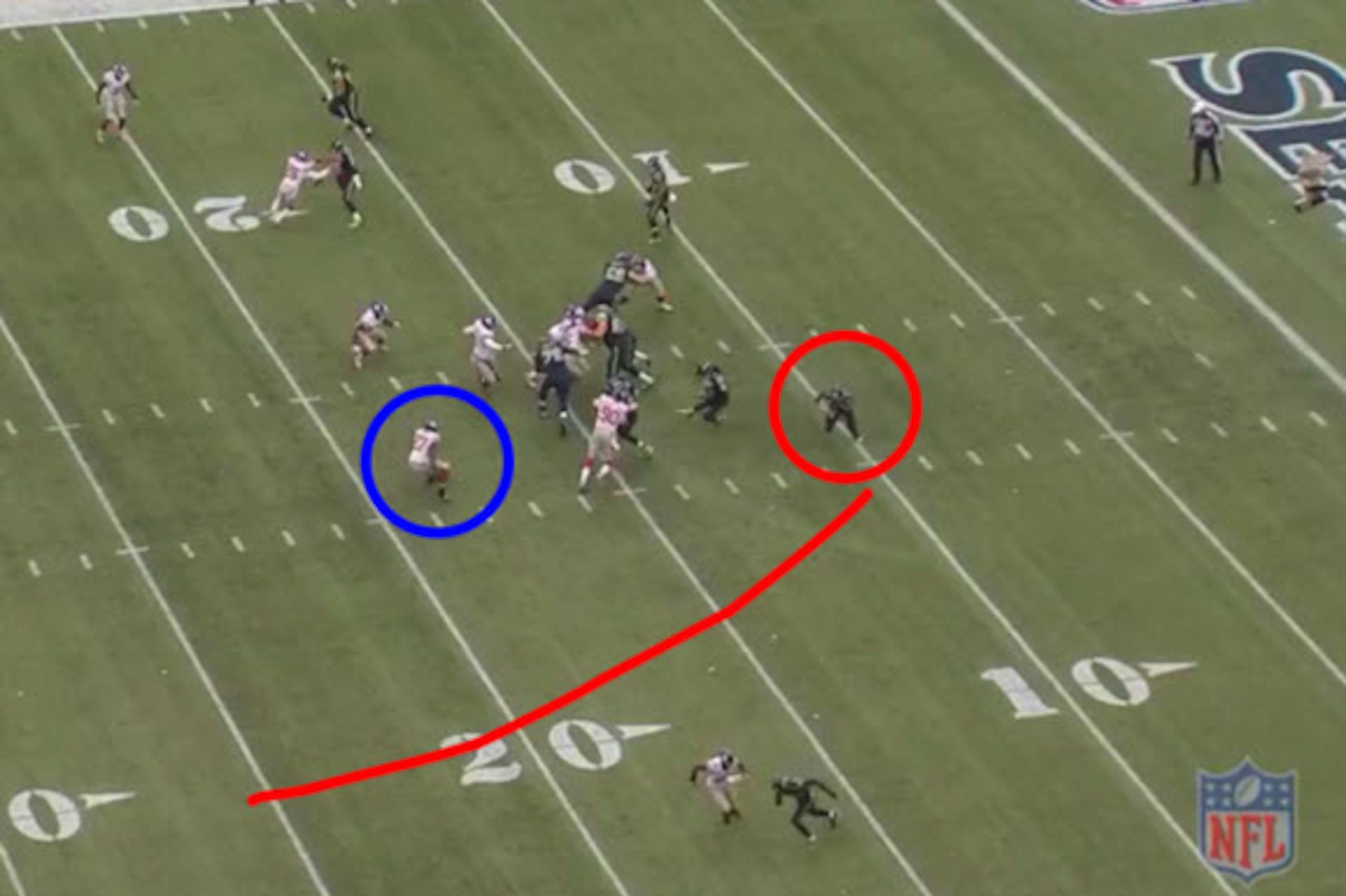
Safety Stevie Brown is the culprit who bites on the play action and starts to charge the backfield, appearing to fail to keep his eye on the quarterback and the ball.
Wilson, who has sold play action, alertly dashes around the edge and through the spot where Brown was supposed to be for the big second-quarter gain and his longest rush of the game.
Here is another view of the play. From this angle, Brown, who again lost track of where the ball was after the snap, is looking at Lynch rather than at Wilson and is anticipating the need to fill the hole.

Had Brown kept his eye on the ball, he probably wouldn’t have been caught out of position and left to chase down Wilson.
Moving Forward
The Giants spent Monday working on corrections, but the results from the run defense’s last few performances right now are very fresh in people’s minds—and that includes opposing offensive coordinators.
The task doesn’t get any easier moving forward. This weekend, the Giants will host the San Francisco 49ers, yet another team that runs the read-option offense that has stumped Fewell and his Giants ever since it made its way to the NFL landscape.
If the Giants haven’t cleaned up the issues that have caused their run-game stock to tumble to rock bottom, it is going to be another long, disappointing afternoon for Big Blue.
Advanced statistics courtesy of Pro Football Focus (subscription required) unless otherwise noted.
Patricia Traina covers the Giants for Inside Football and The SportsXchange. All quotes and information obtained firsthand unless otherwise sourced. Follow me on Twitter @Patricia_Traina.
.jpg?w=2560 "Giants Football")