Progress Report on Houston Rockets' Defensive Improvement Efforts
The Houston Rockets are off to their best start since 1994-95, when they won their last championship. The key to their success has been a renewed attention to defense, as their team has become one of the best in the league at keeping the other guys from scoring.
The most points they’ve given up in a game is 93. Only five other teams in NBA history have started a season in that manner:
| Team | Year | Streak |
| Houston Rockets | 2014-15 | 6? |
| Toronto Raptors | 1979-80 | 10 |
| Indiana Pacers | 2013-14 | 9 |
| Tornoto Raptors | 2003-04 | 7 |
| Chicago Bulls | 1997-98 | 6 |
| Boston Celtics | 6 |
TOP NEWS
Jaylen Brown Calls Out Tatum 🧢
LeBron on President Trump's Criticism
Report: Knicks to Sign Knecht
The Rockets’ schedule has been soft, but to use that as the entire argument to dismiss their early-season success can be a lazy and convenient excuse. They aren’t the only team this year or any other to start with a lighter-than-average slate.
They are, however, only the second team to start 6-0 with all their wins in double digits, tying the 1985-86 Denver Nuggets for that particular record.
The improvement on defense is the reason they’re winning.
The Rockets’ offensive rating of 111.8 this year is nearly the same as last year's 111.0, per Basketball-Reference.com. But the defense has shaved nearly 10 points off last year’s rating, from 106.3 to 96.1.
And interestingly, while the teams on the Rockets’ schedule are generally bad, the offenses they’ve faced aren’t. In fact, three of them are among the seven-most efficient in the NBA.
And in its six contests to date, Houston has held its opponent below its usual scoring five times.
| Team | Offensive Rating vs. Rockets | Offensive Rating | Net Rating | Ortg Rank |
| Los Angeles Lakers | 99 | 105.2 | -6.2 | 17 |
| Utah Jazz | 106 | 112.6 | -6.6 | 3 |
| Boston Celtics | 92.2 | 109.3 | -17.1 | 7 |
| Philadelphia 76ers | 100.1 | 92.3 | 7.8 | 30 |
| Miami Heat | 107.2 | 110.2 | -3 | 5 |
| San Antonio Spurs | 83.8 | 97.7 | -13.9 | 27 |
Even when you factor in the schedule, it’s pretty apparent that the Rockets defense has significantly improved, and that’s a major part of the reason for the team's success.
There are three factors more valid than scheduling which are elevating the Rockets’ rise to defensive dominance: Dwight Howard’s return to form, the addition of Trevor Ariza and the Rockets making it a point of emphasis.
Dwight Howard’s Return to Dominance

The year 2009 called and wants its Howard back.
He is returning to the type of defensive beast who won three consecutive Defensive Player of the Year awards (2009-2011), and that’s a major factor in Houston becoming an elite defense. The tracking data at NBA.com/STATS gives us some insight into that.
Last season, Howard defended 12.8 field-goal attempts per game, yielding makes on 46.1 percent of them. He held opponents to 1.2 percent below their average. Within six feet of the rim, they hit 56.0 percent. Those are solid, but not elite numbers.
This season, Howard is defending 12.2 field-goal attempts per game, but his opponents are shooting just 39.3 percent. And that’s 6.3 percent below what they normally hit. In addition, within six feet of the rim, they’re making just 48.1 percent. Less than 10 feet, they’re shooting 43.2 percent, 9.9 percent below their normal rate. Now, those are elite numbers.
His impact is undeniable. When Howard is on the court, the Rockets' defensive rating is just 85.1. When he sits down, that jumps up to 107.0. He is a compelling reason for their improvement.
It’s early in the season, but if Howard keeps doing this, he’s going to win another Defensive Player of the Year award.
The Addition of Trevor Ariza
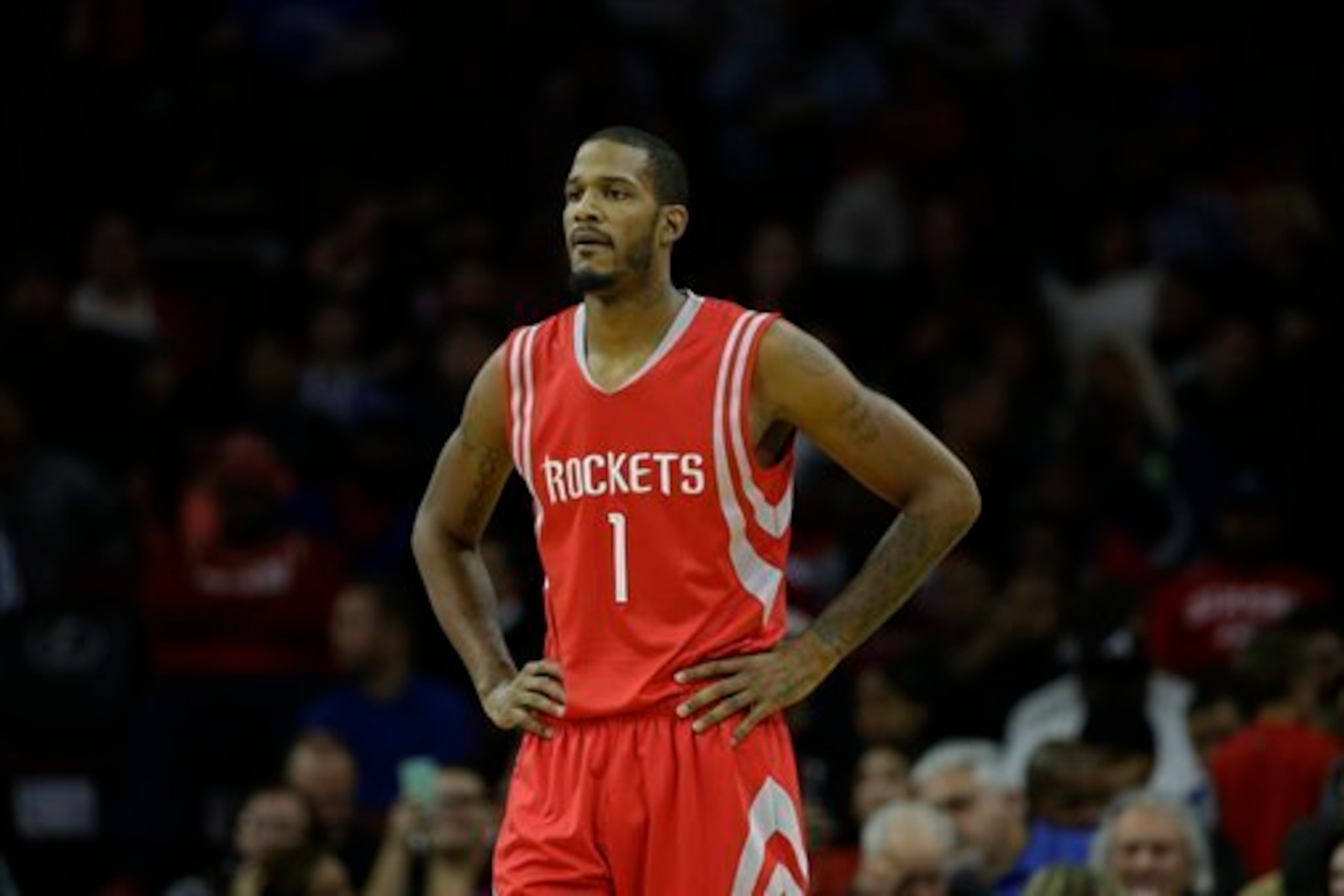
When the Rockets transitioned from Chandler Parsons to Trevor Ariza it was nearly universally considered a downgrade, but to this point in the season, it seems Ariza is an improvement, and a big part of that is his superior defense.
When Ariza is defending the shooter, the Rockets are making their attempts at a 38.8 percent rate and just 29.4 percent of their threes. Within 10 feet of the rim, they’re hitting 40.0 percent of their tosses, 11.6 percent lower than normal.
Compare that with Parsons’ numbers last year. Opponents shot 42.9 percent against him, which was just 1.9 percent below their average. From three they made 36.0 percent, which was .2 percent better than the norm. From less than 10 feet, they were 58.2 percent. Ariza is a clear improvement.
Ariza has supplemented his superior defense while actually giving the Rockets more efficient offense. His player efficiency rating of 20.7 is better than Parsons’ 15.9 from last season.
If all Ariza does is keep giving the Rockets better offense and better defense, then it’s going to be hard to not call him an upgrade.
The Emphasis on Defense

This preseason you couldn’t talk to players on the Rockets without “defense” being one of the first words out of their mouth. It was clearly a point of emphasis. And one could probably gather that a big part of the reason for that was James Harden.
Harden’s indifference to the less glamorous side of the ball gained him viral-video fame when an 11-minute montage of him not playing defense was posted on You Tube.
Even general manager Daryl Morey noticed and came to Harden’s defense, telling Sam Amick of USA Today:
"For whatever reason, it has taken on a life of its own. You've got people doing a 10-minute YouTube clip that everyone references, and I just ask anyone, 'Take your worst 10 minutes from your job the last year and just take those worst 10 minutes and put them in a YouTube clip.'
I'm guessing it wouldn't come out very well for anybody. That, to me, was completely unfair. That bothered me in a big way. Without context, you can grab 10 minutes of anyone and make them look like (expletive). I think reality TV proves that.
"
That said, while the defensive emphasis applied to the whole team, it appeared to be a way of nudging Harden into self-awareness. And it seems he woke up.
His opponents are shooting 41.5 percent against him and 33.3 percent from deep. That’s an improvement from last year’s 42.4 percent from the field and 35.2 percent from behind the arc.
Statistically, Harden has been above-average this season, holding opponents 1.1 percent below their overall rates and 2.8 percent below from three. He’s not going to become All-Defensive team with those numbers, but we might start being able to throw the word “middling” into the conversation, which is a huge upgrade for him.
While Harden is still giving up a hefty 68.2 percent field-goal percentage inside of six feet, he’s averaging 3.2 shots defended from that range, which is .5 more than last year.
That’s counterintuitive. He’s trying to defend more shots, but that results in a high percentage. Even if he’s not succeeding very often, he’s succeeding more than if he didn’t try.
The eye test shows he’s giving effort too.

For example, in the San Antonio Spurs game, on one occasion he rushed back in transition and was the only defender in a two-on-one break. He stuck with the play, first defending the ball-handler, then the pass and then getting the block out of bounds.
It was a nice defensive play. It wasn’t the type of highlight to land on the SportsCenter Top 10 or anything, but it was nice. That’s not what he would have done last year, a time when he would have given up on the play.
It’s the kind of effort that Houston is hoping to get from Harden. All it needs is average from him, not elite. And it's getting that.
Don’t be too quick to dismiss the Rockets' success. The schedule will get harder, but if the other factors remain consistent, there’s every reason to believe that the Houston can maintain its status as a good-to-elite defensive team.
Stats for this article were obtained from Basketball-Reference.com and NBA.com/STATS.