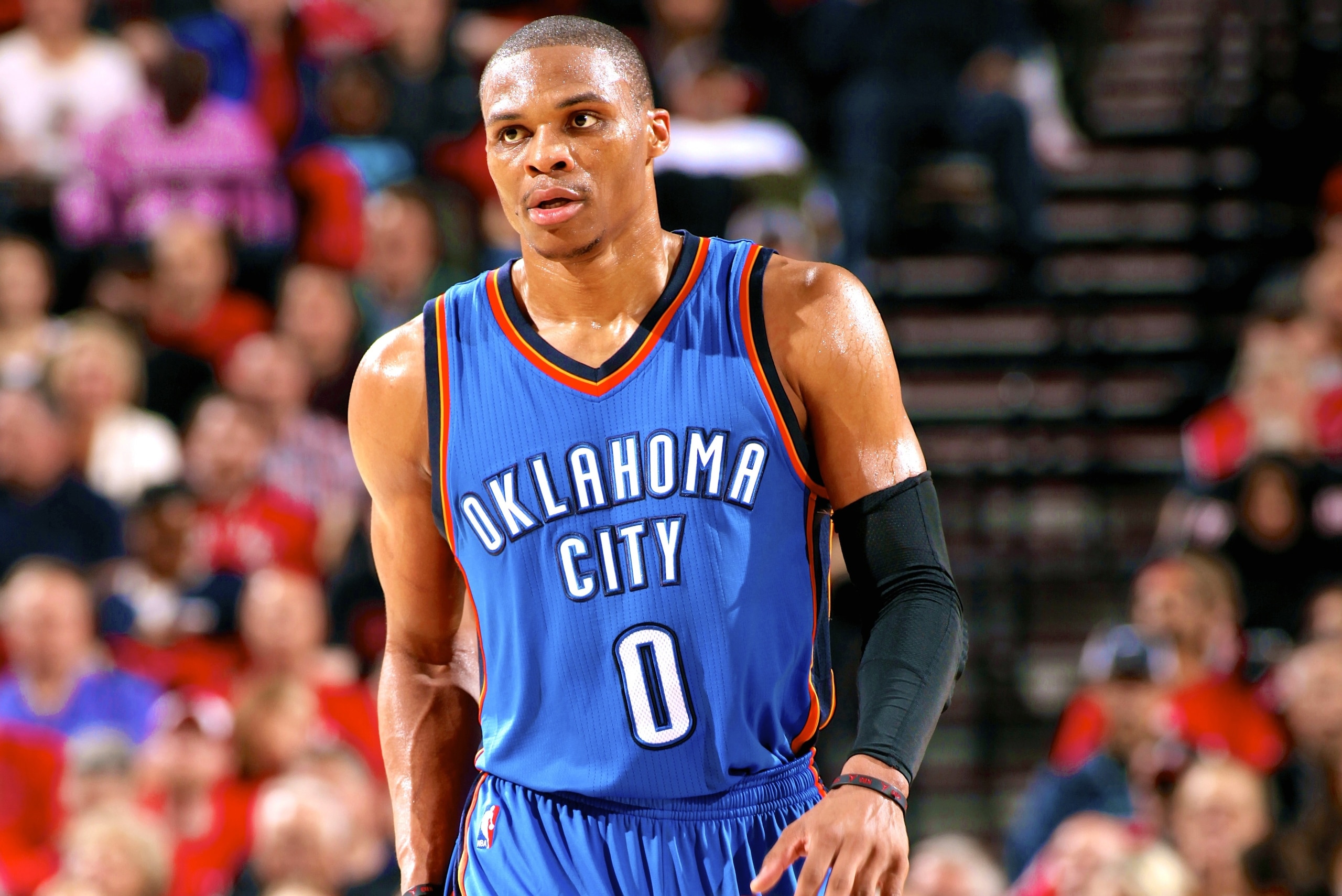


Russell Westbrook looked every inch the leader in the Oklahoma City Thunder's 106-89 season-opening loss to the Portland Trail Blazers. And in the end, his act of stepping up while his team fell short perfectly encapsulated what his early-season ride will be like without Kevin Durant.
No matter how great he is, it's going to be tough.


Working Hard, Working Alone
Against Portland, nobody was tougher than Westbrook. He dominated the game from the outset, scoring and facilitating at will. Of OKC's first seven field goals, Westbrook was responsible for scoring or assisting on six.
Damian Lillard practically disappeared as Westbrook drove home the point that, for all of the young Portland guard's talent, there was still a significant gap between the two. At times, it felt as though Westbrook was not only out to prove he could lead his team on offense, but also that he could eliminate an All-Star on the other end.
Westbrook reached the 20-point mark before Lillard even registered a bucket.
And while Lillard didn't score until the 10:08 mark in the third quarter, Westbrook closed out a sterling first half with the highlight of the night.
OKC's one-man wrecking crew had no choice but to try to knock down the Blazers by himself; Durant wasn't the only Thunder player in street clothes. Joining him were Anthony Morrow, Reggie Jackson and Jeremy Lamb, or as you may know them, Oklahoma City's entire wing rotation.
Tasked with running things alone, Westbrook somehow managed to avoid forcing shots—a habit he routinely caught heat for whenever those attempts cost Durant chances. It was ironic, really: Westbrook would have been excused for hoisting up ill-advised prayers in this one. Nobody would have minded if Perry Jones III lost out on a few looks.
But Westbrook played a high-percentage game, giving up his wild heaves and working himself to the foul line with incessantly aggressive drives.
He flashed the old tricks that made him a nightmare for anyone to guard, but he also broke out a few new ones.
Blazers head coach Terry Stotts eventually realized Lillard was overmatched.
So he tried other options, including rangy defender Nic Batum.
When that didn't work, Stotts sent a third body into the fray.
Regardless of the defender in front of him, Westbrook pressed on, determined as ever.
In the end, he finished with 38 points, six assists, three rebounds, three steals and just two turnovers. He connected on 11 of his 26 shots and nailed 15 of 16 from the foul line. In short, he did everything within his power to give OKC a chance.
But Westbrook's best wasn't enough. The Thunder's depleted collection of backups weren't up to the task—and nobody really expected them to be.
Let's put it this way: Lance Thomas was the first man off the Thunder bench, and he hasn't exactly been a household NBA name during his brief career.
Sebastian Telfair was clearly out of his depth in relief of Westbrook, going 1-of-9 from the field in 15 minutes.
Kendrick Perkins was Kendrick Perkins.
Even typically reliable members of OKC's rotation failed to pull their weight. Nick Collison couldn't find the range on his jumper, and Serge Ibaka failed to create his own shots. When he tried, things went badly, and the talented power forward turned the ball over more often than he put it in the bucket.
He had five giveaways and four field goals on the night.
Some Perspective

It's dangerous to overreact in any direction after OKC's loss, largely because the Blazers are no joke. They notched a postseason series win last year, are tough to beat at home and, most of all, entered this contest completely healthy.
In addition, Westbrook isn't going to pile up 38 points and take nearly flawless care of the rock every night. Hopefully, he won't have to; his teammates are unlikely to keep abandoning him like they did against Portland.
What we can say, though, is that Westbrook passed the first of many tests he'll face without Durant. Losing this game hardly matters in the grand scheme of his new (if temporary) role as alpha dog. Remember, this is totally uncharted territory for him.
Over the past five seasons, Westbrook has played just five games without Durant at his side. All things considered, he performed better than anyone could have expected.
Just as critically, Thunder head coach Scott Brooks passed a test of his own when it came to handling Westbrook—one that showed a change in philosophy that could have far-reaching effects. Brooks pulled Westbrook in the fourth quarter after Portland had flexed its muscle and expanded the lead.
"Scott Brooks on managing Russell Westbrook's minutes: "It's never easy to take him out. ... But you've got to be smart."
— Ben Golliver (@BenGolliver) October 30, 2014"
Westbrook played just 33 minutes.
We all know how Durant logged more playing time than anyone over the past four years, and Brooks' penchant for leaning on stars has resulted in postseason fatigue in the past. In Portland, he eased off, removing Westbrook at a juncture when, before, he might have left him out there to keep fighting.
There's nothing good about Durant's injury. But if both Westbrook and Brooks can use it as an opportunity to develop their respective crafts (and prove critics wrong), it doesn't have to be all bad either.


.jpg?w=2560 "NFL House in Paris Closes for Protests")
.jpg?w=2560 "Trevon Diggs Cut by Seahawks")


