Vikings Offense Continues to Evolve, Improve Under New Personnel
The Minnesota Vikings offense has gone through trying times up to this point in the season. A glut of injuries and a not-so-under-the-radar suspension have ravaged their personnel on offense, but offensive coordinator Norv Turner has begun to evolve his scheme to get the most out of the replacements.
Because the coaching staff installed a new offensive scheme, rough patches were destined to follow. The basis of Turner’s offensive philosophy, an offshoot of the “Air Coryell” system, is not especially complicated. It does differ quite a bit from the schemes of his predecessors in Minnesota, though. Turner mixes run-blocking schemes, using more zone-blocking concepts than previously seen in Minnesota.
TOP NEWS
.jpg?w=2560 "NFL Paris Football")
NFL House in Paris Closes for Protests
.jpg?w=2560 "Seahawks Chiefs Football")
Trevon Diggs Cut by Seahawks
.jpg?w=2560 "Colts Football")
Jonathan Taylor Landing Spots
Coming into the season, Turner surely knew he would be continuously tweaking his game plans and his play-calling as he learned more about his players. What he didn’t know was that his unit would be greatly diminished by injuries and off-field situations well before the halfway point of the season.
Adrian Peterson was the first straw. Losing the game’s best back and the Vikings’ best player completely shifted the offensive outlook.
Then the injuries piled on. The Vikings lost starting quarterback Matt Cassel in Week 3. Whether or not his rookie replacement, Teddy Bridgewater, is better or not, the QB switch affected the offense from a planning standpoint.
Losses piled up elsewhere as well. Starting right guard Brandon Fusco was lost for the season with a pectoral injury, and tight end Kyle Rudolph went out indefinitely with a groin injury.
As a team without quality depth, Minnesota lacked viable replacements for all but Cassel.
Turnover has also occurred in the starting lineup in the backfield recently, as rookie Jerick McKinnon has taken the reins at the starting running back position. That puts the Vikings in an uncommon and suboptimal situation, relying on a rookie quarterback and first-year running back in the starting lineup.
Down to a McKinnon, a raw rookie, and a career third-string back in Matt Asiota, the Vikings running game has slowly evolved to the point where a unit of misfits was able to gash the Bills for 158 rushing yards in Week 7. More impressively, Minnesota did it without center John Sullivan or right guard Vlad Ducasse for most of the game.
Against one of the league’s best defensive fronts, this was not supposed to be possible. The Vikings more than doubled the average yardage opponents had picked up on the ground against Buffalo prior to Week 7:
"The #Bills run defense has already allowed 120 rushing yards today. Coming into this week, led NFL allowing just 67.5 rushing yards per game
— Buffalo Bills Draft (@BillsDraft) October 19, 2014"
In the last four games, the Vikings have run for 579 yards with an even five yards per attempt. In the two games following the Peterson departure, the offense only mustered 113 rushing yards on 2.8 yards per carry. So how did the Vikings running game get to this point after anemic showings earlier in the year?
Turner’s adaptability has a lot to do with it. The most obvious adjustment made in the Buffalo game was emphasizing perimeter rushing plays. Through the first six weeks, McKinnon’s runs went in the following directions":
| Left Off Tackle | Left B | Left A | Right A | Right B | Right Off Tackle |
| 8 | 6 | 6 | 10 | 1 | 12 |
Off tackle represents rushes to the outside of the offensive tackle and beyond. The B-gap represents the gap between the tackle and the guard on either side and the A-gap between the guard and the center.
His usage differed little from Matt Asiata’s, though the two are very different backs in size and athletic capability. Against Buffalo, that changed:
| Left Off Tackle | Left B | Left A | Right A | Right B | Right Off Tackle |
| 3 | 3 | 1 | 1 | 2 | 7 |
The rookie was able to stretch the Bills horizontally and get to the outside, using his acceleration and top-end speed to pick up big gains.
Turner's play-calling accomplished this with tosses and sweeps, which allowed lead blockers to outflank Buffalo's defense. After Minnesota received the opening kickoff, the second and third plays of the game, usually scripted, were both tosses to McKinnon.
The first netted 11 yards. Let’s look at why it worked so well.
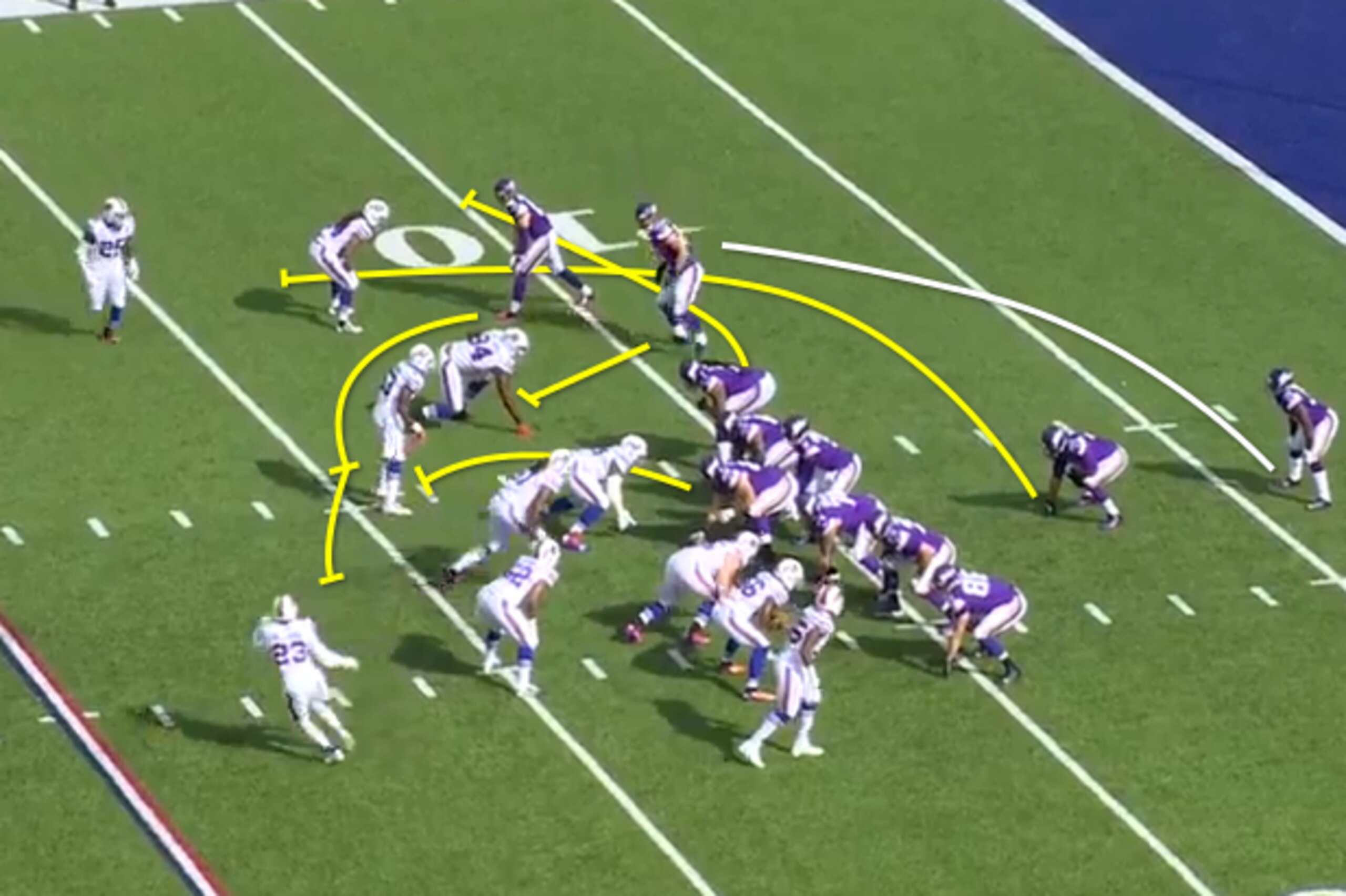
After motioning in from the outside, tight end Rhett Ellison cracks back on the front-side defensive end. Getting the edge sealed is step No. 1 in any toss play. Phil Loadholt then wraps around and leads up the field, shortly followed by fullback Jerome Felton.

By the time McKinnon reached the perimeter, his convoy of blockers had wedged open a big rushing lane for him to accelerate through.
These perimeter running plays, whether sweeps or tosses, give the Vikings the ability to attack the edge of a defense with a back capable of ripping off gains in space. With Matt Asiata given the majority of carries, this was not possible. His lumbering style limited how much yardage he was to gain on perimeter running plays. Now that McKinnon has the lion’s share of carries, changes to the Vikings rushing attack are underway.
Tosses with lead blockers weren’t the only way the Vikings were able to run the ball successfully off tackle.
With changes to the offensive line accompanying the shift to a McKinnon-led rushing attack, Turner has integrated more zone blocking up front. Zone blocking can help simplify the tasks of offensive linemen in the running game. With Mike Harris, a tackle by trade, rushed into duty at right guard and a backup center at the point against Buffalo, this adjustment made sense.
Chris B. Brown of Smart Football explains the simplicity of the inside zone-running play, one with which McKinnon and the Vikings line had success:
"The “zone” aspect comes in with “uncovered” linemen. If “uncovered,” the lineman must step “playside”—i.e. the side the run is going to—and help double-team the defensive linemen along with his “covered” cohort. Once the two of them control that down defensive lineman, one of the offensive linemen slides off to hit a linebacker. It’s not that complicated.
"
No matter how the defense aligns, the blocking duties can be easily executed. These plays are a big reason for McKinnon’s success between the tackles and the offensive line’s success in freeing him up.

Matt Kalil steps out and blocks the end. Left guard Charlie Johnson and center Joe Berger combine to take the nose and linebacker stacked behind. The same goes for Harris and Loadholt with the 3-technique tackle and linebacker.
Then as soon as McKinnon takes the handoff, he wants to read the leverage of his blockers. Zone-blockers are often taught to take a defender where he wants to go. Utilizing power to drive the defender is still important, but no set destination exists. The back reads his blocks and makes the appropriate cuts.
As is clear from the end-zone angle, Loadholt has wedged open a hole with his down block on Bills tackle Kyle Williams.
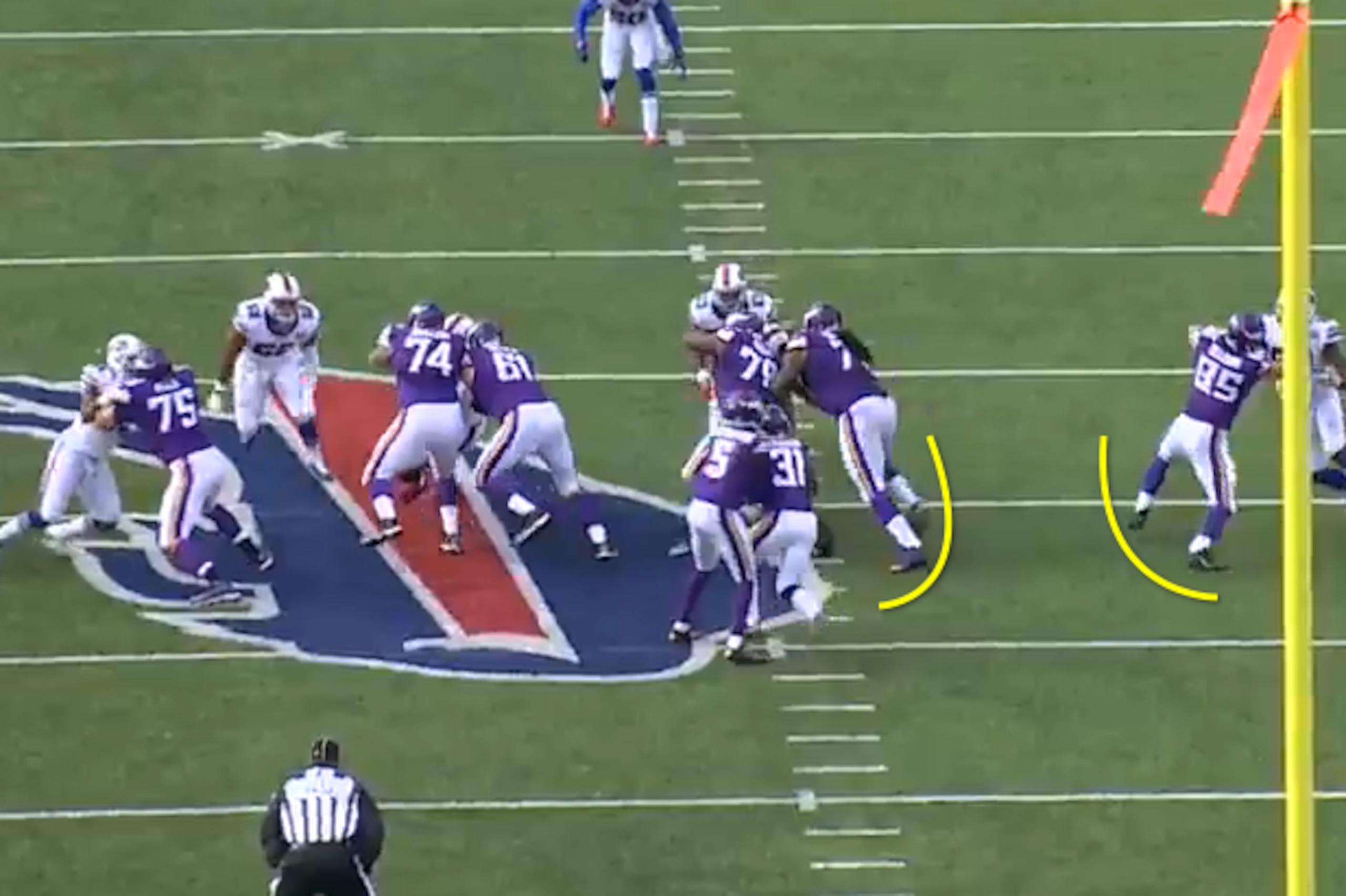
McKinnon plants his left foot and rushes off the outside shoulder of his right tackle. But then the linebacker and a cornerback come into play, quickly reacting to McKinnon’s cut.
The rookie has the wherewithal to make a second cut and stay behind Loadholt, keeping his balance and breaking off a nine-yard gain after emerging from the congested mess.
More examples of zone running are the option plays Turner has added to utilize Bridgewater’s decision-making skills and mobility. Some of the calls give the rookie quarterback run-pass options. Others simply leave a defensive end unblocked, letting Bridgewater give or keep based on the read.
This earns the offensive line a greater numerical advantage, not needing to account for the free end. With the potential for pass plays involved, zone-blocking is often attached to read-option plays. It keeps run blockers from moving down the field illegally.
In the offense’s quest to seal the victory in Buffalo, it went to a zone-read play that sprung McKinnon for 13 yards and a first down.
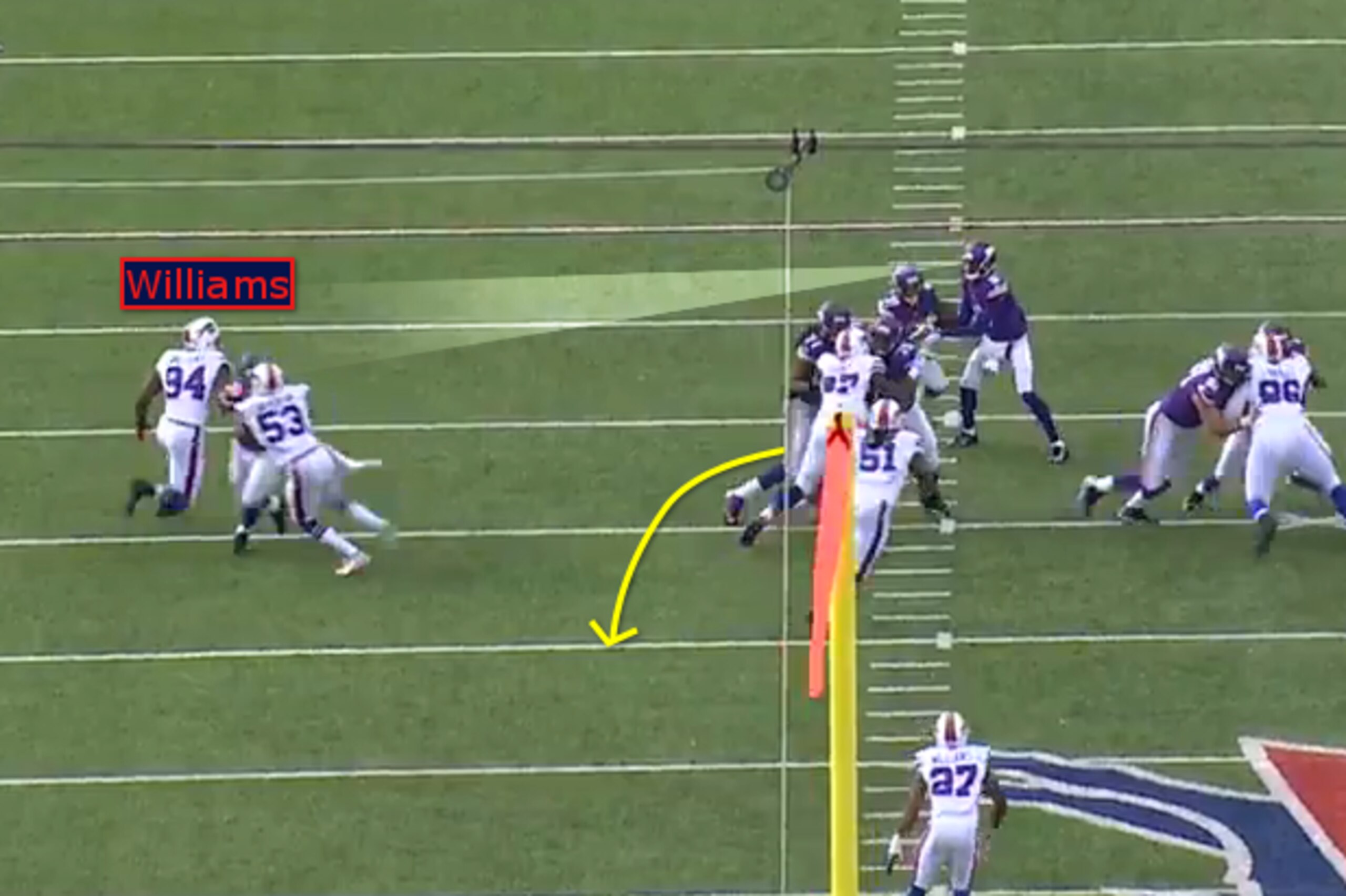
Bridgewater reads the unblocked end, Mario Williams. Because of Buffalo’s wide alignment, it’s an almost automatic give for the quarterback. The play offers Loadholt an easy double-down block on the defensive tackle and then he is to slide up to the linebacker, which he does successfully.

In terms of running behind blockers, this qualifies as an off-tackle carry. The zone scheme changes the way the direction of runs is defined because of how variable the blocking can be.
Minnesota’s offensive line creating a monster hole like this one was not a part of the script, but the offensive adjustments helped simplify the tasks for the offensive linemen and utilize the skills of the Vikings’ best runner.
McKinnon has made big strides in vision and decision-making as a runner, which gives Turner even more liberties as a play-caller.
These offensive adjustments are enabling the Vikings to maximize output from an offensive unit lacking the playmakers it expected to have to open the season. Turner’s tweaking has breathed life back into the rotting corpse that was the Minnesota running game.
Continuing to adapt is the only way for offenses to sustain success in the NFL, especially when they cannot simply beat defenses with talent. The Vikings are most certainly in that situation, so the way Turner is crafting this offense to the personnel he’s forced to make due with is providing the ground game a fighting chance and then some.
Statistics via ESPN.com unless noted otherwise.
.jpg?w=2560)