

How Donte Moncrief Can Help Transform the Indianapolis Colts Offense
In the third round of the 2014 NFL draft, the Indianapolis Colts selected Donte Moncrief, wide receiver from Ole Miss.
And the people did rejoice.
Moncrief's selection was met with more initial joy than any Colts pick since the 2012 draft, not even necessarily because of the player himself, but because of what he represented: a commitment to a dynamic passing offense. Then, of course, there's the fact that Moncrief was one of the best size and speed combinations at the position, comparing favorably to players like Cordarrelle Patterson and Andre Johnson.
TOP NEWS
.jpg?w=2560 "Chiefs Giants Football")
Mahomes Told Teammate to Leave Meeting

Geno Explains Wilson Exchange

McCarthy Wins 1st Giants Start
Basically, people were excited about Moncrief, and who could blame them?
But, it was also an accepted fact that Moncrief would be a project, more than an instant impact. The Colts already had 2012 third-round pick T.Y. Hilton, returning veteran Reggie Wayne and free-agent addition Hakeem Nicks, in addition to former UDFA fan-favorites Griff Whalen and Da'Rick Rogers.
Moncrief would have to wait for his shining moment, but the talent around him also gave him plenty of mentors to learn from.
After Moncrief stood out in training camp, he quickly became a player to watch. Once the Colts struggled to get a downfield passing game going in the first two weeks of the season, the prospect of a big, fast receiver to stretch the defense became an even more tantalizing option.
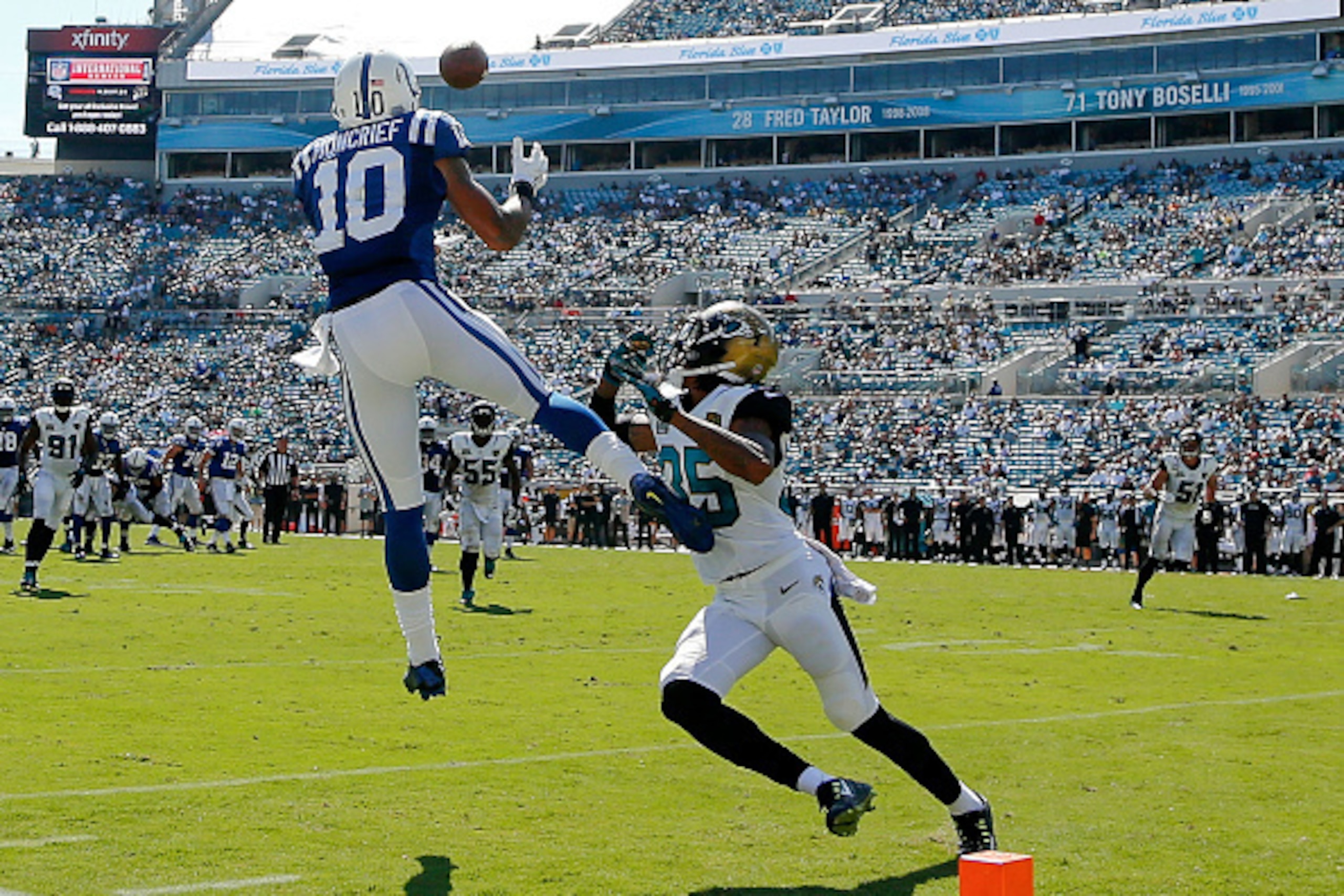
Moncrief had gotten snaps in each of the first three weeks, but he was limited to single digits until the Colts' win over Jacksonville, where a blowout and a mild ankle injury to T.Y. Hilton opened the door for Moncrief. Now, we have three games of Moncrief, combining for 24 total snaps in the passing game. While one game was against the lowly Jaguars, the results for Moncrief have been overwhelmingly positive.
You can see it in traditional stats, with the former Ole Miss receiver being targeted just seven times for six receptions and 80 receiving yards. But I wanted to dig a little deeper, so I tracked each passing play that Moncrief was on the field for, to get a better sense of how the Colts have utilized his talents. What I found was illuminating.
With the rookie on the field, the Colts have averaged 10.65 yards per dropback this season. With Moncrief on the sideline, the Colts have averaged just 5.85 yards per dropback.
Against the Jaguars, with Moncrief playing increased snaps, the difference was stark, as the Colts averaged 12.3 yards per dropack with him, versus 5.8 without him. It's not just a coincidence, although part of the difference is simply the Colts' willingness to throw the ball deep with more receivers on the field.
Some of that increase is because of the threat Moncrief is, with a variety of ways to attack the defense.
| Go | 5 | 25 | 2 | 1 | 22 | 19.8 |
| Skinny Post | 3 | 30 | 0 | 0 | 0 | 5.67 |
| Curl/Comeback | 6 | 9 | 1 | 1 | 10 | 5.5 |
| Crossing | 4 | 2 | 2 | 2 | 12 | 10.25 |
| Dig/Out | 2 | 5 | 1 | 1 | 16 | 13 |
| Screen | 2 | -2 | 1 | 1 | 21 | 14.5 |
| Wheel | 1 | 15 | 0 | 0 | 0 | 0 |
The Colts used Moncrief to stretch the field throughout the last three games, running go routes or skinny posts on 35 percent of his snaps. But Moncrief also attacked shallow zones, running crossing routes or other routes for less than 10 yards on 43 percent of his snaps. The remaining 22 percent was largely 10-yard curl routes.
Moncrief was able to use his speed and balance to elude defenders for yards after the catch on those shallow routes, picking up 41 of his 80 yards after the catch. That included a 21-yard screen pass, the only one of the Colts receiver screens that has been successful so far this year.
His stretching the field has resulted in big plays, too, as his 22-yard back-shoulder catch set up a touchdown.
It's a bit reminiscent of how the Colts use T.Y. Hilton, using shallow crossers and comebacks to get the defensive backs to start biting low before attacking them deep. But, if you track Hilton's routes, you get a much more varied look.

Check out these routes from Hilton's big game against Kansas City in the playoffs, for example. Sure, there are crossers, shallow digs and go routes. But there are also deeper outs and crossers that play with the intermediate zones of the field a bit more. That's one area that Moncrief can expand to as he grows in his knowledge of the offense.
But Moncrief's impact goes beyond his own targets. Just the mere presence of another deep threat causes defenses to pay attention, and it opens up room for others. That was clear several times in the win over the Jaguars.
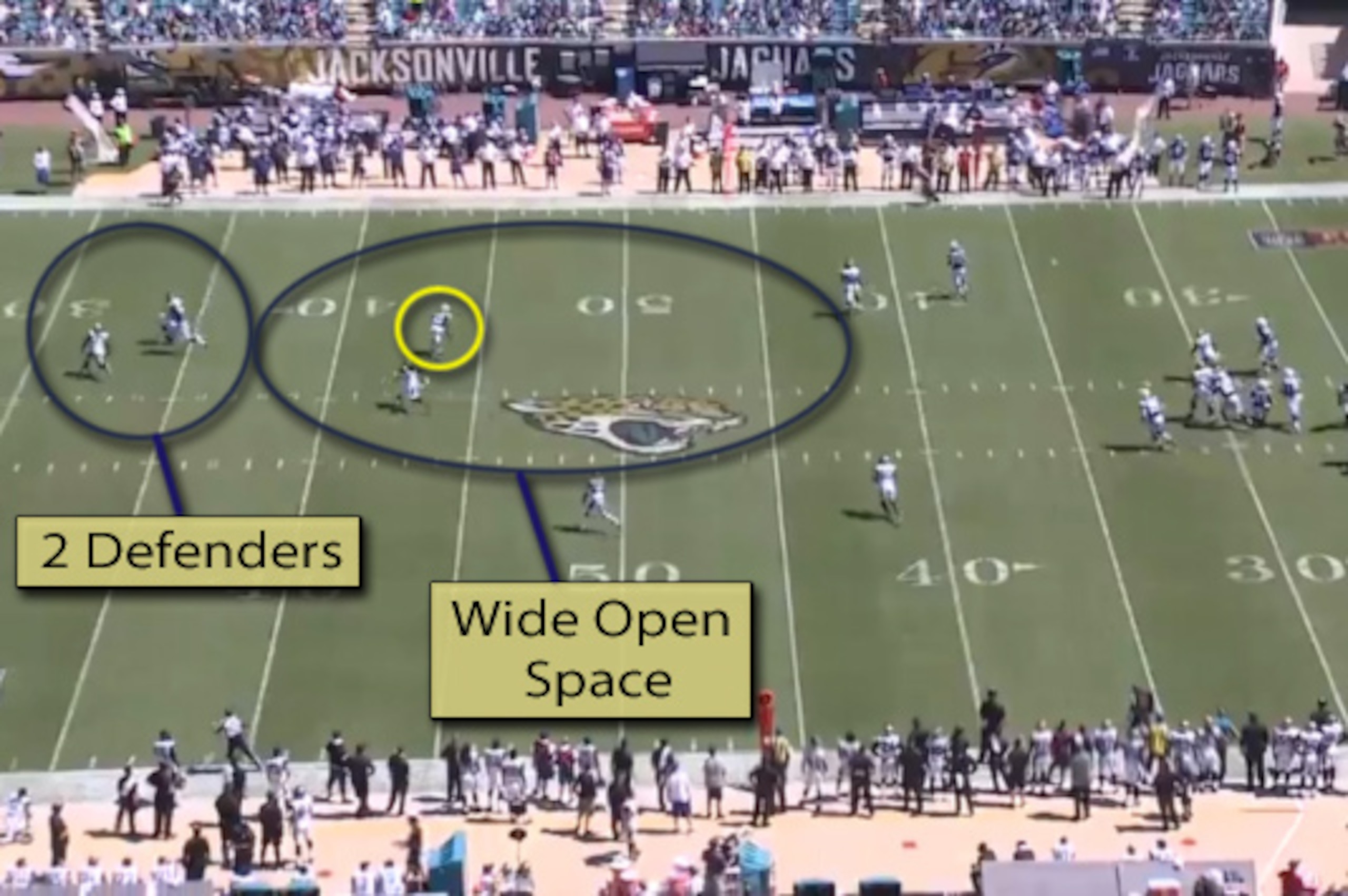
Take this 39-yard pass to T.Y. Hilton, for example. The Colts lined Hilton and Moncrief up next to each other on the right side prior to the snap. Moncrief took off hard down the seam on a "go" route, bringing the safety and corner with him, leaving Hilton matched up one-on-one with the other safety in the middle of the field. With a slight fake inside, Hilton finds himself wide open down the field, and he is able to pick up an extra 10 yards after the catch because of the complete lack of defenders around him.
It's not necessarily because Moncrief is the next Randy Moss, but more an example of the depth of weapons the Colts have, and the kind of potential they have when they utilize that depth to the fullest.
Rather than making the defense cover just one or two routes, using four or five targets running a more varied set of routes leaves the defense stretched to its full capacity. Eventually, it will stretch too far, and snap.
Moncrief is the best weapon the Colts have to accelerate the defense's stretch. It allows the Colts' veteran receivers to get occasional rest, or it allows the Colts to go five-wide and really test the defense's capabilities. More Moncrief can only be a good thing, especially as the Colts continue to iron out the offense's kinks against some of their early-season opponents.
.jpg?w=2560 "🚨 Week 8 AP Top 25 Poll")


.jpg?w=2560 "Updates from EVERY NFL Game 🏈")
.jpg?w=2560 "Baker Gets Glove From Rays 🧤")