

Global dominance, at least in the basketball sense, is within grasp for the two teams left standing at the 2014 FIBA World Cup.
Following Serbia's 90-85 victory over France on Friday, the heavily favored Team USA now knows what awaits it in Sunday's championship clash.
So with this tournament bearing down on the final stretch, it's time to spotlight the biggest and brightest players of all the last two weeks with three All-FIBA World Cup teams.
Whittling down this talented player pool to only 15 wasn't easy, but a number of elements made it possible. Statistics factored heavily into the selections here, as is often the case with any basketball honor.
However, volume numbers weren't the only determining factor. Efficiency mattered, as did value and impact to a team. While the disparity of skill levels made it tough to place a heavy premium on team success, it wasn't completely discarded, either.
The eye test, a critical component of any subjective selections, played its own part in the process, too.
With all but two games completed, here's how the all-tournament team shakes out.
Third Team
1 of 11
Guard: Petteri Koponen, Finland
While versatile guard Petteri Koponen could only keep Finland out of the loss column once in its five games, the 30th pick of the 2007 draft did everything else right.
A smooth scorer (15.8 points on .400 two-point field-goal percentage/.458 three-point FG%/.700 FT%) and savvy setup man (5.8 assists against 2.0 turnovers), he gave Dallas Mavericks fans a reason to be excited for a possible NBA debut in 2015-16.
Guard: Bojan Bogdanovic, Croatia
The 31st pick in 2011, Bojan Bogdanovic started his summer by inking a three-year, $10 million contract with the Brooklyn Nets.
Big things were expected from the 6'7" swingman, and he delivered. He was one of only four players to average at least 20 points a night (21.2) and the only perimeter player to do so with a 50-plus field-goal percentage (50.0).
Forward: James Harden, USA
FIBA James Harden isn't very different from NBA James Harden. He brings a potent, versatile set of skills to the offensive end and a cringe-worthy effort to the opposite side.
Still, it's hard to ignore his 13.1 PPG, 49.3 field-goal percentage and 4.8 trips to the free-throw line per 22 minutes. His 16-point third-quarter barrage helped the U.S. break open its 96-68 semifinal win over Lithuania.
Forward: Aron Baynes, Australia
Aron Baynes' professional basketball future isn't settled, but his strong showing on the international circuit could have suitors lining up.
The Australian bruiser averaged 16.8 points and 7.0 rebounds in the five games he played, suggesting he might be ready for a larger role than the world champion San Antonio Spurs gave him last season.
Center: Hamed Haddadi, Iran
If big men are a dying breed in today's game, no one bothered telling the centers at the World Cup. Senegal's Gorgui Dieng, Lithuania's Jonas Valanciunas, Mexico's Gustavo Ayon, Angola's Yanick Moreira and Greece's Ioannis Bourousis all made compelling cases for this spot.
But Hamed Haddadi, who played five seasons in the NBA, put up numbers that were impossible to overlook: 18.8 points, 11.4 rebounds, 1.2 steals and 1.2 blocks. According to Sportando's Enea Trapani, Haddadi is attempting to find his way back to the big league.
Second-Team Guard: J.J. Barea, Puerto Rico
2 of 11
World Cup Per-Game Averages: 22.0 points, 3.2 assists, 3.2 rebounds, 0.6 steals, 17 efficiency
Considering Minnesota Timberwolves guard J.J. Barea paced the entire tournament in points while converting from distance at a 52.6 percent clip, he absolutely deserved a spot on one of these teams.
The diminutive scorer flashed controlled aggression at the offensive end, understanding when to attack and when to defer to his teammates. His 44.9 field-goal percentage isn't the most efficient line you'll see, but the number grows more impressive when you consider how little offensive help he had. Former NBA forward Renaldo Balkman was the team's only other double-digit scorer (12.4).
Still, Barea's resume had its warts, which is how the field's highest scorer can get left off the first team.
He couldn't lead his team out of the group stage, as Puerto Rico struggled to a 1-4 record. He also had some trouble with turnovers, coughing up four or more in three different games.
He's a role player at his day job, but he deserves credit for not looking overwhelmed as the focal point of his team.
Second-Team Guard: Milos Teodosic, Serbia
3 of 11
World Cup Per-Game Averages: 14 points, 4.1 assists, 2.4 rebounds, 1.0 steals, 14.6 efficiency
Serbia didn't exactly come out of nowhere, but it didn't seem to have the makings of a World Cup finalist, either.
Heading into the tournament, Bleacher Report's Adam Fromal ranked it as the field's eighth-best team, a standing that seemed a tad generous when it trudged through a 2-3 performance in the group stage.
But the Serbs are still standing, thanks in no small part to the play of 6'5" combo guard Milos Teodosic. He's a bit of a wild card, but as NBA.com's John Schuhmann explained, his good days can turn to great ones for his team:
"Milos Teodosic is one of the most entertaining basketball players in the world. The 6-foot-5, 27-year-old combo guard was coming off the bench for Serbia in its first four games, but has started the last three. And he saved his best performance for the quarterfinals, dropping 23 points on Brazil, with 16 of those coming in what was a tight first half.
Teodosic will take some crazy shots, but they often go in. And if he’s hitting from the outside, Serbia’s pick-and-rolls become very difficult to defend and other things open up in their offense.
"
An incendiary shooter can flip the script in a setting like this, and a locked-in Teodosic did exactly that.


Second-Team Forward: Francisco Garcia, Dominican Republic
4 of 11
World Cup Per-Game Averages: 17.6 points, 2.2 assists, 3.2 rebounds, 1.0 steals, 1.2 blocks, 17.6 efficiency
Houston Rockets swingman Francisco Garcia clearly understands the importance of a last impression.
The 32-year-old retired from international hoops after 11 years with the Dominican Republic, but not before leaving a swan song for the ages.
Garcia was magnificent. He compiled an absurd .611/.643/1.000 shooting slash, gave his team an extra playmaker on the wing and served as a disruptive presence at the defensive end.
His team, missing Al Horford (pectoral), escaped out of the group stage with a 2-3 record before falling to the dual-Dragic-led Slovenians in the round of 16. Garcia, whose ankle cost him one game, put up 16-plus points in each of his first four outings before finishing with a quiet seven points in the elimination contest.
His future absence will give the country's younger players a chance to prove their worth, but it could take a while for the team to get over his loss given how well he played on his last leg.
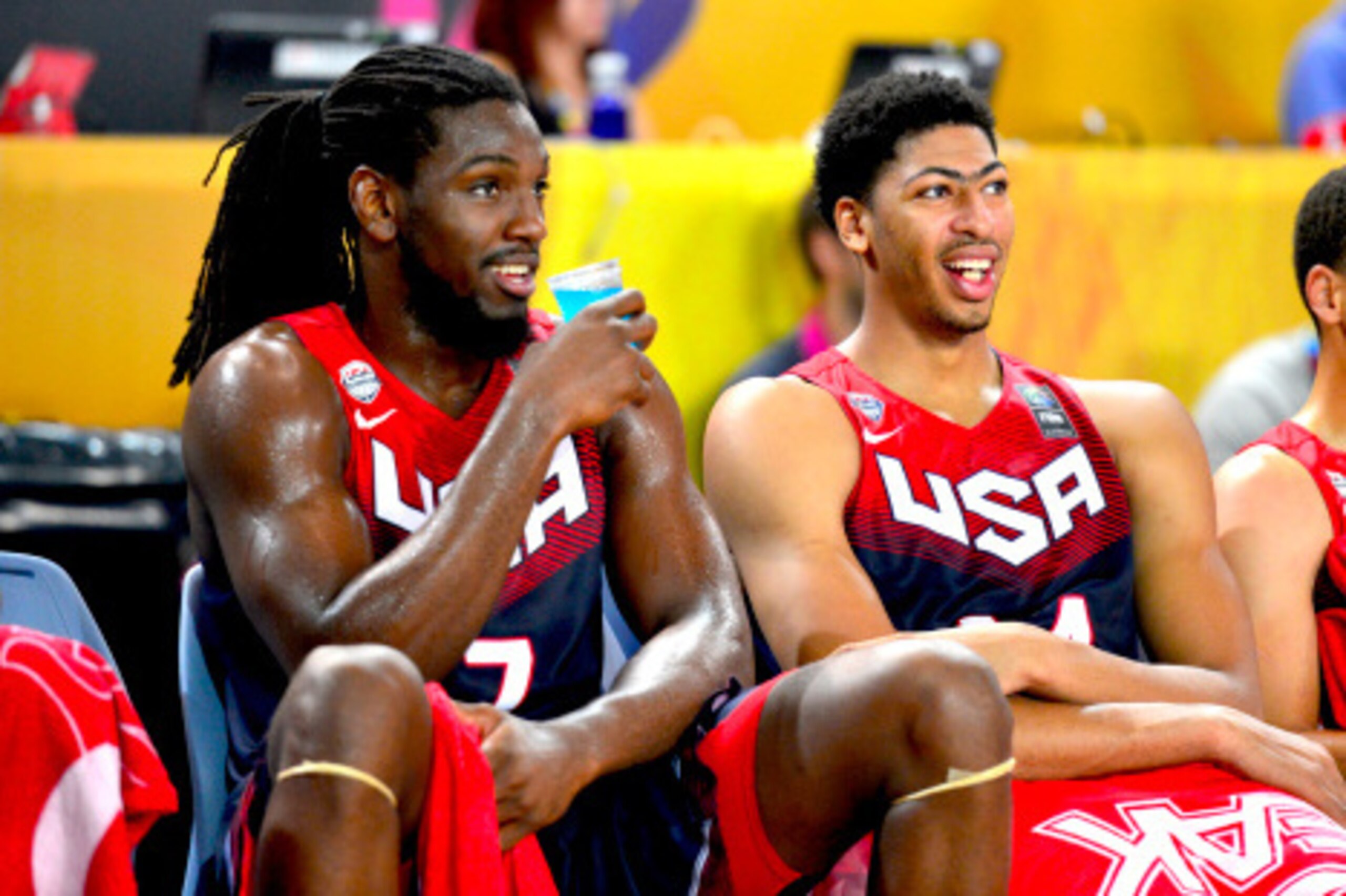
Second-Team Forward: Kenneth Faried, USA
5 of 11
World Cup Per-Game Averages: 12.5 points, 0.8 assists, 7.9 rebounds, 0.6 steals, 0.6 blocks, 18.8 efficiency
It's hard to do what Kenneth Faried is doing.
He's playing a starring role for the best team in the field, yet his skills are rarely seen in players of such stature.
At his essence, he is an energy guy. It's a cliched role in the sports world meant to prop up players for their effort, but it's one which also carries a slight condescending tone, as if their hustle is compensating for a lack of other abilities.
There is no real glory in what he does. His stats are rarely eye-popping (although his scorching 67.6 field-goal percentage might disagree with that statement), and a lot of his best work is done away from the box score.
Why, then, does he embrace the role?
"I just love to play basketball," he told reporters. "Every time I step on the basketball court, you never know it could be your last game, so I like to play my hardest in every game. When you love the game like that it tends to reward you back."
His energy, whether on the glass or out in transition, has been one of Team USA's most powerful weapons. He is a superstar role player, one of the rarest breeds in this business.
Second-Team Center: Andray Blatche, Philippines
6 of 11
World Cup Per-Game Averages: 21.2 points, 0.8 assists, 13.8 rebounds, 1.6 steals, 0.8 blocks, 22.4 efficiency
Forget the Philippines' 1-4 record, the basketball-crazed country's experience with newly naturalized versatile big man Andray Blatche was a resounding success.
Gilas Pilipinas was competitive every time it took the floor, suffering three of its four defeats by four points or fewer. Only Greece put a bigger loss on its plate, and even that scoreboard reading was respectable (82-70).
Blatche's leash got a little too long at times (5.0 turnovers in 33.8 minutes per game), but that wasn't an easy problem to solve. The talent gap between him and his teammates was staggering, so it's not as if the club had other places to turn for production—at least not this type of production.
He not only double-doubled in all five games, he put in at least 14 points and snagged 12-plus rebounds every time out. He was everything the Philippines could have wanted, on and off the floor.
"The type of relationships he built with the guys on the team in one month and a half and the effort in games and practices really said a lot about Andray," team captain Jimmy Alapag told HoopsHype's Jorge Sierra.
First-Team Guard: Goran Dragic, Slovenia
7 of 11
World Cup Per-Game Averages: 16.0 points, 4.3 assists, 2.9 rebounds, 1.0 steals, 14.4 efficiency
It was the second coming-out party of the year for the NBA's reigning Most Improved Player award winner, Goran Dragic.
As was the case during his decorated NBA season, the Dragon dazzled both for his volume and efficiency. He buried an incredible 67.3 percent of his two-point field goals, which helped him remain effective with a three-point shot that started hot (10-of-17 over his first four games) but abandoned him later on (1-of-14 in his last three).
He carried a heavy burden as his team's top scorer and distributor, but he balanced both roles with impressive ease.
"For Slovenia, he was Mr. Everything," wrote Bleacher Report's Adam Fromal. "The ball was nearly always in his hands, and he was given free rein to exert his pick-and-roll prowess at all times."
Slovenia showed well at every turn before colliding with Team USA in the quarterfinals, and even that 119-76 rout was close through the first two quarters (49-42). Dragic left little doubt he was one of the most talented players in the entire field.
First-Team Guard: Klay Thompson, USA
8 of 11
World Cup Per-Game Averages: 12.8 points, 2.1 assists, 2.5 rebounds, 1.1 steals, 0.6 blocks, 13.0 efficiency
Since Klay Thompson isn't a member of Team USA's first team, should that preclude him from this spot?
Obviously, I don't think so. Considering one of the primary problems for the U.S. has been getting out to sluggish starts, it seems silly to punish a player for watching those rough beginnings from the sideline or to not reward a guy for helping turn the tide whenever he steps on the floor.
"Starting to think Klay Thompson has become the most important player on this team," Brian Mahoney of The Associated Press tweeted Thursday. "Gets something done every time he comes into the game."
Thompson ranks third on the team in minutes per game (23.8) and trails only James Harden and Anthony Davis in scoring. The splash sibling of Stephen Curry boasts a 41.7 percent conversion rate from distance (plus a 66.7 percent success rate inside the arc) and has given this team a reliable perimeter presence at the defensive side.
Thompson might not be one the five most talented players in this tournament, but he has been one of its five most valuable.
First-Team Forward: Pau Gasol, Spain
9 of 11
World Cup Per-Game Averages: 20.0 points, 1.4 assists, 5.9 rebounds, 0.4 steals, 2.3 blocks, 21.7 efficiency
While Pau Gasol couldn't prevent France from breaking apart the dream USA-Spain championship bout, the four-time All-Star did everything in his power to try and stop it.
The host nation's 65-52 loss to France was a disaster, but Gasol was dominant in his own right.
He poured in a game-high 17 points that night—which only tied for his fourth-highest scoring total at the World Cup—and tracked down a team-high eight rebounds. Despite also leading the team in minutes played (31-plus), he was the only one of Spain's nine players to see the floor who didn't post a negative plus-minus point differential.
Spain was overloaded with talent, yet Gasol consistently stood out for his stellar two-way play.
"Pau is playing very, very well in all areas," Chicago Bulls coach and Team USA assistant Tom Thibodeau said, per K.C. Johnson of the Chicago Tribune. "His defense, his rebounding, his passing, his scoring—all those things have been very, very good."
In other words, don't waste your time looking for holes in his stat sheet. There aren't any to be found.
First-Team Forward: Luis Scola, Argentina
10 of 11
World Cup Per-Game Averages: 19.5 points, 2.3 assists, 8.5 rebounds, 0.5 steals, 0.2 blocks, 19.2 efficiency
Don't let last season's disappointment fool you. The game hasn't passed Luis Scola by just yet.
OK, that's not entirely true. The 34-year-old's engine no longer possesses the gear needed to play a major role at the NBA level, but his motor works just fine on the FIBA circuit.
"Luis Scola has retreated to the NBA fringes, but he remains a monster on the international stage," wrote ESPN.com's Ethan Sherwood Strauss. "FIBA Scola is a little like 'Olympic Melo,' a player who’s clothed in spectacular power when clothed in his country’s jersey."
There was only so far Argentina could go this tournament with no Manu Ginobili, Fabricio Oberto or Carlos Delfino on the roster. Scola battled to carry the club to the round of 16 (17-plus points each of his first five games), but he was out of answers when Brazil keyed its NBA-heavy frontcourt (Nene, Anderson Varejao and Tiago Splitter) around stopping him.
For a one-man show, though, Scola played the part as well as anyone.
First-Team Center: Anthony Davis, USA
11 of 11
World Cup Per-Game Averages: 13.0 points, 0.9 assists, 6.9 rebounds, 0.9 steals, 2.2 blocks, 17.9 efficiency
Anthony Davis' reign atop the basketball world is coming. While some expected the long, athletic big man to use this tournament as a springboard to the throne, that was never going to be easy.
For one, it's hard to put up mind-boggling numbers when your team is dusting opponents by an average of 32.5 points a night. Plus, this roster is packed with scoring guards, meaning Davis was always going to be battling for touches.
So, don't be surprised that his numbers aren't jumping off the page. That's just the sign of him staying in his lane on a tremendously talented team.
"I'm trying to take shots that I know I can make," he told reporters. "I'm trying to play great on defense, whether it's rebounding, blocking shots or altering shots."
Davis is like a secret weapon Team USA doesn't need to unleash. But when the spotlight has shifted his way, he has dominated his competition.
No other center has made the same type of two-way impact, even with his being limited by how little the team has needed from him.
All statistics used courtesy of FIBA.com, unless otherwise noted.
.jpg?w=2560 "Mahomes Told Teammate to Leave Meeting")


.jpg?w=2560 "🚨 Week 8 AP Top 25 Poll")


.jpg?w=2560 "Updates from EVERY NFL Game 🏈")