Don't Buy into Buffalo Bills QB EJ Manuel as a Breakout Player Just Yet
The Buffalo Bills upset the Chicago Bears in Week 1 of the NFL season.
It was a performance that very few people legitimately expected because of the Bills' situation at quarterback. EJ Manuel struggled through injuries and performance issues as a rookie before playing very uninspired football throughout the preseason.
Without very talented cornerback Stephon Gilmore in the secondary, it didn't seem plausible that a Manuel-led offense would be able to keep up with a Bears offense that boasted Jay Cutler, Brandon Marshall, Matt Forte, Alshon Jeffery and Martellus Bennett.

.jpg?w=2560 "Commanders Eagles Football")

Manuel definitely wasn't the star of the game, as the Bills ran for 203 yards as a team and the defense forced three turnovers, but his display will have warmed the hearts of long-suffering fans in Buffalo.
As you would expect, the Bills started out with a very conservative game plan on offense. Even though the Chicago Bears defense appears to be limited, they do have enough talent to take advantage of a quarterback who is asked to do more than he can.
Two running plays set Manuel and the offense up in a 3rd-and-6 situation on their first drive.

The Bills came out with two receivers wide to the right and one wide to the left. There is a tight end tight to the formation on the right side, with a running back split to the other side of the quarterback. This is essentially a balanced formation because the ball is on the left hash.
When the ball is snapped, Manuel appears to keep his eyes on the deep safety to the narrow side of the field. He doesn't take his eyes away from the safety, instead allowing his tight end to run across his line of vision.
That tight end is running a deep crossing route into space behind the underneath coverage and in front of the deep safety. This is a simple throw for an NFL quarterback when he is not under pressure in the pocket.
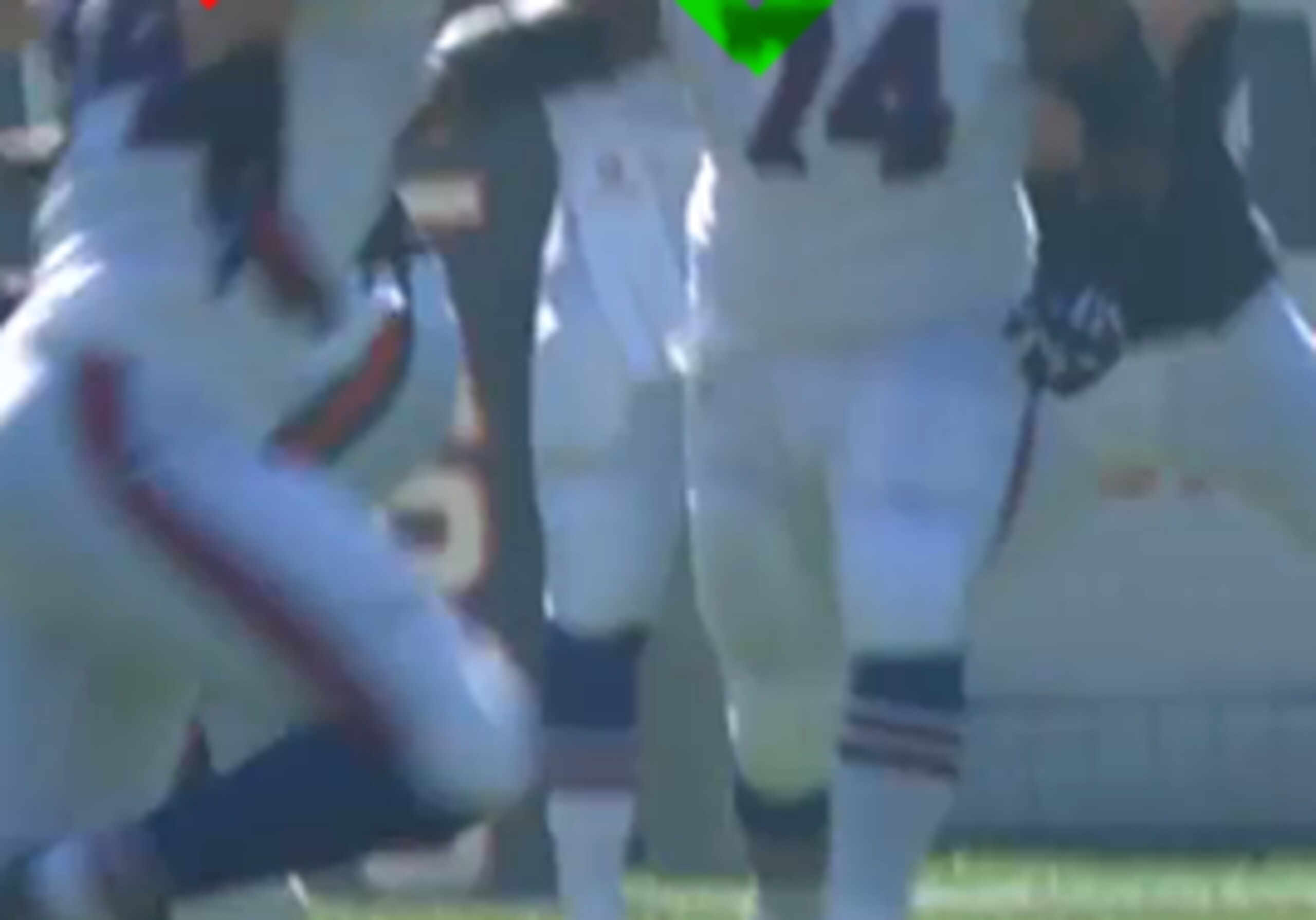
Manuel throws a catchable ball to his tight end, but it's not an accurate pass. When your target is running a crossing route, you need to throw the ball ahead of him so he can catch it in stride or reach out for it comfortably. When you throw the ball behind his head, it creates a situation where the intended receiver needs to unnaturally adjust.
That is what happened on this play. Manuel put the ball in a spot where his tight end could make an unnatural adjustment to make an impressive play, but he shouldn't have forced his receiver into that situation. He wasn't under pressure in the pocket and his receiver wasn't well covered.
On this occasion, the ball fell incomplete, but against a better defense, this kind of throw could easily lead to a tipped ball that heightens the chance of a turnover.
Instead of being predictable with their play-calling and looking to establish the run immediately at the start of the next drive, the Bills actually allowed Manuel to throw on 1st-and-10. Importantly, the coaching staff used play action and motion before the snap to create an easy throw for Manuel.

Robert Woods will eventually catch the ball from Manuel in the opposite flat from where he lines up. His motion before the snap hints that the Bears are running zone coverage, as the cornerback doesn't follow him, which also allows him to be uncovered underneath, as he is behind the line of scrimmage early in the play.
While Woods slips unnoticed underneath the formation, the play fake to the running back draws the attention of six Bears defenders who would otherwise be responsible for dropping into coverage.

All of this movement ultimately results in Woods being wide open in the flat and Manuel running parallel to him behind the line of scrimmage. Manuel has an easy pass to make, as he just needs to flip the ball to his receiver, but even on this throw he is slightly off target as he forces Woods to adjust in space.
It's a minor miss because Woods still makes the reception, but it makes it more difficult for him to create yards after the catch.
He still gets 10 yards and a first down, but if Manuel had led him toward the highlighted green area, then he would likely have had a better chance of breaking off a big gain. Instead of asking Woods to slow down and reach back for an underthrown pass, the young receiver would have been quicker to the sideline and would have had a better opportunity to beat the arriving cornerback in a one-on-one situation.
At this stage, the Bills' script was focusing on creating easy yardage for Manuel, and Woods became a big part of that.

On a 3rd-and-2 that came about because of two running plays, the Bears came out showing press man coverage outside. This was the perfect defense for the Bills on offense, as the receivers to the top of the screen were running a route combination that would carry both defensive backs into one another.
With his first two throws, Manuel had been slightly off target but was never in major danger of throwing an interception. That changed on this play.

From a perfectly clean pocket, Manuel begins his throwing motion at the earliest possible time he can. He sees the separation for his slot receiver running outside and sees the outside defensive back running inside with his outside receiver.
Manuel's problem here isn't mental, it's physical. His throwing motion starts now, but it takes him a long time to let the ball go, and his pass isn't thrown with velocity.
A gliding ball arrives inside of the cornerback and at a pace that gives the cornerback time to recognize its flight. Fortunately for Manuel, Tim Jennings is coming to the twilight of his career and is no longer in his prime, so he doesn't have the physical ability to work back to the ball.
Jennings' momentum carries him away from the ball, while the much younger Woods is able to work back infield toward it.
This pass needs to be a fast ball to the backshoulder for Woods to comfortably catch it in a spot where the defensive back has no chance. Instead of doing that, Manuel throws the ball down the field to a point where the defensive back had plenty of time to turn around for a simple interception if he had the physical ability.
Relying on your receivers to do more than they should—and for the defense to make mistakes or be less effective—is fine when you're playing against these kinds of defenses.
When the play is elevated in the playoffs or against better defenses, there are a lot fewer mistakes and matchups to rely on. In those situations, it becomes exceptionally difficult for a limited quarterback to be effective because he can't make the more difficult plays.
This is why the result of any given play can't simply be used to judge the effectiveness of each player involved.
Manuel completed one more pass on this drive, a simple out route underneath to Sammy Watkins that was well thrown. He also scrambled effectively when he couldn't find anyone in the pocket before taking a read-option run into the end zone at the goal line.
Curiously, the Bills abandoned the run completely to start the next drive.
Manuel checked the ball down to Watkins over the middle for a one-yard gain before finding fullback Frank Summers in the flat after play action. The pass to Summers was very similar to the earlier pass to Woods in the flat. Those two plays set up a 3rd-and-5 when Manuel and Watkins connected for their first big play.
This was the first really impressive play from Manuel.
He initially dropped into a completely clean pocket and kept his eyes downfield as he bounced on his toes at the top of his drop. He appeared to be focused on the deep safety again before he moved his eyes to Watkins, who was running a deep in route from the right side of the offense.
As Manuel let the ball go, a defensive end came free to put pressure on him. Manuel was able to get rid of the ball before the defender got to him to release the ball cleanly.

The timing of the throw and the velocity of the pass were crucial for Manuel here. He put the ball in a spot where only Watkins could make the reception. Watkins wasn't forced to make an exceptionally difficult adjustment and didn't have to absorb a big hit from any incoming defenders.
Making this throw under pressure was very impressive because the potential for a turnover was high. Manuel needed to be accurate and throw on time while under pressure in this scenario.
After handling that pressure to deliver a strike down the field, Manuel followed up with a very poor reaction to pressure. He again faced an incoming defender from his right side, so he could have adjusted to step up and away in the pocket while keeping his eyes downfield, but instead he immediately looked to scramble before sliding down to willingly take the sack.
This is the kind of play a quarterback makes when he is too scared of making a mistake.
After that play from Manuel, the offense was set up in a 2nd-and-16. The Bills cut into the down-and-distance deficit with a fake end-around screen pass that worked perfectly before Manuel scrambled on 3rd-and-11 to settle for a punt at midfield.
The first quarter of this game set a tone for Manuel. A tone that he never really got away from.
Manuel was a complementary piece in a run-first offense that didn't trust its quarterback to consistently make tough throws down the field or manage the pocket. His completion percentage was highly efficient because of this and he completed 16 of 22 passes, but his production overall was limited.
He threw for 173 total yards and one touchdown.
That touchdown came on a shortened field after a Cutler interception in the second quarter. The Bills used play action and route combinations to send Spiller into the flat uncovered. He was forced to adjust to a pass that was thrown slightly behind him before running free into the end zone.
Despite completing so many passes in an approach that consistently created easy throws for him, Manuel repeatedly forced his receivers to make unnecessarily tough catch attempts because of his poor accuracy.
When he did throw the ball down the field, it was only that pass to Watkins that really stood out in a positive way.
His other attempts included an interception he forced down the left sideline to a covered receiver, an overthrown pass to Watkins and a horrible play against the blitz that saw the quarterback jump in the air as he released the ball so it sailed over the head of a wide-open receiver down the field.

Both Woods and Williams made incredible receptions on overthrown passes from Manuel down the seam late in the game.
These aren't typical catches that you'd expect NFL receivers to make. Woods adjusted brilliantly to a high pass that was thrown behind him, while Williams was able to spring into the air to corral a high pass in between the linebackers and safeties.
Each receiver was forced to absorb a big hit from an incoming defensive back because of Manuel's throw.
In many ways, the effectiveness of the Bills offense in this game should be considered a victory for the coaching staff and the front office. The front office has compiled an arsenal of weapons at the skill positions that can not only rival anyone else in the league for talent but can also complement each other very well.
The coaching staff showed off the ability to minimize the pressure on a player who has been fairly regularly written off as a quality starter in recent times. At the quarterback position, that is exceptionally difficult to do no matter how talented the rest of the team is.
Much like Andy Reid did with Alex Smith last season for the Kansas City Chiefs, the Bills were able to mask Manuel's deficiencies and run an effective offense against a less talented defense in this game.
For Manuel to break out as an individual player, his success has to come outside of this situation. He wasn't consistently making difficult throws, he wasn't managing the pocket or reading through multiple receivers. He was executing simple plays adequately.
Even though it's much easier for quarterbacks to get paid huge money nowadays, it's hard to be too optimistic about Manuel based on this game. He has proven that he can be an adequate starter when his defense creates turnovers and his running game can carry the offense.
Maybe that constitutes a breakout display in today's NFL, but it shouldn't even instill you with the confidence that Manuel is now assured of his starting spot for the rest of the season.
Kyle Orton's presence still looms large.
.jpg?w=2560 "Chiefs Dolphins Football")
.jpg?w=2560 "Cardinals Giants Football")