
New York Jets' Best and Worst Draft Picks of the Last Decade
When you read this, NFL draft day 2014 will be less than three weeks away. Spend some of that time reviewing some of the best and worst New York Jets picks between 2004 and 2013.
"Best pick" and "worst pick" mean different things to different folks. A viable definition of "best pick" would be a player who significantly out-performed his draft position. Tom Brady comes to mind, although he'd qualify as a "best pick" under any scenario. More often, "best picks" are early round selections who achieved their potential and more. They are a team's Ring of Honor recipients, its NFL Hall of Famers.
This story's "best picks" list features players who are still active, so it anticipates who those award winners might be. It prioritizes players who have demonstrated or have the potential to demonstrate a long-term commitment to the Jets. It considers behavior at the bargaining table as well as results between the sidelines. If players' rank depended solely on their football skills, the ranking would be different.
There is more than one plausible definition of "worst pick" as well. Technically, a "bad pick" is a player who doesn't make the team, especially in today's relatively small seven-round draft. When the draft's round count was in double digits, that definition didn't work as well. A team could draft more "camp bodies" and be pleasantly surprised if they stuck around.
The definition of "bad" or "worst" pick more often is a player from whom much is expected but little is received. It's typically an early round pick, whose career was long on promise and potential, short on achievement. It can also be a later-round pick if he turned out not to be worth the effort. That's especially true if he cost his new team an established contributor.
Round of selection, players or picks lost, durability and time with the team are all factors that separate ordinary bad picks from disasters. Only the "Dishonorable Mentions" include players who are still on the team.
See how many of these names you recognize.
Sources
- New York Jets draft history: New York Jets Media Guide
- New York Jets history: NewYorkJets.com
- New York Jets player rankings: NewYorkJets.com
- Player Statistics: Pro-Football-Reference.com
Honorable and Dishonorable Mentions
1 of 9
Here's the first place where we stretch the rules. It seems fitting to acknowledge players who have filled significant roles between 2004 and 2013 despite their late draft selection. It also seems fitting to acknowledge the near-miss busts, including some current players who might earn that status if they don't shape up.
Honorable Mentions
These players may never make the Jets' Ring of Honor or NFL Hall of Fame. They have, nevertheless, out-played their draft positions and taken important roles both on the Jets and, in one case, elsewhere.
G Matt Slauson (No. 193), 2009
All this sixth-round pick did was start every game he ever played, 48, as a member of the New York Jets. The Jets didn't reward him at free-agency time, but the Chicago Bears did. Slauson played for the Bears under a one-year contract for $815,000 in 2013. He signed a four-year deal with them for $12.8 million, $4.9 million guaranteed, in January.
S Antonio Allen (No. 242), 2012
The Jets had two seventh-round picks in 2012. Antonio Allen has played his way into being, according to ESPNNewYork.com's Rich Cimini, "a likely starter" in 2014. Pick No. 244, WR Jordan White, battled various injuries since his selection and received his release before the 2013 Green and White scrimmage.
WR Jeremy Kerley (No. 153), 2011
Fifth-round selection Kerley was the Jets' leading receiver in both 2012 and 2013. That may be because of the state of the Jets' receiving corps. Before you accept that explanation, consider that Kerley was out of the lineup during the three-game losing streak that cost the Jets a possible 2013 playoff berth. He seems to be the go-to guy when the Jets need to keep a drive alive.
With the addition of Eric Decker and a possible early round rookie, Kerley might not get as many targets in 2013. But he also might benefit from less defensive attention and make bigger plays when the Jets call his number.
Dishonorable Mentions
Two of these players can still clean up their acts. The third appears in many draft bust lists.
CB Kyle Wilson (No. 29), 2010
The Jets drafted Wilson in the first round despite already having Darrelle Revis and Antonio Cromartie. Wilson has mostly played the third or nickel corner, except for 2012 when he started 15 games because of Revis' injury. But he has played nickel corner for the most part. It's a useful role, but if that's the extent of his value, the Jets could have done better.
WR Stephen Hill (No. 43), 2012
The Jets swapped their second-round pick (No. 47) with Seattle and gave the Seahawks picks in the fifth (No. 154) and seventh (No. 232) rounds as well. They were supposed to get a big-play receiver in return. While Hill has had his moments, most often against the Buffalo Bills, his two-year legacy of dropped balls and injuries may well reduce his role to backup in 2014 and draft bust after that.
K Mike Nugent (No. 47), 2005
Mike Nugent is not a bad kicker. He'll begin his 10th NFL season in 2014. The problem with his second-round selection was that he didn't become the Jets' next Pat Leahy. Nugent only lasted three full years, and part of a fourth, in green and white. Leahy lasted 18 years.
At the time the Jets picked Nugent, players such as WR Vincent Jackson were still on the board. The issue isn't that the Jets picked a kicker. It's that they picked a kicker too soon.
4. Best: DT Sheldon Richardson (No. 13), 2013
2 of 9It may be jumping the gun to call Sheldon Richardson's selection the Jets' fourth-best pick in 10 years. Consider it a tribute to his immediate and widely recognized impact.
The words "2013 NFL Rookie Defensive Player of the Year" sum up his accomplishments nicely.
So did ESPN, who described Richardson's year as follows: "Often double-teamed as the season wore on, Richardson made 42 tackles and had 3½ sacks. He clogged the running lanes so effectively that the Jets ranked third against the run this season."
Richardson was a bit of a two-way player as well, scoring two touchdowns as a fullback.
He completes, along with Damon "Snacks" Harrison, the rebuilding of the defensive line that began with Muhammad Wilkerson's first-round selection in 2011. As long as general manager John Idzik keeps these three players well-paid and happy, the Jets should have a top defensive line for many seasons to come, and Richardson will occupy a higher position in lists like this.
4. Worst: FB John Conner (No. 139), 2010
3 of 9A fifth-round draft choice normally doesn't belong in this type of list. A look at the effort the Jets made to get John Conner and the results each side derived just might change your mind.
To get Conner, the Jets gave their seventh-round pick to the Seattle Seahawks, No. 236 overall. They also included change-of-pace back and return specialist Leon Washington, a 2008 Pro Bowl and All-Pro selection.
Maybe the Jets thought Washington's best years were behind him. They were wrong. His rushing and receiving numbers were lower with Seattle, but his return production increased.
- With the Jets, Washington appeared in 55 games. He returned 64 punts for 599 yards, averaging 9.4 yards per return, and returned 117 kickoffs for 2,986 yards and four touchdowns, averaging 25.5 yards per return.
- With the Seattle Seahawks, Washington appeared in 48 games. He returned 104 punts for 1,069 yards, averaging 10.3 yards per return, and returned 127 kickoffs for 3,329 yards and four touchdowns, averaging 26.2 yards per return. He made the Pro Bowl in 2012.
Here's NFL.com's analysis of the man the Jets got in return:
"The Jets get a young fullback to develop behind Tony Richardson. As a head-banger with good strength and power, Connor has the skills to be an ideal lead blocker in the Jets' power running game. Though he doesn't catch the ball well out of the backfield, he has skills that the Jets covet in their lead backs.
"
The "head-banger with strength and power" is what earned Conner his nickname, "The Terminator." Play the video to share his coaches' enthusiasm.
However, NFL.com's analysis of Conner's weaknesses proved all too prophetic:
"Conner is not fast enough to be an outside runner and sometimes is a bit late getting to the edge as a lead blocker. Sloppy footwork causes him to struggle to make blocks in pass protection. Does not have good hands, runs imprecise routes and lacks the ability to be a consistent check-down option in the passing game.
"
Here's part of how Alan Schechter of TheJetPress.com described Conner's play:
"When it came down to the skills needed to be an effective fullback, Conner was lacking some of those. For example, it was noted in his scouting report that Conner would sometimes be late to his spot as a lead blocker. Did we ever see that before? Yes I think so.
He was not a great asset as a pass receiver out of the backfield, had difficulty in pass blocking, and had the above mentioned problems with run blocking, due to inconsistent foot work.
"
It appears that in Conner's case his weaknesses overcame his strengths.
3. Best: CB Darrelle Revis (No. 14), 2007
4 of 9Mark my words. Some will see this slide's heading and immediately click the comment link to question my sanity. Why, they will ask, isn't Revis your best Jets pick of the last 10 years?
If football skill were the sole criterion, Revis would be No. 1. After his rookie year, he earned Pro Bowl invitations in every year he was healthy from 2008 to 2011 and in 2013 as well. He earned All-Pro honors from 2009 to 2011.
Revis' history of front-office issues is what drops his rank. These issues are why in 2014 he will play for his third team in three years. These issues boil down to how Revis goes about getting the pay he believes he deserves.
Here is a recap:
- As a rookie, Revis missed 21 days of training camp during contract negotiations. He signed a five-year $36 million deal.
- Revis held out for more in 2010, missing all but a week of training camp and every preseason game. Revis' new deal was for $32 million over four years, all guaranteed.
- In 2012, Revis wanted a renegotiation and threatened to sit out training camp. That, combined with his uncertain physical status because of a season-ending ACL tear, caused his April 2013 trade to Tampa Bay where he signed a six-year, non-guaranteed, $96 million deal.
- Despite a Pro Bowl season in 2013, the Buccaneers cut Revis to save cap room and avoid losing a third-round pick to the Jets. He signed with New England for $12 million in 2014 and a possible $20 million in 2015.
This series of contract issues that delayed or threatened Revis' training camp participation may explain why the Jets, for all of Revis' talent, didn't welcome him back this year. His salary, even at $12 million, would have consumed over 9 percent of the 2014 salary cap. The Jets have other needs.
This list rewards on-the-field performance, but it rewards character, as well. You'll read about character issues in NFL draft profiles. A team's perception of a player's character can impact his draft position.
In his contract squabbles, Revis displayed the character of a high-maintenance player who put his own needs ahead of the team's. Call me sentimental, but I rate as better picks players who display excellence on the field and a non-confrontational spirit at the bargaining table. Assertive negotiation, knowing one's worth, is one thing. Aggressive negotiation, negotiation by threat, is another. Teams have no place for the latter in an age where a hard salary cap places limits on the payroll.
The highest spots on this list belong to accomplished players who behave like "Jets for life." Darrelle Revis is no longer in that category.
3. Worst: OL Vladimir Ducasse (No. 61), 2010
5 of 9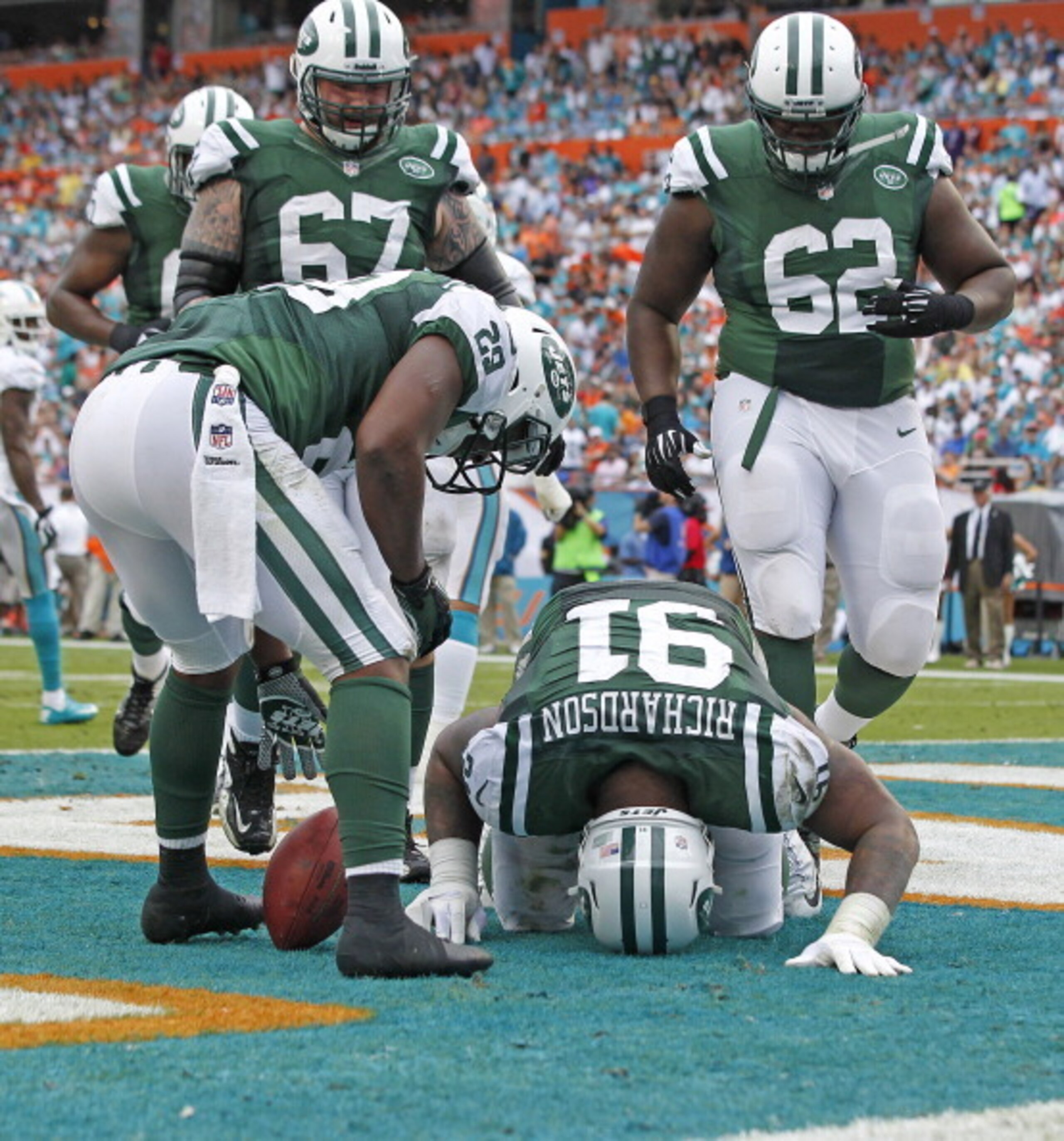
When Vladimir Ducasse lost his starting job to rookie Brian Winters in 2013, it marked the effective end of his Jets career. Ducasse started five games in four years.
Ducasse had no knowledge of American football until he came to the U.S. from Haiti in 2002. He played collegiate football at the University of Massachusetts, former general manager Mike Tannenbaum's alma mater. While he was a second-round pick, his draft profile described him as a project.
It was perhaps to his detriment that the Jets didn't know where he would fit best. They tried him at both guard and tackle, under three offensive coordinators. The only competition for a starting job he won was in 2013. Winters helped by injuring his ankle.
Maybe Ducasse's most controversial opportunity came in 2012. That's when former offensive line coach Dave DeGuglielmo charged that rotating Ducasse with Matt Slauson was "a directive from high above me." Both DeGuglielmo and Slauson departed at season's end. (Slauson was a free agent.)
In a Sept. 19, 2013 post, ESPNNewYork.com's Matt Ehalt called Ducasse "the poster child for the previous regime's failures in the draft: a high draft choice who barely got on the field and hadn't contributed much." Fellow ESPN New York writer Rich Cimini acknowledged Ducasse's strong game against New England's Vince Wilfork in Week 2.
However, according to Cimini, things changed after Week 4:
"After a promising game in Week 2 against the New England Patriots, Ducasse's performance level has slipped. He has a team-high six penalties for 40 yards, and he allowed several quarterback pressures in last Sunday's 38-13 loss to the Tennessee Titans.
"
That paved the way for Winters.
Ultimately, Ducasse's six penalties in four starts placed him third on the offensive line. Leader Willie Colon had 12 penalties in 16 starts; Ducasse's replacement, Winters, had seven penalties in 12 starts.
That's one reason why Ducasse's career with the Jets is over. Maybe he'll find the niche with the Vikings that he never could find with the Jets.
2. Best: DE Muhammad Wilkerson (No. 30), 2011
6 of 9Muhammad Wilkerson may not have taken the NFL by storm the way Darrelle Revis did. It's the steady improvement over his first three seasons that has established Wilkerson as a defensive leader on the team, the anchor of one of the league's best defensive lines.
Here are the highlights:
- Wilkerson's sack totals have grown from 3.0 in his rookie year to 10.5 in 2013.
- His solo tackles have risen from 35 to 43.
- He scored a safety as a rookie, returned a fumble 21 yards for a touchdown in his second year and grabbed his first interception in 2013.
How Wilkerson handles his upcoming contract negotiations will play a key role in establishing his place as a great pick. He deserves a deal that recognizes his status as a premier player. The way he goes about getting it will speak volumes about his character.
If Wilkerson sticks by what he told New York Post reporter Bart Hubbuch, his upcoming contract talks should arouse no resentment. Wilkerson made the following points:
- He wants to be a Jet for life. Wilkerson communicated that sentiment to management in January. He grew up in Linden, N.J. then played his college ball at Temple University in Philadelphia. He would be a great example of a local product made good if he sticks with the Jets.
- He won't hold out. That threat loomed because of negotiations about his next contract that are underway. It means that he'll accept playing under the terms of his rookie contract's fifth-year option without raising a fuss. That should bring sighs of relief to anyone tired of Darrelle Revis' contract dramas, especially Jets management.
The ball is in the Jets' court. Wilkerson has made it clear he wants to stay and has said the right things about his contract talks. The Jets should consider themselves honor-bound to treat him fairly.
Wilkerson might prefer to remain with the Jets, but self-preservation demands that he test the market if they don't make an appropriate offer.
2. Worst: QB Kellen Clemens (No. 49), 2006
7 of 9Kellen Clemens' quarterback position puts him ahead of fellow second-round bust Vladimir Ducasse. He got his opportunity to start in 2007 but didn't do well enough to win the job permanently.
After reading this draft profile excerpt from FootballsFuture.com, it's hard to imagine the Jets seeing Clemens as Chad Pennington's replacement:
"The good thing about Kellen is that he has continued to improve every year in college. The bad news is, he still doesn’t appear to have the ability to really carry his team. He doesn’t have the physical ability to make plays on his own or the consistency to continue to move the offense down the field. When he’s at his best, he resembles Rich Gannon, but that does not happen enough. Some team on Day Two will draft him and hope he continues to progress.
"
The Jets' hopes went unrealized.
In his first preseason, Clemens participated in a four-way competition for starting quarterback with Patrick Ramsey, Brooks Bollinger and Pennington.
Pennington won. Clemens won the No. 2 job, appearing in two games
Clemens' break came in 2007, when he started eight games because of Pennington injuries. In a 4-12 year, Clemens' record was 3-5, including a 40-13 Week 13 victory at Miami.
That year, Clemens completed 130 of 250 passes for 1,529 yards and five touchdowns while giving up 10 interceptions and 27 sacks. It was the most action he would see with the Jets.
Alan Schechter of TheJetPress.com observed, "Kellen Clemens was given the opportunity to make the starting lineup every year through 2009. He was the only one that kept learning, and re-learning the same Schottenheimer offense. "
He lost the starting job to Brett Favre in 2008 followed by Mark Sanchez in 2009. In fact, Clemens only started once after 2007, replacing an injured Sanchez in 2009. His last season with the Jets was 2010.
Consider this: Geno Smith started more games as a rookie than Clemens did during his five-year Jets career. Smith's 16 starts were almost double Clemens' nine.
No matter what you think of Smith, in many ways he's already surpassed the achievements of this 2006 second-round pick.
1. Best: D'Brickashaw Ferguson (No. 4) and C Nick Mangold (No. 29), 2006
8 of 9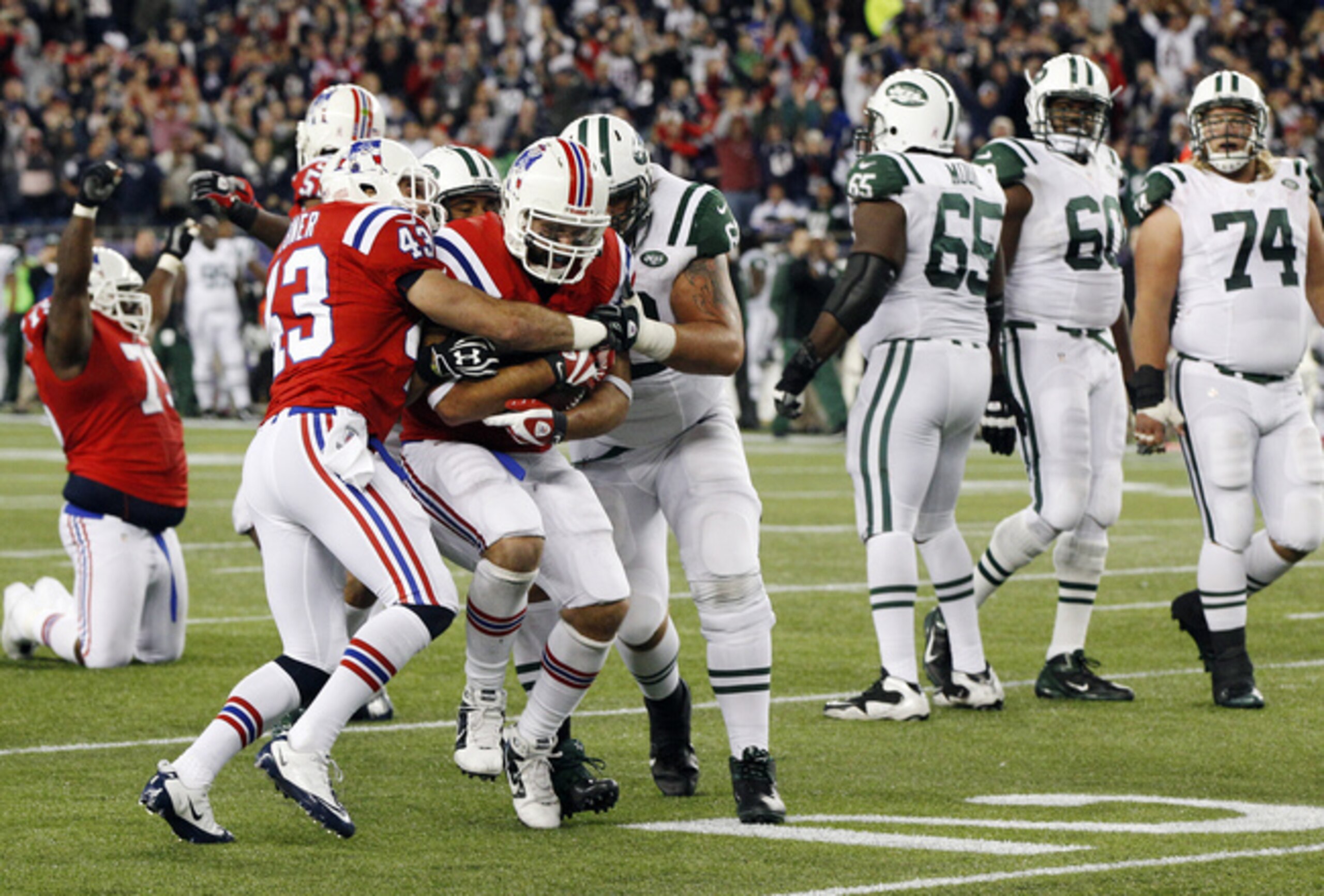
This slide is where I break the rules again and praise not one draft pick, but two. It's because center Nick Mangold and tackle D'Brickashaw Ferguson have anchored the Jets' offensive line beginning with their rookie years. In that eight-year span, 128 games, only Mangold missed a start, two games in 2011. Otherwise, their presence was as regular as clockwork.
They've represented the Jets with excellence. Mangold's resume includes five Pro Bowl invitations: four between 2008 and 2011 and a fifth in 2013. He earned All-Pro center awards in 2009 and 2010.
Ferguson earned three consecutive Pro Bowl invitations from 2009 to 2011.
Ferguson helped his team at the bargaining table, as well. When the Jets faced their 2013 salary-cap squeeze, he agreed to restructure his contract to clear $5.1 million in cap space.
If I had to identify the better pick between them, I'd go with Mangold, based on his numerous awards and the Jets' use of a three-team trade to get him. It cost the Jets John Abraham, but this is one example of a Jets draft deal that worked.
I'd rather not have to separate them. Just as the offensive line plays as a unit, Mangold and Ferguson deserve recognition as a unit. If they go on the Jets' Ring of Honor or earn places in the NFL Hall of Fame, I hope they receive those honors together as well.
1. Worst: DE Vernon Gholston (No. 6), 2008
9 of 9The cheers you hear in this video in response to Vernon Gholston's selection in the 2008 draft were probably the loudest he heard during his NFL career.
Others have told the story about how Gholston fell from All-American sack machine at Ohio State to washout in the NFL. He failed to register one sack in three years and didn't collect a $9 million performance incentive.
A close look at Gholston's NFL Scouting Combine profile may provide some insight.
The profile makes it clear that Gholston was an imposing physical specimen with athletic talents in the class of a John Abraham or Dwight Freeney. It acknowledges his passion, his love for the game.
There are a couple of points, however, that suggest that Gholston's ability to compete declined as the game grew more complex and he faced talent more equal to his own.
Take his introduction to football in high school. Gholston had never played before. Ironically, he was too big to play in Detroit's Police Athletic League, the area's only organized competition before high school. Had Cass Technical High School coach Thomas Wilcher not seen the 6'3", 240-pound Gholston in the hallway and asked the 14-year-old to play, there might not be a Gholston story to tell.
Here's how Gholston's introduction to football began:
"As a sophomore at Cass Tech, Gholston was first tried at linebacker, but he was overwhelmed by the plays he needed to know to play that position. One of the offensive coaches "stole" the youngster away from the defensive squad and had him play offensive guard as a sophomore.
"
It's probably unfair to suggest that the inability to learn quickly should have been a warning sign. That's especially true since Gholston did play linebacker in his senior year, earning Rival.com's recognition as the 11th-best defensive end prospect in the nation.
At Ohio State, Gholston earned All-American honors as a senior, making 37 tackles, 25 of which were solo. He recorded 14 sacks, 15.5 tackles for a loss (stops), two passes defended and returned a recovered fumble 25 yards for a touchdown. Those numbers, combined with his physique, made pro scouts salivate.
His scouting profile's criticisms should have raised red flags.
"Instinctive player, but is still a relatively new to the game and needs more reps to help him gain experience, as he relies on his athletic ability...Has improved his technique, but can't be considered a technician using his hands or displaying an array of pass rush moves...Must develop a better feel for blocking schemes, as he doesn't always protect his body from cut blocks and is not yet consistent at splitting double teams...Can be fooled by misdirection and while he gives total effort, he sometimes can't find the ball until it is past him.
"
That reads like a blueprint for defending against someone who "gets by on his athletic ability."
The profile's conclusion, "In a few years, with patient coaching and more experience, he has the potential to change the game," should have left the Jets' war room scurrying for another first-round pick. Instead, they put a project player in a draft position where only the closest to a sure thing should be.
Follow Philip Schawillie on Twitter: @digitaltechguid
.jpg?w=2560 "Patriots Chiefs Football")
.jpg?w=2560 "Titans Camp Football")