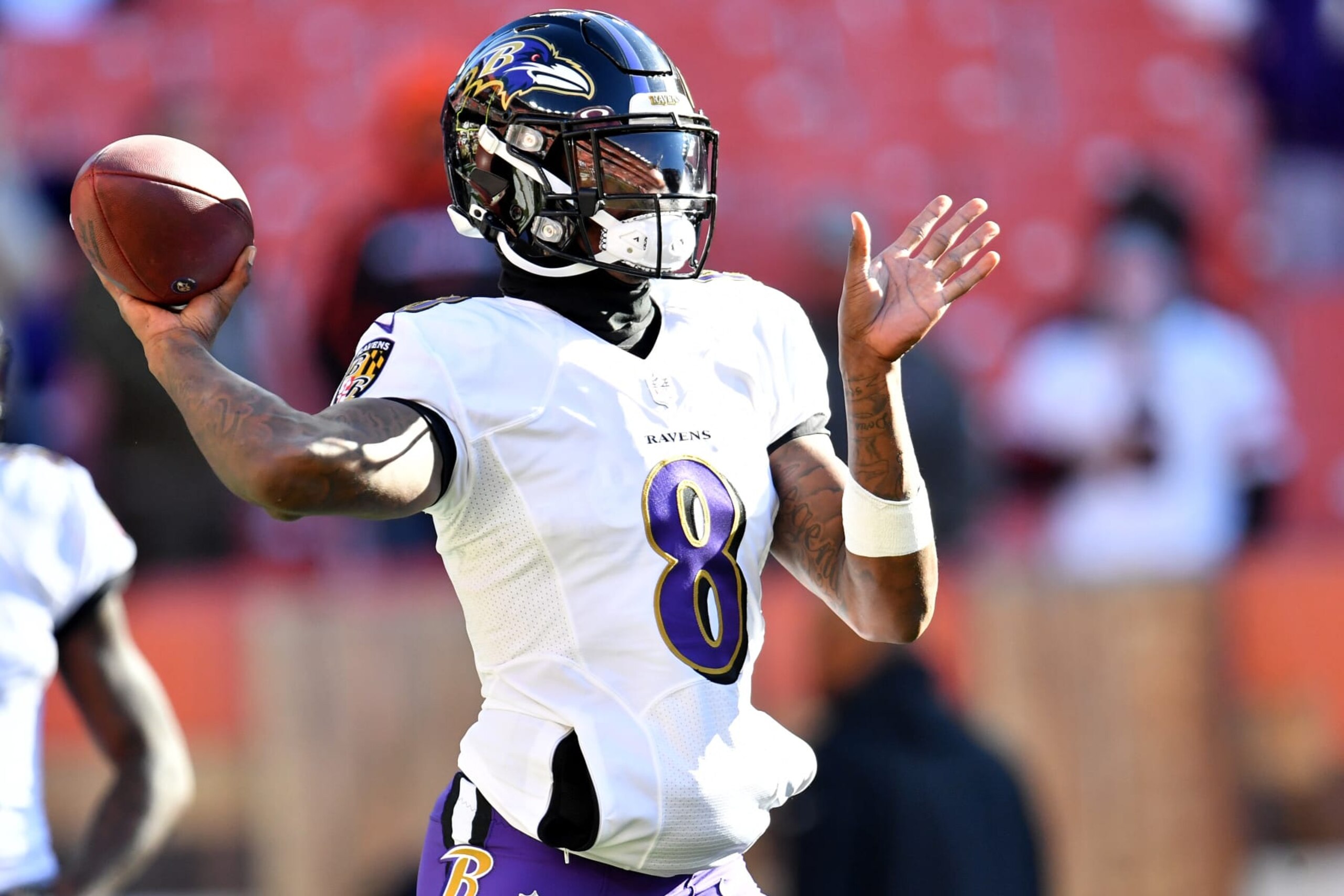

Projecting Lamar Jackson, Joe Burrow, Justin Herbert's New Contracts Next Offseason

Even though we are only one game into the 2022 regular season, next offseason is shaping up to be very intriguing, with three of the league's best quarterbacks eligible to sign new deals.
In the case of Lamar Jackson, he's been eligible to sign an extension with the Baltimore Ravens for the past two years. The sides were unable to agree to terms on a contract during that time.
Ravens general manager Eric DeCosta said in a statement Friday that, "despite best efforts on both sides," they couldn't reach agreement on a long-term deal with Jackson before the 2019 NFL MVP's self-imposed deadline.
TOP NEWS
.jpg?w=2560 "Chiefs Giants Football")
Mahomes Told Teammate to Leave Meeting
.jpg?w=2560 "Steelers Buccaneers Football")
Baker Gets Glove From Rays 🧤
.jpg?w=2560 "Steelers Saints Football")
Steelers Roll Saints in Paris
While Ravens fans ponder what might happen with Jackson after this season, players from the 2020 draft class will be eligible to sign extensions for the first time next offseason.
The headliners from that group are quarterbacks Joe Burrow of the Cincinnati Bengals and Justin Herbert of the Los Angeles Chargers.
Looking ahead to March 2023, here are our best guesses for what the next contracts for Jackson, Burrow and Herbert will look like.
Let's start with Jackson, since his situation has the greatest sense of urgency because this is his final season under contract. The 2016 Heisman Trophy winner won't hit free agency.
Baltimore will almost certainly use the franchise tag to at least continue negotiating with him and not risk losing him on the open market.
Assuming Jackson gets the franchise tag, it could guarantee him $45.4 million in 2023 based on current estimates. Spotrac also noted the Ravens could tag him in 2024, as well, which would put him at a slightly lower cost over the next three seasons than what Russell Wilson will make during that time on his new deal with the Denver Broncos:
While it's unclear exactly what it would take for Jackson to give the Ravens a long-term commitment, there has been speculation he could be seeking a fully guaranteed contract in the same range as what Deshaun Watson got from the Cleveland Browns ($230 million over five years).
Fox Sports' Jay Glazer reported on Aug. 21 that the Ravens were offering Jackson a deal worth more in total value than what Kyler Murray got from the Arizona Cardinals ($230.5 million over five years), but the team didn't want to give him a fully guaranteed deal.
Baltimore head coach John Harbaugh is optimistic that things will eventually be worked out with Jackson.
In the interest of bringing some drama to this discussion, let's say, hypothetically, the Ravens decide Jackson is being unreasonable with his demands and want to take advantage of his value on the market.
The Ravens could use the non-exclusive franchise tag on him that would allow Jackson to accept an offer sheet from another team, but the signing club would have to sacrifice two first-round draft picks if Baltimore decides not to match it.
If any player is going to get a team to sacrifice two first-round picks through the non-exclusive tag process, it's almost certainly going to be a quarterback. Jackson has been one of the league's best at the position when he's been healthy since entering the NFL in 2018.
A more likely result if the Ravens move on from Jackson would be similar to what happened with Davante Adams this offseason. The Green Bay Packers used the non-exclusive tag on the star wideout.
After Adams informed the Packers he wouldn't play on the tag and the two sides couldn't come to terms on a long-term deal, the 29-year-old was traded to the Las Vegas Raiders. He signed a five-year, $140 million deal with the Raiders.
If Jackson were to get traded, the acquiring club would presumably be willing to give him whatever he wanted for the certainty of having an elite quarterback under contract for several years.
Watson and Kirk Cousins are so far the only quarterbacks who have signed fully guaranteed contracts. In Cousins' case, he's signed three different deals with the Minnesota Vikings since 2018 for a combined total of $185 million over six years.
It can reasonably be argued that Jackson has been better than Watson and Cousins throughout their NFL careers; it's not out of the question he could parlay that success into a fully guaranteed $250 million contract from some team.
The salary cap figures to keep increasing every year because of how much television money the NFL will be making, so the cap hits on a fully guaranteed deal for a player of Jackson's talent shouldn't make it difficult to build an excellent roster around him.
Extensions for Burrow and Herbert seem much more simple to figure out. They will still have two years remaining on their rookie contracts after this season, assuming the fifth-year options get picked up next offseason.
Jackson is an outlier in the quarterback-extension discussion because most players who seemed like locks to get a new deal from their current team have done so as soon as they were eligible.
Patrick Mahomes signed his 10-year, $450 million deal with the Kansas City Chiefs in June 2020. Josh Allen, who was in the same 2018 draft class as Jackson, got a six-year, $258 million extension from the Buffalo Bills in Aug. 2021.
Based on how the market usually works, whichever one of Burrow or Herbert signs first will set the floor for the other one. Watson's deal with the Browns briefly made him the second-highest-paid quarterback by average annual salary at $46 million, behind Aaron Rodgers ($50.27 million).
Murray's extension with the Cardinals signed in July moved him ahead of Watson in average annual salary ($46.1 million). He was surpassed last week by Russell Wilson's new deal with the Denver Broncos ($48.5 million).
It stands to reason both Burrow and Herbert could hit $50 million per season. Anything less than five years and $250 million total, with at least $170 million guaranteed, for both young stars would be a bargain for the Bengals and Chargers.
Any concerns about Burrow coming off a torn ACL, MCL and additional damage to his PCL and meniscus that cut his rookie campaign short were completely washed away in 2021. The LSU alum led the league in completion percentage (70.4) and threw for 4,611 yards with 34 touchdowns in 16 starts to lead the Bengals to an AFC North title.
Herbert almost single-handedly got the Chargers in the playoffs with his Week 18 showing against the Las Vegas Raiders last season and has been the most prolific quarterback through his first two seasons in NFL history.
Burrow probably has more leverage than Herbert because the Bengals played in the Super Bowl seven months ago, but expectations are incredibly high for the Chargers in 2022 after their offseason moves.
.jpg?w=2560 "Titans Colts Football")
.jpg?w=2560 "Eagles Jaguars Football")
.jpg?w=2560 "🚨 Week 8 AP Top 25 Poll")

.jpg?w=2560 "Updates from EVERY Game")