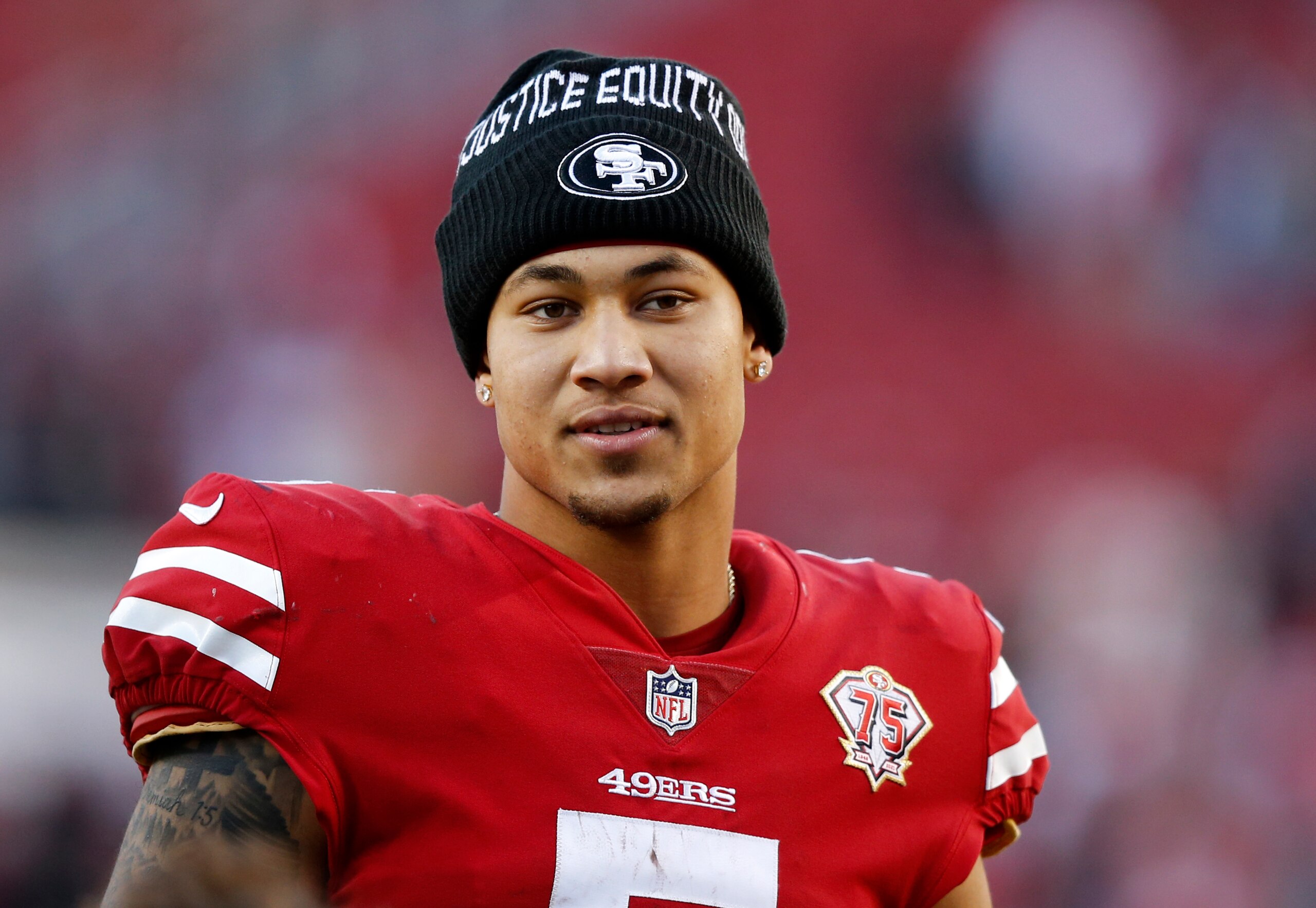

How Will Trey Lance Change the 49ers Offense?
Though Jimmy Garoppolo remains on the roster without a clear exit plan, the San Francisco 49ers selected Trey Lance No. 3 overall last year. The team's prized draft pick from the 2021 class should see the field in a starting role for the 2022 season.
In April, general manager John Lynch expressed confidence in Lance as a competitor who's ready to take over the starting job while reports about a shift at quarterback caused a buzz:
"All these reports, I don't know where they all come from. We always believe in competition, but at the same time we are great believers in what Trey Lance brings to the table. We believe he is ready. He is going to have to show that. I think he's ready to show that to us, show that to his teammates, and show that to the world."
TOP NEWS
.jpg?w=2560 "Chargers Chiefs Football")
Reported Details of Seahawks-K9 Split ⛓️💥
.jpg?w=2560 "Patriots Bears Football")
Buzz: Bears TE Likely Out for Season
Bears' Santos Wanted to Kick 58-Yarder
While Garoppolo healed from shoulder surgery on his throwing arm, Lance took all the first-team reps through mandatory minicamp, per The Athletic's Matt Barrows. Once the former starts to throw, the 49ers may try to trade him. If no team bites, they'll likely cut Garoppolo to save $25.6 million, per Over The Cap.
So, what does a transition from Garoppolo to Lance mean for the offense?
Let's start with the obvious difference.
The 49ers will have a more athletic signal-caller under center. While Garoppolo has the mobility to dart outside the pocket on bootlegs, Lance has the ability to turn a short loss or a dead-end play into a first down. We saw him in action on the run last year:
As shown in the highlights above, opposing teams will need to look out for designed quarterback runs, especially in short-yardage situations and near the goal line. As a collegian at North Dakota State, Lance rushed for 1,325 yards (6.9 yards per carry) and 18 touchdowns in 19 games.
Head coach Kyle Shanahan may feel more comfortable with an aggressive approach on fourth down because of Lance's ability to move the chains with his legs. His ball-carrying prowess may be able to mask the loss of Pro Bowl guard Laken Tomlinson (free agency) and Pro Bowl center Alex Mack (retired).
While at spring practices, Barrows noted that Lance didn't use his legs a lot and focused on beating the defense through the air.
"Lance rarely took off and ran, concentrating instead on picking up yards with his arm," Barrows wrote.
Lance has to pose a realistic threat with his arm or else he's going to take a ton of hits on attempts to move the ball on the ground. The second-year quarterback only has two NFL starts on his resume and appeared in just seven games since 2020, dating back to his time with the Bison.
Shanahan can ease Lance into the lead role with a heavy dose of run-pass option designs to define his throws and open up passing windows.
Last year, Tua Tagovailoa and Jalen Hurts ranked No. 1 and 2, respectively, in passing yards out of RPO play calls. The latter ran the most RPO plays in the league, while the former ranked sixth. Both played with new offensive coordinators and still made notable strides in their second season. Shanahan can use a similar method with his young signal-caller.
With an RPO-heavy game plan, the 49ers can marry Lance's athleticism with the bread and butter of Shanahan's offense, the zone run scheme.
Defenders must respect San Francisco's ground attack, which ranked top-seven in yards for two of the last three years. As linebackers and safeties commit to stopping the run, Lance can pull the ball away from the ball-carrier's gut and distribute it to his pass-catchers, who will likely have one-on-one matchups. Like Tagovailoa and Hurts, he can significantly improve his completion rate between Year 1 and 2 in an offense that opens up passing lanes for him.
For comparison, Garoppolo has completed 50 of 68 passes for 740 yards, two touchdowns and an interception on RPO plays in his eight-year career.
Once Lance becomes more comfortable reading defenses, Shanahan may trust him to make pre-snap RPO decisions, which rely on the quarterback's ability to determine whether to pass or hand the ball off against specific looks and coverages before the center hikes the ball.
In an ideal setup, Shanahan would likely prefer a balanced offense, which allows the play-caller to attack defenses according to specific weaknesses. Some weeks, the 49ers can depend on their staple run game, but if beneficial, they should be able to attack holes in the secondary.
Based on the 49ers' pass-run ratio when Garoppolo played more than six games in a single season, they didn't fully trust him to beat defenses with his arm. In 2019 and 2021, he made no fewer than 15 starts, and the offense had the fourth-fewest pass attempts but ranked top-five in rush attempts for those campaigns.
Under Shanahan, the 49ers have used wideout Deebo Samuel in addition to several running backs to maintain an effective rushing offense. That's a necessary strategy when the quarterback is a game manager in a good number of matchups.
Now, the 49ers can use Lance's arm strength to open up the offense. As a result, we should see a more balanced attack and perhaps fewer carries for Samuel, who, according to NFL Network's Ian Rapoport, wants to play a traditional wide receiver role after logging 59 rush attempts for 365 yards and eight touchdowns in 2021.
Garoppolo has an average arm and has shown a tendency to heavily target the middle of the field and let outside cornerbacks off the hook (h/t Pro Football Focus via Niners Nation's Akash Anavarathan):
Lance can challenge defensive backs outside the numbers with the ability to make big plays downfield.
In his second career start, a Week 17 win over the Houston Texans, Lance had an average target depth of 12 yards. It's the highest single-game mark of any 49ers quarterback since Garoppolo averaged 13.3 yards in Week 14 against the Texans in 2017, per Pro Football Focus' Jeff Deeney.
For the 2021 season, Garoppolo tied for 22nd in intended air yards per pass attempt (7.5). In a small sample size (71 attempts), Lance averaged 9.3 intended air yards per pass attempt.
Last season, Garoppolo led the NFL in yards per completion (12.7), but he accomplished that feat as the league leader in average passing yards accumulated after the catch (6.5). Meanwhile, Lance averaged 14.7 yards per completion, but he moved the ball with more intended air yards (longer throws downfield).
Shanahan doesn't have to abandon his effective run schemes, but Lance adds a vertical dimension to the aerial attack that Garoppolo doesn't provide under center. Furthermore, with a passer more equipped to throw over the top, the 49ers may be able to unlock wideout Brandon Aiyuk's big-play ability. He averaged 17 yards per catch in two years at Arizona State.
With a mix of RPO designs, big-armed throws 20 to 30 yards downfield and a splash of off-script sequences that can result in first-down runs or extended plays to give pass-catchers more time to separate downfield, Lance should bring more excitement to the 49ers offense.
Of course, Shanahan and his coaching staff have to frame it all together in order for Lance to maximize his skill set, but he has the tools to add those dimensions to the game plan, which would elevate an offense that ranked 13th in scoring and racked up the seventh-most yards last year.
If Lance gets off to a good start in 2022, the 49ers offense will be fun to watch with some electrifying sparks mixed into the run and pass game.
Maurice Moton covers the NFL for Bleacher Report. You can follow him on Twitter @MoeMoton.
.jpg?w=2560)