In The Zone With Andre Agassi
Agassi’s balls look more like (Bjorn) Borg’s balls would have looked if Borg had been on a yearlong regimen of both steroids and methamphetamines and was hitting every single f***ing ball just as hard as he could. Agassi hits his ground strokes as hard as anybody who’s ever played tennis – so hard you almost can’t believe it in person. -David Foster Wallace, “The String Theory”
Anyone who has read the essay from which that quote originated knows that Wallace was not a fan of Andre Agassi.
He loathed his wardrobe, his personality, and even his game, which he compared to a film of the Soviet Russian army subduing dissidents in an Eastern European satellite.
In fact, when grouped with what he said in “Roger Federer as Religious Experience” regarding Rafael Nadal (“unsleeved biceps and Kabuki self-exhortations,” anyone?) it was clear Wallace didn’t have a high regard for power baseliners in general.
He recognized talent in the native Las Vegan, though. Even those who loathed the long hair and flashy clothes of his early years, or the pirate rag of his mid-'90s resurgence all noticed his innate feel for the game: He took the ball earlier and hit with more consistent pace than anyone ever had, and returned serve even better than Jimmy Connors, whose returns revolutionized tennis in the ‘70s.
These attributes, combined with his…unconventional fashion sense drew numerous new observers to the game, but concerned many a tennis purist (like Wallace) that their refined, cultured game was under siege from a hard-hitting Hun in Nikes.
They were saved from seeing him in the winner’s circle too often, however, firstly by his own suspect discipline and secondly by the competition he faced: First in 1990 and then in ‘95, he reached the final of the US Open, only to meet the purists’ standard bearer in Pete Sampras, the most complete player of his generation.
TOP NEWS

Agassi, Serena and more iconic US Open outfits
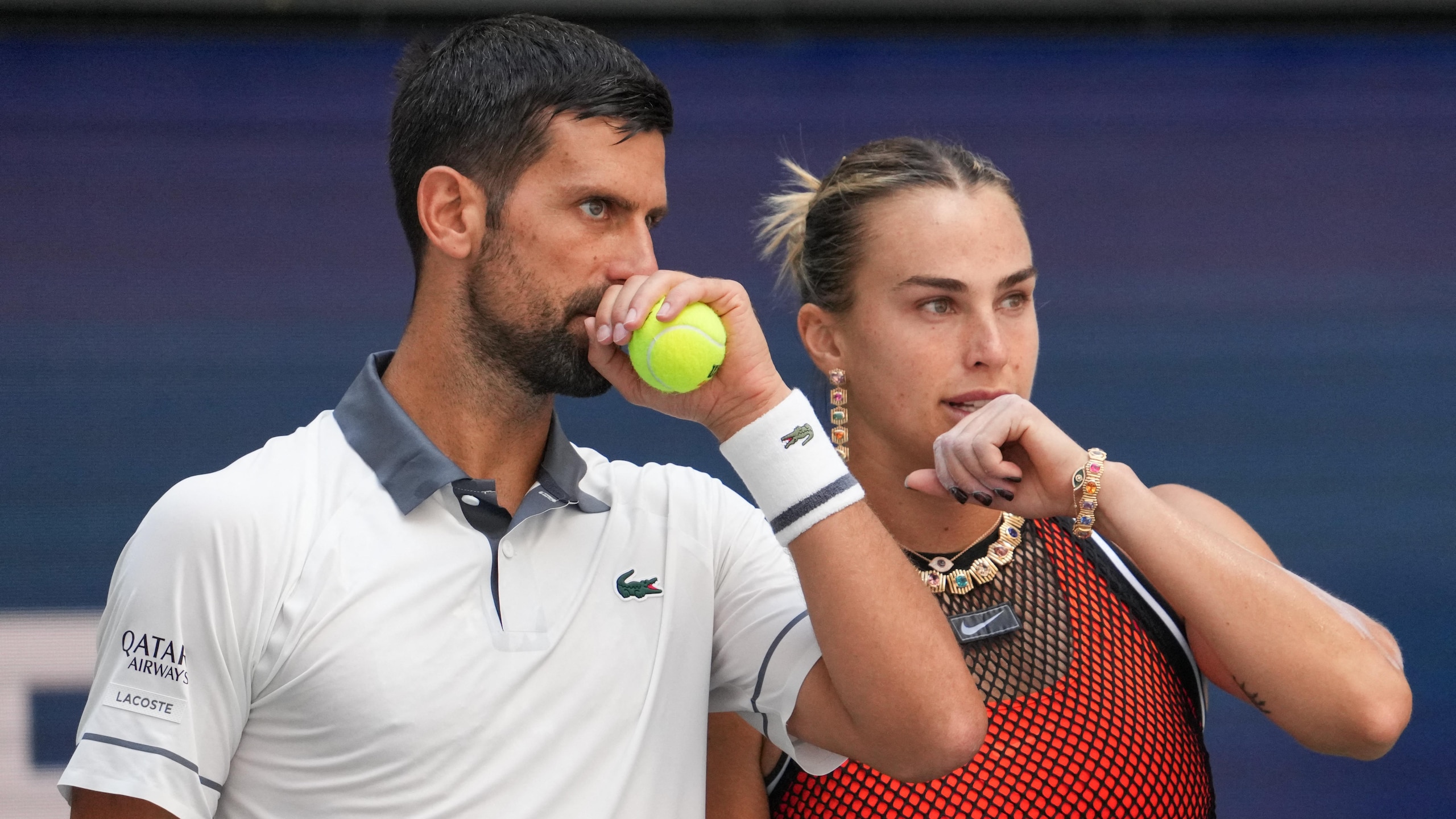
Novak, Aryna Lose in US Open Doubles
🎾 Buzz: Mamdani's 'Affordable' US Open Tix
In both cases, the defeats he suffered stole his momentum and, particularly in ’95, were so discouraging as to exacerbate his dedication deficiency.
Though it took longer to reach fulfillment than his supporters would’ve liked, Agassi’s undeniable ball-striking ability remained, ready for the day he chose to put it to use.
That day arrived when he won the 1999 Roland Garros, completing his collection of Grand Slam titles and helping him back to the No. 1 ranking. In his 30s, he remained a contender at the majors, eventually accumulating eight of them.
And it was his last, the 2003 Australian Open, that displayed the American legend in his most dominant form, despite his being just shy of 33.
This was partly because Agassi had solved his self-discipline issues: At this point, Double-A was no longer the skinny kid in denim shorts who bragged about eating cheeseburgers, but a grown man who could bench press somewhere in the neighborhood of 300 pounds and who spent the off-season running up hills to prepare him for the AO.
The other factor was the competition: Sampras, having won the ’02 US Open just months earlier, was unofficially retired.
Most of those who remained were now, like Agassi, power baseliners who hit harder than previous generations, but lacked the American’s unprecedented vision and reaction time.
Still, it took him some time to work his way into form in that event, as he labored through the first round against 93rd-ranked Brian Vahaly in a match that was over in straights, but by the hardly dominant scoreline of 7-5, 6-3, 6-3.
If a Vahaly had pushed him, his second-round opponent, South Korea’s Hyung-taik Lee, appeared a genuine threat. Lee had just won his first career title in Sydney a few days earlier, beating Andy Roddick and Juan Carlos Ferrero (both of whom would win majors that year) along the way.
When Lee used his fleet feet and smooth one-handed backhand to win his opening service game and then pressure Agassi’s serve, it appeared that Double-A had a long day ahead of him. However, after holding, he proceeded to break Lee, and then did so twice more to win the first set, 6-1.
A 23-year-old grad student at the time, I was following the score online, finding it considerably more interesting than the musings of the Romantic Era poets I was studying.
Still, the thought of a stern lecture from an erudite English professor and the idea that I might be wasting the considerable sum I’d used to enroll eventually forced my attention back to the books, at least until my required reading was finished.
When I turned the Internet back on somewhere between 30 minutes to an hour later, I was surprised to find that Agassi and Lee were no longer on the “Matches Underway” page of the AO’s Web site. I switched to “Completed Matches” where I saw Lee’s name with a 1 and two 0s beside it.
After losing the opening game, Agassi had pulled off 18 in a row against his very tough opponent. It was a beating so severe as to prompt Bud Collins to ask Agassi afterwards if he were aware that Lee was from South Korea, and not North.
As hard as that was to top, Agassi’s form only seemed to get better from there: The only set he lost in six matches was to Nicholas Escude, a dangerous Frenchman with an all-court game and the only one of Agassi’s opponents who offered any contrast to his baseline play.
In his quarterfinal encounter with the speedy Sebastian Grosjean and the semis against veteran Wayne Ferreira, the Double-A lost seven games apiece.
On the opposite side of the draw there were a few players with games that could have tested Agassi: There was then-No. 1 Lleyton Hewitt, there was the rapidly rising Andy Roddick, as well as the huge-serving and hitting Moroccan Younes El Aynaoui.
As it happened, the draw gods seemingly sought to use these three to destroy one another, as El Aynaoui served Hewitt off the court in four hard-fought sets, then pushed Roddick to a 21-19 fifth set—that’s three sets' worth by itself—before falling.
Roddick, exhausted and succumbing to tendinitis in his critical serving arm, fell in the semis to Rainer Schüttler of Germany.
Schüttler was himself more of a counterpuncher, primarily relying on speed but possessing surprising bite on his first serve and forehand.
Before Roddick, he had defeated Richard Krajicek and David Nalbandian, and he went on to win two titles that year and finish in the top 10 for the first time.
But against Agassi he was seen as the second coming of Chris Lewis, the New Zealander who found himself in the 1983 Wimbledon final where tennis viewers everywhere could see him in the chokehold of John McEnroe.
And that’s basically what happened: He wasn’t speaking of Agassi at the time, but Wallace once wrote that watching two mismatched baseliners play was like “watching an extremely large and powerful predator get torn to pieces by an even larger and more powerful predator.”
In this case, Schüttler would have been a jaguar: lithe, strong and with an imposing set of fangs, but no match for a Kodiak bear.
When playing well, Agassi typically required a bit of time to really sink his teeth into a match, at which point he would use his immaculate precision and ability to reach the ball in few photo flash steps to demonstrate that opponents would not get any balls by him.
That established, he had the freedom to run his opponents from side-to-side until they grew weary, surrendering more errors or simply declining to retrieve any more of his shots.
The difference between a very good Agassi and an Agassi in The Zone is that no time was required to ease into the match.
From the first point, Double-A was drilling any serve that he could get a racket on, finding angles that would make a geometrician giddy, pounding the German’s legs and easily finishing points with drop volleys at net.
By the third set the very fast, very fit Schüttler was spent, and Agassi finished the match by breaking him for the seventh time.
Fittingly, the last point was a second serve, and after the American struck the forehand return he was celebrating by the time the ball had landed. He’d surrendered only five games; one less than McEnroe allowed Lewis.
Afterwards, he said it was the best he’d ever played, and few could argue that he hadn’t made the most of his game by the end of his career. Of course, it’s not a game for everyone, especially those who prefer finesse to power.
It’s their loss; at his best, Agassi showed that pace can be picturesque.
For the previous installment, In the Zone with John McEnroe, click here.
.jpg?w=2560 "Bills Browns Football")


.jpg?w=2560 "BTJ Suffers Shoulder Injury")
.jpg?w=2560 "Players with Shocking Career Earnings 😳")