
French Open 2011: Roger Federer, Yet to Lose a Set, Has Novak Djokovic Next
 On a windy day at the center of the tennis world, Roger Federer completed yet another three-set match at the French Open, this time against Gael Monfils.
Despite the fact that the crowd's native son Monfils was in the match that could catapult him to the semifinals, somehow Federer held the crowd in restraint and got the applause he is so used to at the end of the last set, winning in a tiebreaker.
In the tennis world, few stars have ever burned as bright as Roger Federer. Some will argue none have or will ever burn as bright for as long as Federer.

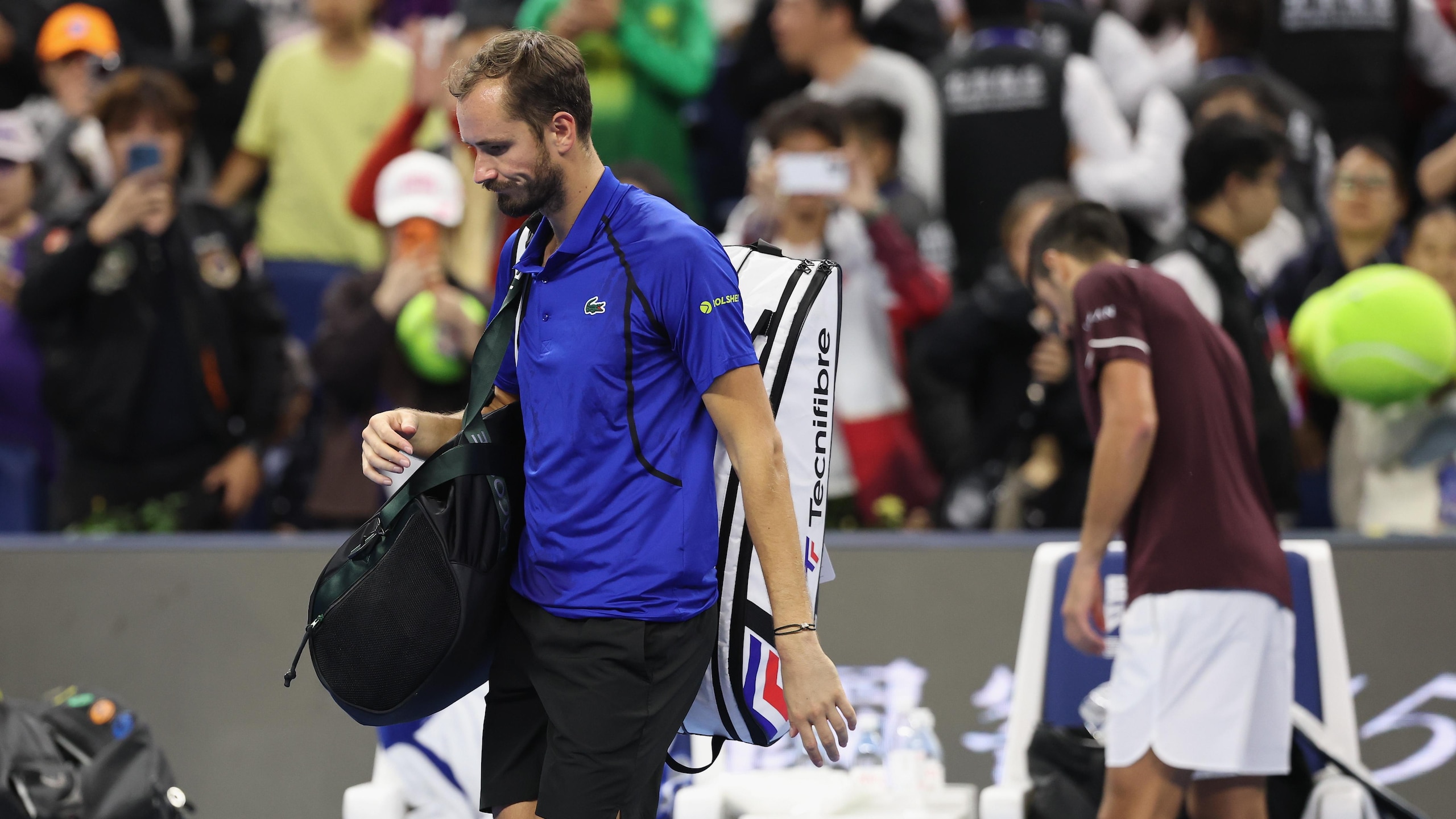

The win was fairly easy, although Federer seemed to have more problems initially with the conditions than Monfils. The wind was swirling, and the French Open refuses to water down the courts more than to start the match, so the conditions worsened as the match progressed.
In his typical efficient way, Federer won the points with both winners and unforced errors on Monfils' part. Despite the relatively easy first two sets, Federer was much more tentative in the last one. Break followed break until the third set was tied six-all. Then, with some uneven spots, Federer closed out Monfils in the tiebreak after Monfils continued his error-filled ways.
The third set was some small retribution for Monfils after appearing done in the first two sets, particularly by the conditions. Monfils at one point slammed his racquet on the ground in disgust at yet another error that gave another game to Federer, and his body language was not good through most of the match. Yet he gained some force in the third, with Federer sending some of his now famous wild shots toward the crowd and well out of the playing surface.
The huge ball-striking mistakes are now the usual, especially toward the end of matches. Without his former precision, Federer seems to play much more of a center court game, rarely going for the corners or advancing to the net, seeming to be satisfied waiting for an opponent's mistake.
The significance of Federer's run without losing a set so far in the French Open pales in comparison to the run of his next opponent, Novak Djokovic. The latter's 43-match winning streak and perfect 41-0 record this year are on the line on Friday.
Federer is making as much of that as he can, seeking a mental edge over the past few days.
Speaking about the upcoming match, Federer postured the match against him as helping Djokovic largely because it was against him yet again.
“I think there’s less at stake for me than for him. He’s got a lot of things going on. Sure, I’d love to be again in a Grand Slam final because I haven’t achieved that in a few slams,” The Herald Sun quoted Federer, as saying.
“I’m sure it’s been tricky for him, but he’s been doing a great job. Now maybe the streak is less at stake in some ways, because it’s more of a big match against me so it’s easier to focus just on playing me instead of the whole situation. It’s going to be an interesting day,” he added.
But Federer also suggested similarities between this situation, when Djokovic is going for the No. 1 ranking, which he gains if he beats Federer, and the situation he faced in 2004.
"I know he has a lot on the line, which we all know about," Federer said. "I have been there myself before in 2004 when I was going for world No. 1 against (Juan Carlos Ferrero) in Australia in the semis of a Grand Slam, as well. So it's a similar situation."
The reality is that Djokovic was at one time subject to Federer's mystique. A wonderful mental barrier has emerged for Djokovic over the past several months that makes this a thing of the past.
Today, Djokovic is the best in the world—and he should prove that on Friday.
There is always hope in Federer's camp. That his age is still not a factor. That his will remains strong. And that he will eventually add to his men's record 16 Grand Slams, two more than his closest rival Pete Sampras. (Steffi Graf holds the all-time record of 22 Grand Slams during her career.)
But that has become very doubtful. Even were he to advance beyond Djokovic, he would have to meet Rafael Nadal, against whom he has a losing record. Nadal must beat Robin Soderling in the quarterfinals and then either Juan Ignacio Chela or Andy Murray. None should prove too difficult for him.
For now, we can look forward to a glorious match on Friday between two competitors for whom the tables have turned dramatically in recent years. Although only Djokovic and Nadal have beaten Federer in straight sets in a Grand Slam event, the last time at the Australian Open this year, Djokovic appears to have the upper hand with both this year.
The No. 1 player has a great advantage at the moment given the state of men's tennis. As the No. 1 seed, Nadal has been seeded to play only one of the top three players at the recent Grand Slams. The other two have been seeded to play both Nadal and the other in order to win a Grand Slam.
That advantage goes over to Djokovic as long as he gets through Federer on Friday. He then only has to play either Federer or Nadal for as long as he holds the ranking.
That is likely the biggest factor in the upcoming match. Achieving No. 1 today is far more important to Djokovic now than it was to Federer in 2004. The pressure to do this on Friday could prove to be too much for Djokovic.
Coupled with Federer's incentive to get to the finals and to best Djokovic after so many recent failures, this match is clearly must-see TV.
.jpg?w=2560)
.jpg?w=2560 "Viral Rams Coach Vid 🖕")


.jpg?w=2560 "Injury-stricken Seahawks signing veteran RB")
