
The New York Mets Sale: Should Mets Fans Be Happy?
 The Wilpon brothers, who are majority owners of the New York Mets are in final negotiations with billionaire hedge fund manager David Einhorn to sell a 30-33 percent interest in the team for a reported $200 million.
The deal supposedly includes a provision allowing Einhorn to purchase an additional 27-30 percent in three years, so that he would then own 60 percent at the same valuation. The Wilpons can avoid the latter sale and retain majority ownership of the club by repaying the initial $200 million to Einhorn, in which case Einhorn retains his 30 percent interest for essentially nothing while receiving a $200 million cash return on his $200 million investment.



So, the question presents itself is how should Mets fans react to this sale?
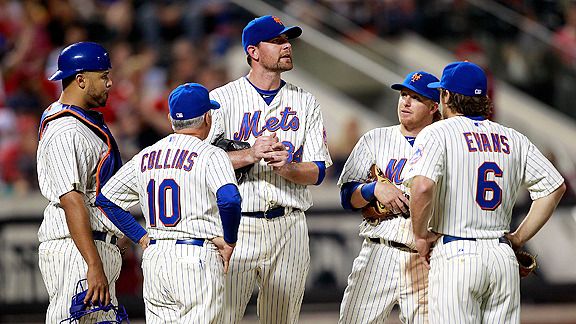
It's no secret the Wilpons, along with their business and team ownership partner Saul Katz, have been distracted lately. It's also no secret that they and the franchise are in desperate need of cash.
Both issues stem in part from the fallout of the Bernie Madoff saga, as the trustees for the victims in the Madoff affair are suing them for a $1 billion.
As if that was not enough, the club is said to be hemorrhaging cash and is on pace to lose $70 million this season. Anything that can ease both situations—as this sale will do—has to be a positive for the team's performance.
The idea that the Wilpons may be gone in three years probably brings new joy to the clubhouse—especially following principal owner Fred Wilpon's interviews in the New Yorker and Sports Illustrated last week.
There is another reason Mets fan should have reason to hope. The track record of hedge fund owners in professional sports is generally a good one. Whether it's the application of lessons learned in the hedge fund business, the ability and willingness to spend the necessary time to lead the organization—since most of them are billionaires and have the luxury of time—or the knack for picking the right personnel, the track record holds up across sports.
In baseball, there is John Henry, whose Red Sox broke an 86-year drought two years after he bought the team. In basketball, there is James Pallotta, a member of the ownership group of the Boston Celtics. In hockey, you have Philip Falcone, who owns part of the Minnesota Wild.
This brings up a somewhat unrelated topic, but an interesting one nonetheless.
I'm sure many of you are aware of the Stadium Curse; the negative effect on stock price and financial performance of companies that enter into naming rights agreements for stadiums and arenas.
There may be a corollary to that rule emerging and it would indicate that investors in Greenlight Capital, the hedge fund managed by David Einhorn, should be wary. This curse applies to investors in hedge funds whose managers acquire sports franchises.
There appears to be a negative correlation between fund performance and franchise ownership.
That is to say, the performance of the hedge fund goes down once the manager has taken ownership in a professional franchise.
Whether it is due to distraction or market luck is hard to say, but the correlation is apparent. It may all be bad mojo, just like the Stadium Curse, although in both cases, I tend to lean towards the idea that the investment is overpriced and reflects poorly on the priority of the company/hedge fund manager.



.jpg?w=2560 "Latest Peyton-Colts Rumors")


