
March Madness Bracket 2011: The Most Noteworthy Snubs of the Tournament
Who's a No.1 seed? Why did this team get a higher (or lower) seed? Who has the easier road to the Final Four?
No matter how much the NCAA expands its tournament, part of the discussion will also be who didn't get in.
This year is no different, as there are a handful of teams that saw their dreams of making the NCAA Tournament disappear into thin air, as the selection committee passed them over.
Here is an in-depth look of six teams that were relegated to the NIT in order to try to be the "69th" best in the nation.
Alabama Crimson Tide
1 of 6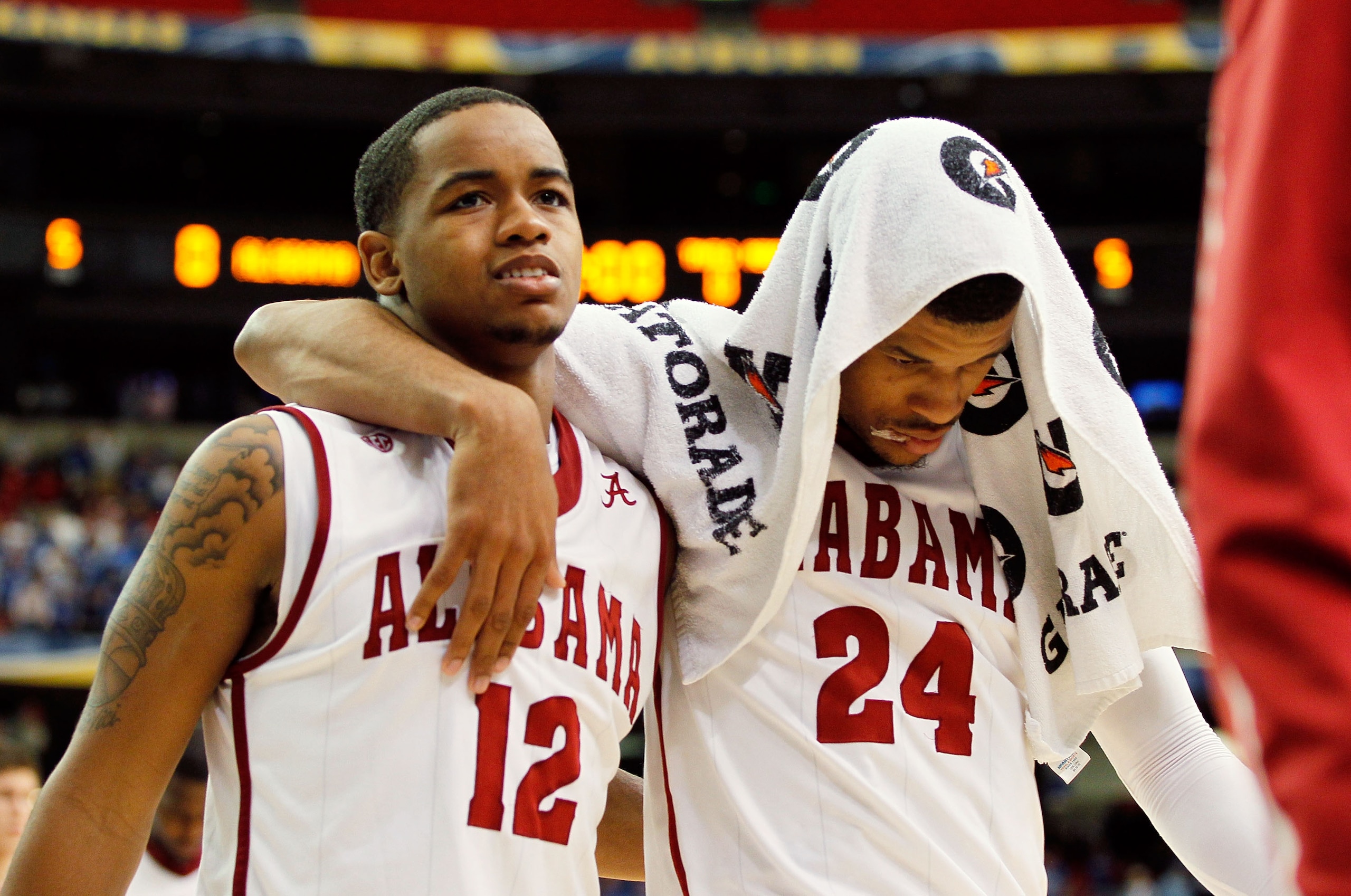
Record: 21-11 (12-4 SEC)
Good Wins: Georgia (twice—home game, neutral site), Kentucky (home game)
Bad Losses: Iowa (neutral site), Providence (away game), Seton Hall (neutral site)
Why should they be in: Alabama thought it wrapped up a bid in the NCAA Tournament after beating fellow bubble conference foe Georgia twice in six days. Not only did Alabama fail to make the tournament, but Georgia made it in and does not have to play in one of the four play-in games. The Crimson Tide finished 12-4 in the SEC and were put out in the SEC semifinals by Kentucky, the same Wildcat team that lost to Alabama on Jan. 18 in Tuscaloosa.
Why they are not in: Alabama did not have a good strength of schedule and an RPI of 80 to go along with a bad start to the season. At the Paradise Jam Tournament, the Crimson Tide lost to Seton Hall and was placed in the loser's bracket where they also lost to Iowa and St. Peter's. Combine that with a loss at Providence and dominating the weaker of the SEC divisions—the SEC West—and it is safe to say that this sealed the Crimson Tide's fate.
Boston College Eagles
2 of 6
Record: 20-12 (9-7 ACC)
Good Wins: Texas A&M (neutral site), Virginia Tech (twice—at home, away game)
Bad Losses: Yale (home game)
Why should they be in: Although Boston College's resume did not have many good points, they did sweep fellow bubble team Virginia Tech. The Eagles also beat a quality opponent in Texas A&M during the Old Spice Classic.
Why they are not in: The main reason why Boston College failed to make it to the field of 68 was due to bad losses and failure to step up when it counted. The Eagles' 13-4 start was highlighted by bad losses to Ivy League opponents Yale and Harvard. Then after bouncing back from a 3-7 stretch to briefly improve its tournament chances, Boston College lost to Clemson, 70-47, during the quarterfinals of the ACC Tournament. The result: Clemson made the NCAA Tournament, while Boston College is in the NIT.
Colorado Buffaloes
3 of 6
Record: 21-13 (8-8 Big 12)
Good Wins: Kansas St. (three times—home, away, and neutral), Missouri (home game), Texas (home game)
Bad Losses: Iowa St. (away game), Oklahoma (away game), San Francisco (away game)
Why should they be in: Do you know how hard it is to beat a team three times in a season? How about coming back from a 22-point deficit to a top five ranked team? Colorado did these things this season and still fell short.
Why they are not in: The Buffaloes did win some key games in the Big 12, but their out-of-conference wins were not that impressive. To make matters worse, two of their four losses outside the Big 12 were to Georgia and Harvard, who both anxiously waited to hear their names announced on Selection Sunday. Going 1-6 in a rough seven-game stretch from Jan. 18 through Feb. 9 did not help matters either.

.jpg?w=2560 "Seahawks Chiefs Football")
Harvard Crimson
4 of 6Record: 23-6 (12-2 Ivy League)
Good Wins: Boston College (away game), Colorado (home game)
Bad Losses: Yale (away game)
Why should they be in: Harvard coach Tommy Amaker has made this team competitive and it showed that while staying in contention for the Ivy League until the final seconds of the tiebreaker game. The Crimson also notched wins against fellow bubble teams Boston College and Colorado, while losing five of their six game against NCAA Tournament teams.
Why they are not in: Princeton's game-winner sadly sealed Harvard's fate. Even though the Crimson beat Boston College and Colorado, Harvard could have benefited if close losses to either Michigan or Yale went the other way.
St. Mary's Gaels
5 of 6
Record: 25-8 (11-3 WCC)
Good Wins: Gonzaga (away game), St. John's (home game)
Bad Losses: San Diego (away game)
Why should they be in: 25 wins and splitting the regular season tournament in a recognized mid-major would at least put St. Mary's into talks of getting into the NCAA Tournament. The Gaels tried to schedule well and they were close in most of their losses this season. St. Mary's even scheduled a game after the West Coast Conference tournament to help its chances, a game that it beat Weber St., 77-54.
Why they are not in: St. Mary's did have an impressive win over St. John's early in the season, but the Red Storm were a much different team then than they are now. However, losing to a 6-24 San Diego team was the crippling blow. That loss was the first of a late-season three-game losing streak to hinder the Gaels chances at making the NCAA Tournament.
Virginia Tech Hokies
6 of 6
Record: 21-11 (9-7 ACC)
Good Wins: Duke (home), Florida St. (twice—home, neutral), Penn State (home game)
Bad Losses: Georgia Tech (away game), Virginia (twice—home, away)
Why should they be in: Virginia Tech knocked off then No. 1 Duke, 64-60, on Feb. 26 and advanced to the ACC semifinals. Last year, the Hokies were on the bubble because of bad schedule strength, so they added a road game against Kansas St. and were paired with Purdue in the ACC/Big Ten Challenge this year.
Why they are not in: However, the Hokies' strength of schedule was still weak as only played UNLV and Penn State as their other non-conference foes. Virginia Tech also shot itself in the foot by following up the Duke win with losses to Boston College and Clemson to put the team right back in the bubble. Inconsistent play hurt the Hokies and placed them in the NIT for the fourth year in a row.

.jpg?w=2560 "WWE Raw Live Grades 🔠")
.jpg?w=2560 "Multiple NFL Trades Predicted")


