
Josh Koscheck, Jon Fitch, Georges St. Pierre: Wrestling or Lay-and-Pray?

I am a bad person.
As the banker, I cheat kids in Monopoly. I sell caravans with bad wheels in the English countryside, miscount my word scores against the elderly in Scrabble, and have my teammates illegally attack the leg of my pending opponent in Californian Karate tournaments.
A famous, lolly-gagging nuclear technician from Springfield once said, "Weaseling out of things is important to learn. It's what separates us from the animals... except the weasel."
TOP NEWS
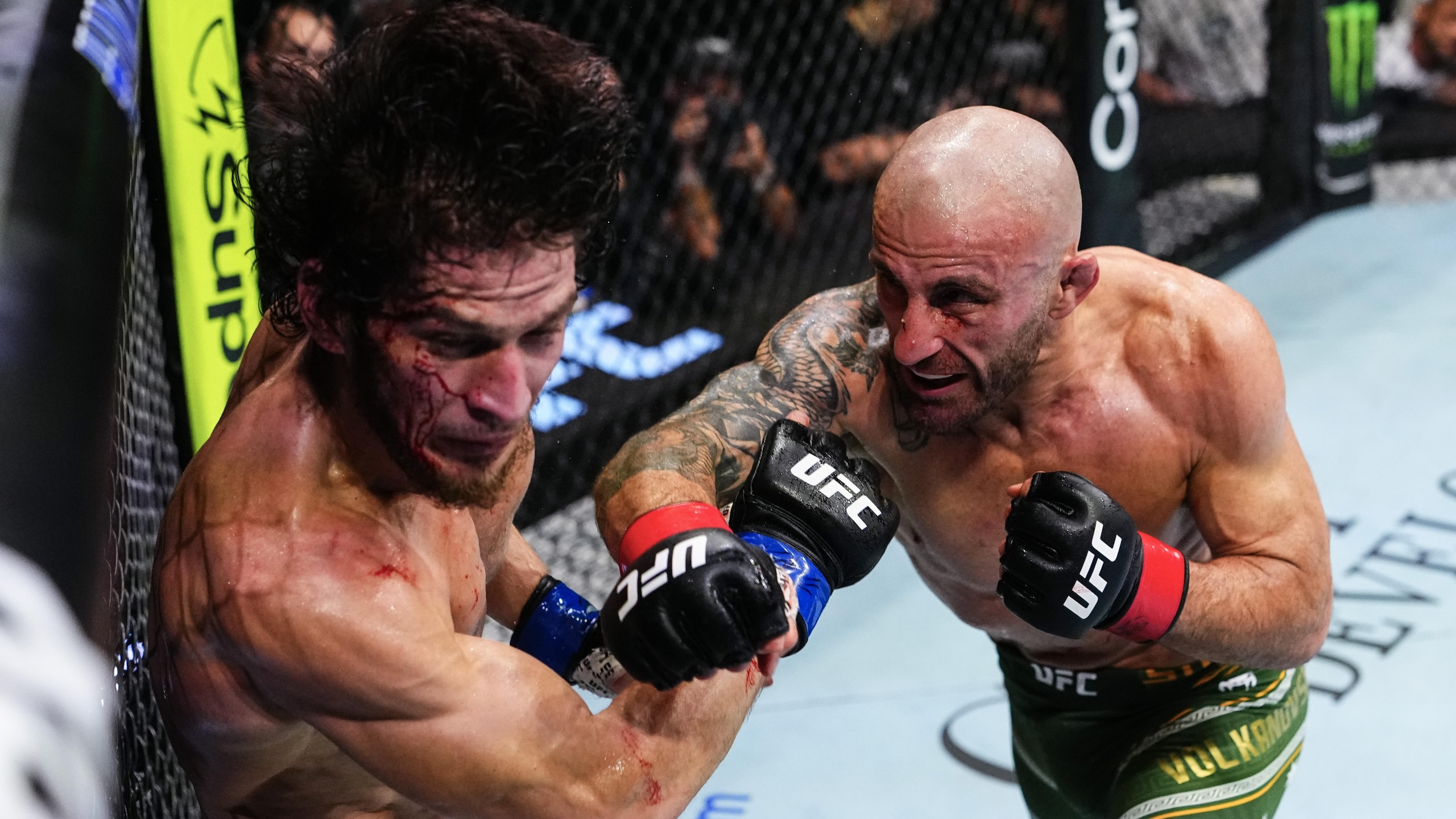
Volkanovski Retains UFC Title 🏆
Volkanovski breaks record after title win at UFC 333
Fights to Make After UFC 333 ➡️
Think of coupons that offer discounts. They invariably read "valid only one per offer/customer." I imagine that at one point in time they lacked that disclaimer, but after a few jokers brought in hundreds of coupons and walked off with so many free items, the rules were changed.
Many gas stations now require me to pre-pay. Why is that? It is because Man recognizes his own weaknesses and thus implements mechanisms to protect him from himself.
It is human nature to exploit situations to "get mine." Sports, known as the ultimate level playing field, is not exempt from this glitch in our moral DNA.
This principle of creating checks and balances to ensure people are not bending the rules too far is implemented across the board in all sports.
In football, a play clock was introduced, and delay of game penalties are issued to those who expire the issued time. Intentional grounding is one of the harshest penalties in the sport because it is seen as counter to the spirit of the game: playing with no intention to advance nor score.
Teams are also awarded six timeouts, plus two two-minute warning time-outs, in a game to prevent teams from doing nothing more than striving to preserve a lead. This is because football does not want to see stalling. They want to see football.
In soccer, they quite cleverly conceived the notion of "added time" so players who are trying to waste time do so fruitlessly. The referee simply calculates the non- playing time that elapses and adds it onto the scheduled time.
The referee also is quick to hand out yellow cards to those who deliberately attempt to stall and kill time (although some may feel that extending a soccer game punishes the viewing public more than anyone else).
Goalkeepers often receive this late in a game when they are slow to deliver a goal kick. These measures exist because people do not want their trust in a game to be violated, and they understand that people will manipulate a game to win.
Still in doubt as to the existence of people who might go out of their way to twist the rules to win cheaply? Talk to No. 16 of the New York Rangers. The debate of what is cheating can be best answered with the superlative documentary: Bigger, Better, Faster.
In MMA, we are still trying to work out the kinks. Naturally, people will gravitate to varying sides and different philosophies will ensue. The greatest grievance appears to be with what people call " lay and pray."
This is, in my definition, where fighters obtain top position and merely attempt to hold their opponent beneath them with controlling the top position being their main objective—strike and submission attempts are not the goal but a means to keep the position held.
This is usually done by wrestlers who can get that position with their takedown skills, and this complements their basic wrestling ability. Lay-and-pray-ers are looking to stay on top and not win via knockout nor submission, but via decision.
Wrestling is an exciting part of the game. Hall-of-Famer Matt Hughes' super slams helped further launch the sport and will always be an integral part of highlight films. Tito Ortiz was—stress on was—extremely popular.
Tito is one of the first MMA icons and really hit crossover star status. People loved him, appreciated his wrestling skills and his thirst to end fights via ground-and-pound.
There is nothing against wrestling. It is against intentionally creating non-action. Anderson Silva is one of the most exciting athletes of all time, and he is relentlessly booed. This is because the electric stand-up star does not try to finish fights.
The onus should be on both fighters to create action. If the bottom player is working to make a fight happen against someone who is doing everything in their power not to fight, punitive measures should be taken against the top player.
Joe Rogan likes to admonish the officials and fans for looking for the stand-up, stating that a lack of action is part of the game—well, it is not. In fact, there is a passivity rule that should be enacted by the referees.
If someone does have superior wrestling skills, they should be rewarded for it, but it does not grant them impunity to manipulate the integrity of the fight by not looking to try to advance their position, land strikes or secure a submission.
It is a fight. If someone loses to a better wrestler, it is easy to scream lay-and-pray but does not make it valid. Most fans can appreciate the art of wrestling. They can also understand that no fighter can look to attack and end the contest every second of the fight.
The audience also appreciates how tiring it is and expects some resting to occur at various points of the fight. They even seem to enjoy a fight when two exhausted opponents keep going after it!
However, some people argue that lay-and-pray is justified and that it is the responsibility of the fighter to be able to protect himself from this legitimate fighting philosophy.
The argument unfolds as such: Fighters can train to heighten their skills so that they are not allowing the other to hold them down. First, from the bottom, one has gravity working against him, a highly-trained person of equal body weight on top who is focusing all of their energy on keeping them there and a mat underneath them limiting their movement.
To suggest that one simply create space and escape as a justification of an athlete not trying to score further points in a game is absurd. Yes, they should do all of those things—but should it take more than two minutes? One has now lost half the round.
While they should be behind for conceding the takedown, they are also now considered to have lost all the time it took them to escape and get back to their feet. Consider how long Royce Gracie needed to find a submission off his back against people with no jiu-jitsu skills—it is not that simple.
As kids are told to "stand up to the bullies and they will back down," today, lay-and-pray advocates say, " Be Demian Maia, and they won't take you down." Well, that works for about 20 people on the planet—the rest of us are just not that talented.
Furthermore, in today's world of MMA everyone has sound jits, so it is going to take time to escape from someone who is skilled and playing defensively.
Lay-and-pray-ers are skilled at simply using their strength to lie on top without moving or giving the bottom player any chance to exploit aggressive openings.
I would argue that very few Mixed Martial Artists are not trying to improve their ground game, subs, escapes and sprawls; stalling is difficult to prevent. That is why there are stalling rules in wrestling, too.
Jon Fitch is a black belt in Guerrilla Jiu Jitsu under his famed coach, Dave Camarillo. Camarillo, who is a judo and jiu jitsu expert, is a coach at American Kickboxing Academy and plans the strategy and in-fight instructions for Fitch and others.
Yet, his star pupil has produced no wins via ko nor submission in his last eight fights. Are we truly expected to believe that he is really trying to end the fight—really?
Naturally, stalling will happen from time to time and is human nature. That is acceptable. Most people would have given Chael a pass had he stalled for those final three minutes; he had invested four plus rounds of pure aggression.
It is sound strategy to be defensive-minded at times, but it should not be a philosophy. No one protests the last minute kneel downs in football because both teams had the play clock and their timeouts to counter this measure.
Josh Koscheck, under the same Camarillo system, employs this exact strategy of lay-and-pray: Watch the Paul Daley fight. This is a game plan more than an accepted and unavoidable reality of the fight game; it is their goal.
GSP is not a lay-and-pray-er, in my opinion. I think he just does not have the power to knock people out, nor the submission skills to get subs against elite grapplers.
In the Fitch fight, GSP hit him with everything he had but could not finish the AKA product. In the Hardy fight, he almost had a kimura and an armbar but lacked the details ( like squeezing his knees together on the armbar) to finish the moves.
Although he did sub Hughes, he also lost to Hughes via armbar in their first fight by attempting a kimura from an incorrect posture. His KO win over Serra was due to knees to the body, not KO punching power.
In that same Hardy fight, his corner, Greg Jackson, was telling him not to pass the guard. Jackson's goal was to obtain the takedown and to land strikes from an elevated position inside the guard of The Outlaw. This is a style which will produce few finishes.
Hardy, from his back, cannot hurt Georges too badly with the limited power of his strikes from this position. To his credit, GSP kept trying to pass the guard and to land more meaningful strikes and go to where he would have more submission possibilities.
I see the French-Canadian as a great wrestler who does not lay and pray but has limited finishing power.
It is not the wrestling nor the ground game that most fans object to, it is people not trying to win. Placing blame on camps and individual fighters is not the goal; the judges should be better informed of grappling techniques, and referees should use the tools already available to them.
A great example of this would be Mir-Lesnar 2. Brock was on top and holding Frank in half-guard. Herb Dean explained that he needed action or he would stand them up. Brock would land short strikes and then hold. Herb would warn him and then would strike. This seemed fair to me. The fans chanted "Stand them up."
However, I think Dean did a superb job. Lesnar proved to be trying to finish the fight because he turned the lights out on the brash Las Vegan. If people are working from the top, let them do their thing despite the fans' disapproval.
Josh Koscheck and St. Pierre will meet in Montreal on Dec. 11. I predict a very exciting fight. Although I don't have confidence in his one-shot KO power, I think a dynamic striking game, well-designed takedowns and vicious ground and power over five rounds will produce a stoppage win for the hometown Habs fan.
How valid is my authority to offer a prediction? Well, no, Matt Millen, I was not in their training sessions nor their locker room.
As for the lay-and-pray controversy: In time, judges will be better educated and the referees will follow the existing rules and issue warnings to stallers. Plato: "You can discover more about a person in an hour of play than in a year of conversation."
This suggests to me that this glitch in our DNA is enhanced in sports. We inherit a "sneaky" gene, and this often manifests itself in ugly ways. We will purposely look to find loopholes to enhance our chances of success; that is man.
Here is an excellent article that I felt was very well written that counters my points.
http://bleacherreport.com/articles/507366-the-falsities-of-lay-and-pray




.jpg?w=2560 "Jonathan Taylor Landing Spots 📍")




