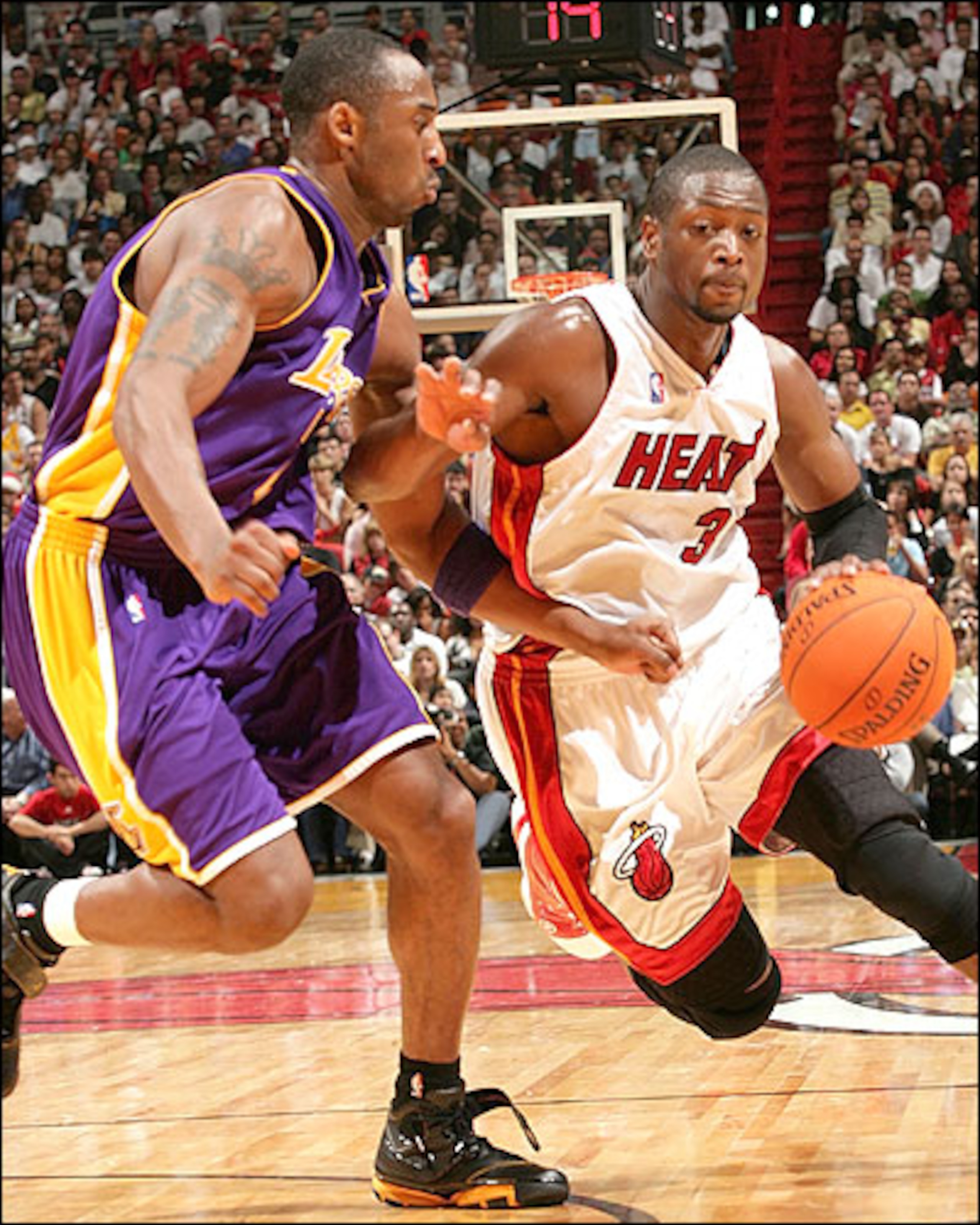

NBA Fallacies: Dwyane Wade Will Never Be Better than Kobe Bryant
Often in life the hardest thing to do is to accept change. Mainly because with change comes dealing with the unknown. Over the course of human existence, we’ve developed and nurtured a fear of the unknown. At the same time, we’ve done the exact same thing with human curiosity.
Basically, we often inquire about what we fear in order to gain understanding. It’s why we have progressed as a species like no other on this planet. However, this contradicting philosophy isn’t often applied in the realm of sports.
Fans just aren’t interested in learning about things they fear, not the irrational ones at least. It’s often better to feel like one is correct than actually confirming a particular speculation.
People often hide from what they fear as a defensive or self-preserving action—these are the people that survive but don’t embrace life and all its wonders. In regards to sports, these are what many call fanatics.
They are bold and irrational in their assertions and often have a way of skewing facts to fit to their beliefs. Often with these kinds of people, once an opinion is formed on a particular subject, rarely is it swayed.
Fanatics are a part of every sports culture. In America, none may rival that of those who support the NBA. They create fallacies about players and find ways to individualize a team sport. Often attributing success to a single player’s action, and either totally or partially disregarding the contributions of others.
Because of such poor etiquette and illogical reasoning, many NBA fans are missing out on one of the greatest talents in NBA history.
Who is this player? Why he’s none other than Dwyane Wade of the Miami Heat.
Dwyane Wade has been one of the most productive players in the NBA since his rookie season. He has slowly established a foundation on which he can stand and arguably lay claim to being the best player in the NBA to date.
Those misinformed will quickly denounce notions of him being the best, while somehow continually adding him in the discussions of the top two or three players in the league—basically suggesting that he’s possibly second or third best but no way in the world is he number one, even though he’s accomplished quite a few things that those viewed as better haven’t.
The hypocrisy that surrounds Wade is arguably one of thee most atrocious behaviors in all of sports. His accomplishments are brushed aside like no other. For some reason, those apart of the media and who aren’t fans of him continuously paint an inaccurate description of him and his impact on the game.
If Kobe Bryant is his generations “Michael Jordan," Dwyane Wade is its “Clyde Drexler.” And that’s entirely from an accolades and legacy stand-point, thus far. In regards to statistics, Wade's numbers mirror Jordan more than those of Kobe Bryant.
Wade has managed to do what most fans require in order to be viewed as the best. He’s been a consistent performer, continuously played his best against the best, and became an NBA Champion.
So why the limitations on his greatness when he is ranked as the sixth most efficient player in NBA history?
Why has he reached his potential when so many find tons of holes in his game to poke at?
Are people this afraid of being wrong about an opinion they have unreasonably formed, that they are willing to inaccurately label a player who has earned their unbiased attention?
If you aren’t, would you be willing to subject yourself to the reasoning of a Wade supporter on why he is who he is?
I hope so.
The perception of him as a whole is a fallacy that needs to be dismantled. Simply put, Dwyane Wade is so much more than what people give him credit for.
Let us proceed with his journey.
5. Why Wade Can't Be Viewed as Being Better than Kobe Bryant
1 of 6We all have teams and players we support or root for harder than we do any other. These players and teams often play the game as we wish we could or as we believe it should be. And so the false sense of relation is born.
When we find such players that allow us to express these values, we tend to cling and idolize them. It’s a self-created relationship where only one party is aware of this created bond. It allows the fanatics to feel apart of something so much bigger than anything they could achieve alone.
Many fanatics are so deeply rooted with their support of these teams and players that it actually skews their views on reality. They often deem anything conflicting with their own belief system as false preachings.
This isn’t what being a fan is supposed to be about. It isn’t about blind allegiances to any particular aspect of the sport. It isn’t about being fanatical and irrational. And it isn’t about the false relationships we create with these sport entities.
Rooting harder for one player than you do another does not make that player better than the next guy. Fans aren’t some magical beings that guide these players to achieving what ever it is they do. Players are motivated by their own selfish agendas or need for self-fulfillment—kind of like what drives a fan to get through the day.
Why Wade Can’t Be Considered Better
Of every current player today, none has a bigger following of fans or fanatics than Kobe Bryant. The second may be LeBron James, though his popularity has taken a huge hit with his decision to join Dwyane Wade on the Miami Heat.
In the case of Kobe Bryant, Wade is competing against history in a lot of aspects. Not just the history of things Bryant has accomplished before Wade’s arrival into the league, but more in line with the established opinion that Bryant has been the best player for the past four or five seasons. This is a claim often made in reference to his two team accomplishments (two time NBA Champion), his two scoring titles, two Finals’ MVP awards, and his NBA MVP award.
Bryant is a player who has been a part of five championship teams, as stated, two of which have come during the seven years Wade has been apart of the NBA. It is important to note that Bryant has never won a NBA Championship while Wade has had a teammate that has made an All-Star team that particular season, the same rule holds true for Kobe Bryant.
Somehow the team accomplishment has become a way of discrediting the abilities of one player, while also boasting that of another. Using that logic, Wade has been better than Bryant three of the past seven seasons.
“No, no, no,” is what Bryant fanatics are screaming at this point. The team accomplishment argument apparently can only be applied in regards to promoting Kobe.
If Bryant has only been a champion five times, does that not imply that on nine other occasions the NBA has had another player with the distinction of being the best player? In fairness we must also demerit the three years that Shaquille O’Neal won the Finals MVP (2000-2002). That means a valid claim can be made for Kobe Bryant being the best in the game an eye-popping, two seasons. Which in return implies that Wade has too carried the distinction of being the best in the game, based on his 2006 merits—using the team accomplishment argument of course.
I can’t help but wonder if I’m the only one that sees’ the hypocrisy of such a sentiment.
Then there’s the individual accolades given based on the opinions of others. Things like the NBA MVP award and All-NBA teams are based on the voting of others. The fact that a vote is needed to establish a winner proves why the opinion of best in the game is 100 percent subjective.
Kobe is only four years older than Wade but has seven years of experience on him. In the NBA, that’s a life time of memories to try and erase, especially when that player is a once-in-a-life-time talent. This may be the biggest reason people dismiss Wade as being better than Kobe.
Even when Michael Jordan was dropping 63 points against the Larry Bird lead Celtics, the masses weren’t eager to just label him as a better player. Even though his individual numbers exceeded that of more notable names, he hadn’t matched or exceeded their team accomplishments.
The same rule of thumb is apparently being applied with Wade. Although he is outplaying Bryant from an efficiency stand-point, his team isn’t winning as often as that of Bryant’s. Once again a player is penalized as an individual and not for his actual play on the floor.
Bryant supporters often speak of what it is that Bryant can do and Wade can’t. Their favorite is that Wade doesn’t posses the shooting range of Kobe Bryant and that he never will.
Now remember where I stated the seven years of experience over Wade that Kobe has. His shooting range is directly tied into his tenure in the league. Kobe has gotten better with time and so has Wade.
Case in point: Over Wade’s first seven season in the league, he has only once averaged a full made shot from three point range (1.1 in 2008-2010) over the course of a season. In contrast the exact same description can be labeled upon Bryant. Through his first seven seasons, Bryant only once connected at a rate of one or more made three pointers per game (1.5 in 2003-2004).
So to be fair to Wade (who has shot 38, 0, 38, 35, and 41 percent in the postseasons), he will continue to improve. After all, he did make more three pointers and shot a better percentage during the 2008 Olympics than Kobe Bryant.
To be frank, all Bryant supporters do is make excuses for when Wade excels at a level he doesn’t and overstate the areas of the game that he does. It is a rather childish tactic that is generally employed when an individual doesn’t have a reasonable response to rebuttal a claim against Bryant.
To them, the notion that a player can possibly be better than Bryant doesn’t exist. But they are quick to voice there opinions on why they believe he is who they think he is.
Basically their opinions hold more weight than those who don’t share their beliefs—hypocrites and nothing more. Thus the reason why Dwyane Wade can’t be considered better than Kobe Bryant.
It isn’t about Bryant being more productive on the court. Because the numbers prove he isn’t.
It isn’t about Bryant being more of a competitor. Not when He is seven and six against Wade in head to head matchups, never mind the fact that he has fielded the better club in nine of the matchups.
It isn’t about being more clutch because Wade has proven himself on the greatest stage the NBA has to offer, a stage that Bryant has underperformed on twice.
4. The Proficiency Argument Favors Wade
2 of 6There are two things that generally separate the greats from the good and mediocre players. The first being their competence or how successful they are on the floor from an individual stand-point. The second is the ability to display a high level of facility or penchant for making things easier for their teammates. The word proficient is generally applied to a player that posses these qualities.
Often Kobe is complimented with this title because of his constant honing of his craft or the technique in which he displays.
It’s another case in which people are being extremely hypocritical of everyone else not named Bryant, or either they just don’t fully understand the word proficient.
They are basing their assertion on what something looks like as appose to the end results.
Case in point: Kobe is said to have perfect technique (even though there’s no such thing as perfect—everything in life is with flaw) on his jump shot, yet he isn’t anywhere near being the best jump shooter in the league. So what’s the big deal about having perfect technique if it doesn’t lead to being the best shooter?
In my estimate, production trumps appearance every time.
When you look at box scores for top scores you will never see a stat that records the technical value of a shot. I’m sure Bryant supporters would love if such a thing existed but the fact remains it doesn’t. The only thing that matters in regards to scoring is how efficient or successful a player is at doing it.
Bryant supporters preach that variety lends reason to thinking a player is better than those who aren’t as adapt at doing a multitude of things. In making these claims, they often state how Bryant is so much better at doing what he does than everyone else—as if that statement can be argued.
Of course he does, because no one does what it is he does. The same holds true with Wade, no one does as well what he can because no one attempts to emulate his style and abilities.
Great players aren’t defined because of their skill levels or abilities they posses. They are defined by the way they react to the many situations they face through the course of their careers.
If you think there aren’t hundreds of people on this planet that can shoot better than Bryant you’re delusional. If you think there aren’t hundreds of players in the NBA as physically gifted as Dwyane Wade, you’re beyond reasoning with.
I reiterate that these players aren’t defined by their abilities. They are defined by the mannerism in which they approach and react. It doesn’t matter if Player-A is a better shooter than Player-B. Only thing that matters is who is more successful at putting the ball in the basket.
Over the last seven seasons, Wade trumps Kobe Bryant—period.
3. The Seven Year Comparison of Wade and Bryant
3 of 6The thing that most people seem to struggle with when comparing players is what can be argued as a nod to providing reason on why one believes a person is better.
In the case of Kobe, his supporters often mention his career achievements. This would be fine if their rebutting a claim that Ray Allen or Rip Hamilton were better because they have had an equal amount of time to put up a reasonable argument.
The same premises does not hold true for Dwyane Wade. His tenure in the league is seven years fewer than that of Kobe Bryant, so it isn’t remotely reasonable to believe that he should have the same amount of accolades as a player who had played seven years prior to him joining the league.
To be honest, personal accolades aren’t any grounds to determine if any player is better than the next. They simply represent the merits of another person’s opinion. Saying Kobe has more defensive first-team honors than Dwyane Wade is not relevant in an argument of which is better. It only serves a purpose to prove which player is more accomplished.
But if someone is to pig-headed to notice how unreasonable they’re being. One can simply argue over the accomplishments of both players during the tenure of the player with the fewest years in the league.
Seven Years of Amazement
In the case of Wade versus Bryant, there’s been seven years thus far on which one can compare how well they’ve performed during the same era. The previous duration of Bryant’s career is about as important as what Wade will be able to do in any years he may play with Bryant retired.
Understand that to formulate a reasonable and objective opinion on the two, a foundation has to be established where both players have equal footing. You can’t obtain objectivity by arguing what Wade would do during an era that he didn’t play in and the same rule applies for Kobe once his time has come.
Speculation doesn’t leave room for anything but subjectivity. Simply put, nothing before or after the time they occupy the same era is important.
So let us take a look at the numbers for both players over the past seven season. And unlike Bryant supporters, I won’t suggest that we remove Wade's rookie and second seasons because his numbers aren't as favorable as in others.
Games Played: This particular stat doesn’t address whether or not a player is better then the next, but it does address which player is more durable in some aspects. Of 574 possible games Bryant played 525 (91.4 percent) and Wade played 471 (82.0 percent). Both players have only four season of playing 75 (91.4 percent) or more games. Bryant fanatics often reference Wade’s health as if it’s a knock on his abilities, but neglect to reference the six seasons Bryant has failed to reach at least 75 games.
Minutes Played: Another stat associated with durability and directly affects production. Kobe has played 20,540 minutes (39.1 per game) and Wade has played 17,717 (37.6 per game). Kobe has a 1.5 minute advantage, not a glaring advantage at all.
Field Goals Made: Kobe has made 5,171 (9.8 per game) baskets and Wade has made 4,184 (8.9 per game). To help you understand how close the two players have been, one simply needs to only look at the points scored per minute. Bryant is at .25 and Wade is at .23. Hardly grounds to suggest that Wade isn’t equally adapt at scoring as Bryant.
Field Goal Attempts: Kobe has taken 11,403 (21.7 per game) attempts and Wade 8,678 (18.4 per game). Kobe takes [3.3] more attempts per game but only makes .7 more baskets. So how is Wade not the more efficient scorer? Easy, biases.
Field Goal Percentage: Kobe netted a 45.3 percentage and Wade a 48.2 percentage. Wade is just more efficient at putting the ball in the basket.
Three Pointers Made: Bryant made 886 (1.6 per game) and Wade 246 (0.5) over the seven year time span. Wade had never made more than 22 three pointers in his first five seasons. The past two seasons he has connected on 88 and 73 for a total of 161 (56 fewer than Bryant). That’s more than the 156 games he played. So yes Bryant is more proficient than Wade at making three pointers, but it isn’t as big as Bryant's fanatics try and make it seems.
Three Pointer Attempts: Bryant took 2,572 (4.8) and Wade 851 (1.8) three point attempts. Up until 2008-2009, Wade had never attempted more than 79 three pointers in a season. The past two seasons he’s averaged over 240 attempts.
Three Point Percentage: Bryant connected at 34.4 percent and Wade 28.9 percent. Over the past two seasons, Bryant has connected on a 31.5 percentage rate and Wade a 30.5 percentage rate—but Bryant supporters won’t tell you this.
Free Throws Made: Bryant made 3,904 (7.4 per game) and Wade 3,353 (7.1 per game).
Free Throws Attempted: Bryant attempted 4,631 (8.8 per game) and Wade 4,352 (9.1 per game).
Free Throw Percentage: Bryant connected at 84.3 percent and Wade 77.0 percent.
Offensive Rebounds: Bryant had 606 (1.1 per game), and Wade had 594 (1.3 per game) offensive rebounds.
Defensive Rebounds: Bryant had 2,346 (4.4 per game), and Wade had 1,704 (3.6 per game) defensive rebounds.
Assists: Bryant had 2,706 (5.1 per game) and Wade 3,126 (6.6 per game) assists.
Steals: Bryant had 840 (1.6 per games) and Wade 862 (1.8 per game) steals. It’s amazing that Wade had 22 more steals even though Bryant played 54 more games.
Blocks: Bryant had 244 (0.4 per game) and Wade 461 (1.1 per game) blocks. I have no idea how a player with a two to three inch height advantage and a higher vertical leap manages to be doubled-up in a department by a guy who played in a lot fewer games.
Turnovers: Bryant had 1,616 (3.0 per game), and Wade had 1,749 (3.7 per game) turnovers.
Fouls: Bryant committed 1,391 (2.6 per game), and Wade committed 1,749 (2.5 per game) fouls.
Points: Bryant scored 15,132 (28.8 per game), and Wade scored 11,967 (25.4 per game) points. Kobe averaged 3.4 more points while taking 3.3 more attempts per game. Considering that Wade shoot at nearly a 50 percent rate, It’s safe to say that he’d averaged at least two more points if afforded those same three extra shoot attempts.

2. The Truth about Who Carried a Team to the Championship First
4 of 6The Media and Bryant supporters like to say that Wade was carried to his lone title by Shaquille O’Neal.This is a way of trying to discredit Wade and what he did as a third year player.
Reason why this happens is because Wade was able to achieve something that Bryant didn’t—carry a team that featured legendary center Shaquille O’Neal.
Wade ranked no less than third in every statistical category.
Do keep in mind that this is a team that was loaded with veterans. Wade was the second youngest member on the Heat’s playoff roster. Only Wayne Simien (22-years-old) was younger than Wade.
First: Points per, Assist per, Steals per, and Minutes per game.
Second: Free Throw Percentage.
Third: Rebounds per, Blocks per, Field Goal Percentage.
Carrying the Heat in Shaq’s and J-Will’s Absence
Shaquille O’Neal (starting center) and Jason Williams (starting point guard) both missed 23 games during the 2005-2006 championship season. Wade would play 75 games that season—often injured in most.
The Heat would go 10-9 during that stretch with only Wade to carry the scoring load (Antoine Walker was the second leading scorer with 13.6 points per game).
The Heat would go 48-27 in the games that Dwyane Wade played. Keep in mind that the Heat was 52 and 30 on the season (seven wins off the previous season mark).
So with O’Neal playing 14 less games, the Heat only lost seven more games. Safe to say Wade has been overlooked a long time.
The voting for the MVP process was exposed for the fraud it is. Somehow with Shaq going down after the second game of the season and missing the next 19 games (nine of the games where against playoff opponents) he managed to finish second in the MVP race behind Steve Nash, while Wade finished sixth.
Veteran Support Argument
Kobe fanatics also enjoy bringing up the names of Wade’s veteran teammates as a way to discredit how important Wade was to the Heat. So let’s just address what was really the truth.
Shaquille O’Neal: During the playoffs he averaged 18 points per game on 61.2 percent shooting. In the winning game of the 2006 Finals, Shaquille O’Neal had nine points and one assist in 30 minutes of play. He would average 13.6 points in 35.1 minutes during the Finals—hardly the signs of someone carrying a team.
(Paul Gasol would average 18 points on 58 percent shooting during the Lakers 2008-2009 title run.)
Antoine Walker: Walker would average 13 points per game on 40.3 percent shooting. In the winning game of the 2006 Finals, Walker went 6-for-17 (35.3 percent) for 14 points and two assist in 33 minutes of play. He would average 13.8 points in 36.5 minutes during the Finalshe really carried Wade?
(Lamar Odom would average 12.3 points on 51 percent shooting during the 2008-2009 title run.)
Jason Williams: Jason Williams averaged nine points on 40 percent shooting during the playoffs. In the title game, Williams went 1-for-7 (14.3 percent) for three points and seven assist in 30 minutes. He would average nine points in 31.1 minutes during the Finals.
(Derek Fisher would average eight points on 39 percent shooting during the 2008-2009 title run.)
James Posey: Posey averaged seven points per game on 43.0 percent shooting. In the title game Posey went 2-for-5 (40.0 percent) for six points and zero assist. He would average seven points in 29.5 minutes during the Finals.
(Trevor Ariza would average 11 points on 50 percent shooting during the 2008-2009 title run.)
Gary Payton: Payton averaged seven points on 42.2 percent shooting. In the title game, Payton went 1-for-3 (33.3 percent) for two points and two assist in 18 minutes of play. He would average three points in 22.1 minutes during the Finals.
(Shannon Brown would average five points on 43 percent shooting during the 2008-2009 title run.)
Alonzo Mourning: Morning averaged four points on 70 percent shooting. In the title game, Morning went 3-for-4 (75.0 percent) for eight points and zero assist in 14 minutes. He would average four points in 10.8 minutes during the Finals.
(Andrew Bynum would average six points on 65 percent shooting during the 2008-2009 title run.)
So based on the contributions of both players teammates, it’s easy to see why Wade was the first to lead a club to a NBA Championship. It’s easy to see why many view his performance as the greatest of all-time.
1. The Playoffs Are Where Legends Are Made
5 of 6The playoffs are where legends are formed. Over his seven year career, Wade has guided a club to the playoffs in six of his seven seasons. Over that time frame, Wade has advanced past the first round in three of his six seasons (2004, 2005 and 2006), advanced to the Eastern Conference Finals twice (2005, 2006) and played in one NBA Finals (2006).
Wade has had some of the most memorable moments in playoff history. Here’s a quick recap of what he’s been able to achieve over that time frame.
Defensive Ratings of His Opponents
They say the playoffs are where defenses get better and scoring gets tougher. Apparently someone has forgotten to tell Dwyane Wade. Over his seven year career, only once has he faced a defense rated lower than 12th.
Of the 12 playoff series he’s played in, six of them have been top five in the defensive ratings. Five of the remaining six were rated 12th or higher.
- Hornets 2004: 12th
- Pacers 2004: 3rd
- Nets 2005: 7th
- Wizards 2005: 19th
- Pistons 2005: 3rd
- Bulls 2006: 7th
- Nets 2006: 5th
- Pistons 2006: 5th
- Mavericks 2006: 11th
- Bulls 2007: 1st
- Hawks 2009: 12th
- Celtics 2010: 5th
Points Scored
Dwayne Wade averages 25.4 points per game on 48.2 percent shooting (30.0 percent from deep) during the regular season of his career. In the playoffs Wade averages 26.3 points per game on 48.2 percent shooting (34.7 percent from deep).
Kobe Bryant averages 25.3 points per game on 45.5 percent shooting (34.0 percent from deep) during the regular season of his career. In the playoffs Bryant averages 25.5 points per game on 44.8 percent shooting (33.7 percent from deep).
There goes the theory of Bryant raising his game and Wade folding.
In 66 games played, Wade has scored 20 or more point 55 of his 66 games (83 percent of his games played). Here’s a detailed breakdown of Wade’s scoring statistics over his seven year career.
- 0 – 9 points: 1x
- 10 – 19 points: 10x
- 20 – 29 points: 31x
- 30 – 39 points: 18x
- 40 – 49 points: 6x
Field Goal Percentages
Wade has connected at a 40 percent or higher rating in 49 of his 66 playoff games (74 percent). Here is a log of his field goal percentages by the game.
- 10 – 19 percent: 1x
- 20 – 29 percent: 2x
- 30 – 39 percent: 14x
- 40 – 49 percent: 19x
- 50 – 59 percent: 18x
- 60 – 69 percent: 9x
- 70 – 79 percent: 2x
- 80 – 89 percent: 1x
Assists Per Game
The greatest aspect of Wade’s game isn’t his scoring. It’s his ability to play with his teams system and making things easier for his teammates on the offensive and defensive end.
Wade has dished out five or more assist in 46 of the 66 games he’s played (70 percent). Here’s a look at his assist totals from a game by game tally.
- 0 assist: 1x
- 1 assist: 0x
- 2 assist: 4x
- 3 assist: 4x
- 4 assist: 11x
- 5 assist: 12x
- 6 assist: 11x
- 7 assist: 7x
- 8 assist: 5x
- 9 assist: 1x
- 10+ assist: 10x
Conclusion: Thy Will Is Greatest of Them All
6 of 6For the past seven seasons, the media has avoided this young man and all that he has done for the sport. The fans have blindly fed into the false accusations of who Wade truly is on the court.
However, neither might have a choice but pay him attention. With the moves that the Miami Heat have made this offseason, he will once again have the stage that his talents deserve.
Wade will be apart of the NBA version of must-see-TV. Every night he and his teammates will garner first billings on every major sports network.
The world will finally be treated to the player who will is greatest.
He is the best basketball player on the planet. Not because he is the most physically gifted or the most talented. Not because he is the most hyped or the most experienced.
He is the best because he produces when needed and the effort is always there—always. He’s the one player that has never been accused of quitting on his club in regards of the top three players.
So keep claiming Bryant is more clutch when his history is filled with moments where he’s come up short, moments where he’s left his teammates to fend for themselves, and moments where he’s been upstaged by a player with seven less years of experience.
This is Wade’s legacy thus far. I thank you for the lending me your time and attention and pray you appreciate the rest of his journey.
You are watching one of the greatest talents in NBA history. Where he stands currently is unimportant, only where he finishes. And I’m inclined to believe that he will be remembered as a top 10 performer once it is all said and done.
First player in NBA history to record at least 2,000 points, 500 assist, 100 blocks and 100 steals in a season(2008-2009).

.jpg?w=2560 "Mahomes Told Teammate to Leave Meeting")
.jpg?w=2560 "5 Teams Eyeing Jonathan Taylor")



.jpg?w=2560 "NFL investigating Eagles")
.jpg?w=2560 "Jonathan Taylor Landing Spots 📍")