

Shawn Michaels Exclusive: HBK on His WWE Artistry and the Greatest Match Ever
Greatness in professional wrestling is an idea too big to be contained by mere combat in the ring. The sport is much more than that, a combustible concoction of moments, feelings and energy that can have tens of thousands of people on the edge of their seat one minute and laughing hysterically the next.
No one in the history of wrestling has a better claim to greatness than the "Heartbreak Kid" Shawn Michaels. Over a career that spanned decades, he did it all, reinventing what wrestling looks like inside the squared circle while, at the same time, challenging the conception of how it is presented on television at the forefront of the famed Attitude Era.

Greatness, for Michaels, is a zipline down to the ring in sequined white leather. It's two hands defiantly pointing at your own crotch. It's a whispered "I'm sorry; I love you." It's a daring dive off the top of a ladder. It's saying goodbye when the time is right.
On Sunday at WWE Backlash, Randy Orton will wrestle Edge in a match preemptively billed as "The Greatest Wrestling Match Ever." Michaels, with all due respect, never needed to make that kind of bold claim before a bout. Others would do it for him in its aftermath, rewarding excellence more proven than theoretical.
But even Michaels, arguably the best there ever was, doesn't have a foolproof scheme for how to make a match great. And it's something he's thought about quite a bit as one of the architects of WWE's NXT, a wrestling show with great matches at its core.
"I think if there was a formula, we'd certainly try to do it as often as we could," he told Bleacher Report with a laugh during an exclusive interview. "Look, I think it takes a number of different aspects. Timing being one of the biggest ones. The story. The people that are in it. Clearly, the execution, of course. The psychology. Nowadays, having a good idea of what it is the fanbase is looking for and wants.
"And I'll say this—I think now maybe more than ever, it has to connect through some real-life experiences, where it can appear as if art is imitating very much real life. I think that's an added ingredient that may not have been there 20 years ago. So it's quite a list."
When you take all of that into consideration, putting together a great wrestling match feels like a nearly impossible task. Two craftsmen can have a good match fairly easily. But reaching for true greatness requires risk—not just putting your body on the line with a series of daring moves but also making yourself vulnerable emotionally in front of millions of people to tell a story that means something, a realization Michaels only came to after spending several years away from the industry nursing an injury.
"There are a number of different aspects I began to focus on and notice," he said. "And you just do your best to pull from all those different emotions, put together the best match you can and then go out there and execute it perfectly. And then there also has to be a bit of flexibility, so, when you're out there in the moment, you can capture a feeling you might not have even known was going to be there.
"I think some of it has to do with age, maturity, heaven forbid a little wisdom in there. And also you begin to understand that you're not a spring chicken. You're not 10-feet tall and bulletproof. And some of that also has to do with the temperament of the business as a whole. Everything continues to change and evolve. You as a performer have to change and evolve with it."
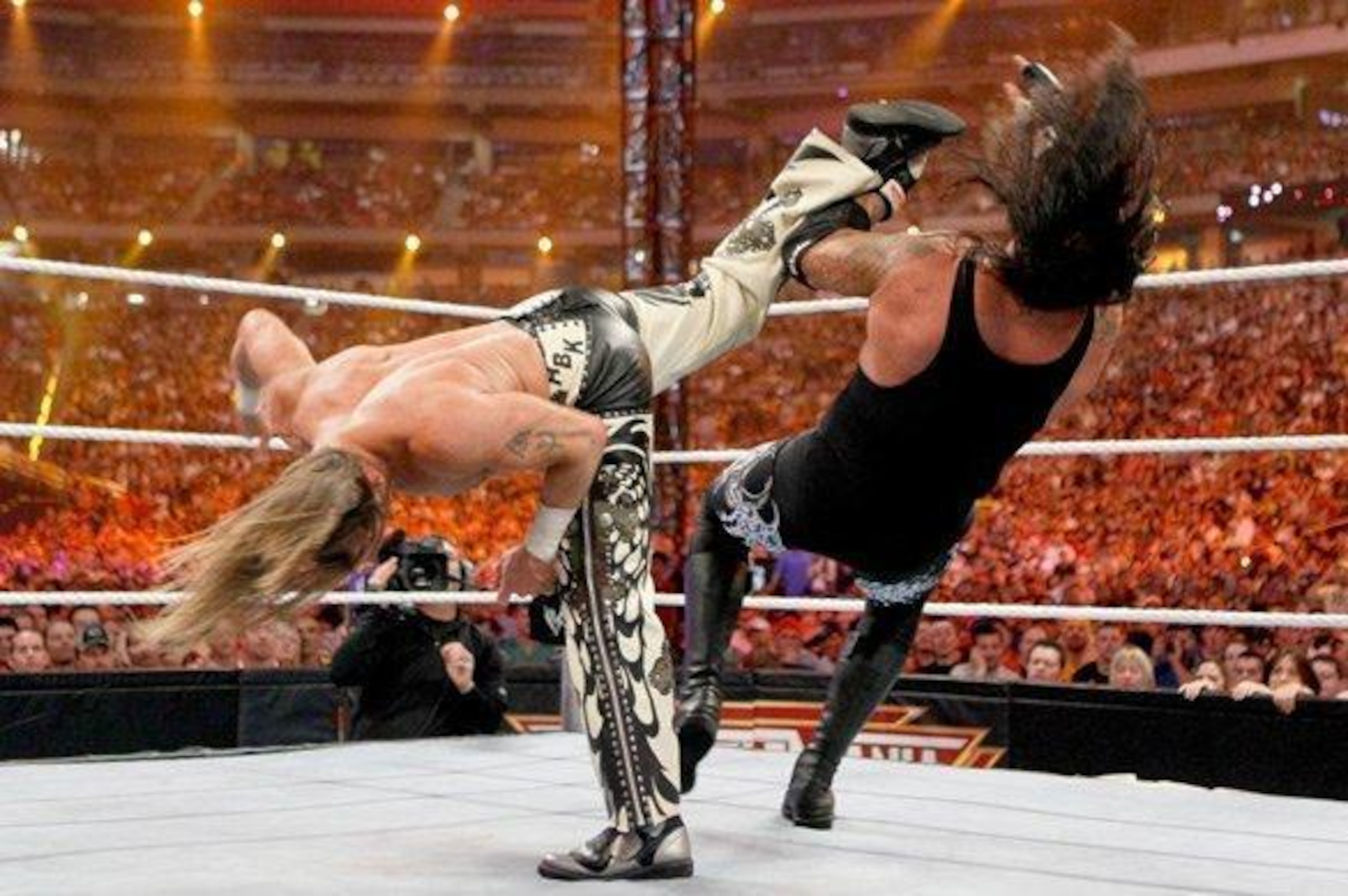
Michaels was able to put all of his philosophies to the test in the final match of his career, an epic tour de force against The Undertaker at WrestleMania 26 that is widely regarded as the best bout in WWE history.
The two had completed a match the previous year that left Michaels feeling so satisfied, so content with how his career had turned out, that he began contemplating stepping away from the business for good.
"I just got this sense of peace about me that I hadn't really encountered before," he said. "And I told my wife, 'That might've been the one to end it all.' She said, 'Really?' And I said, 'Yeah. I don't know what more you do after that?' I just felt like that went as good as it can possibly go."
On screen, he obsessed over beating The Undertaker one final time, a challenge that The Deadman refused—until Michaels cost him his WWE Championship. Taker, his blood now up, agreed to one more match, with the caveat that, should he fall short again, HBK would be forced to retire from the business.
More than just setting up the bout, it was a stipulation that helped Michaels draw the emotional energy he'd need to make the match truly special.
"A lot of the things that I did in my career were real to me out there," he said. "I didn't have to act. I've done this stuff since I was 19. It's been a big part of my life. I'm very fortunate to have a family that understands that, and that appreciates that. Dad does one thing. He only does one thing, but he puts every bit of himself into it and we're good with that.
"That emotion was me as a 44-year-old man trying to say, 'Thank you for letting me do a job that I just so loved.' I got paid for it and was able to call it a job and a career and never once seemed like an ounce of work to me. And it was an absolute thrill to do, so it was very easy for me to capture that emotion. It was real."
Competing with The Undertaker at WrestleMania meant the match was not only riddled with ridiculously high expectations, but it was also one fans all believed they knew the outcome to.
This was The Undertaker in mid-streak, not just a performer at the height of his powers but an unstoppable one who literally never lost. Convincing fans Michaels might pull off the impossible was a challenge he didn't take lightly.
"I don't know if this is the right philosophy, but it's one I've always had," Michaels said. "I've never ever felt that you had to make them believe something. It isn't about believing. It's about having a doubt. I didn't need them to think I was going to win. But I wanted them to have second thoughts.
"I don't think making people believe something is ever possible unless it's innate in them. Unless it's something that they want to believe. And so you try to capitalize on what they want to believe. There were people who had hope that the impossible might happen, hope that it might not be my last one. And so you just have to put a doubt in there.
"Catching a fish is catching a fish. How deep you set that hook makes it totally different. Barely setting that hook, you have to ease the fish in; set it deep, and it doesn't take that much finesse or work.
"That's what you do in wrestling. It's just about getting them, for just a moment, to think they might not be right. That maybe they can't call it. And after that, it's just finesse. From that point on, you're just doing your best to take them on that ride."
When it came time for the final stanza, Michaels knew he needed to do something special. Two years earlier, he had helped provide Ric Flair the perfect sendoff, whispering "I'm sorry. I love you," before superkicking him into retirement.
But HBK wasn't The Nature Boy, and Michaels believed the character needed a different kind of moment before departing stage right.

"We were just trying to think of something for the end. You sort of think to yourself, like, 'OK, so this isn't the, 'I love you' moment, but we need something here. What is that?' And again I don't know. I can't recall. I'll give (producer) Michael Hayes the props cause I think it was him, but he just said, 'The end should be one last act of defiance for Shawn Michaels. A slap in the face.'
"We went all the way back to who this character was. They've seen the arc of him having this life-changing experience and coming back a different person. But still, when he goes down, he's going to go down with a little bit of attitude. A little bit of grit. And when he said it, we all just felt like yeah, that's it. That's it. And of course Taker comes back and realizes, 'I got to put the dagger in this guy.'
"I mean it's just really trying to figure out 'what best defines this guy?' And not just in that moment but this guy overall. It's the completion. It's the end of the book. It's the end of the movie. It's the end of the story. What rounds out this guy? You know? And it's falling short. It's heartbreak. It's giving everything that you've got but going down. Going down with a little bit of defiance, going out in a way that's a little bit hurtful and vulnerable. And it just seemed to work perfectly for what we wanted to accomplish."
Originally, Michaels had one last hurrah planned, a final match in all the major cities he'd performed in around the world, wrestling's version of an NBA retirement tour. But, when the 'Mania bout was complete, he didn't think it felt right to ruin the perfect sendoff. The WrestleMania goodbye could serve, he believed, as the goodbye to everyone.
"After that match, myself and Taker and Michael Hayes were doing what we did the year before too, sitting in a room by ourselves with a shot of Jack Daniels," Michaels said. "I told them, 'You know what? That might be the one to end it all. I don't think I'm going to do that other thing.' And Michael said, 'I agree.' And so I just sort of decided right there that was going to be it."
Ten years removed from his legendary denouement, wrestling still beats in his heart, fills his mind and brings him joy. But now Michaels lives vicariously through others, helping produce NXT programming and grooming the next generation of legends.
Once the out-of-control petulant diva who drove Vince McMahon crazy at times, he's now the elder statesmen, a living, breathing icon whose word carries weight. He thinks often about the mentors who helped mold him, realizing the responsibility he has and power he wields to help make dreams come true for others.
"I always connected with Pat Patterson because it was real to him," Michaels said. "He could sit there and cry in front of you trying to tell you about how much he loved the wrestling business or what he wanted for somebody. He did it with Bret (Hart). He did it with me. He did it with guys that he didn't know, didn't have any relationship with, but he saw talent and ability.
"He developed a relationship with us and pulled for us in every aspect. No matter how much trouble, no matter how much hassle we might've been, he brushed all of that aside because he appreciated the person and the passion and the desire that they had. And I guess that's what I do with all my guys. I don't lie. I don't B.S. them. You know?"
The most important advice Michaels offers flies in the face of conventional wisdom, especially in the era of corporate wrestling. But he believes sometimes you have to push back, to fight for what you believe in, to bare raw emotion in defense of your vision.
"It's OK to take this stuff too seriously sometimes, to sometimes not be able to blur those lines between real and what isn't real," he said. "Everybody talks about how 'It's just business, brother' and you know, that's a bunch of hogwash. Some guys in a lot of this generation, they're like me. I think that's why so many of them have connected with me is because I think they saw through the character and saw that, 'I think that guy really, really loves this. And he loves us. He absolutely is thrilled being out here doing this.'
"I care about them and their success and their success in the ring and their creative fulfillment in it. Creatively there are some things that they want as a human being, as a performer. And sometimes in wrestling, you have to forego that for money or for a spot, or for this story or for that story.
"I understand both sides. I understand the business side, but I understand the performer side, too. I try to connect the creative and the office standpoints in a way that doesn't cause any dissension. I work pretty hard to weave those two worlds together. And I tirelessly do it on their behalf, no matter how much it gets on people's nerves."
Creating a great wrestler, just like creating a great match, isn't a formula and there are no guarantees that what works for one performer will translate when attempted by another. Michaels doesn't have all the answers—and he doesn't need to. NXT is a team effort, with others, including his close friend and WWE executive, Paul "Triple H" Levesque, providing alternate viewpoints and input to help everyone grow.
"They need balance," Michaels said. "I think we do really well. Me connecting on the emotional side when it's warranted, for that vulnerability, when that weakness, when that passion, all those a little bit softer emotions for fighting from underneath. For instance, when you're a Tomasso Ciampa and a big, strong, rough, tough character, that's sometimes hard to find.
"And then Hunter [Levesque] balances that out for me because he's so good with the other. What's cool? And what's badass? So I think we're a good combination in there, to help them see all the angles... It's easy for me to do what I do now. I love working with NXT. I love working with the young talent just like I loved performing out there."
Jonathan Snowden covers combat sports for Bleacher Report and is the author of Shamrock: The World's Most Dangerous Man. Edge faces Randy Orton in "The Greatest Match Ever" Sunday at Backlash on the WWE Network.
.jpg?w=2560 "AD Trolls Bears WR on IG 😂")
.jpg?w=2560 "Viral Dan Campbell Presser 💙")
.jpg?w=2560 "Report: Steelers WR to Miss 'Weeks'")
.jpg?w=2560 "Buzz: MHJ Hired Agents for Trade")
.jpg?w=2560 "Cam Ward Says He's Not A Loser")


.jpg?w=2560 "Chargers Fall to 0-5 🤢")