

NBA Stars with the Worst Supporting Casts
Putting a franchise centerpiece in place is every NBA team's most important job. A close second: surrounding that cornerstone with an adequate amount of help.
Not surprisingly, some squads have done better at assembling a supporting cast than others.
A select few are in the earlier stages of resets, affording them a slight cushion. Other teams are further along in the process or even contending for a title. Their dearth of helping hands is more painful—particularly if, and when, their shallow well is the byproduct of underachieving sidekicks rather than a more comprehensive talent deficit.
Figuring out which stars are on the biggest islands is an inexact process. Strictly going by workload differentials doesn't cut it when so many are, by design, the heavily featured center of their teams' universes. Focusing solely on the weakest benches doesn't paint a large enough picture. Key injuries, much like franchise timelines, can also skew results.
Players won't hear cries for help if their situations are molded almost exclusively by injury. Jrue Holiday hasn't yet played with Zion Williamson and is only just now getting bumps from a healthy Lonzo Ball and Derrick Favors. He's not here.
Andre Drummond is only the Detroit Pistons' best player because of Blake Griffin's left knee issues. He's not here either. Similar circumstances apply to the Warriors' D'Angelo Russell and the Nets' Jarrett Allen and Spencer Dinwiddie.
Common sense will dictate how we identify those stars in need of the most help. Advanced metrics, on-off impacts and the like will steer the vehicle as well, but in the end, our objective is to find the marquee talent most obviously in need of assistance.
Honorable Mention: Devonte' Graham, Charlotte Hornets
1 of 6
Newly minted stars cannot gain full entry in this supporting-cast conversation. Sustainability is part of the equation, and Devonte' Graham still totes the burden of proof. His ascent will reach more of a consensus if it spills over into next season, removing the possibility that this is a one-off detonation.
People invariably rail against his receiving even an honorable mention. Those rebukes are, at least for now, futile.
Graham has genuinely been one of the NBA's most valuable players this season. Only one other person is clearing 19 points and eight assists per 36 minutes while shooting better than 38 percent from distance: Ja Morant(!).
Good-stats-on-bad-teams truthers can holster their arguments. Graham's production is hardly empty. He ranks third in made off-the-dribble threes, trailing only James Harden and Damian Lillard, and he's second in total assists at the rim, sandwiched between LeBron James (first) and Trae Young (third), according to PBP Stats.
This fits with how poorly the Charlotte Hornets have played without Graham. They're scoring 16.6 points per 100 possessions fewer when he's on the sidelines, giving him, bar none, the biggest offensive-rating differential in the entire friggin' league. He is also the only one of Charlotte's players who owns a positive luck-adjusted regularized adjusted plus-minus (RAPM) through at least 500 minutes of action, per NBA Shot Charts.
Bradley Beal, Washington Wizards
2 of 6
Bradley Beal is among the easiest inclusions unless you believe John Wall, who's on the shelf with a left Achilles injury, is the Washington Wizards' best player. Which, at this point, you really shouldn't.
Some fun developments have come out of Washington. Thomas Bryant, currently working his way back from a right foot injury, is legitimately good. Ish Smith, too. Isaiah Thomas is shooting 41.2 percent from three. Davis Bertans has a superstar green light and hates missing from beyond the arc. Mo Wagner was right there with him, on lesser volume, before his left ankle injury.
The Wizards offense is only 2.8 points per 100 possessions worse without Beal on the floor. That's sort of saying something. They're seventh in offensive efficiency and still scoring at a slightly above-average clip when their No. 1 option sits. Their overall point differential is better during that time.
This all means only so much. That the Wizards haven't made more of Beal's minutes speaks to their lack of well-balanced depth. They need better defenders around him—they're dead last in points allowed per 100 possessions—and a path to simplifying his offensive burden.
Beal is averaging 27.8 points and 6.6 assists per game—flat-out absurd numbers. But the level of difficulty ascribed to his usage is showing. Just 44.7 percent of his made buckets have come on assists, a career low, and this marks the first time since 2014-15 he won't outperform his expected effective field-goal percentage, according to PBP Stats.
Whenever the second-most valuable player on your team is a toss-up between Bertans and Bryant, something isn't right. While Beal will get help from Wall next season, assuming they're both still on the roster, the Wizards have a finite amount of cap flexibility and trade assets with which to significantly deepen the roster beyond that.
James Harden, Houston Rockets
3 of 6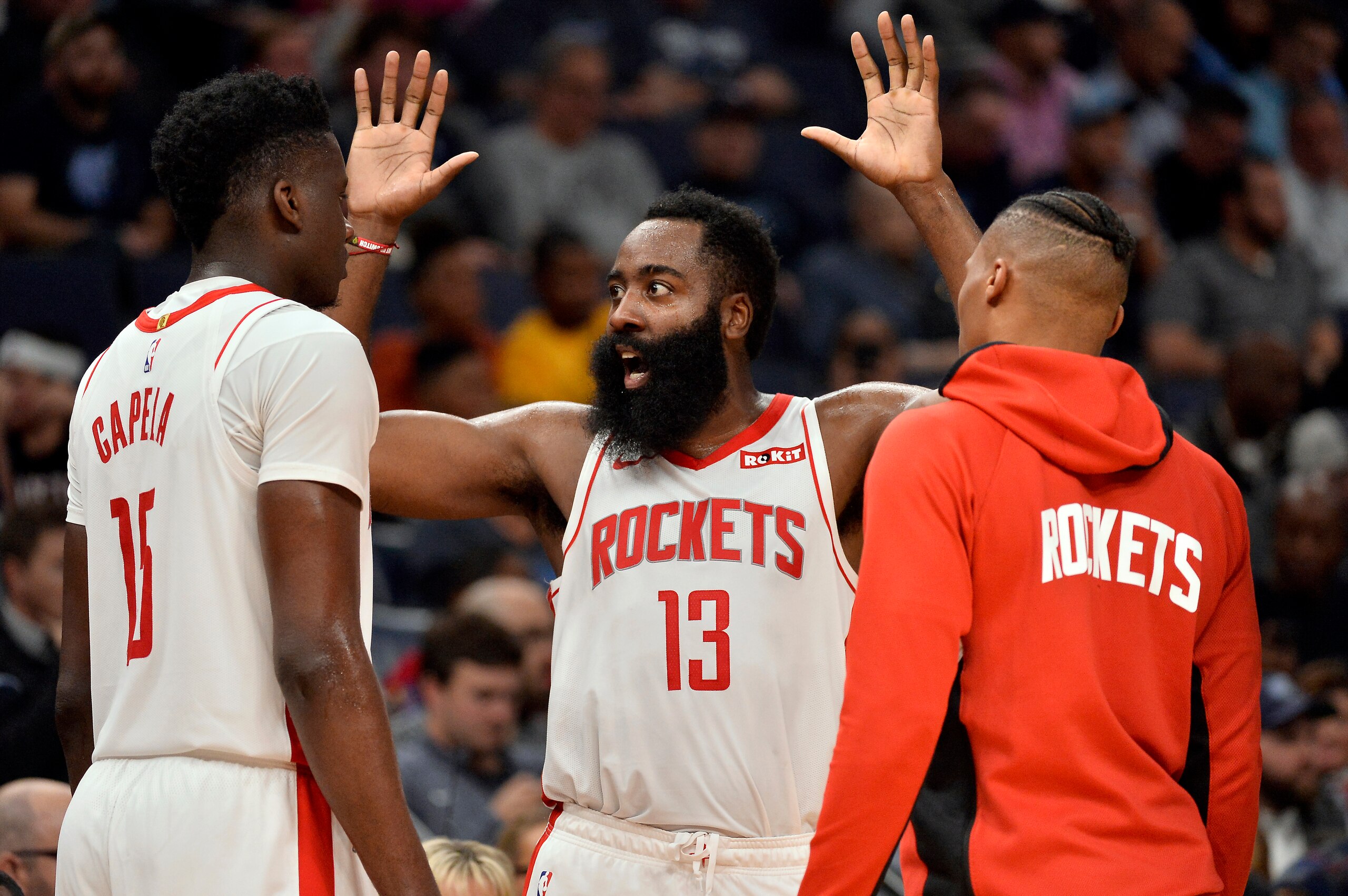
James Harden isn't supposed to be here. The Houston Rockets turned Chris Paul and draft picks into Russell Westbrook presumably to lighten their dependence on the NBA's leading scorer.
So much for that.
Harden's usage has dropped since last season, but not by a margin that suggests he plays beside an actual co-star. Westbrook, meanwhile, is on pace for the worst three-point-shooting season in league history among anyone who has averaged at least three long-ball attempts per game.
Houston could live with his high-volume brick-laying if he gave the Rockets a fighting chance during Harden's stints on the bench. He hasn't. Take a look at the team's on-off splits:
- Harden and Westbrook (1,762 possessions): 6.9 net rating
- Harden, without Westbrook (956 possessions): 10.3 net rating
- Westbrook, without Harden (640 possessions): minus-5.6 net rating
The Rockets' effective field-goal percentage falls by 4.3 points with Harden off the court, the second-highest drop by anyone in the league who has logged at least 750 minutes. That is bonkers for a team with a co-star who plays point guard.
Eric Gordon's return will help some. It doesn't fix everything.
Bleacher Report's Andy Bailey has compiled a database in which he averages player rankings across 10 catch-all metrics. The gap that separates Harden's mark from Houston's second-best finisher (Clint Capela) is 53.2. That chasm widens to 110.9 when going from Harden to the Rockets' No. 3 (Westbrook)—far and away the largest differential for any top star you'd dare mention in the MVP conversation and his team's third-best player.
Kevin Love, Cleveland Cavaliers
4 of 6
Kevin Love's nod doesn't need a long-winded roster breakdown. The Cleveland Cavaliers aren't built to win. End of story.
Aside from Love, they have just one other player who cracks the top 150 in the composite catch-all rankings put together by Bleacher Report's Andy Bailey. That ties them with the Charlotte Hornets for the league low in total top-150 appearances.
This reality jibes with the Cavaliers' personnel, now more than ever following the Jordan Clarkson-for-Dante Exum swap. Collin Sexton and Darius Garland rank second and third on the team, respectively, in total touches per game, and Cleveland was making an effort to up Kevin Porter Jr.'s volume prior to his left knee injury.
Relying so prominently on three youngsters, only one of whom (Sexton) has left his teenage years behind, is a recipe for cellar-dwelling. Love, 31, is operating on a completely different timeline and not happy about it. As The Athletic's Shams Charania and Joe Vardon reported:
"Love was fined $1,000 by the Cavs for an outburst on the bench on Dec. 31 in Toronto, sources said, and disagreed with the fine. He was spotted by cameras slapping chairs on the Cavaliers bench away from the team huddle in the third quarter of the blowout. ... He asked a Cavs coach to take him out of the game so he could cool down. During the next timeout, when a coach asked what was wrong, Love said he didn't like how selfish the first unit was playing, sources said.
"Saturday's exchange between Love and [general manager Koby] Altman was not the first. At the end of last season, Love raised his voice toward the general manager and Altman threatened to fine him. Sources said they heard Love say, 'Go ahead. I have plenty of money.'"
Cavs head coach John Beilein begs to differ. So does Love's Instagram. (Postgame Instagram, anyway.) Whatever. Love's body language has said it all. He's frustrated. Whether he has a right to be this annoyed is up for debate.
Maybe the Cavs did tell him they planned to compete in the post-LeBron James era when they signed him to a four-year, $120.4 million extension in 2018. Fully blaming the team in this situation still rings hollow. It was Love's camp that apparently approached Cleveland about a new deal, per ESPN's Brian Windhorst. Whatever visions of winning the Cavaliers might've had were also derailed by a foot injury that cost Love most of last season.
More than that, Love is an intelligent adult. Cleveland struggled to win minutes without LeBron when it had both Love and Kyrie Irving. What made Love think the Cavaliers could fast-track themselves toward the playoffs following the departures of both stars in consecutive offseasons?
Cleveland is one of four teams—joining Charlotte, Memphis and New York—with an effortless road to max cap space this summer. The roster around Love could look drastically different (read: better) next season. This, of course, assumes he's not traded before then. And, well, don't do that. He's a safe bet to get moved.
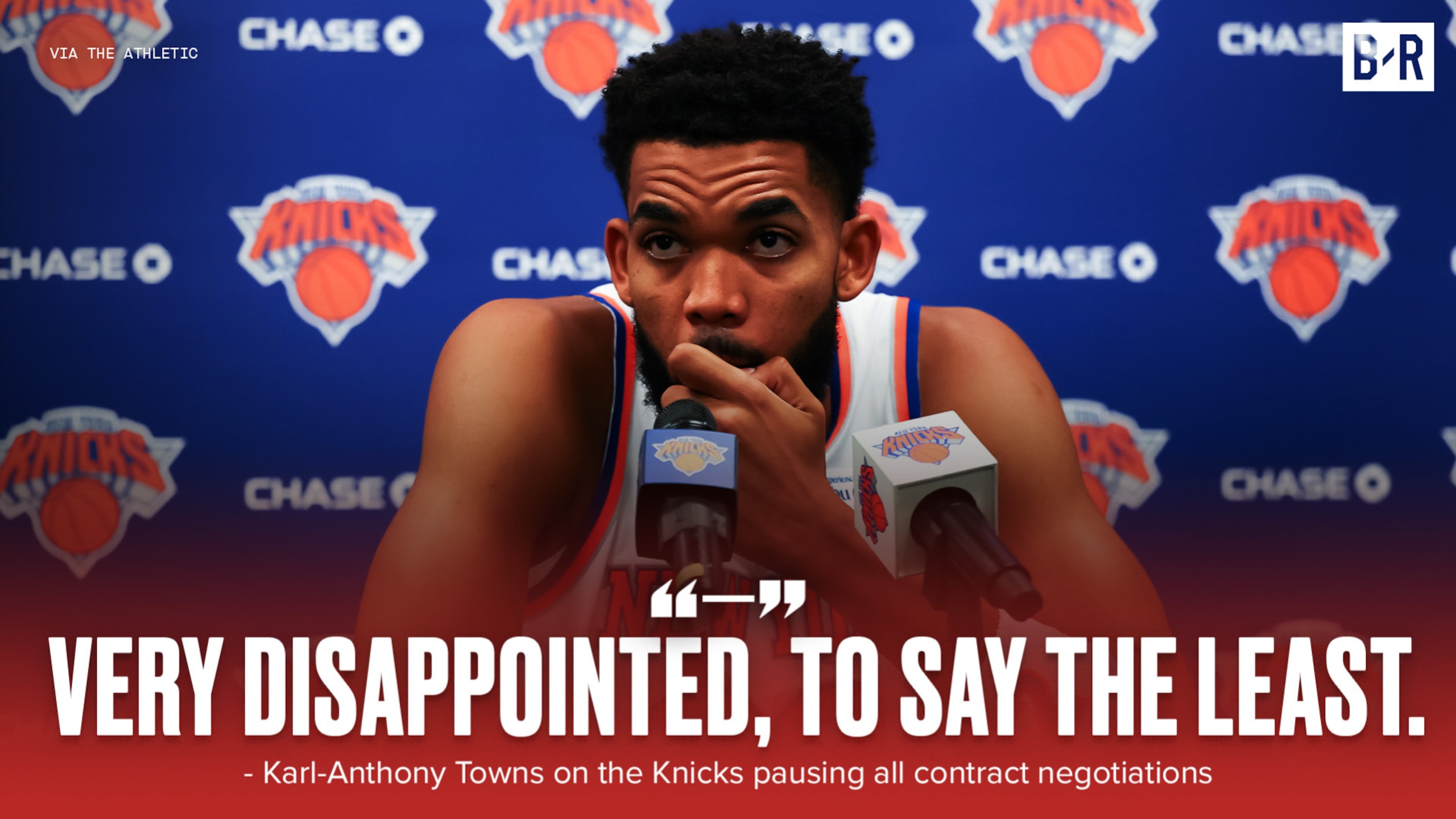
Karl-Anthony Towns, Minnesota Timberwolves
5 of 6
Karl-Anthony Towns' recent absence with a left knee injury is nothing if not proof of how far away the Minnesota Timberwolves are from surrounding him with a competitive supporting cast.
In the 10 games since he last played, they have posted the league's worst offensive rating and effective field-goal percentage. That they've gone 4-6, with the No. 1 defense, over this stretch could be seen as impressive, but their record is artificially inflated by matchups against the Kevin Love-less Cleveland Cavaliers and Glenn Robinson III-led Golden State Warriors.
Minnesota's offensive rating plunges by 16.2 points per 100 possessions when Towns is off the court. Here's every player with a larger offensive-rating swing this season:
- Devonte' Graham (plus-16.6)
That's it.
This isn't a flawless snapshot of the Timberwolves' depth, but it's also accurate. Even their defensive performance without Towns fails to carry them outside this conversation.
They have just two other players who place inside the top 100 of RAPM, according to NBA Shot Charts: Robert Covington and Jake Layman. And the latter hasn't played since Nov. 18.
Trae Young, Atlanta Hawks
6 of 6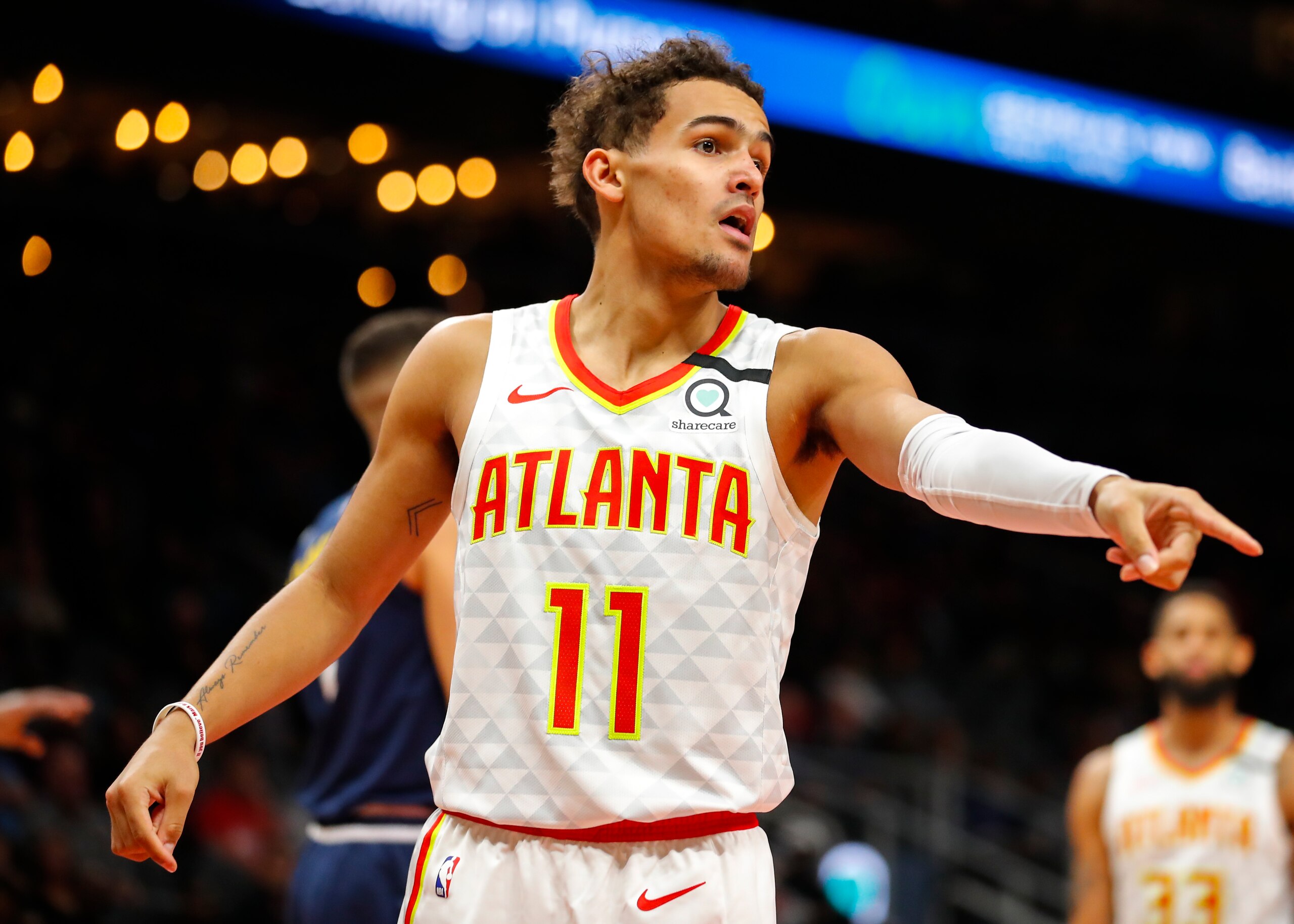
Trae Young's case is complicated. The Atlanta Hawks absolutely have a suboptimal supporting cast, one replete with the NBA's worst bench point differential per 100 possessions, but his star credentials aren't yet Teflon.
Consider what The Athletic's Seth Partnow wrote while explaining why he doesn't consider Young an All-Star this season:
"I'm not suggesting Young's stats are empty, the Hawks have been decently better with him playing, cratering on offense when he has been off the floor. But the ecosystem in Atlanta is almost lab-engineered to goose his top line box score stats, and I am loathe to want to overly credit for having relatively unskilled teammates. This isn't to say players on teams with poor records should never be All-Stars, but I do think such players should have a little bit thicker a binder of demonstrable positive impacts than Young has.
"When we back out those pinball box score numbers, those impacts become somewhat less impressive. For all the talk of him driving Atlanta's offense, the Hawks are scoring 107.1 points/100 in non-garbage time minutes — or a team getting blown out as frequently as Atlanta has been, how much weight should we assign to 4th quarter production in a 25 point game? — with Young on the floor, 35th percentile performance per Cleaning the Glass. While they haven't played a ton of non-garbage time minutes together, the Hawks have only managed to score 100.4/100 (6th percentile) when Young has John Collins as a running mate. Further, observing the usual small sample caveats, it's worth noting Young is currently 102nd in single-season Offensive RAPM, solidly above average, but hardly superstar level impact. And though it's an All-Star game so who cares about defense, Young ranks 468th of 473 players in Defensive RAPM. For a guy on the team with the worst record in the league, I need more."
Young's ceiling is not under siege. Partnow's line of questioning is more about the immediacy of his superstar impact—evidence that maybe Young's coronation has been rushed.
Still, for this discussion specifically, his exact standing isn't everything.
Atlanta exists to put the ball in Young's hands. That's not his fault. And whether by choice or accident, the Hawks have no other choice. They don't employ another playmaker beyond him.
Kevin Huerter is second on the team in pick-and-roll ball-handler possessions per game with 3.3—five times less than Young's volume. He is also second in the share of his made three-pointers that have gone unassisted. About 13 percent of his treys have come without a helping hand...compared to 67.5 percent for Young.
The Hawks offense is not up to snuff even with Young. It places in the 15th percentile of efficiency when he's on the court. But they're even worse off without him, failing to hit the 5th percentile. And where Young ranks 41st in luck-adjusted offensive RAPM, according to NBA Shot Charts, only one of his teammates falls inside the top 300 (Jabari Parker).
No wonder why, per The Athletic's Shams Charania, the Hawks recently felt the need to promise him they'd acquire more NBA-level talent.
Unless otherwise noted, stats courtesy of NBA.com, Basketball Reference or Cleaning the Glass. Salary and cap-hold information via Basketball Insiders, Early Bird Rights and Spotrac.
Dan Favale covers the NBA for Bleacher Report. Follow him on Twitter (@danfavale) and listen to his Hardwood Knocks podcast, co-hosted by B/R's Andrew Bailey.


.jpg?w=2560 "Buzz: MHJ Hired Agents for Trade")
.jpg?w=2560 "AD Trolls Bears WR on IG 😂")
.jpg?w=2560 "Report: Steelers WR to Miss 'Weeks'")
.jpg?w=2560 "Viral Dan Campbell Presser 💙")


.jpg?w=2560 "Cam Ward Says He's Not A Loser")