
Pokemon Sword and Shield Review: Gameplay Impressions, Esports and Speedrun Tips

There is a certain unmatched level of expectation that has transported Pokemon Sword and Shield to its release on the Nintendo Switch—it is the first mainline Pokemon game on a non-handheld, after all.
And while the on-paper list of features and some divisive cuts seem jarring, once Sword and Shield is in a player's hands, the same pervasive Pokemon formula and charm is once again irresistible.
The casual-but-deep RPG experience and battle systems, paired with a fun romp through the United Kingdom-inspired Galar region and its Pokemon inhabitants, is a measured, fun time.

.jpg?w=2560 "Steelers Saints Football")
.jpg?w=2560 "Rams Raiders Football")
Some shakeups in the form of an open-world Wild Area and streamlining of many features, including the competitive scene, helps Sword and Shield feel like it is molding the series toward what players want.
Graphics and Gameplay
Sword and Shield is pleasing to the eye regardless of one's initial expectations for a console Pokemon game.
This is a colorful, animated experience. Players glide through the countryside and hit a few varied cities on the way, from the industrial-aged takes on steam power to the small English villages with a few houses dotting the dirt around a giant gym.
The scale of the visual presentation is superb. Early on in the game, simply stepping outside and seeing the sprawling pastures stretching off toward a town in the distance and Pokemon flying overhead in the clouds is sensational.
Player characters are animated, and the cutscenes sometimes feature animated counterparts. Pokemon themselves hop around the map with tails wagging, and different types of animal-based 'mons take longer than others to chase the player.
There is a ton of attention to detail for those willing to take notice. But by far the most impressive visual feat is the battles against gym leaders. These have a big-game feel out on a pitch, and a surrounding crowd reacts realistically to every turn of a battle. The scope of the arena and crowd gives these meaningful Pokemon battles a juice that was missed on handheld consoles. Camera cuts to the crowd put an emphatic bowtie on the immersion, if not the tension of a close battle.
That said, non-gym-finale battles are all over the place visually. Sometimes there's a backdrop to illustrate the surroundings of the battle. Other times there's nothing at all. Weird things like no cutscene or animation for fast travel at all seem a little jarring.
And this is where a bit of disclaimer comes into play. Expectations play a role in the enjoyment of the visuals just like anywhere else, and performance-wise, pop-in is a big problem. Some of the visual hiccups and decisions are really disappointing alongside a recent Switch release like Luigi's Mansion. Saying this looks like a handheld game blown up for the Switch isn't fair given the art direction and scope at times, but throwing it alongside some of the console's heavy hitters doesn't do it any favors.
On the gameplay front, expectations don't play much of a factor thanks to the tried-and-true formula.
Trainers who know the deal will feel right at home—and, finally, this 20-plus-year-old series acknowledges that. Simply tell the NPC and skip all the tutorials at the start of the game, such as how to catch a Pokemon.
That was the first major hint this was a streamlined game with unnecessary fat trimmed all the way down.
Battles are what longtime fans have come to expect. The turn-based fights are simplistic enough that a rudimentary understanding of type matchups will see casual players through. But the depth beyond the surface layer will once again fuel thrilling competitive scenes. Either end of the spectrum is a sheer joy to play again thanks to a new cast of 'mons.
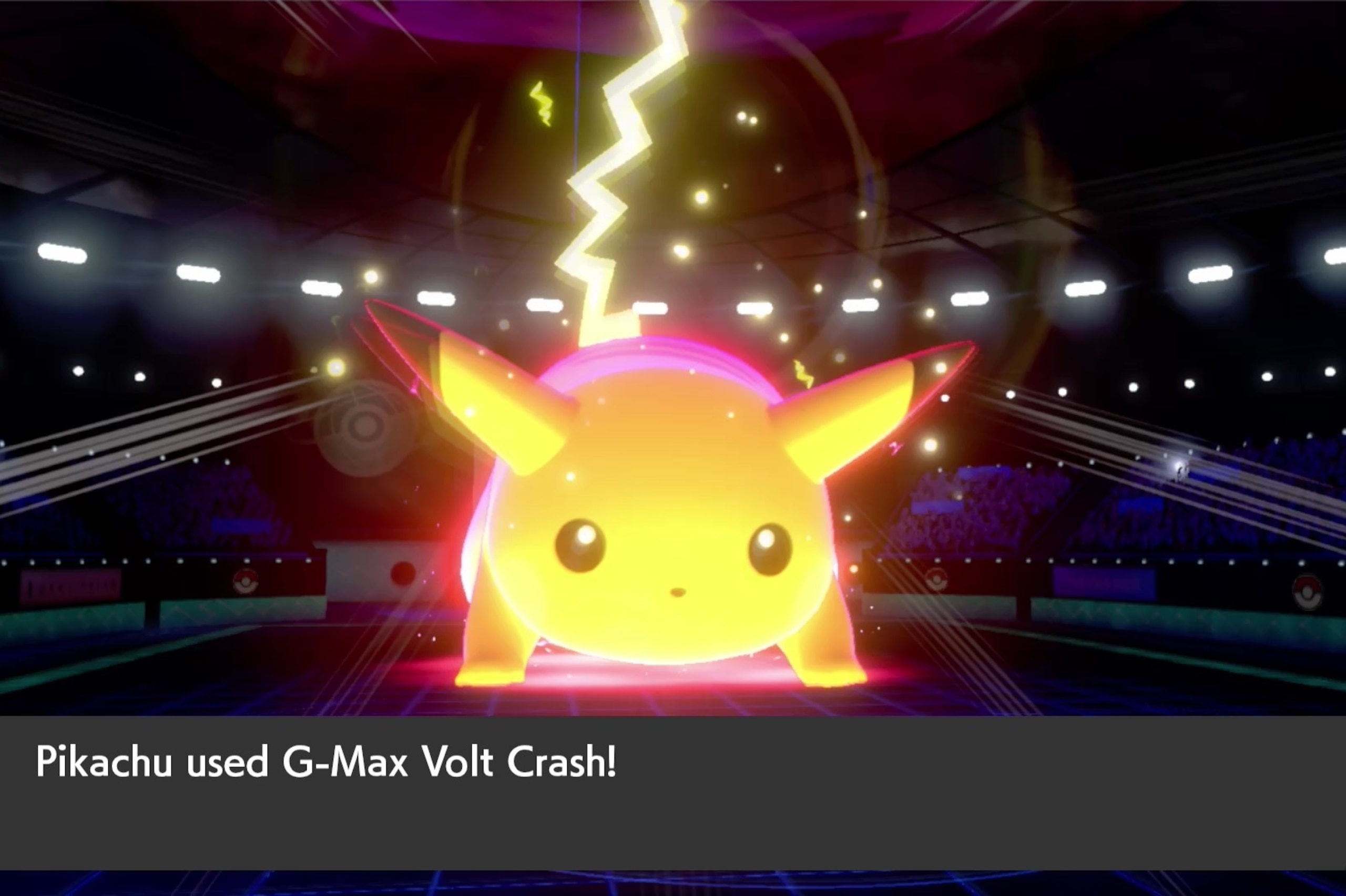
Within battles are some new mechanics in the form of Dynamaxing and Gigantamaxing. The former is accessible to all Pokemon under certain circumstances. It balloons the 'mon to massive heights and resets the moveset to simplified terms. Throughout a playthrough, it never feels overpowered and otherwise fits the big-fight feel well, though the competitive side could likely unearth some deeper usages that change this thought in hindsight.
Arguably more interesting is the overworld change. No more random encounters for the series, as was telegraphed with Let's Go Pikachu and Eevee. Besides some 'mons hiding in tall grass (which can be rare), all Pokemon walk around on the overworld now. Trainers who don't want to fight can simply avoid them.
Catching Pokemon received an interesting tweak, though. This time out, gym badge constraints dictate whether a trainer can throw a Pokeball at all. It's possible to run into a brutally strong Pokemon in the wild but be restricted from capturing it. On one hand, this actually makes sense because lucking into an overpowered juggernaut of a 'mon could ruin the game flow. On the other, it yanks the player-agency carpet out from under a player's feet.
Leveling Pokemon has received some streamlining, too. Exp. Candy is exactly what it sounds like and offers some serious flexibility in team construction. An underleveled 'mon compared to the rest of the team won't be for long.
More controversial is the universal experience share instead of it being an item one 'mon held in the past. This has been a big point of discourse since its unveiling, but the story's pacing seems to negate much of the concern. Unless a player is putting up double-digit hours in the Wild Area instead of progressing the story at a steady pace, the difficulty doesn't get too easy. Like any RPG, excessive grinding will skewer the experience.
Map traversal feels great. There's the annoying instance of NPCs blocking the way to certain routes in an effort to steer the player in the proper direction. But annoying as it may be, it beats archaic elements like needing HMs to progress. There are no trees to cut or boulders to move with strength. The game throws fast travel and a bike at trainers quickly.
This fast-tracked progression seeps into the collecting, too. Players stumble into the Wild Area almost right out of the gates, and away they go. There's an almost overwhelming amount of Pokemon for the taking right there, and it's safe to presume a large chunk of players will slaughter the first gym or two because they'll end up so overleveled thanks to the distracting (in a good way) nature of the open-world area.
While the visuals compared to expectations might take some time to sooth over, there is little in the way of complaint on the gameplay front. And to be blunt, that's the one that matters quite a bit more.
Story and More
At its best, Sword and Shield is silly fodder in the story department. A small-town kid goes off on an adventure to become the very best, and so on.
But there are some interesting layers. The whole Galar region's backdrop suggests an incredible backstory. It really hints at the whole sword and shield concept but seems to skirt around the topic at times, which leaves a sense of intrigue to it all.
Characters-wise, the rival at least has a clear-cut motivation and development. But the cape-wearing champion is annoying, although perhaps that's largely because the game reminds the player seemingly endless times that he's a) very bad with directions and b) undefeated.
As always, the story is just backdrop to everything else. The new Wild Area is an open-world concept that checks in a little bigger than expected and thankfully puts the player in control of the camera with the right stick. Different regions have different weather cycles, which means different Pokemon at certain times, and they all refresh items to discover.
As if that wasn't replayable enough, Wild Area also houses the new Max Raids. These are where players figure to get the most mileage from the game over the long run. Teaming up with four others (or NPCs) to tackle massive boss-type 'mons in a set amount of turns with limited permissible faints is brilliant. And the four- and five-star raids are, well, good luck.
Sword and Shield is simply loaded with side content. At camps, trainers can interact with their team and cook up some curry. Ingredients discovered in the Wild Area lend to different recipes, and the interactive minigame then gets assigned a grade. Oh, and this serves as a way to heal the team out in the wild and dole out experience points.
Trainers can also send boxed Pokemon off on jobs for companies for droves of experience. Other staples like nursers and breeding persist. While not a staple feature by any means, the trainer card system is a fun side detail to collect when not customizing one's own.
Speaking of customization, Sword and Shield goes off the deep end with it. Pages and pages of purchasable attire and items like bags and glasses are almost intimidating to sift through.
As pretty and charming as Galar can be, it does start to feel like trainers are simply rushed from town to town, collecting badges and getting on with it. There isn't a ton of depth to most locales, which isn't the end of the world, but there also isn't that unforgettable set piece outside of towns. There isn't surviving a dungeon to meet Red at the end. There isn't a Pokemon Mansion or sprawling cruise ships.
Adding to this point, Team Yell seems like another Pokemon flavor that got dashed in favor of the open-world concept. They do their job well enough—they're brutish football (the real kind) fans. But they're not a nefarious, plotting organization. They're just sort of in the way.
Sword and Shield could have struck a better balance between old and new. The big-fight feel of the massive arenas makes for a great time, but the distinct, unforgettable locales and devious villains that serve a purpose just aren't there.
There's also the unavoidable topic of the Pokedex. It seemed to quietly get announced that trainers wouldn't be able to catch every single 'mon in this game, which is rough given the series tagline is "gotta catch 'em all."
The problem with the omissions isn't so much about completionists being unable to catch every single Pokemon as it is each individual could potentially be missing out on their absolute favorite one they've kept close to their hearts for more than 20 years.
Given the personality of Galar and its Pokemon and the swiftness of the progression, this lack of including 800-plus Pokemon in one game isn't often felt, generally speaking. Even so, it's a little weird players can't even catch all of the Pokemon available in a Super Smash Bros. game now.
Along the same lines as the 'dex complaints is another angle to consider—the relationships a player establishes with his or her 'mons. The camp system and interactions with each, as well as the personality traits, explained in each Pokemon's info card, help players forge relationships with their team. But some game mechanics, such as Gigantamax, aren't widely available. It's jarring to establish a rapport with a Pokemon only to have an unavailable mechanic force it from the party.
For some of its many faults, Sword and Shield drips with quality of life features. Swapping Pokemon freshly captured right into the current lineup instead of sending it to the PC is great. The box link permitting PC access is refreshing. Something as simple as showing how effective a move might be on the move-selection screen really shines. A Move Relearner and item shop are in each Pokemon Center.
Like everywhere else, Sword and Shield has ups and downs based on the player, but the streamlined ideas speak to absorbing player feedback and tuning the tried-and-true process in smart ways.
Esports and Speedrunning Tips
The competitive side of Pokemon just opened up to everyone.
Certain new wrinkles in the form of items have changed the accessibility game when it comes to competitive. One item lets trainers change a 'mon's nature. Streamlined breeding and move sharing helps, too.
Besides introducing meta-changing moves and a new host of Pokemon to the cast, the online structure of Sword and Shield lends itself to growth. Not that it was going to have any problems for a long, long time to come, but hitting Ranked Battles in tiers and even being able to use Rental Teams is a big step in the right direction.
As for speedrunning, like any Pokemon game, Sword and Shield is going to draw a massive audience in this regard.
And runners are going to tear it to shreds.
Some of the quality wrinkles to the game help. Fast travel early on means backtracking is simple. Early access to a bike means gunning through routes to new areas is faster than it has any right to be.
But some creativity is going to fuel speedruns, too. Early access to a wide variety of 'mons means targeting ones with high-speed stats, then attack, is simple. And taking those choices to the relearner at a PokeCenter opens up some overpowered movesets early. It's a simple matter of catching the right two or three Pokemon, tweaking their movesets to create an advantage at the first two-to-four gyms and going buck wild.
Along the way, there isn't much of a point to spend a lot of time in the open-world diversion of the game. Powering through while riding type advantages and flourishing from the EXP. Share across the entire party means record times should fall left and right and make for some must-see streaming material.
Conclusion
Pokemon Sword and Shield was never going to please every single style of player. Balancing the wants and needs of casual players, the competitive element and hardcore collectors, to keep it basic, is a broad ask, even for Pokemon.
But Sword and Shield hits quite a bit more than it misses. This isn't necessarily a poster child for a game lacking ambition, but the sense Pokemon is just too big to fail and this release played it a bit safe is pervasive throughout the game.
Even then, a streamlined, charming experience with all the depth a player desires wrapped in the unstoppable formula with a fun backdrop really is hard to put down. This is the quintessential Pokemon experience, even if it isn't exactly what everyone had dreamed up for years.
Pokemon's mainline debut on the Switch is a joy for its simplicity-complexity balance and addictive nature. The essence of the series persists throughout the fun romp, and for that, it fittingly sits as one of the best games on the Switch.

.jpg?w=2560 "AP Poll Top Five Week 9")
.jpg?w=2560 "Packers Safety Slams Refs 🤬")
.jpg?w=2560 "Lamar Being Out Shocked Ravens")
.jpg?w=2560 "Mahomes Told Teammate to Leave Meeting")

