

Postseason microscopes are not especially kind to NBA teams and their players. Relatively small samples are used to render radical, big-picture verdicts. It doesn't seem fair.
Then again, the playoffs are why we watch. Championship pushes are why teams play. Coming up short under the brightest lights should have implications, otherwise it dilutes the stakes.
In this way, expectations are a hydra. And getting singled out for missing them is an occupational hazard. It is also, in many respects, a compliment.
Suffering our armchair wrath is not like receiving a secret wink. These players and teams are supposed to be better, and we're calling them out for missed opportunities and general underachieving. That we're harping on them at all, though, means they're held to a higher standard.
Every inclusion is owed to a failed vote of confidence or hope. That's, like, almost flattering. And we're not mad things have turned out this way so far, just disappointed.
Also: We might be a little bit mad.
On-the-Bubble Disappointments
1 of 7
Will Barton
Looking back at Will Barton's crummy showing in the first round would be a painful exercise for the Denver Nuggets if they had lost to the San Antonio Spurs in Game 7. He is one of their best playmaking safety valves, both an x-factor and a potential trump card.
But he has not played like the same old Will Barton since returning from his right hip injury. He notched a 46.5 effective field-goal percentage over his final 41 outings. For reference, he posted a 52.8 effective field-goal percentage last season.
His postseason performance is an extension of those struggles. His effective field-goal percentage is comfortably below 40, he's not getting to the foul line, and Denver needed to yank him from the starting five.
Disappointing? Most definitely. Entirely unexpected? Not quite.
Golden State Warriors' Rotation
Golden State is not a failure for letting the Los Angeles Clippers hang around for too long. Not yet anyway.
Every "collapse" on their part is a hiccup until proven otherwise—a chance for us to get jokes off, speculate about Kevin Durant's free agency and just generally hope for a few extra nail-biter moments. We can circle back to their letdown status if they get bounced before—hell, even during—the NBA Finals.
If the Warriors are going to lose, though, it'd be with conviction. Their worst moments continue to come at their own hands. First-quarter lethargy, defensive disengagement and, most inexplicable of all, questionable rotations decisions have hurt them more than anything.
Durant, Stephen Curry and Draymond Green have shared the bench for 40 possessions thus far. That's 44 possessions too many.
Never mind regular-season rotations. This is the playoffs. The Warriors should never play a single minute without at least one of their three best shot-creators on the court.
Short First-Round Series
2 of 7
Fans of advancing teams will disagree, but two Game 6s through the first round is just not enough. We deserve more drama. Like, actual drama.
Ben Simmons beefing with Jared Dudley is great for memes. But the back-and-forth between a top-25 player and top-250 player loses loads of traction when the series doesn't go beyond five games.
Injuries robbed us of some pressure-cooking competition. The Indiana Pacers (probably) don't get rip-rolled by the Boston Celtics if Victor Oladipo is healthy. The Detroit Pistons (most likely) don't get super swept by the Milwaukee Bucks if Blake Griffin doesn't miss two games and have to try playing through a left knee injury that required surgery.
Other abbreviated outcomes are easier to accept just because. The Brooklyn Nets are fun, but not ready. Stealing Game 1 from the Philadelphia 76ers was a pleasantly surprising curveball that incited some unease. The Orlando Magic were never pushing the Toronto Raptors anywhere near the brink, despite D.J. Augustin's heroism in Game 1.
Getting only five games between the Houston Rockets and Utah Jazz is tough to stomach. Clashes between fourth and fifth seeds are supposed to be closer. The Rockets aren't a good pull for the Jazz, but Utah bricked open shot after open shot and had opportunities to pick up an extra win in Games 3 and 5.
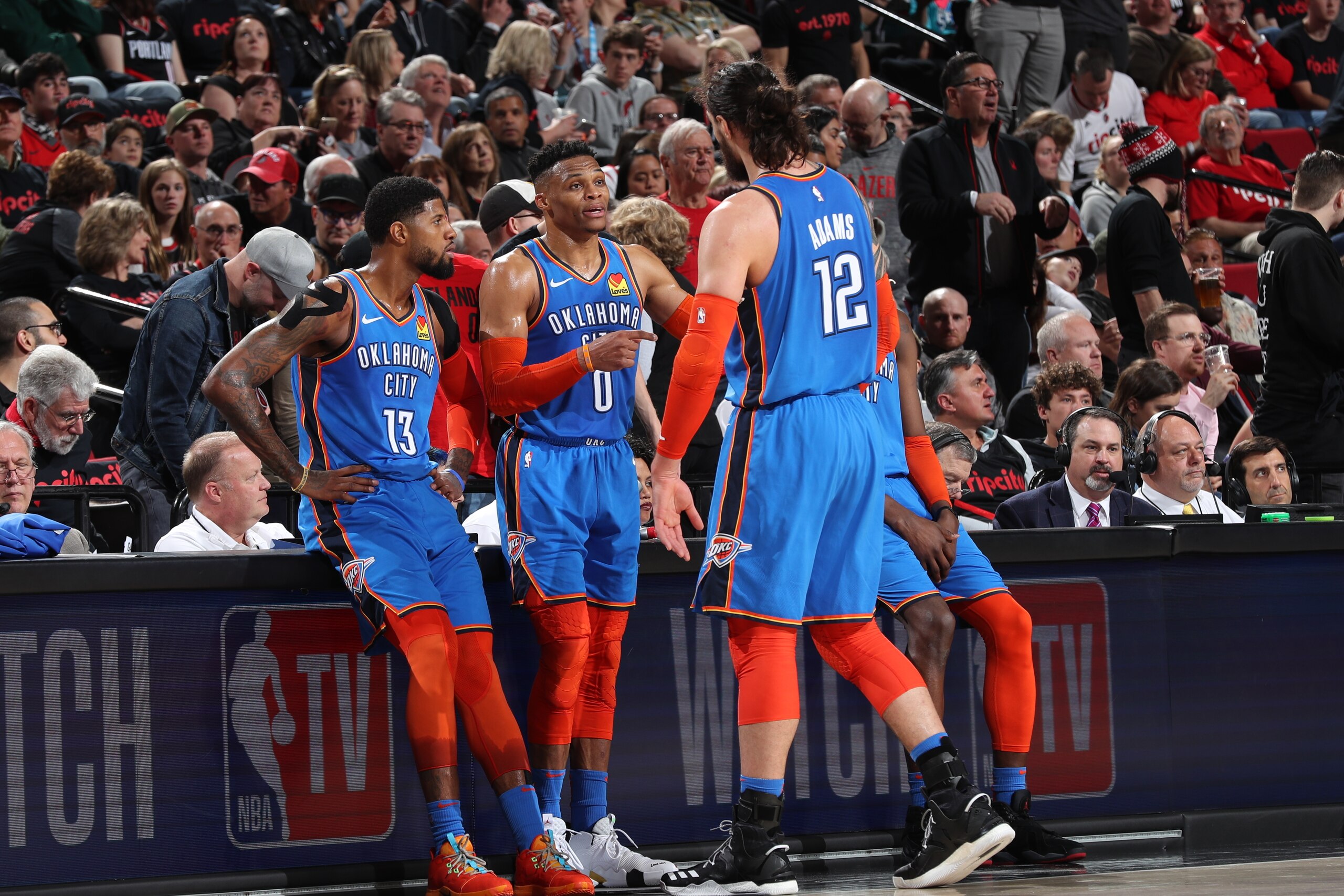
The Oklahoma City Thunder falling in five to the Portland Trail Blazers is unforgivable. Damian Lillard is the postseason MVP, and CJ McCollum is recapturing offensive form at the right time, but the absence of Jusuf Nurkic should've left them at a disadvantage—or at least something less than a 4-1 advantage.
Blame Russell Westbrook, Paul George's shoulder, Oklahoma City's lack of shooting, Enes Kanter's grudge, whatever. That series looms as the opening round's biggest disappointment, the authentic-feeling feud between Lillard and Westbrook notwithstanding.
And really, after thinking about it, we've only been treated to one meaningful Game 6. With all due respect to the Clippers, who are punchy and deep, the Warriors' victory was never really in doubt. That head-to-head, while entertaining, needed the unlikeliest of Game 7s to instill any sort of genuine late-April stagecraft.
Here, then, is to the Denver Nuggets and San Antonio Spurs, and their commitment to going the distance.
D'Angelo Russell
3 of 7
Five games versus a clearly superior Sixers squad cannot provide a referendum on the legitimacy of D'Angelo Russell's breakout season. Better players than him have melted against Ben Simmons' combination of length and size.
Still, with restricted free agency on the horizon, Russell's performance wanted for assurances. He shot 37.9 percent on two-pointers, 32.4 percent from three and just 46.7 percent at the rim. He did go 9-of-19 on deep balls when defended by Simmons, but Philly dared him to make plays inside the arc. He failed. Brooklyn as a team averaged just 0.85 points per possession when Simmons was on Russell's case.
Shaky playmaking compounded the issue. Russell kept his turnovers in check, as usual, but didn't have an answer for Simmons' pressure. He was coaxed into contested twos and forced to abandon touches after picking up his dribble. The latter completely neutralized his vision.
It didn't help that the Nets struggled to make shots, but Russell wasn't in a position to drop impactful passes. He averaged 9.0 potential assists compared to 12.5 during the regular season.
Not all individual matchups will be this tough, but Russell has to adjust. Making quicker decisions off screens is a good place to start. He has to get more kick behind his downhill drives, if only to bolster what remains a problematic free-throw-attempt rate.
This doesn't negate his career season. Not even close. He finished with the league's sixth-highest usage rate and attempted more pull-up jumpers than everyone except James Harden and Kemba Walker. That brand of volume isn't easy to sustain, and Russell responded by joining Harden and Stephen Curry as just the third player in league history to clear 25 points, eight assists and three made triples per 36 minutes.
And yet, Russell didn't do anything to help his market. He is going to get paid, because scorers always do. But he didn't alleviate enough concerns to guarantee max or near-max offers.
About one-third of the league will have big-time cap space this summer. Very few of them need a starting point guard. Russell's market was always going to fall on the tepid end for a 23-year-old working off a well-deserved All-Star selection. His postseason debut didn't do anything to change that.


Oklahoma City Thunder
4 of 7
Some of the sheen had worn off the Thunder's season before the playoffs. A tougher schedule invited their post-All-Star break malaise, and Paul George's MVP case flattened while he played through a right shoulder injury.
That doesn't excuse Oklahoma City from falling to Portland in five games. On the contrary, the Blazers didn't have Jusuf Nurkic, their second-best player during the regular season. For all their offensive inconsistencies, the Thunder are long and physical on defense and entered as clear favorites.
So much for that.
Russell Westbrook is predictably facing the most backlash. The Blazers dared him to jack up long twos, and he bit. More than one-quarter of his looks came between 10 feet and inside the three-point line, from where he shot under 25 percent. His 32.4 percent success rate from downtown on 6.8 attempts didn't do the Thunder any favors, and he converted fewer than 46 percent of his opportunities around the rim.
Obituaries are now being written for Westbrook's prime. They are neither an overreaction nor completely on the mark. As ESPN.com's Zach Lowe wrote:
"It's not really that Westbrook—after four knee surgeries in six years—is perhaps the worst high-volume three-point shooter ever. He is, but that's almost trivial—a punchline. He has always been a bad three-point shooter; he's just worse now, so bricky that opponents are braver taking an extra step away from him when he doesn't have the ball. And as has been the case for the entirety of his career—see last season's version of this same fallout column—Westbrook has never been much interested in making himself useful when he doesn't have the ball."
Slumping two-percentages exacerbate Westbrook's situation, and the aging process is already underway. It is harder for him to carry lineups through his trademark force of will. Oklahoma City was outscored by 5.4 points per 100 possessions when he played without George during the regular season. Those solo minutes remained a major problem against Portland.
This isn't entirely on Westbrook. He needs to adapt, but so do the Thunder. Their roster construction is desperate for more spacing and another playmaker who isn't a non-shooter.
Terrance Ferguson and Jerami Grant were the only players who shot better than 33 percent from deep against the Blazers, and their "success" is misleading. Grant went 0-of-8 from distance in Games 1 and 2, and Ferguson's 38.6 percent clip was skewed by a 3-of-4 outlier in Game 3 and negligible volume.
Uncomfortable questions must now be asked about the Thunder's make-up. They don't have the tools to answer them. They once again profile as a taxpayer next season and aren't flush with desirable trade bait. Four players will earn over $15 million in 2019-20: George ($33 million), Westbrook ($38.5 million), Steven Adams ($25.8 million) and Dennis Schroder ($15.5 million). Only George is a net-positive asset at his price, and he's the one player they can't afford to lose if staying relevant is the goal.
General manager Sam Presti has pulled rabbits out of his hat before, but for the first time, the franchise that navigated an outgoing James Harden trade and Kevin Durant's departure feels truly stuck.
Nikola Vucevic
5 of 7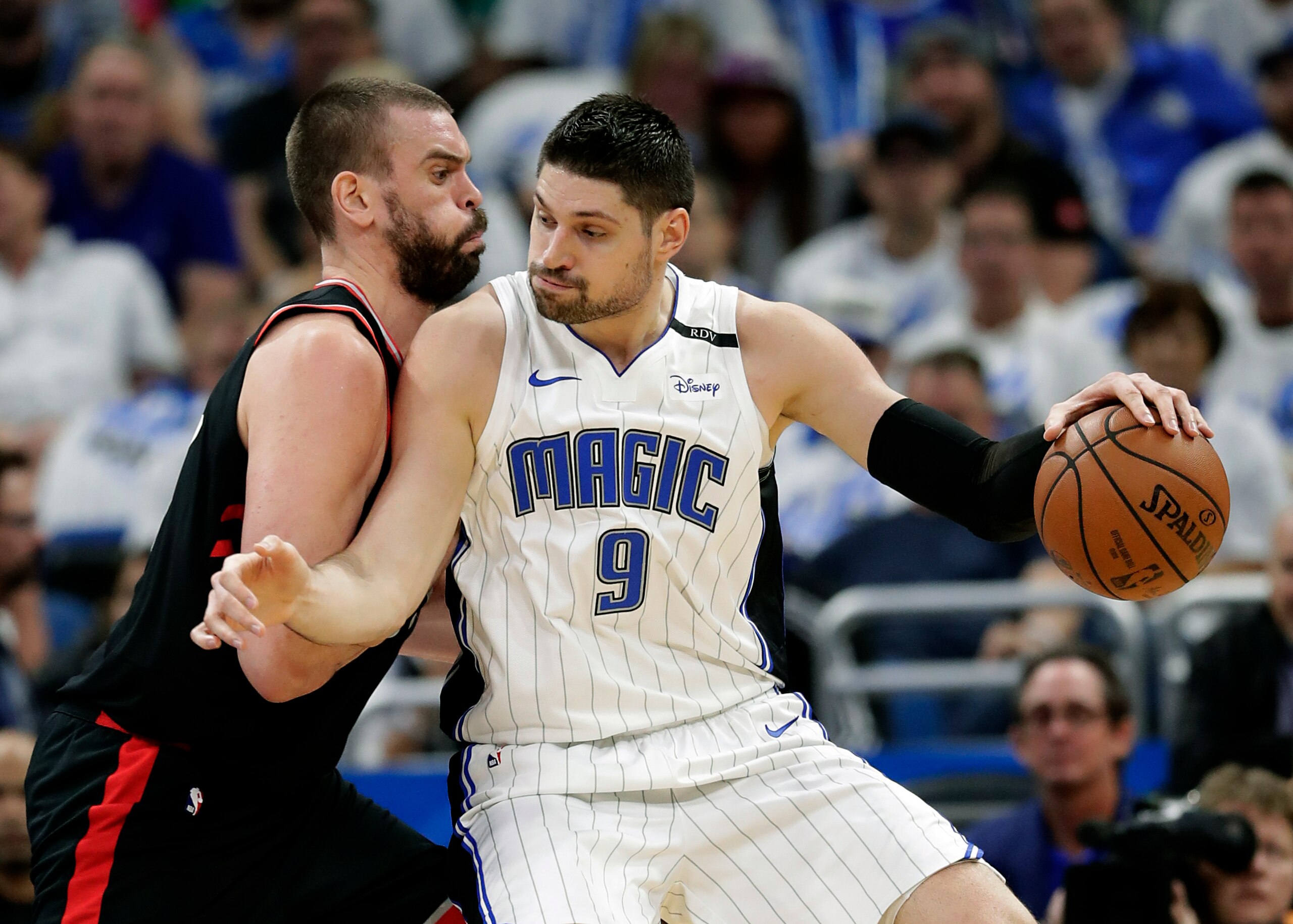
Nikola Vucevic's first-round dud is protected by the Magic's unavoidable exit. They weren't supposed to make the playoffs, and they certainly weren't ever going to beat the Raptors.
But bonus basketball is not without consequences, and Vucevic could not have imagined a more unflattering end to his career year. After getting an All-Star nod and posting stat lines worthy of pre-injury DeMarcus Cousins, he shot 40 percent on twos and 23.1 percent from three against Toronto (down from 54.9 and 36.4 percent, respectively, during the regular season).
Marc Gasol positively flustered him. Vucevic shot 30 percent on post-ups while turning the ball over on 25 percent of those touches. Orlando's offense averaged fewer than 0.9 points per possession when Gasol was his primary defender.
Five games is five games is five games, but postseason cold streaks are far from ideal ahead of free agency. And Vucevic was already facing a complicated, if not quiet, market.
Not many teams are on the prowl for an expensive center, and he doesn't fit the desired big-man archetype. His defense is better than advertised. He makes timely contests around the rim and can hold his own when dropping back in the pick-and-roll. But he can't be the anchor of an entire approach.
Average defense is a stock boon when paired with Vucevic's offensive tool belt. He can rip threes, outmaneuver with his back to the basket, facilitate from the post and even drop some nifty passes on the move.
Everything changes if his offensive bag isn't deemed postseason-proof. The Raptors weren't a good matchup for Vucevic at either end of the court, but that's part of the problem. Which team will offer cornerstone money to a regular-season star who, at the very least, will see his playoff value fluctuate by opponent?
Portland's Treatment of Al-Farouq Aminu
6 of 7
Look at this picture. Really look at it.
Yes, it is iconic. But if you squint really hard, you'll see Al-Farouq Aminu nearly being crushed to smithereens on the bottom right. That's no way to treat who is, with Jusuf Nurkic out, your best defender.
Pecking orders are difficult to establish for impromptu pileups. I get it. But how the bleepity bleep does Skal Labissiere get prime placement over Aminu?
Things happen, and Aminu was all smiles. I get that, too. I still expected better from the Blazers and their sing-songy culture. They have another series left to play, and maybe another after that. They need Chief.
So please, Portland: On Damian Lillard's next seminal game-winner, consider not squishing Aminu.
Utah's Offense
7 of 7
Donovan Mitchell is toting a lion's share of Utah's criticism. He deserves it.
His first 16 career playoff games are mostly forgettable. He has a true shooting percentage under 50, and with the exception of his 19-point fourth-quarter detonation in Game 4, he bordered on detrimental during the Jazz's gentleman's sweep at the hands of the Rockets.
Overreacting to Mitchell's struggles places too much stock in a smaller sample size. He is not suddenly a supercharged Rodney Stuckey or shorter Kendall Gill. His All-NBA ceiling is intact.
At the same time, Mitchell's postseason warts are more than growing pains. Defenses can tailor their game plans around him until the Jazz acquire someone else with an elite floor attack. But he wasn't only misfiring on tough looks.
Mitchell shot 31.3 percent on wide-open attempts, including 16.7 percent on uncontested threes. And he coughed the ball up on 20 percent of his isolation possessions. Preliminary concern over his trajectory is fair.
Ultimate judgment must be reserved for now—until Utah gets him more help.
Secondary shot creation has hampered the Jazz since the Gordon Hayward era. Try as they may to work around it, they need another consistent off-the-bounce initiator before they have a chance to crack that next tier of contender.
Granted, failing where they are built to fail isn't the end of the world. The Jazz collectively join Mitchell on the frontlines of disappointment because they couldn't execute on the most fundamental level. They finagled high-percentage shots against the Rockets. They just didn't finish them.
"Per a source: NBA average on *SUPER* wide-open threes—no defender within 10 feet—was roughly 40 percent this year," the Sharp Notes podcast's Ben Dowsett wrote. "The Jazz were slightly above average, shooting 41.4 percent for the year. Versus Houston, the Jazz generated seven such shots per game—highest in the NBA by far. They made 20 percent."
Utah needs to address its shot-creation issue over the offseason and has the cap flexibility necessary to chase Kemba Walker. But missing gimmes is not an inherent limitation. The Jazz are deep enough that Royce O'Neale should not go protracted stretches as their best or second-best offensive player. Ditto for Jae Crowder. Joe Ingles joined Mitchell in going cold at the wrong time. No one the roster shot even 35 percent from deep for the series.
That the Jazz stumbled against the Rockets is not unexpected. The degree to which they failed is a different story—and worth thorough reflection over the offseason.
Unless otherwise noted, stats courtesy of NBA.com, Cleaning the Glass or Basketball Reference.
Dan Favale covers the NBA for Bleacher Report. Follow him on Twitter (@danfavale) and listen to his Hardwood Knocks podcast, co-hosted by Bleacher Report's Andrew Bailey.

.jpg?w=2560 "Rodgers Iced Out on Plane 💎")
.jpg?w=2560 "Raiders Could Start Mendoza")
.jpg?w=2560 "Mahomes Told Teammate to Leave Meeting")
.jpg?w=2560 "🚨 Week 8 AP Top 25 Poll")


.jpg?w=2560 "Lamar Being Out Shocked Ravens")
.jpg?w=2560 "Lions Outlast Packers")