


Dragon Quest XI: Echoes of an Elusive Age is Square Enix's latest bold attempt to penetrate the western market for what is globally one of video gaming's biggest franchises.
It's fitting, then, that Dragon Quest XI is a callback to the roots of the series as it celebrates its 30th anniversary. This tale hits all the right notes, bringing the universe to life while leaning on current console technology and otherwise simplified mechanics and menus to dial things back to the classic JRPG experience fans of the genre covet.
The question for Square Enix is simple: Does Dragon Quest XI do enough right to reach beyond the niche audience? This is a series that launches on a weekend in Japan to avoid school days. The original Dragon Quest XI was only the 25th game in history to receive a perfect review score from Famitsu when it launched a year ago.
TOP NEWS

Unranked CFB teams cause chaos in Week 8

Brown with an all-time summary of relationship with Tatum

More top teams upset and more takeaways from CFB Week 8
With improvements across the board and a dash of quality of life from a speedrunning perspective, this latest effort might just have enough to create a newfound mindshare in the realm of video gamers.
Graphics and Gameplay

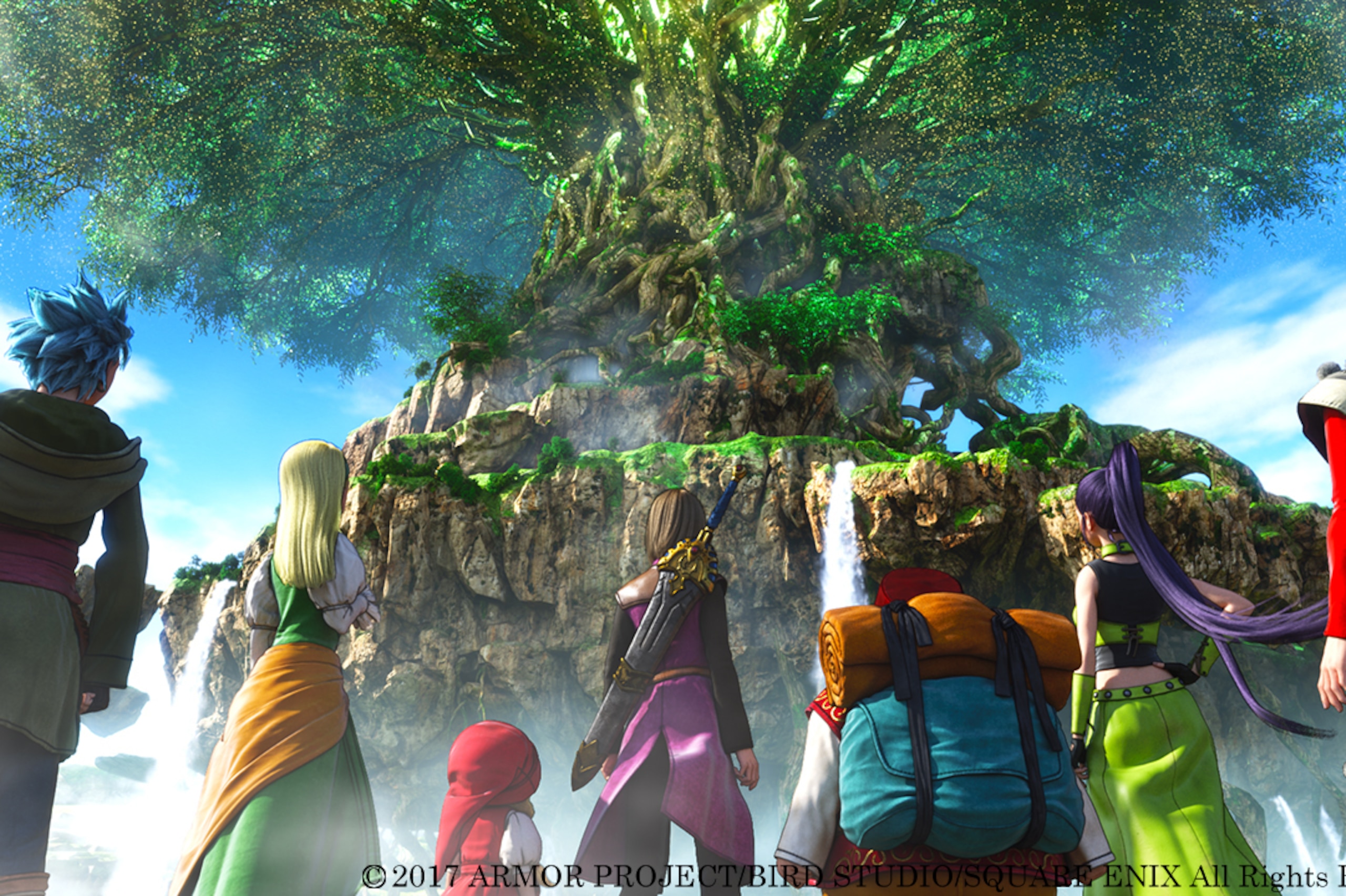
The first thing that pops off the screen upon booting the game is the art style.
Vibrant colors greet players and set the mood in a style reminiscent of a top-notch anime, which is fitting because Akira Toriyama—the man responsible for Dragon Ball—is the character designer here, as he has been for every game in the series.
As such, each character is unique and has a strong complementary physics system attached to them. As was the intent to set the game apart from competition all those years ago (1986), enemies are mostly vibrant and colorful, if not cute.
The game world itself is equally as impressive and operates on a breathtaking day/night cycle. Every town an RPG fan could imagine is well represented here, from the castle walls of a kingdom to a steamy volcano-side retreat to a trading outpost port city and beyond. Every NPC in these areas is equally as unique.
An entire ecosystem of enemies—including fan favorites like Slimes—interact with the environment and each other. These interactions are new to the series, as is the ability for enemies to surprise a player, catching them off guard.
It's a living, breathing world in the truest sense, as longtime fans of the series have often requested. And character dialogue in villages and out in the wild changes based on events unfolding in the story, making for a fun diversion and further bringing the world to life.
In short, this is the sort of transition longtime players of Pokemon have hoped the series would do on a powerful console as opposed to a handheld.
The gameplay goes in a different direction, albeit in a good way. At times, Dragon Quest XI can feel like it is on training wheels. Slap each party member into a preferred routine and the battle will unfold without user input.
But that's no fun, of course. Enjoyable gameplay in JRPGs is all about getting into a groove during a battle, and it's easy to get engrossed here thanks to easy-to-digest menus and systems.
Comboing character skills together is simple and players will rarely feel like the outcome of a fight is out of their hands. A new freedom to move around the battlefield and control the camera itself is nice, but those tacticians who want to control each and every move might soon forget the feature is even there—the battles are that good, a perfect callback to turn-based JRPGs of old.
Story, Draconian Mode and Features
The story told in Dragon Quest XI isn't going to blow anyone away—but that doesn't mean it isn't told well.
In a sense, you show up for the hero's quest and stick around for the superb supporting cast. The party members surrounding the player's silent protagonist (voice actors did an excellent job all around here, a feature not even present in the original Japanese version) might be one of the most memorable supporting casts in a JRPG spanning these past 30 years.
It helps that the story fleshes out the backgrounds. The dialogue and personality do much of the heavy lifting, but peeling back the layers of each prominent character as the story unfolds is a gift that keeps on giving. The story also feels episodic in nature as players weave through a diverse world, making for finely turned chunks of playing time per session feeling similar to working through a show on a streaming service.
The Western version of the game has received some other enhancements as well. There's a dash button now, meaning less of a slog exploring (which is incredibly rewarding and should be undertaken).
A Draconian Mode lets players customize their experience to a degree of difficulty they will enjoy, offering options like tougher enemies, restrictions on items players can buy in shops and more. For those wanting to turn this into Dark Souls, well, the level of customization required is certainly there.
Other streamlined features are worth noting. Leveling a character is both rewarding and liable to bring players back for more. A panel system splits a character's skills into different segments and players can use points to unlock grids of skills, with some moves and pep pieces revealed right away, while other more powerful skills are hiding behind the requirement of unlocking adjacent panels first.
Crafting is just as enjoyable. As a player levels up, different types of strikes with a forge hammer will unlock. It's an addictive minigame with real in-game consequences, because mastering said minigame creates better armor than what's available for purchase.
Speaking of minigames, there is a whole lot of them. There are casinos with true-to-life games in them, crossbow challenges out in the world, medals to collect and more. All offer legitimate gear upgrades and again, scratch an itch when it comes to feeling rewarded.
The way all of this weaves together into the narrative, from defeating certain monsters for terrain traversal to crafting proper armor (with varying stats based on a minigame performance) and beyond, is downright impressive. Nothing feels out of place or tacked on for the sake of being there.
Speedrunning Tips and Appeal
On first pass, trying to speedrun a JRPG with a billed game time of 60-100 hours seems like a terrible idea.
But it's not as daunting as it sounds thanks to some of the design decisions.
There are plenty of notes here that when added up lend to the idea Dragon Quest XI is actually a superb speedrunning option, both for those who do it competitively and those who do something along the lines of a speed charity run on stream.
The first note is right in a player's face: the Western localized version of the game has a dash button assigned to a trigger. It's a huge change of pace, and while it is obvious, it's hardly scratching the surface as far as optimal speedrunning notes go.
There's another one right in front of players they might not spot: there are no random encounters. As mentioned, the monsters are right on the screen and easily avoidable.
Sometimes it's the little things that make a perfect speedrun. When a player has the map pulled up, rotating the right stick will change the character's direction on the map, which provides a boon when a player needs to quickly orient themselves. And for those feeling lost, NPCs with pink bubbles on the map will tell you how to proceed, as will the party chat option.
Other staples of speedrunning are here. It's easy to skip dialogue and lean on these navigation systems to advance the game. Certain cutscenes and lengthy pep-power combinations are skippable. Side quests are all quality, but not necessary. Players get a horse early on in the adventure and can summon one out in the wild, meaning faster traveling, an ability to insta-kill enemies you charge into and looting materials and chests from atop the horseback.
By the way, taking the time to loot might seem counterintuitive for a speedrun, but it's simpler than it sounds since there are no random encounters. Stockpiling assets means discovering new forgeable items, meaning you can save gold and forge items instead. That will leave more gold for the endgame to splurge on items if necessary.
While on the topic of traveling and what might seem counterintuitive, it's absolutely critical to visit each and every location. Doing so means the player can cast Zoom and immediately travel back there at any point in the game. Strategic use of Zoom, such as after a boss battle deep in the middle of nowhere as opposed to walking back out, will seriously cut down on total play time.
Other general speedrunning tips to consider include leaning on the auto-equip options in the menu, which will do so under offensive, defensive or magical umbrellas. During battles, setting the team to "fight wisely" is much faster than navigating menus and thinking strategically. Moving the player closer to enemies will cut down on animation frames as well.
Out in the wild, monsters are often near lootable items, so if a player gets spotted while looting, use the game's freeze mechanic to celebrate the loot to figure out which way the enemy is coming from, then book it in the opposite direction.
Something else a speedrunner might find helpful is diving into the options and cranking the camera speed to 10, meaning faster access to information while speedily hurrying through the game.
Of course, professional speedrunners will repeatedly play the game and find ways to further break records. Making each party member specialize in a certain area instead of trying to be balanced will dramatically speed up the first half of the game.
Certain items will or won't be useful on speedruns. Knowing what bosses are coming in advance will lend to speedrunners crafting the right items to capitalize on bosses well in advance. Along those same lines, the perfect party combinations and pep combinations will eventually surface.
It all adds up to confirm a sense of speedrunning balance. Speedrunners will enjoy the puzzle that is optimizing strategies throughout the game's many systems. And from a viewer's perspective, taking this journey together and watching its absolute dissection into barebones efficiency is simply another way to immerse oneself into a brilliant world, both visually and in its execution.
Conclusion
Much of Dragon Quest XI's refinements aren't necessarily new, but it would be a gross mischaracterization to suggest this is a game falling back into old habits and tropes for the sake of cashing in on a major name brand.
Rather, this feels like a love letter to fans of the series and also happens to double as a smart capitalization on a niche. JRPGs aren't oversaturating the market like they were in the PS2 days, so a quality offering now is bound to give the Dragon Quest series as a whole the desired Western expansion it has deserved for a long time.
It isn't a stretch to say Dragon Quest XI might be the best game in the series. It is akin to the forge minigame itself—rework an item enough times and players learn the exact strategy to perfect it.
That is what Square Enix has done here. Dragon Quest XI is the perfect blend of the past elements in the series and raises the bar for competitors.
Impressively, it's an experience fully up to the user, too. Want to spend 120 hours engrossed in the world seeing the scenery, talking to every NPC and finishing all side quests? Go for it. Want to breeze through an enjoyable story with unforgettable characters? It's possible. Want to craft varying levels of speedruns or watch them unfold? Dragon Quest XI has it in a way few in the genre before have made possible.

.jpg?w=2560 "Chiefs Giants Football")
.jpg?w=2560 "Jonathan Taylor Landing Spots 📍")

.jpg?w=2560 "5 Teams Eyeing Jonathan Taylor")

