

What Matt Harvey Must Do with Reds to Save MLB Career from Nightmare
Matt Harvey has already gotten one thing he needed to reboot his major league career, and that's a fresh start with a new team.
Now comes the hard part.
In case anyone is just now returning from a long sea voyage or some such endeavor, the last week has been a busy one for the pitcher known as "The Dark Knight." The New York Mets designated him for assignment on May 4 and traded him to the Cincinnati Reds on Tuesday after he refused a minor league assignment. He's set to make his Reds debut on Friday in Los Angeles against the Dodgers.
TOP NEWS

Realistic Offseason Trade Ideas 💡

Players Who Were Worse Than You Think in 2026 ⚾
Latest Free Agent Rumors 👂
The 29-year-old first arrived in New York in 2012 and found himself starting the All-Star Game for the National League by the middle of 2013. Tommy John surgery knocked him out of the spotlight for a while, but he had little trouble reclaiming his acehood when he returned in 2015.
The last three seasons, however, have been Harvey's bane (or Bane, I suppose).
He was limited by injuries—including a shoulder issue that required surgery—to just 36 appearances in 2016 and 2017. He also managed just a 5.78 ERA when he could pitch. That begat a 7.00 ERA through eight appearances this season, which begat his ouster from New York.
Of course, there have also been some off-the-field controversies along the way. But those must also become water under the bridge now, and it sounds like he knows that as well as anyone.
"There's a lot of good memories, there's a lot of bad memories, but after today, I'd rather not talk about my past experience with the Mets," Harvey told reporters Thursday. "I'd like to move forward with my new organization and help them."
Having peace of mind never hurt anyone. And health permitting, maybe it's all Harvey needs to erase the disparity between the pitcher he used to be and the pitcher he's become. That would get him back on track and boost his value for his upcoming foray into free agency.
More likely, it's going to take an entirely new approach to his craft.

Through thick and thin, Harvey has continued to operate like a power pitcher. As evidence, consider this Brooks Baseball chart of the year-to-year progression of his pitch mix:
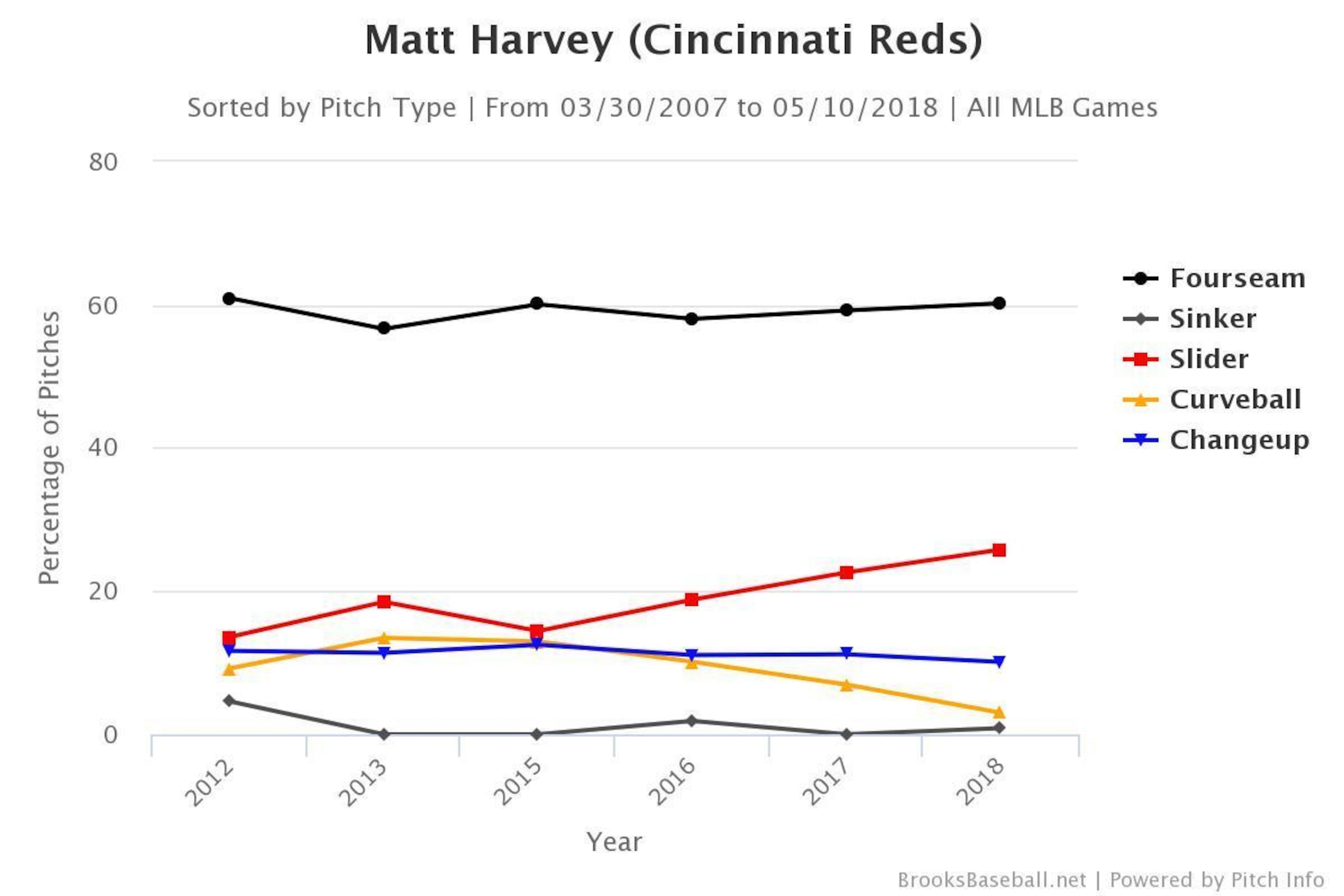
His curveball has fallen out of favor while his slider has risen in favor, but everything still runs off the four-seam fastball. That would be fine if it was the same fastball it used to be, but everyone knows that's no longer the case.
Harvey's average fastball has gone from sitting in the high 90s to sitting in the low 90s. It's also lost the rising action that it used to have. To put it simply, it has diminished from explosive to flat.
His other pitches have also flattened out to some degree or another. Nowhere is the overall decline of his arsenal more evident than in his fading ability to strike batters out:
If one method of collecting easy outs is going to disappear like that, it's imperative that alternatives appear.
To Harvey's credit, he has been inducing more infield pop-ups in 2018. But he's also been staying below the MLB average with his ground-ball percentage, so those pop-ups have only accounted for a small percentage of a steady supply of balls in the air.
The fly balls have been the most dangerous, as they've traveled quite far on average:
- 2015: 309 ft
- 2016: 306 ft
- 2017: 323 ft
- 2018: 341 ft
Thus far, this dangerous trend has produced six long balls. That equates to two homers per nine innings, which is downright James Shieldsian.
In light of this, it was easy to feel optimistic about Harvey's future when the rumor mill was connecting him to the San Francisco Giants. They play in AT&T Park, which does not suffer dingers gladly.
Instead, he's landed at Great American Ball Park. It's rating as the best place for home runs in 2018, according to ESPN.com, and Harvey's spray chart of non-homer fly balls and line drives suggests that it'll threaten to make his gopheritis even worse:

So, that old saying about the definition of insanity as doing the same thing over and over and expecting different results? There's a good chance that'll apply to Harvey unless he makes some changes.
At the very least, perhaps Reds pitching coach Danny Darwin can convince Harvey to change how he's using his formerly mighty fastball. He's been throwing it lower than usual. What limited data there is suggests he should be throwing it higher.
But at this point, the best thing Harvey can do is throw his four-seamer less often and maybe even scrap it altogether. He has a sinker that he can dust off. It also wouldn't hurt to try to learn a cutter on the fly.
Otherwise, the only thing left to suggest is that he start giving hitters different looks at the same old stuff. He could trying mixing in different arm slots or simply changing his position on the rubber.
No matter how Harvey starts reinventing himself, the reality is that some kind of reinvention is not optional. He needs to do it if he wants to start reclaiming his place in the majors.
If he doesn't, he'll be lucky if he so much as stays in the majors.
Stats courtesy of Baseball Reference, FanGraphs, Brooks Baseball and Baseball Savant.



.jpg?w=2560 "Love's Body Already 'Tired'")

.jpg?w=2560 "Tyreek Deal May Come Soon")
.jpg?w=2560 "Mahomes' Wife Trolls Kubiak 💀")