2018 NFL Draft: Ranking the Top Future Franchise Cornerstones
There is nothing more valuable in the NFL than high draft picks. The reason for this is simple: The cost-controlled contracts of draft picks are too valuable to give away for traditional cap space.
Most high draft picks who "hit" also rarely see free agency. Out of the 32 first-round picks in the 2010 draft, over half were still on their original teams' rosters six years into their respective careers.
Draft picks don't just impact franchises in the immediate future, but also 10 years down the road because of how few elite talents hit the open market each offseason. In this draft class, there are 10 prospects we consider potential cornerstones for teams. Players who can mold their teams' identities through two or three contracts.
We'll take you through why these players, including three quarterbacks, have separated themselves from the pack less than two months before the 2018 draft. They have the best chances to still be on their teams in 2025 if a squad is lucky enough to be able to select them this April in Dallas.
10. Saquon Barkley, RB, Penn State
1 of 10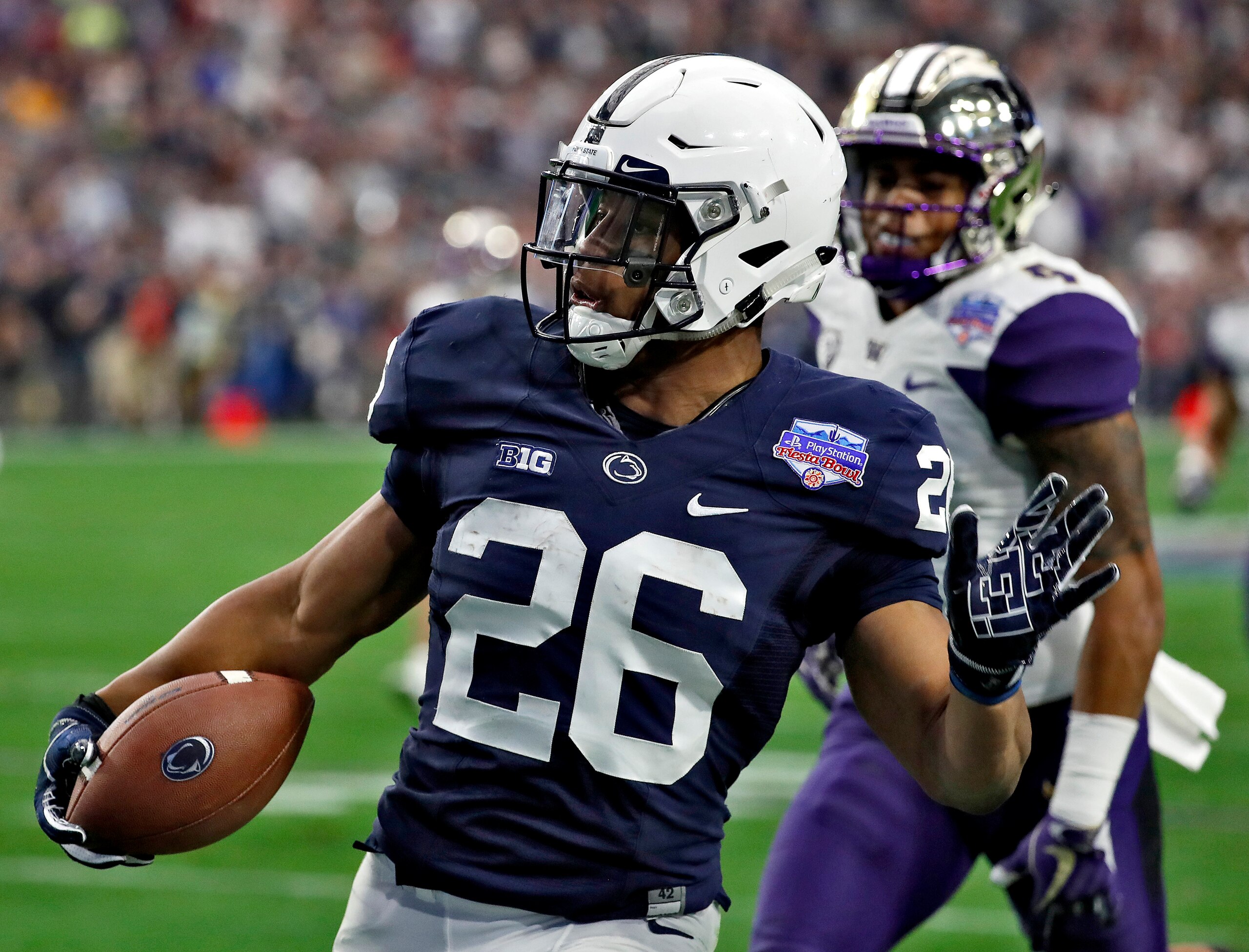
"Generational" may be too strong a term to describe Saquon Barkley, since Adrian Peterson was drafted in 2007, but the Penn State running back did dominate the Big Ten, recording 5,038 yards from scrimmage and 51 offensive touchdowns in his three years as a Nittany Lion. He's widely considered the top back in the class.
The ever-growing importance of pass-catching backs can't be understated, with the emphasis on the ground game diminishing since 2004. Two-way stars such as David Johnson, Le'Veon Bell and Todd Gurley are the faces of the position. Darren Sproles has recorded just 686 carries but 532 receptions in his NFL career, and he has one of the five-highest career earnings at running back.
In that aspect, Barkley (102 receptions, 1,195 receiving yards) blows his competition out of the water.
Still, we need to think about the long-term meaning of a cornerstone. Carolina Panthers kicker Graham Gano signed a four-year, $17 million contract Tuesday. Currently, only four running backs on veteran contracts match his $9 million guaranteed. Only five veteran running backs match his total contract value.
With the league treating running backs like kickers for their second contracts, it's hard to have Barkley ranked higher than 10th.
9. Sam Darnold, QB, USC
2 of 10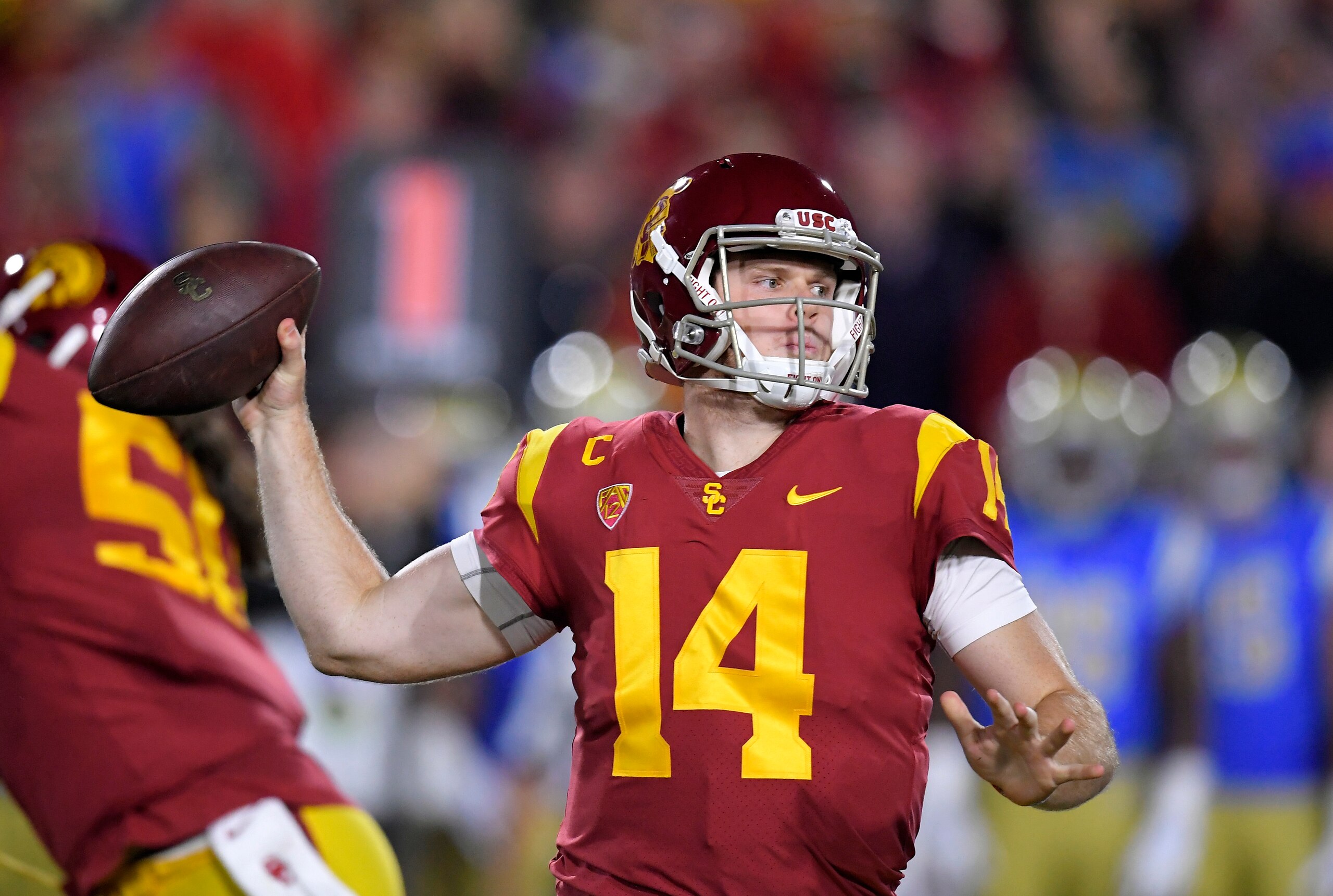
There is no position in the NFL more synonymous with "cornerstone" than quarterback. The highest-drafted players are quarterbacks. The highest-paid veterans are quarterbacks.
USC Trojans signal-caller Sam Darnold entered the 2017 college football season as the favorite to get picked first overall, and he still may go at No. 1. But there are legitimate questions about his game.
After he recorded nine interceptions as a redshirt freshman in 2016, Darnold threw nine in his first six games of his sophomore season, including at least one in every single contest, before he righted the ship.
Some may overstate the negatives to his long throwing motion, but he's more Jameis Winston than Tim Tebow. As a redshirt freshman, Winston threw 40 touchdowns and just 10 interceptions, taking college football by storm and earning himself the Heisman Trophy. The following season, his numbers dropped to 25 passing touchdowns and 18 interceptions.
The first overall pick in 2015 has had his bumps and bruises in the NFL. He's recorded 69 passing touchdowns and 44 interceptions through three seasons, leading the Tampa Bay Buccaneers to a 18-27 record.
Expect the same out of Darnold early on, with the potential to have hot streaks like Eli Manning, who has two Super Bowl rings but just one elite (2011) regular season to his name.
8. Roquan Smith, LB, Georgia
3 of 10
Lost in the shuffle of the combine narratives is Georgia Bulldogs linebacker Roquan Smith, who ran a 4.51-second 40-yard dash at 236 pounds. The true sideline-to-sideline linebacker is built for a transition to the speedier, more coverage-heavy NFL.
After recording just 6.5 tackles for loss over his first two college seasons, Smith posted 6.5 sacks and 14 tackles for loss in his consensus All-American junior campaign. Some may question if he can get off blocks from NFL offensive linemen, but we need to be honest about how often run defenses lead to wins.
The Jacksonville Jaguars had one of the worst run defenses in the league last season (21st), but they had the best pass defense. They made the playoffs for the first time since 2007 and went to the AFC Championship Game behind the league's second-ranked defense overall.
That's how this works in 2018.
Smith's athleticism is hard to match, even for first-round talents. You have to go back to Pro Bowl linebackers Anthony Barr and Ryan Shazier to find first-rounders at the position who ran faster 40-yard dashes than Smith at heavier weights. Smith has the potential to be a Pro Bowler in his rookie season, a rarity for this class, which doesn't have many elite talents.
.jpg?w=2560 "Rams Raiders Football")

.jpg?w=2560 "Steelers Saints Football")
7. Baker Mayfield, QB, Oklahoma
4 of 10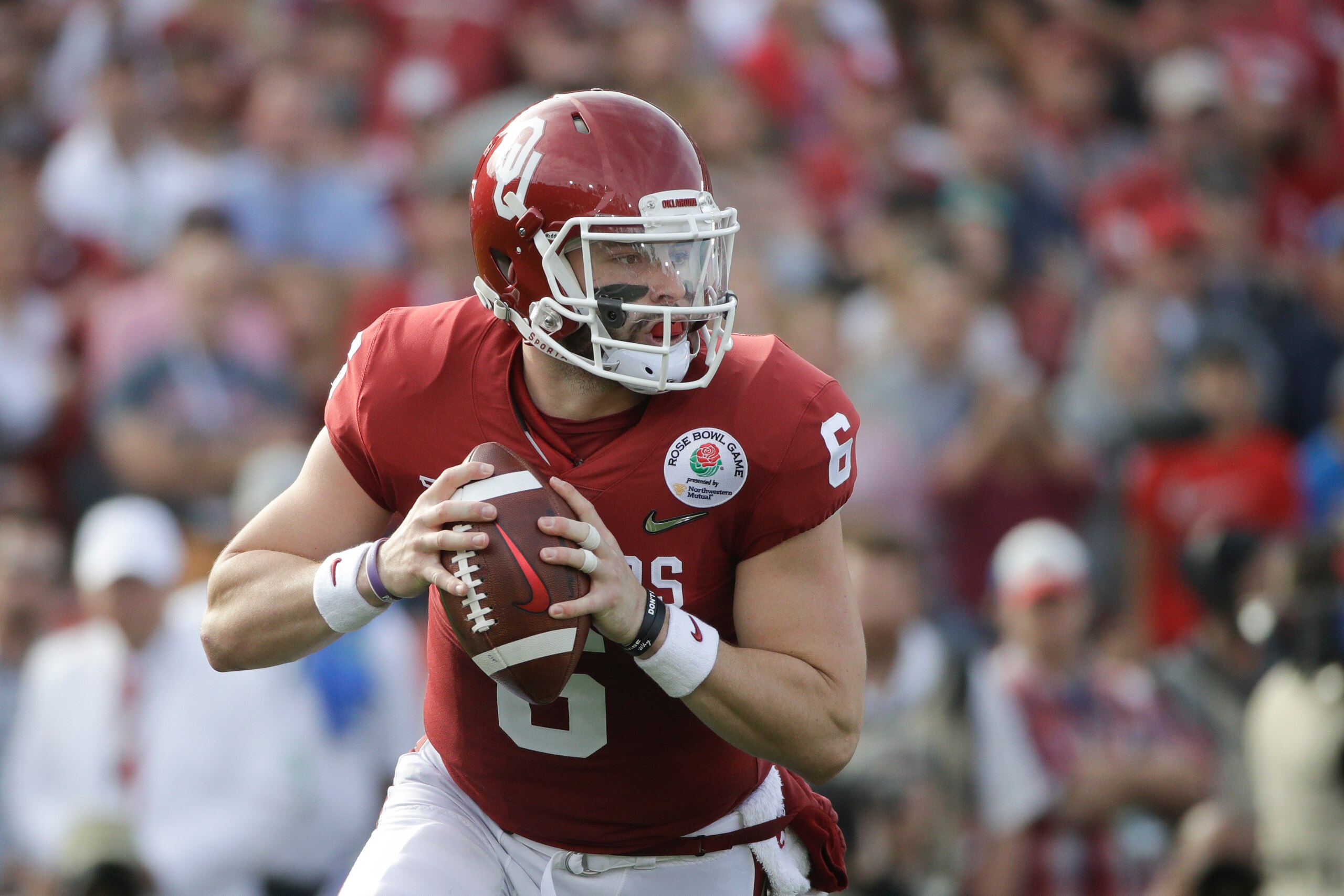
In 2011, Wisconsin's Russell Wilson set the FBS passing efficiency record with a 191.78 rating. Robert Griffin III, Winston, Cam Newton and Marcus Mariota are all in the top 10 of that list. It seems like elite passers in college football have an easier time adjusting to the NFL.
Oklahoma's Baker Mayfield broke the passing efficiency record in 2016 at 196.39. In 2017, he did it again with a 198.90 rating and won the Heisman Trophy.
Under a creative offensive coordinator, Mayfield could have a Rookie of the Year season. The backyard-style passer throws late over the middle a little more than you'd like, but it's hard to bet against the history of elite passers making quick impacts in the NFL.
If, say, the Denver Broncos or New York Jets lose out on the Kirk Cousins bidding war, one would assume that Mayfield would rise on their short list of targets at the top of the draft.
6. Denzel Ward, CB, Ohio State
5 of 10
Since 2007, only four first-round cornerbacks have recorded both a 4.36 40-yard-dash time or better and at least a 38-inch vertical leap: Pro Bowlers Patrick Peterson, Marshon Lattimore and Dominique Rodgers-Cromartie and Trae Waynes.
Ohio State corner Denzel Ward will be added to that list in April.
The pass-heavy NFL is increasing the demand for quality corners. By the time Ward's rookie contract is up, that position may be considered the third-most important behind quarterbacks and defensive linemen. His athleticism, developed by the same Ohio State program that developed Lattimore, will come in handy.
After the Buckeyes were forced to replace Lattimore as well as first-rounders Malik Hooker and Gareon Conley in 2017, Ward proved his worth as a first-year starter with an All-American season (two interceptions, 15 passes defended). After surprisingly measuring in closer to 5'11" than 5'9" at the combine, Ward should be considered a top-10 lock and future Pro Bowl cornerback.
5. Quenton Nelson, OL, Notre Dame
6 of 10
The NFL treats interior offensive linemen more differently than any other position when it comes to second contracts.
It is still rare for guards and centers to be top-20 locks, but five years after they're drafted, they are paid much closer to offensive tackles, pass-rushers, defensive tackles and wide receivers than off-ball linebackers, tight ends, safeties and running backs, based on numbers from Spotrac.
Quenton Nelson of Notre Dame is a generational guard talent who was named a captain and an All-American in his junior season. Well-rounded as a run-blocker and pass protector, he may even get a shot to play offensive tackle in a pinch.
As the best offensive lineman in the class, Nelson checked off boxes by scoring in the 70th percentile in both the three-cone drill and the 20-yard shuttle, the two measurements for short-area quickness, per MockDraftable. High draft-pick offensive linemen who do well in short-area quickness drills almost always prove their worth at the next level.
We're in the golden era of defensive tackles. Almost every team has at least one player who could be a Pro Bowl interior defender going into the 2018 regular season. Nelson is the best insurance policy against those talents in this draft class.
4. Derwin James, S, Florida State
7 of 10
Steve Palazzolo of Pro Football Focus said Monday that Florida State safety Derwin James is a more generational talent than Barkley. He's right.
He can contribute as a single-high safety, a two-high safety, a box defender, a slot defender and possibly a cornerback after he ran a 4.47-second 40-yard dash at the combine. The All-American left school with three interceptions, 15 passes defended, 186 tackles, 15 tackles for loss and 5.5 sacks.
Those numbers scream "all-around contributor" to every team in the NFL. Safety is always in competition with cornerback for talent. If established stars like Jalen Ramsey aren't moving from safety to cornerback, athletic projects like Damarious Randall are. This has been a staple of the league dating back to the days of Nnamdi Asomugha.
If James can stick at safety, he may be the most dominant player at his position in this draft class. Like with Nelson, the 10-year-starter talk is legitimate.
3. Bradley Chubb, EDGE, North Carolina State
8 of 10
Bradley Chubb ran a 4.65-second 40-yard dash at the combine, cementing his status as a top-10 pick. The North Carolina State pass-rusher earned All-American honors as a senior after his second straight double-digit-sack season. As a member of the Wolfpack, he posted 25 sacks and 54.5 tackles for loss.
At 6'4" and 269 pounds, he has a prototypical frame, foot speed and production. He's a version of Derek Barnett—a comparison former NFL defensive end Stephen White made this cycle for SB Nation.
Chubb, who knows how to win through the B- and C-gaps, translates well to the modern NFL. This isn't the 1990s. It's harder to get a sack on a per-snap basis than it was 25 years ago, per Pro Football Reference. A player who can win with inside moves, creating a shorter distance to sacks, pressures and hits, is more valuable now than ever.
2. Josh Rosen, QB, UCLA
9 of 10
According to 247Sports' composite rankings, UCLA's Josh Rosen was the top pro-style quarterback in the 2015 recruiting class. Three years later, he has the chance to be the first overall pick in the draft.
After earning All-American honors his senior year of high school and as a true freshman, Rosen missed most of his sophomore season with a shoulder injury before his bounce-back year in 2017. He finished his college career with 9,340 passing yards, 59 touchdowns and just 26 interceptions.
After having a different offensive coordinator in each of his three college seasons, Rosen has developed an NFL-ready intermediate passing game. His deep ball was shaky until the game against USC in November, but he checked off every other box in his scouting report before then.
His combination of size and ideal throwing mechanics separates him from Mayfield and Darnold.
1. Minkah Fitzpatrick, DB, Alabama
10 of 10
Alabama safety Minkah Fitzpatrick has been a known star for several years. After an All-American season in 2016, he was expected to be a potential top-10 pick when he was draft-eligible. After another All-American campaign, Fitzpatrick's fate appears to be sealed.
Sometimes called "Coach Saban's son" by teammates, Fitzpatrick doesn't have a hole in his evaluation...other than the fact that he never really played outside cornerback for Alabama.
When cornerback-sized safeties with corner speed get noticed by the NFL, they doesn't usually stick to safety. The 6'1" Fitzpatrick ran a 4.46 40-yard dash at the combine. That should put him in the scarce cornerback talent pool.
He had 171 tackles, 16.5 tackles for loss, five sacks, nine interceptions (four for touchdowns) and 24 passes defended in college, and one usually would assume he would project into a Harrison Smith-like safety role. Instead, that seems to be his floor, as his transition to cornerback seems inevitable.
Combine measurements and results courtesy of NFLDraftScout.com.
.jpg?w=2560 "Cowboys Packers Football")




.jpg?w=2560 "🚨 Week 8 AP Top 25 Poll")