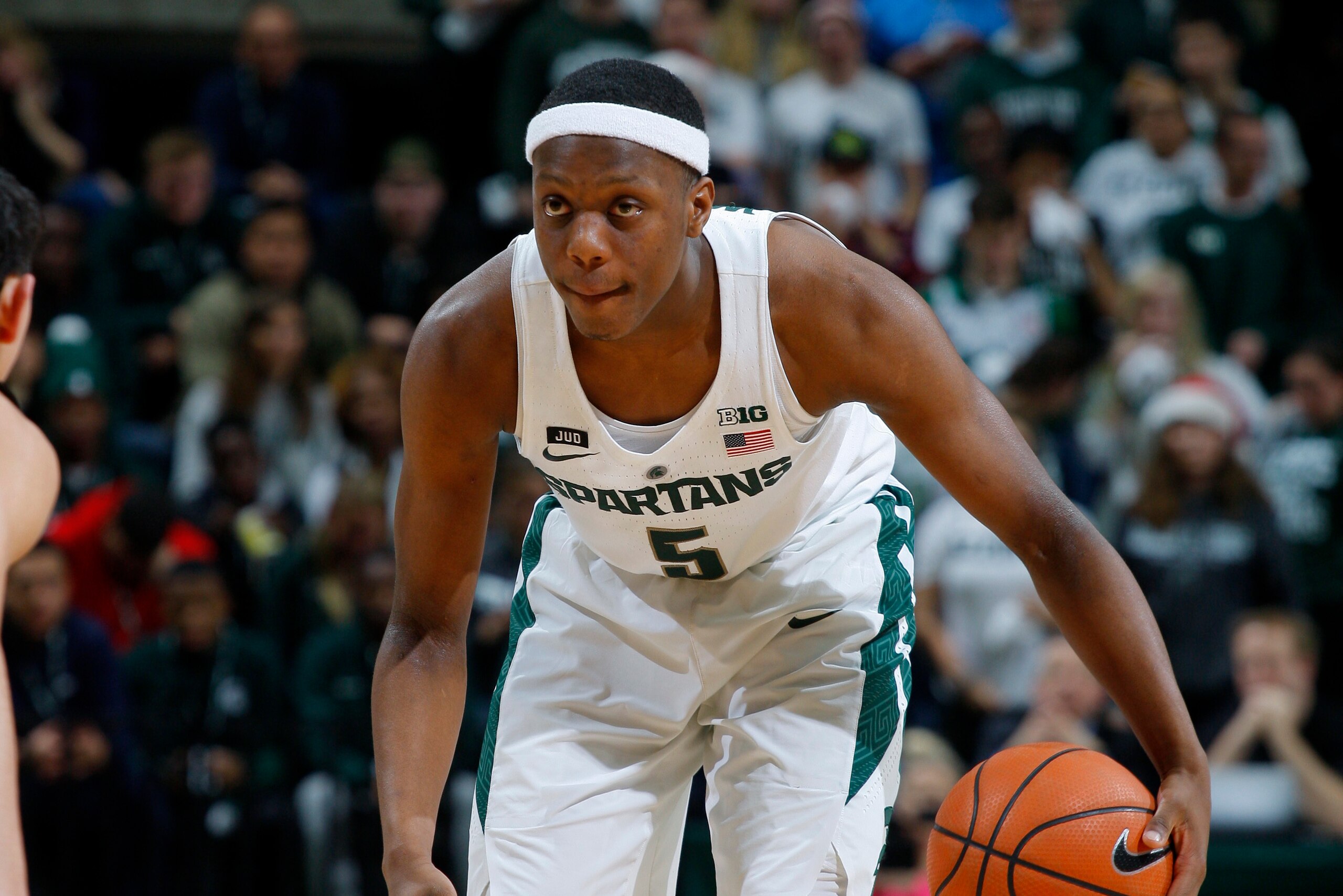


Everyone in the national media thought that Miles Bridges would be the sophomore who led Michigan State to the 2018 men's college basketball Final Four, but teammate Cassius Winston has been one of the biggest breakout sophomores in the country.
Sophomores are the forgotten class in college basketball. The freshmen are the shiny new toys and the primary candidates for the NBA lottery. The upperclassmen are the ones who have been around for a while and who we generally love (or despise) the most. But sophomores are too old to be a novelty and too young to be the face of the team. People seem to dismiss them with an "If they were good enough, they would've left last year" wave of the hand.
But there are always breakout sophomores who reside near the top of the national leaderboards and/or play a huge part for a title contender.
After about six weeks of games, these are the sophomores who will enter conference play as all-conference candidates, even though no one was realistically expecting them to be this good. Players are ranked in ascending order of national impact, which is a combination of team success and individual improvement from last year.
Statistics are current through the start of play on Dec. 21.
Honorable Mentions
1 of 11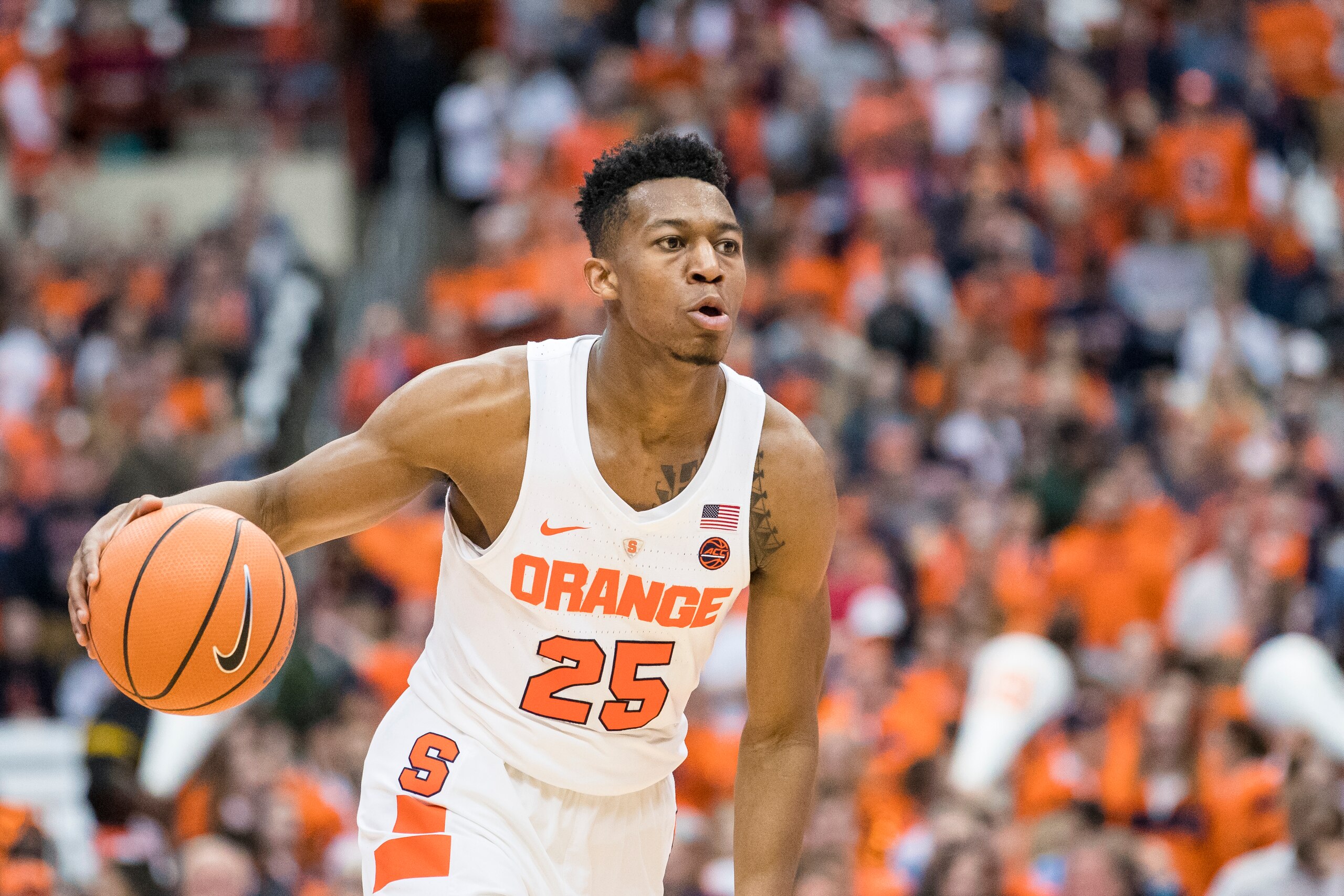
Tyus Battle, Syracuse
Battle has become a more assertive scorer, averaging 15.9 field-goal attempts per game as a sophomore compared to 8.6 as a freshman. But what choice did he have? Syracuse lost six of its seven leading scorers from last season, leaving Battle as the only established returning weapon. The jump from 11.3 points per game to 20.7 is nice, but really, the only thing that changed is his volume of shots.
Kyle Guy, Virginia
Similar to Battle, it's not a surprise that Guy's scoring average has increased by roughly 10 points per game, since Virginia lost most of last year's go-to scorers. Guy's minutes-per-game rate has gone up by about 60 percent, and he's taking shots 30 percent more often while on the floor. His shooting percentages aren't much different from last year. He's just taking significantly more shots, which was to be expected.
Eugene German, Northern Illinois
On a per-game basis, German's points, rebounds, assists and steals have each more than doubled from what he did as a frosh. He has scored at least 16 points in eight consecutive games. But on the list of sophomore-year spikes from players who most fans have never heard of, German's jump is only about the fifth-most impressive.
Jerrick Harding, Weber State
There's not much of anything to separate Harding's improvement from German's. Both guys averaged around 9.0 points and 17 minutes per game as freshmen and are now good for about 20 points in 29 minutes. They also both play for teams that are worse than last year and are currently hovering around .500.
Markus Howard, Marquette
Howard's rate of three-point attempts per game has more than doubled. He's now attempting nearly 10 shots from downtown on a nightly basis, but his percentage (54.7 percent as a freshman; 39.8 percent as a sophomore) has paid the price for that increase. But he's a much more efficient scorer inside the arc, and he has become a better rebounder to go along with his leap from 13.2 points to 22.8 points per game.
Blake Francis, Wagner
Francis has had a huge spike in scoring, jumping from 7.2 points to 18.9 per game. But Wagner has played one of the weakest schedules in the country, and points are the only area where he has shown notable improvement.
Quentin Goodin, Xavier
Goodin is the biggest reason I wasn't sold on Xavier before the season, as he had a brutally inefficient freshman year. But he has improved significantly as a passer, two-point shooter and free-throw shooter. He still has a long road to travel to become an All-Big East-caliber point guard, but he has broken out in the sense that he can run this Musketeers offense without being a liability.
Quinton Rose, Temple
Big year for sophomores named Quentin/Quinton. Temple's star has improved in just about every way imaginable, outside of an increase in turnovers. But he was already a key contributor as a freshman, and it's a little tough to make the case for someone as a breakout player when he averaged better than 10 points per game in his first season.
C.J. Jones, Arkansas
Jones isn't a starter—let alone a household name outside of Fayetteville—but he has been providing incredible value in his limited minutes. Jones is averaging 11.1 points in 18.9 minutes, which equates to a very strong rate of 23.5 points per 40. The career 50-percent shooter (46.8 percent from three) is probably going to have another breakout year in 2018-19 when all these senior Razorbacks graduate.
10. Justinian Jessup, Boise State
2 of 11
2016-17 Stats: 7.4 PPG, 2.8 RPG, 35.5% 3PT
2017-18 Stats: 15.2 PPG, 5.5 RPG, 51.8% 3PT
While many of these guys barely played as freshmen and are merely putting up big numbers due to a spike in playing time, Jessup started 31 games last year. He has simply become a much more efficient player.
In addition to the improvement from three-point range, he's up from 42.9 to 51.5 percent from inside the arc, as well as from 76.7 to 88.9 percent at the charity stripe. As a result, Jessup is averaging 1.54 points per field-goal attempt, compared to 1.16 as a freshman.
It's much more than just the jump in true-shooting percentage, though. Jessup has gotten much better as a rebounder, he's a marginally better defender, and his rate of both turnovers and fouls committed has decreased.
To sum it all up, he has gone from a guy who averaged 0.098 win shares per 40 minutes as a freshman to one currently sitting at 0.268 as a sophomore, per Sports Reference. He also has a box plus/minus of 12.3, which was good for 19th-best nationally at the start of the day on Wednesday.
Long story short, Jessup has become one heck of a second fiddle to Chandler Hutchison. That duo of versatile Broncos should be a lot of fun to watch in Mountain West play.
9. Anfernee McLemore, Auburn
3 of 11
2016-17 Stats: 5.4 PPG, 4.5 RPG, 1.2 BPG
2017-18 Stats: 8.9 PPG, 6.6 RPG, 3.4 BPG
I will forever be a sucker for guys who lead the nation in block percentage, and Anfernee McLemore currently has the highest block percentage in more than a decade.
The increase in points and rebounds is primarily a byproduct of additional playing time and a new three-point stroke (16 attempts compared to just one last year). Per 40 minutes, his scoring is up 2.8 points and his rebounds are up by 0.9, neither of which is remotely breakout material.
But the blocks. Oh, mercy, the blocks.
McLemore averaged a respectable 3.1 blocks per 40 minutes as a freshman, but he is swatting away 6.5 shots per 40 minutes as a sophomore.
Nerlens Noel was one of the greatest shot blockers in recent memory, but he only averaged 5.5 per 40 minutes. Fellow Kentucky alumnus Anthony Davis had a rate of 5.8. Even Reggie Lynch—who ranked first or second nationally in block percentage in three of the last four seasons—has never had a mark above 6.0 blocks per 40 minutes.
And McLemore's block rate has actually decreased since I began this research, as he had just one block in 21 minutes against Murray State on Tuesday. Before that, he was sitting at an even more mind-blowing 6.96 blocks per 40 minutes.
You want to know how Auburn is 10-1 despite playing without what were supposed to be two of its best players (Austin Wiley and Danjel Purifoy)? The lackluster schedule might be the biggest reason, but McLemore's emergence as a one-man wrecking crew in the defensive paint is a close second.

.jpg?w=2560 "Rams Raiders Football")
8. Jon Axel Gudmundsson, Davidson
4 of 11
2016-17 Stats: 8.2 PPG, 4.0 RPG, 3.5 APG, 1.1 SPG, 32.7% 3PT, 52.4% 2PT
2017-18 Stats: 16.4 PPG, 5.5 RPG, 5.5 APG, 1.6 SPG, 40.4% 3PT, 69.4% 2PT
Of our top-10 breakout players, Jon Axel Gudmundsson scored the most points per game as a freshman. He started all but three games for Davidson, receiving some incredible on-the-job training while sharing a backcourt with 2,000-point scorer Jack Gibbs.
But no one outside of Belk Arena knew who the Icelandic Assassin was.
Davidson went 17-15, didn't sniff the NCAA tournament and rarely played on national television. On the off chance that you were intentionally paying a little attention to the Wildcats, Gibbs (22.1 PPG) and Peyton Aldridge (20.5 PPG) were the players to know. Heck, I went to a Davidson game last February and I didn't even notice Gudmundsson.
This year, though, you can't miss him.
Aldridge is still leading the team in scoring at 21.5 points per game, but Gudmundsson is all over the box score on a nightly basis. He had 24 points, nine rebounds and eight assists in the season opener against Charleston Southern. He had at least 12 points, six rebounds and six assists in back-to-back games against Charlotte and North Carolina. It's only a matter of time before he notches his first career triple-double.
Should he maintain his current averages, he would become only the sixth player in the past 15 seasons to average at least 15.5 points, 5.5 assists, 5.5 rebounds and 1.5 steals per game. The others were Markelle Fultz, Evan Turner, Elfrid Payton, Nate Wolters and Alex Hamilton—otherwise known as three lottery picks and two of the best mid-major players in the past decade.
And there's no good reason to assume he won't continue playing this well. Three of Davidson's eight games have come against UNC, Virginia and Nevada, each of which has (at least) second-weekend potential in March. If he can do this against those guys, he might be even more unstoppable against the Atlantic 10.
7. T.J. Gibbs, Notre Dame
5 of 11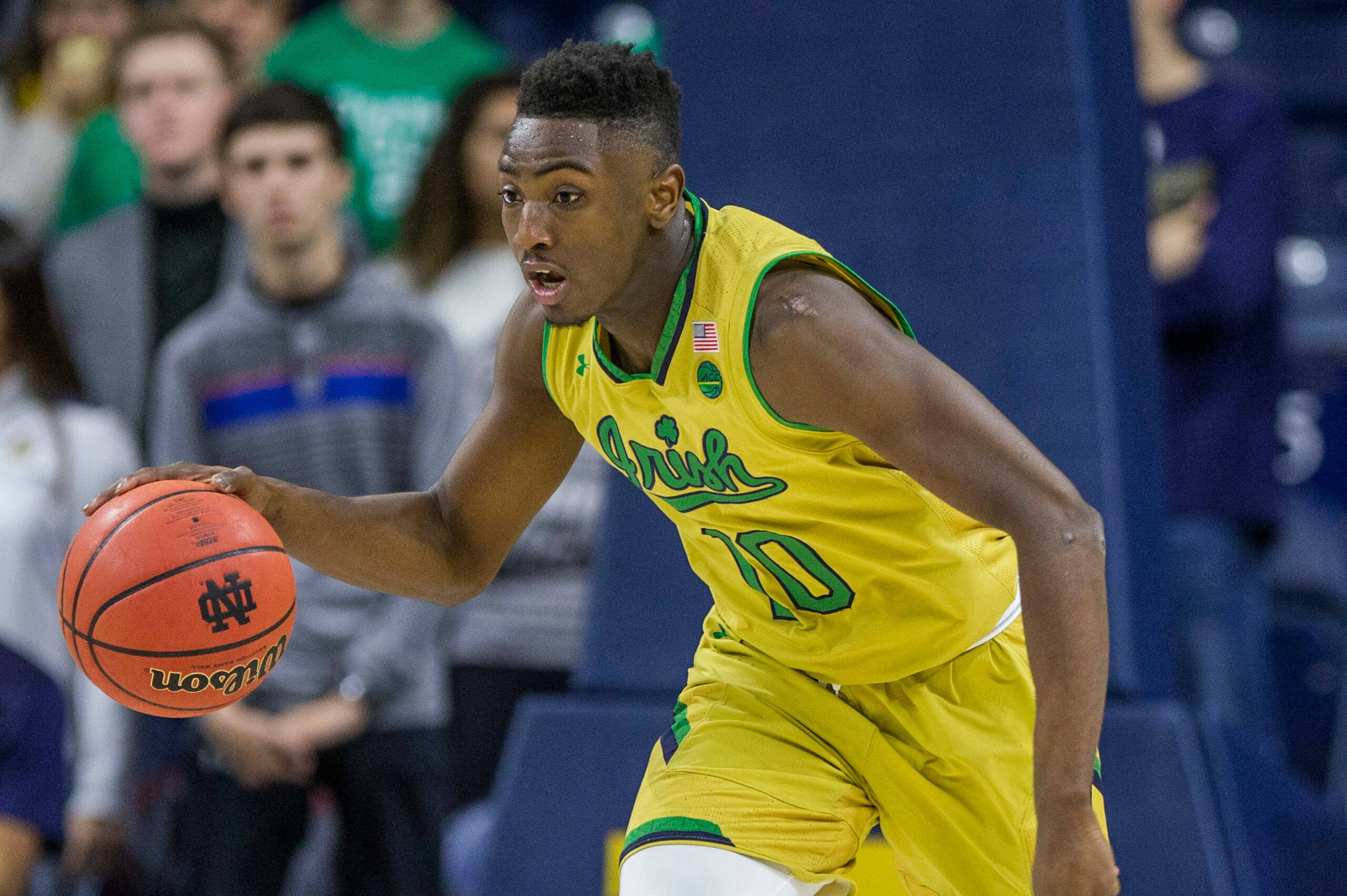
2016-17 Stats: 4.7 PPG, 1.7 APG, 1.5 RPG, 32.1% 3PT
2017-18 Stats: 14.1 PPG, 2.7 APG, 2.2 RPG, 51.8% 3PT
How does Mike Brey keep getting these guys who explode as sophomores or juniors?
Last year, it was Matt Farrell, becoming an all-ACC-caliber player as a junior after barely touching the floor in his first two seasons. The year before that, V.J. Beachem made a big offseason leap. Between the 2013-14 and 2014-15 seasons, both Zach Auguste and Demetrius Jackson went from role players to leaders. And I'll be darned if Bonzie Colson doesn't keep getting better every year.
But this year's breakout member of the Fighting Irish is sophomore Temple "T.J." Gibbs.
With Farrell and Steve Vasturia averaging a combined 69.0 minutes per game last season, there wasn't much room for Gibbs to make an impact as a freshman—even though he was a top-100 recruit, per 247Sports. The most he scored in a single game was 13 points, and he never logged more than 25 minutes.
When he played 38 minutes and scored 21 in the season-opener against DePaul, it was immediately apparent that Notre Dame would be fine without Vasturia and Beachem. It was the first of four 20-point games for Gibbs in the opening month of the season.
He has already made 12 more three-pointers than he did in the entire 2016-17 season, and he has done so in 112 fewer minutes. Like so many others on this list, Gibbs has become both more assertive and more efficient.
And there's still plenty more room for growth, as he is only averaging 10.3 field-goal attempts per 40 minutes. Maybe it doesn't come this season, but after Colson and Farrell graduate, look for Gibbs to become a superstar as a junior.
6. Justin Simon, St. John's
6 of 11
2015-16 Stats: 2.3 PPG, 1.2 RPG, 0.3 APG, 0.3 SPG, 0.3 BPG
2017-18 Stats: 10.6 PPG, 8.2 RPG, 4.3 APG, 2.4 SPG, 1.0 BPG
Back in 2015, Sean Miller signed a four-player recruiting class, each of which was rated as a top-50 player by 247Sports. Allonzo Trier immediately got a lot of playing time as a freshman, but Justin Simon got lost in the backcourt depth chart behind Gabe York, Kadeem Allen, Parker Jackson-Cartwright and Trier.
Simon got a bit of playing time during the seven-game stretch that Trier was out with a broken hand, but he appeared in just four of Arizona's final 11 games, playing 15 total minutes.
With Trier, Allen and PJC all returning for another year and both Rawle Alkins and Kobi Simmons committing to the Wildcats before the 2015-16 season ended, Simon read the writing on the wall and bolted for a school that actually wanted to use him.
Chris Mullin and St. John's have to be thrilled to be that school.
After sitting out in 2016-17, Simon has been a stat-sheet stuffing sensation as a sophomore. (Say that three times fast.) He has four double-doubles and has twice come close to a triple-double. Simon had 11 points, 11 rebounds and nine assists Wednesday afternoon against Saint Joseph's. And in a November game against Molloy, he had 11 rebounds, nine assists and seven points. In six of 12 games, he has finished with at least six points, three rebounds, one assist, one steal and one block.
St. John's has been playing without one of its stars (Marcus LoVett; knee injury) for the past five games, but because of Simon, it hasn't missed a beat. He has averaged 12.6 points, 7.4 rebounds and 5.0 assists in December, leading the Red Storm to four wins and a near-win over Arizona State. If and when they get back to full strength, this could be the best version of the Johnnies in nearly two decades.
5. Udoka Azubuike, Kansas
7 of 11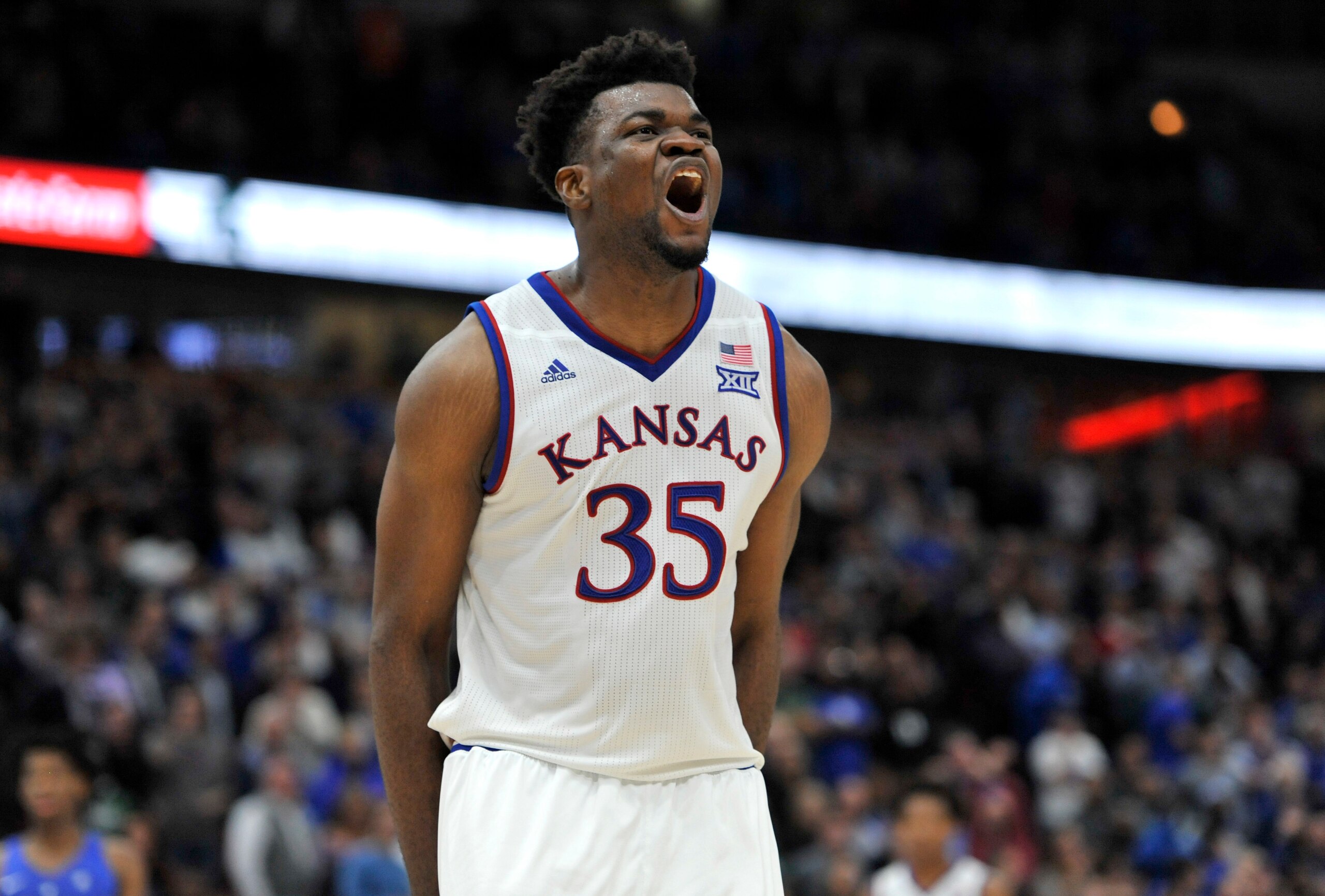
2016-17 Stats: 5.0 PPG, 4.4 RPG
2017-18 Stats: 14.7 PPG, 8.1 RPG
Can you even imagine where Kansas would be right now if Udoka Azubuike wasn't having a great sophomore season?
The big man has scored in double figures in all but one game this season and already has three double-doubles on the year. He was the hero for the Jayhawks in the recent road game against Nebraska, racking up 26 points and 10 rebounds. He was also huge in the Champions Classic win over Kentucky. He finished that game with 13 points and eight rebounds while keeping John Calipari's frontcourt players from accomplishing anything.
The increase in points and rebounds per game is readily apparent, but the two more impressive areas of improvement are Azubuike's fouls and turnovers.
Heading into this season, the massive question for Kansas was: Can Azubuike stay on the floor for 25-30 minutes per game without becoming a liability? In limited minutes as a freshman, he averaged 8.7 fouls and 4.2 turnovers per 40 minutes. He also attempted 8.2 free throws per 40 minutes at a horrendous success rate of 37.9 percent.
He's still an awful free-throw shooter (43.5 percent), but his free-throw rate is way down, which has kept it from being a problem. And he has made remarkable strides to avoid committing both fouls and turnovers. Per 40, he's only committing 3.8 fouls and 2.0 turnovers.
Moreover, he is now one of the most efficient scorers in the nation, making 77.6 percent of his field-goal attempts with a second-best-in-the-nation 77.5 effective field-goal percentage.
4. Charles Matthews, Michigan
8 of 11
2015-16 Stats: 1.7 PPG, 1.6 RPG, 0.4 APG, 25.0% 3PT
2017-18 Stats: 14.8 PPG, 5.2 RPG, 3.2 APG, 36.8% 3PT
Similar to Justin Simon's brief experience with Arizona, Charles Matthews was a highly touted recruit who barely saw the floor as a freshman on a loaded roster. In his case, Matthews was buried on the depth chart behind Tyler Ulis, Jamal Murray and Isaiah Briscoe at Kentucky. Matthews actually started three games in nonconference play, but he was a complete non-factor after that, held scoreless in 15 of his final 23 games.
He then transferred to Michigan, sat out a season and became a significantly better player.
For starters, Matthews is way more assertive. He averaged a pithy 5.6 field-goal attempts per 40 minutes with the Wildcats, but he's averaging 14.9 with the Wolverines. And he's making them at a much higher rate. In addition to the above increase in three-point percentage, Matthews has also gone from 45.8 to 59.6 percent on two-point attempts.
Despite nearly tripling his rate of shot attempts per 40 minutes, Matthews has also more than tripled his assist rate from 1.4 per 40 to 4.3—and with only a slight increase in turnovers.
In a nutshell, Matthews barely touched the ball with Kentucky and didn't do much with it when he did. Now, he's practically running the show for Michigan. John Beilein has lost a lot of quality players due to transfer or early declaration for the NBA draft, but he gained one heck of a stud in Matthews.
3. Daniel Utomi, Akron
9 of 11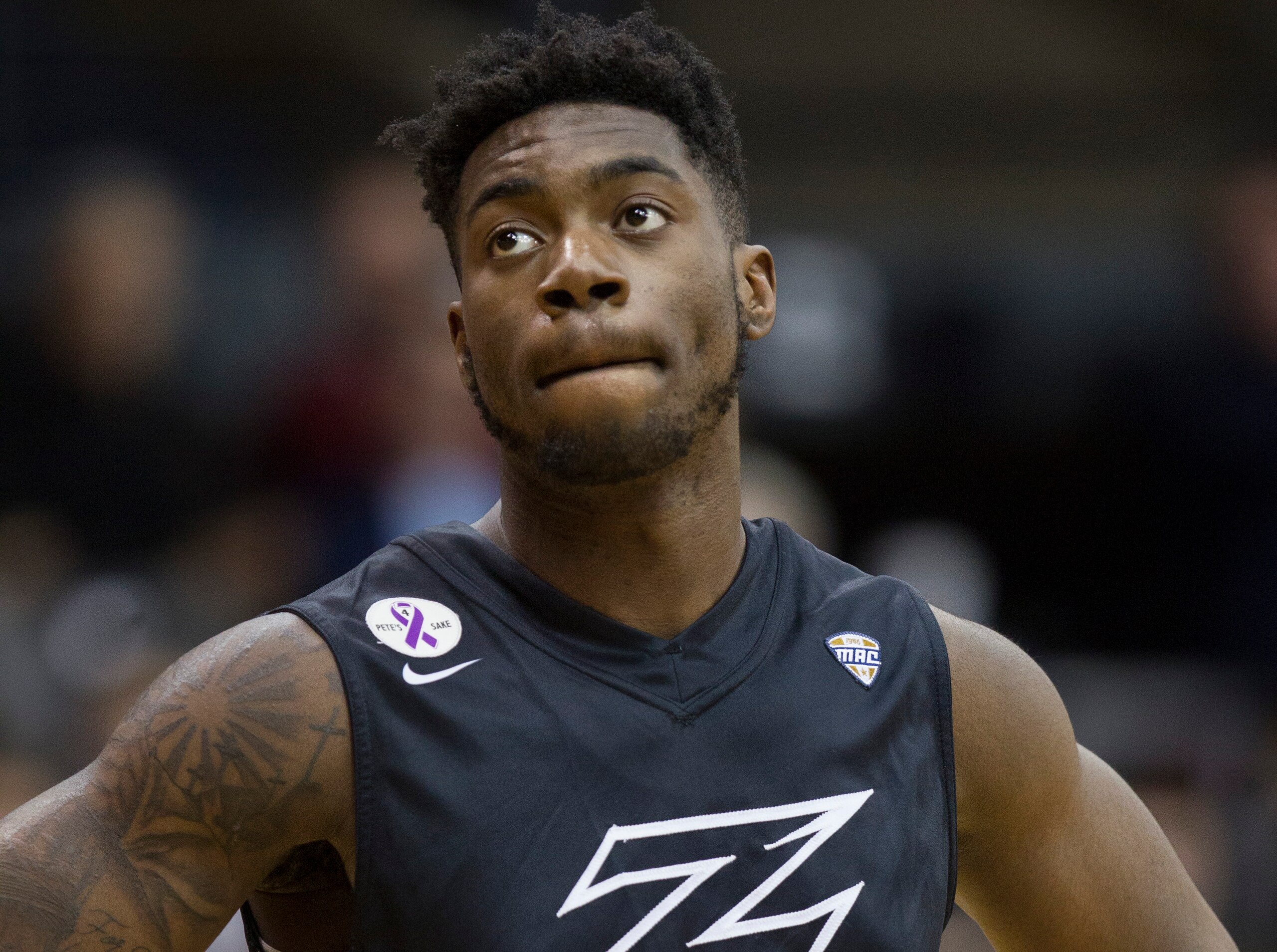
2016-17 Stats: 4.8 PPG, 1.2 RPG, 0.3 APG, 0.3 SPG, 41.9% 3PT
2017-18 Stats: 20.3 PPG, 7.1 RPG, 1.5 APG, 1.4 SPG, 50.0% 3PT
As a redshirt freshman, Daniel Utomi's career high in scoring was 19 points. The most minutes he played in a game was 20. He scored one point in the entire month of December 2016.
As a sophomore, he is averaging better than 20 points per game. He has played at least 32 minutes in every game but one. And he has made at least three three-pointers in every game in December.
That is quite the adjustment, and a necessary one after Akron lost virtually everyone from last season.
Isaiah Johnson and Kwan Cheatham graduated. Antino Jackson, Aaron Jackson, Noah Robotham, Josh Williams and Tavian Dunn-Martin all transferred. All told, the Zips lost seven of last year's nine leading scorers, so they were just about going to need to play Utomi for close to 35 minutes per game, regardless of how well he played.
Fortunately for John Groce, he has become a star.
Utomi's playing time has increased by roughly 350 percent, but he has also become a considerably more efficient player. His shooting percentages from inside the arc, beyond the arc and the free-throw line are all up. On a per-40-minutes basis, his points, rebounds, assists, steals and fouls have each improved by at least 20 percent.
However, there's a big "But": Akron is rated 194th on KenPom and has yet to face a top-125 team. But watch out for this guy over the weekend. The Zips are playing in the Diamond Head Classic, and they open with a game against USC. If he has another 20-plus points in that one, feel free to retroactively consider him the No. 1 player on this list.
2. Max Heidegger, UC Santa Barbara
10 of 11
2016-17 Stats: 7.6 PPG, 1.4 APG, 20.5% 3PT, 26.8% FG
2017-18 Stats: 22.5 PPG, 3.1 APG, 44.7% 3PT, 47.3% FG
To put it lightly, Max Heidegger was not good as a freshman.
He became one of just five players in the past two seasons to attempt at least 200 shots with a true-shooting percentage of 40.0 or worse. He finished the season with negative-0.3 win shares and had a box plus/minus of negative-9.2, which means the Gauchos would have been much better off with just about anyone else in his spot.
But this year, Heidegger is leading the Big West in win shares and has quadrupled his player efficiency rating from 6.1 to 24.4.
It's not that uncommon to see a player significantly improve his efficiency between his freshman and sophomore season. It's even more common to see a guy get a spike in volume. But this type of combined improvement is incredible. In 134 fewer minutes than last season, Heidegger has already scored 73 more points.
In one summer, he went from a guy who couldn't hit the broad side of a barn to one who rarely misses. And along the way, he helped turn UC Santa Barbara back into a relatively respectable minor-conference team. In 2016-17, the Gauchos went 6-22 and finished in 331st on KenPom. They already have nine wins this season, and they're back up to No. 139 in those tempo-free rankings.
1. Cassius Winston, Michigan State
11 of 11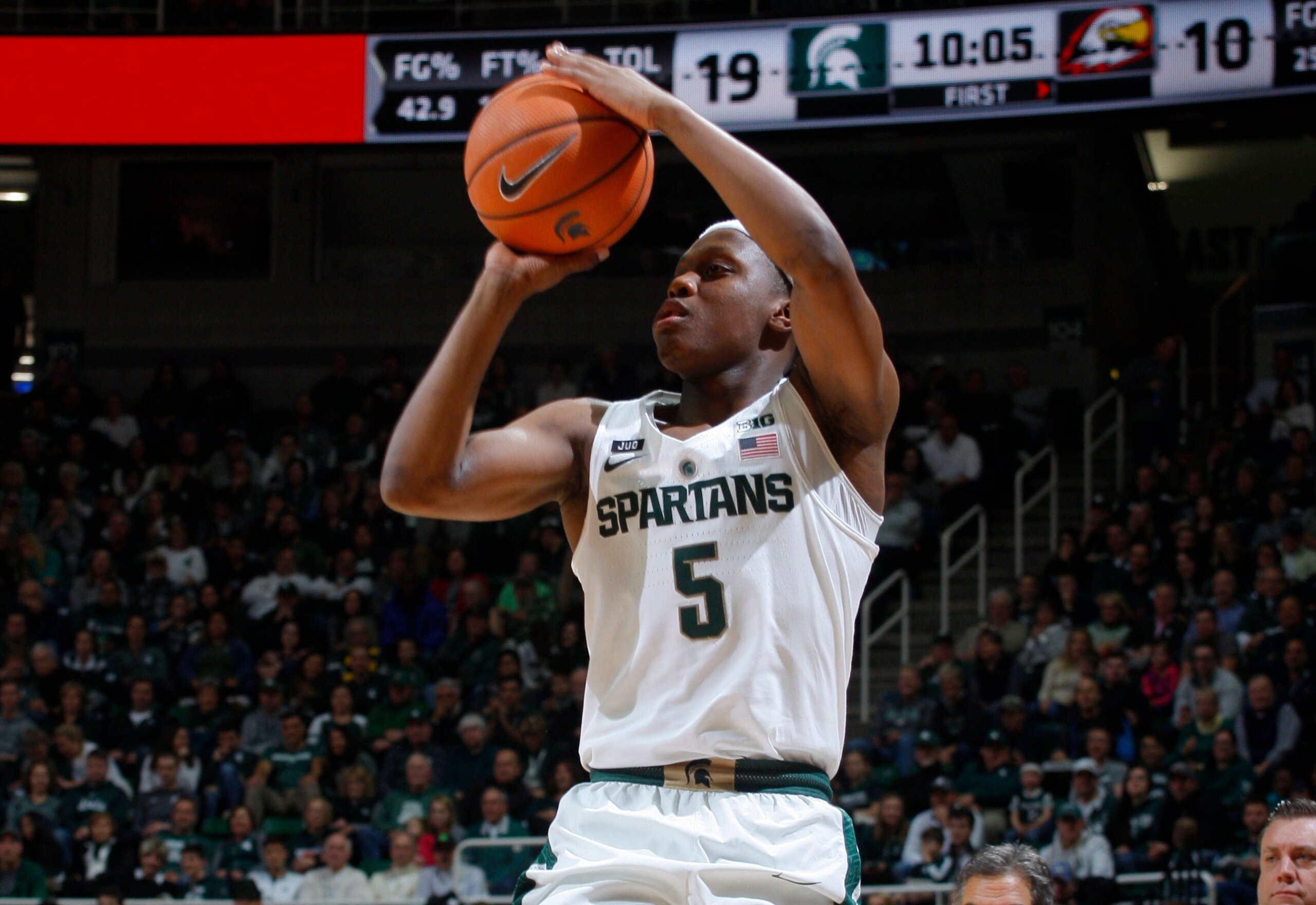
2016-17 Stats: 6.7 PPG, 5.2 APG, 1.8 RPG, 38.0% 3PT
2017-18 Stats: 13.0 PPG, 6.8 APG, 3.7 RPG, 57.7% 3PT
Though Cassius Winston's sophomore-year leap isn't the largest in terms of percent increase, it is metaphorically the biggest. For it is because of Winston's sudden emergence as a deadly assassin from three-point range that Michigan State is arguably the favorite to win the 2018 national championship.
No, that isn't the only reason people are buying stock in the Spartans. Jaren Jackson Jr. has been otherworldly as a freshman, and the combined force of Miles Bridges and Nick Ward remains unstoppable. Toss in Joshua Langford and everyone in this starting five is averaging better than 10 points per game, even though no one is playing more than 28.3 minutes per night.
But Winston—who only started five games as a freshman backup to Lourawls Nairn Jr.—has become the most indispensable player on this roster.
He is Michigan State's best shooter by a wide margin, and he is a phenomenally willing passer, averaging better than 10 assists per 40 minutes. Winston occasionally tries to do too much and has committed multiple turnovers in 10 of 12 games, but even that bugaboo can't weigh him down. He's still the most efficient offensive player for the Spartans.
Bridges, Jackson and maybe even Ward are better NBA prospects than Winston. But we're not worried about June. Rather, in March, it's all about your guard play, and from that perspective, Michigan State is even better equipped for a deep run than expected.
Kerry Miller covers men's basketball and college football for Bleacher Report. You can follow him on Twitter @kerrancejames. Advanced stats courtesy of Sports Reference and KenPom.com.



.jpg?w=2560 "Rodgers Iced Out on Plane 💎")
.jpg?w=2560 "🚨 Week 8 AP Top 25 Poll")
