


2017 has been a contentious year for WWE, defined by the rise of new NXT stars, while part-time talent still dominated the top of the card from Brock Lesnar's Universal Championship reign to Shane McMahon's and Kurt Angle's surprisingly frequent appearances on pay-per-views.
With so many old and new faces dominating the scenes, it would be difficult to boil down the whole year into a few important bullet points to discuss which stars made the most impact. Instead of focusing on the moments, though, it is possible to look at simply the comparative data to see who truly defined 2017.
From TV to house shows to PPVs, WWE wrestlers competed all over the world, and their total body of work can be defined by the number of wins and losses they garnered in that time. Who won more than anyone else? Who lost at the highest rate? Which performers were utilized more than any other this year and how did their success compare to 2016?
TOP NEWS
BS Meter on Biggest Wrestling Rumors 🌡️
New Truths About WWE and AEW 😲
Way-Too-Early WrestleMania 43 Predictions 🔮
The data compiled consists of the win rates and appearances at live television shows, house show tours and PPVs for 10 top male wrestlers as well as two representatives for the women's and tag team divisions. All numbers were collected from totaling appearances logged on the Internet Wrestling Database with recent house show results added from Sportskeeda.
| Brock Lesnar | 12-1 (92.3%) |
| John Cena | 48-14-1 (77.4%) |
| Randy Orton | 77-28 (73.3%) |
| Roman Reigns | 78-18-3 (81.3%) |
| Dean Ambrose | 110-16-4 (87.3%) |
| Seth Rollins | 83-16-1 (83.8%) |
| AJ Styles | 73-62-2 (54.1%) |
| Braun Strowman | 34-40-5 (46.0%) |
| The Miz | 20-81-3 (19.8%) |
| Kevin Owens | 38-77-2 (33.0%) |
| The New Day | 35-57 (38.0%) |
| The Usos | 60-41-2 (59.4%) |
| Charlotte Flair | 48-61-3 (44.0%) |
| Alexa Bliss | 40-66-1 (37.7%) |
The Most Impressive and Least Impressive 2017s
Unsurprisingly, the wrestler with the most exemplary record in 2017 was Brock Lesnar, who put his loss to Goldberg behind him quickly to likely end the year at 92.3 percent, with just his Royal Rumble elimination keeping him from a perfect year.
What may be more surprising is the second man on the list: Dean Ambrose. The Lunatic Fringe was the only wrestler to win over 100 matches this year with a final record of 110-16-4 and an 87.3 percent win rate. His record is nearly as impressive as Roman Reigns' 117-14-6 run in 2016 with much less fanfare.
On the opposite end, The Miz has the worst record of the wrestlers listed at 19.5 percent. Kevin Owens did not fare much better at 33 percent, showcasing how heels even with championship gold are always more likely to lose than faces.
Interestingly, PPV win rates are fairly even across the board this year. KO had a 60 percent win rate on PPV next to Ambrose's 55.6 percent while Reigns was down to 40 percent for the year. While these matches are a small part of the overall win rate, they are generally considered the most impactful, so it is interesting to see that no one (beyond Lesnar) was heavily favored in PPV appearances this year.

As the comparative bar graph shows, the difference is not massive, but it is noticeable how most of the PPV win rates edge toward 50 percent. The main outliers on this trend are AJ Styles (20 percent) and Braun Strowman (33.3 percent), who had worse records on PPV than at any other events in WWE.
The top two tag teams in WWE, The New Day (44 percent) and The Usos (59 percent), had fairly average years overall, with The Usos winning out thanks to their longer time as champions. Meanwhile, the representatives for the women's division had near identical win rates with Charlotte pulling ahead late after her championship victory to lead at 44 percent to Bliss' 37.
Despite being the most decorated in their respective divisions, no one comes close to win rates of the top stars in the men's division, showcasing how much more likely the other divisions are to be booked evenly without one performer dominating the rest.
Appearance Rates in 2017
The most often-used performers in WWE were Styles at 135 appearances and Ambrose at 126. Together they have been in more matches than Lesnar, Reigns, Strowman and John Cena combined. Owens at 115 is the only other performer on the list even close to their appearance rate.
On the other hand, Lesnar appeared 13 times, up just two from last year, while Cena competed 62 times, up 14 from last year when he was injured or on hiatus for most of that time. Mainly due to his shoulder injury, Strowman is the only other performer listed to wrestle fewer than 90 matches this year.
Much like their win rates, Charlotte and Bliss had close to identical appearance rates this year. The same can be said of The Usos and New Day, which is surprising given the month-and-a-half that New Day took off in order for Kofi Kingston to recover from an ankle injury. This is likely tied to how popular The New Day is, leading to more frequent use when around.

The above bar graph compares where the wrestlers ranked from No. 1 to 14 in both win rate and appearance rate, and the difference is staggering. Obviously, Lesnar's first-place win rate compared to his 14th-place appearance rate is always going to be notable.
However, it is more telling how many wrestlers have abysmal win rates yet have appeared on nearly every show this year. KO, Miz and Styles all can claim to be among the most active performers in WWE yet have win rates that do not reflect any sort of respect for that work ethic. Only The New Day has the same rank in both appearances and win rate.
Compared to 2016
Comparing this year to the last opens up an interesting discussion on how the brand has evolved, with both the appearance rates and win rates telling a different story for the top stars in the business.
2016 was an unusual year for multiple stars, which led to a more haphazard collection of data points. Cena was down to his lowest win rate in over a decade with a mere 56.3. Lesnar also had an uncharacteristic 72.7 percent win rate. That was still far above average though as only Reigns and The New Day also had win rates above 70.
In comparison, 2017 seemed to be a year that reestablished the dominance the top talent. Lesnar, Cena, Orton and every member of The Shield walked out with a 70-plus win rate. The next closest stars were The Usos at 59.4 percent.
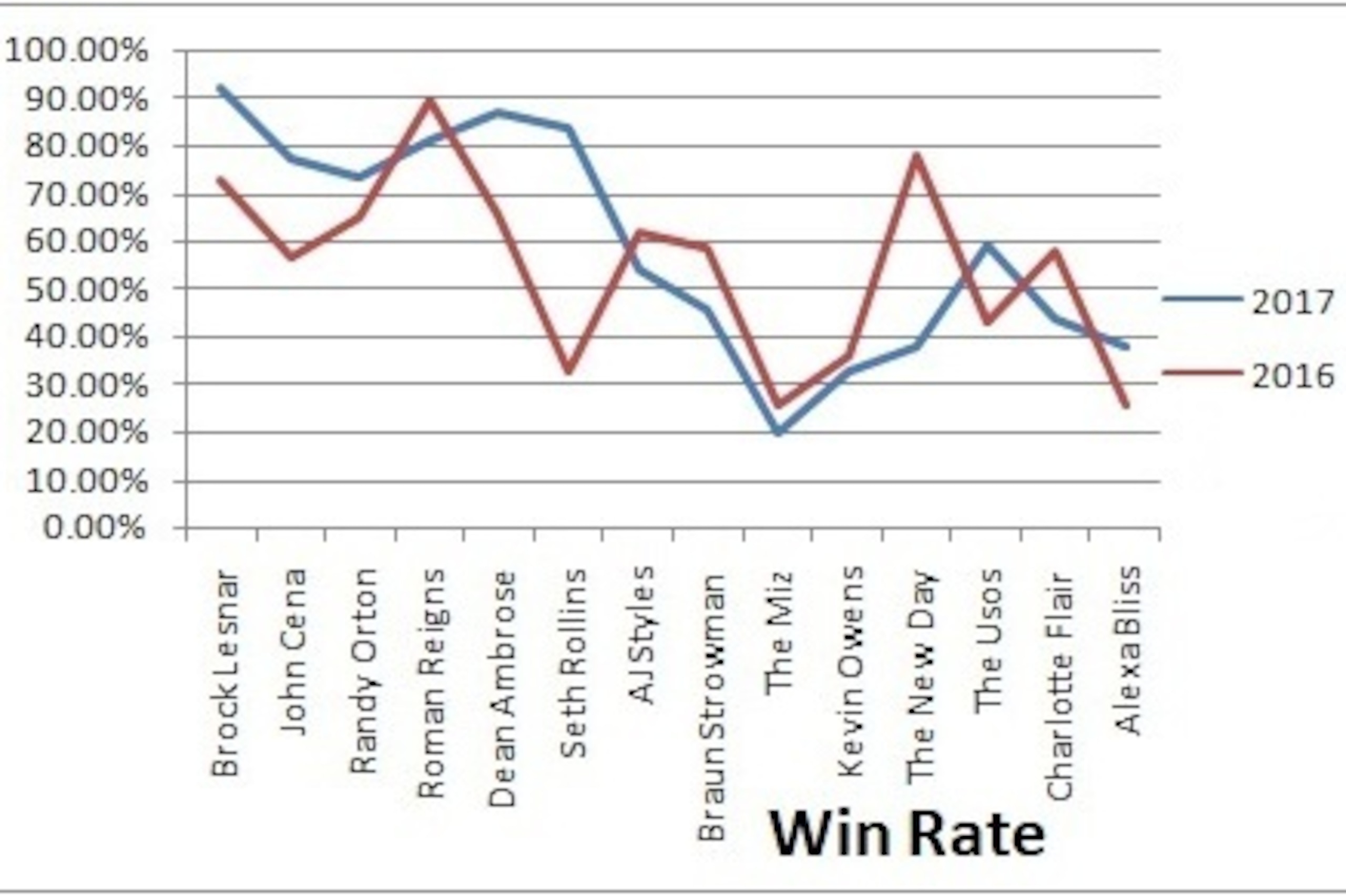
The graph above shows the difference. This return to a noticeable hierarchy was fairly clear throughout 2017. Lesnar has been dominant, while Cena and Orton have been more readily booked as stars again rather than putting rising stars over. The Shield's return to form has been a slow build, but the booking has clearly been focused on keeping all three strong until they realigned.
Appearance rates are consistently down from 2016. Even though the data for 2017 does not include the final month of the year, this would only leave on average about seven additional appearances to close the year.
Despite this, the difference in the number of appearances from 2016 to 2017 excluding Lesnar, Cena and Orton on average is 36. This number goes down to 29 if the data is extrapolated to the end of the year. To put that number into perspective, that is equivalent to over three months of matches for Reigns or half of Cena's year.
The most notable reason for this change is the brand split that came midway through 2016. While it was still heavily affected by the split of brands, it was not until 2017 that WWE was able to bring in more talent to balance out the product and make sure there was enough talent to perform on each show.

As shown in the graph above that compares the two with extrapolated data, one of the wrestlers whose appearances went down significantly was Ambrose, who was heavily used in 2016. He jumped between touring brands to accumulate a ridiculous 181 matches, and that number is down from 2015 as well.
The spikes in appearances that dominated 2016 are less pronounced in 2017 because no one needs to be overly relied upon. While injuries have affected the number of certain talents, all top talent will likely fall in the 100-120 range going forward. This is a healthier number than in the past and should avoid overworking stars.
Conclusion
2017 was a unique time for WWE. As the data shows, the talent most well known by name alone returned to their perch with dominant win rates even when they appeared infrequently throughout the year. WWE seemed far more set on embracing the talent seen as moneymakers first.
The question is: Does it matter? The faces won quite a bit while the heels struggled, but it is likely neither Miz or KO will lose standing because of their low win rates. Other divisions are growing and thriving without overly relying on any single talent to dominate the division with wins.
It may just be safest to assume that the stars are not wholly affected by their win rates, especially if they get important victories when it counts and put on great shows in the ring regardless. Styles may have become as big a star in WWE as any of the top names, but he has only recently started a dominant win streak, averaging out to just 54.1 percent.
It may be telling to return to this data next year as new stars rising in rank, including Samoa Joe, Finn Balor, Shinsuke Nakamura and Bobby Roode, take firmer roles on their brands. If they end up taking the places of wrestlers with low win rates or appearance rates, it may signal more strongly what are the most defining traits of a star.
It is difficult to predict WWE's future because it is always changing. Each year, there are shifts in usage as competitors rise and fall and are given more or less to work with. There are certain guarantees that will take much longer to change.
Lesnar will always rank near the top in total win rate in WWE while barely appearing. Cena will continue to perform at a lower rate but be treated with more reverence with each return. Ambrose and Styles will likely remain near the top of the appearance charts as long as they are healthy, which makes them perhaps the most important members of whatever brand they wrestle for.
Despite these guarantees, the variables are far more numerous and volatile. Wrestling matches are certainly a crucial element in defining what makes a WWE Superstar special, but they are the only defining element.
These matches and the rates associated with them may not be the clear defining traits of success, but they do have an important role in highlighting a performer's value to the company. Hopefully this data has given a clearer sense of how wrestlers were used in WWE in 2017.
.jpg?w=2560)

.jpg?w=2560 "Raiders Could Start Mendoza")


.jpg?w=2560 "Rodgers Iced Out on Plane 💎")
.jpg?w=2560 "Packers Safety Slams Refs 🤬")

.jpg?w=2560 "🚨 Week 8 AP Top 25 Poll")
