

How Did Oregon Pull off the Coup of the CFB Recruiting Season?
For years, they were the prime example of everything fresh and futuristic, the splashy new and next in a sport that long had lived off its history and traditional pageantry.
Then in a matter of games—not seasons—the Oregon Ducks got stale. Not even Nike's deep pockets could prevent the fall. Oregon coach Willie Taggart admits that the team is now in a "rebuild"—his word—and as crazy as it sounds, he couldn't be more right.
The question is: How quickly can the Ducks get off the mat?
TOP NEWS

Week 5 AP Top 25 Poll 🔢

Updated CFP Bracket Projections 🔮
Top Overreactions after Week 5 of CFB Season 😧
One weekend of recruiting is a helluva start.
One weekend when eight recruits for the 2018 class—including six 4-star players—bought what Taggart is selling: reinventing Oregon.
"I didn't know what to think because, you know, they were losing," says 4-star safety Steve Stephens of Fresno, California, one of the eight to commit late last month during the Ducks' spring game weekend. "Then I got there, and [Taggart] showed me what it will be when we're all on board. He showed me how we're going to be unique. We're going to change Oregon."
The very thought of that three years ago was laughable, when Oregon played in the College Football Playoff national championship game and star quarterback Marcus Mariota won the Heisman Trophy.
Now the Ducks are caught in a cruel twist of irony, a quickly deteriorating transformation from the top of college football to the bottom of the Pac-12. The only thing faster was their once-feared Blur Ball offense.
"It doesn't take long these days for any program, even the Alabamas," one Pac-12 coach says. "In the end, it's about players. You can have all the fancy uniforms you want. [Oregon] fell so fast because they weren't getting players that make a difference on Saturday."
That is how you go from playing for it all one year, to sustaining your worst home loss (by 49 points) in decades, blowing a 31-point lead in a bowl game, and winning just two measly Pac-12 games in a season over the next two years.
You don't end one season with an implosion in a bowl game, and follow it with the worst season since 1991 without some collateral damage.
Those 13 games were enough for Oregon to fire good-guy coach Mark Helfrich after just four seasons, hire Taggart and do everything it could to tourniquet the bleed-out.
Taggart stepped in and did what he has always done at every stop in his career: zero in on recruiting. He did it as Jim Harbaugh's assistant at Stanford, and he did it to turn around programs as head coach at his alma mater (Western Kentucky) and his hometown university (South Florida).
There's no better barometer of how a college programs recruits and develops players than the annual NFL draft. Last month, USF had three players selected in the draft, and WKU had two, including guard Forrest Lamp, a Taggart recruit who went 38th overall.
Oregon didn't have a single player selected.
That's why Taggart built his staff at Oregon around some of the game's top recruiters, including co-offensive coordinators Mario Cristobal (Alabama) and Marcus Arroyo (Oklahoma State), defensive coordinator Jim Leavitt (Colorado) and defensive backs coach Keith Heyward (Louisville and USC).
Players win games. Those 783,360 different uniform combinations—really, that's seven hundred eighty-three thousand three hundred and sixty—don't mean a thing when it's 3rd-and-short late in the fourth quarter and you're desperate for a first down.
You identify recruits early in their high school careers, never stop recruiting them and hopefully it pays off when their senior seasons arrive. Helfrich and Kelly relied too much on closing late and flipping recruits.
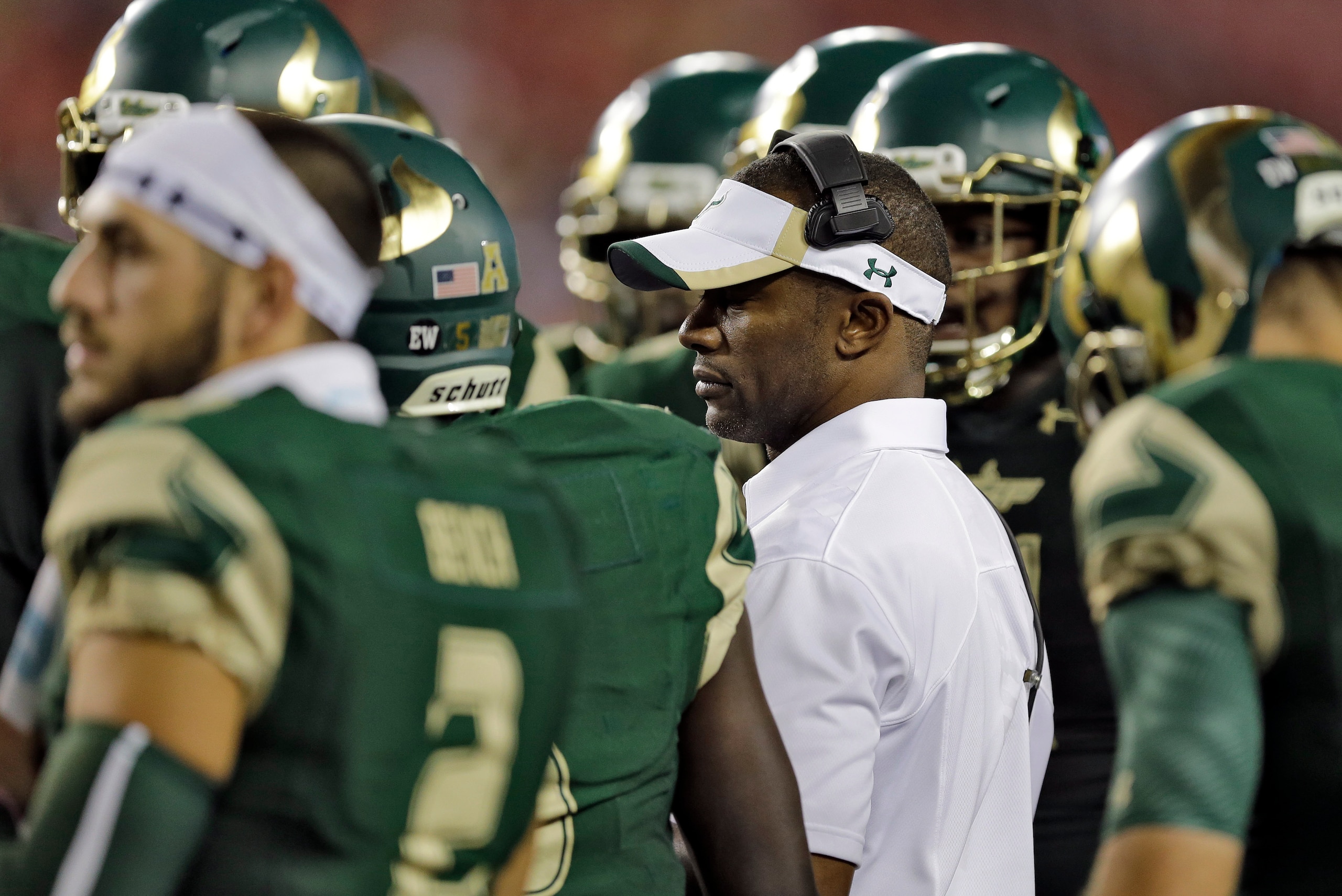
Taggart walked into Eugene and told his staff no state is off limits, and after last month's big haul, Oregon's geographic footprint has clearly expanded.
Jamal Elliott, a 4-star tailback from Durham, North Carolina., wasn't recruited by Oregon until Taggart took over. He says he first spoke to an Oregon coach (Cristobal) a month ago, later agreed to go to Eugene for an official visit during the spring game and committed before he left.
Isaiah Bolden, a 4-star cornerback from Wesley Chapel, Florida, was recruited heavily by Florida, FSU and Miami and wasn't even considering Oregon, but he always had a connection with Taggart (Wesley Chapel is 15 miles north of the USF campus) despite the reality that USF isn't a Power Five school. Once Taggart took the Oregon job, going to college 3,000 miles from home didn't seem like such a bad idea—and he committed during the spring practice weekend.
Adrian Jackson, a 4-star linebacker and the No. 1 player in Colorado, was considered a lock for the Buffs. But once Leavitt, CU's defensive coordinator and the man who not so long ago built the USF program from scratch, moved to Oregon, Jackson quickly followed.
Jevon Holland, a 4-star athlete from Oakland, California, had long been considered a guarantee for Washington, where his high school coach, Napoleon Kaufman, once starred. Then Taggart got into the mix, and the same thing happened during the spring game weekend—a weekend that could be a turning point for a program in transition.
"There was always something about [Taggart]; I've always felt so comfortable around him," Bolden said. "[Oregon] might be down now, but any player who is confident in his abilities knows he can help any program. We all feel like this 2018 class will be the class that puts Oregon back on the map."
| Steve Stephens | S | California | 4-star | April 30 |
| Adrian Jackson | OLB | Colorado | 4-star | April 29 |
| Isaiah Bolden | CB | Florida | 4-star | April 29 |
| Dawson Jaramillo | OT | Oregon | 4-star | April 29 |
| Jevon Holland | ATH | California | 4-star | May 1 |
| Jamal Elliott | RB | North Caroloiina | 4-star | April 30 |
| Spencer Webb | TE | California | 3-star | April 29 |
| Travis Dye | RB | California | 3-star | April 8 |
When Taggart arrived at Oregon, he told his staff members they couldn't lean on what made Oregon so special over the years: the magnificent facilities, the unique relationship with Nike king Phil Knight, the wild uniforms.
While they were important in the big picture, nothing, he stressed, was more important than building relationships.
That's why Bolden will spend the next three or four years three time zones from his family. Why Stephens resisted the pull from mega programs USC, LSU and Oklahoma. Why Elliott will leave everything he knows on the East Coast for the unknown in Oregon—for a relationship one month in the making.
"He's like a father, just someone you can trust," Elliott said of Taggart. "He's the reason why I pulled the trigger. I felt like we knew each other a long time. We're about to get it rolling here."
One weekend of recruiting is just the beginning.
_0.png?w=2560)


.jpg?w=2560 "Grading WWE Raw 🔠")

.jpg?w=2560 "Viral Rams Coach Vid 🖕")


.jpg?w=2560 "Injury-stricken Seahawks signing veteran RB")
