NFL Draft 400: Ranking the Draft's Top Running Backs
The 2017 NFL draft class features elite talent at the top of the board in Texas A&M's Myles Garrett and LSU's Leonard Fournette. After that? This is one of the deepest classes in the six years I've been scouting for Bleacher Report.
Stacking the board from top to bottom for the '17 class was no easy task. There is a record-breaking amount of first-round talent on my board. Outside of Round 1, it was easy to imagine 60 of the top players landing in the top 40. If you can't find starters in Round 4 of this class, you're doing it wrong.
So, who is the best overall? How about the best at each position? The goal of the NFL Draft 400 series is to figure that out.
The top 400 players were tracked, scouted, graded and ranked by me and my scouting assistants, Eliot Crist, Marshal Miller, Dan Bazal and Connor Rogers. Together, we viewed tape of a minimum of three games per player (the same standard NFL teams use). Oftentimes, we saw every play by a prospect over the last two years. That led to the grades, rankings and scouting reports you see here.
Players were graded on strengths and weaknesses, with a pro-player comparison added to match the prospect's style or fit. The top 400 players will be broken down position by position for easy viewing before the release of a top-400 big board prior to the draft.
In the case of a tie, a player was ranked based on his overall grade in our top 400.
Here are the top running backs for the 2017 draft.
All advanced stats courtesy of Pro Football Focus. All athleticism metrics courtesy of Mockdraftable.
Matt Miller's NFL Draft Grading Scale
1 of 41
At the end of each scouting report, you'll see a final grade that falls somewhere between 4.00 and 9.00. This scale comes from the teaching I received from Charley Casserly, Michael Lombardi and other former and current front-office personnel in the NFL. I tweaked it this year to be more transparent, and as a result, each player received a number grade as well as a ranking.
This applies to all positions across the board.
| Grade | Label |
| 9.00 | Elite—No. 1 pick |
| 8.00-8.99 | All-Pro—Rare Talent |
| 7.50-7.99 | Round 1—Pro Bowl Potential |
| 7.00-7.49 | Round 1—Top-15 Player Potential |
| 6.50-6.99 | Round 2—Rookie Impact/Future Starter |
| 6.00-6.49 | Round 3—Rookie Impact/Future Starter |
| 5.80-5.99 | Round 3-4—Future Starter |
| 5.70-5.79 | Round 4—Backup Caliber |
| 5.60-5.69 | Round 5—Backup Caliber |
| 5.30-5.59 | Round 6—Backup Caliber |
| 5.10-5.29 | Round 7—Backup Caliber |
| 5.00 | Priority Free Agent |
| 4.50-4.99 | Camp Player |
40. Anthony Wales, Western Kentucky
2 of 41
| Height | Weight | 40 Time | Arm Length | Hand Size | 3-Cone |
| 5'8 7/8" | 197 lbs | 4.51s | N/A | N/A | 6.83 |
POSITIVES
An ideal developmental project as a third-down back, Anthony Wales has the vision, instincts, hands and return skills to work his way onto an NFL roster. Wales is able to find creases to take swing passes for big yards and can create chunk plays on his own. He’s shown the skills to be great in a screen package. Wales doesn’t have great long speed but is quick in a short area and has enough burst to beat defenders to the corner or get separation on a linebacker in coverage.
NEGATIVES
Wales projects only as a third-down or special teams contributor at the next level due to a lack of size, power and breakaway speed. He’s a quicker-than-fast scatback type who will have to earn his keep as a special teams performer early on. He’s a little impatient as a runner. Wales doesn’t have the power to be effective in short-yardage situations and could have a hard time holding up against the size of an NFL pass-rusher.
PRO COMPARISON: Fozzy Whittaker, Carolina Panthers
FINAL GRADE: 4.99/9.00 (Undrafted Free Agent)
39. Marcus Cox, Appalachian State
3 of 41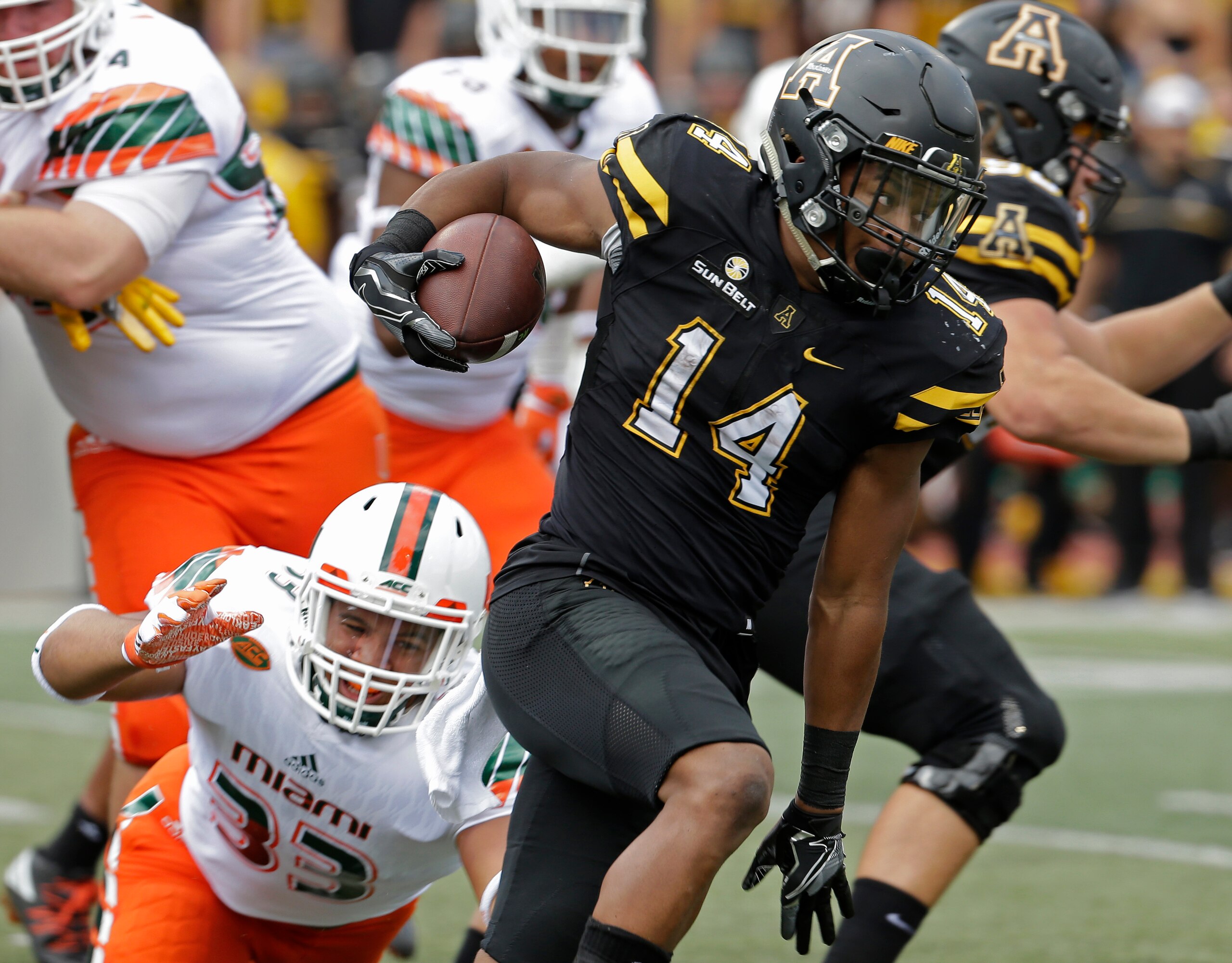
| Height | Weight | 40 Time | Arm Length | Hand Size | 3-Cone |
| 5'10 1/2" | 211 lbs | 4.65 | N/A | N/A | 7.50 |
POSITIVES
Marcus Cox rushed for over 1,000 yards in each of his four seasons at Appalachian State, giving him the type of production few in this draft class can compete with. Cox is able to win with his vision and timing on cuts. He quickly gets to the second level and plays with the urgency you want in a running back. He keeps his feet churning and doesn’t let defenders trip him up or make simple arm tackles.
NEGATIVES
Cox lacks the burst or quickness to shake a defender. He’s not a power back and won’t run through contact to pick up extra yardage. Cox doesn’t seem to show the natural instincts of a runner and is a one-speed, one-gear kind of player. Cox missed four games in 2016 with a leg injury and comes into the NFL with a heavy workload over the past four seasons (901 carries).
PRO COMPARISON: Benny Cunningham, Chicago Bears
FINAL GRADE: 4.99/9.00 (Undrafted Free Agent)
.jpg?w=2560 "Rams Eagles Football")
.jpg?w=2560)
38. Taquan Mizzell, Virginia
4 of 41
| Height | Weight | 40 Time | Arm Length | Hand Size | 3-Cone |
| 5'9 3/4" | 197 lbs | 4.55 | N/A | N/A | 7.00 |
POSITIVES
The quick feet and instincts of Taquan Mizzell give him a shot to make an NFL roster. In a zone scheme, Mizzell can make the cuts needed to get through the line of scrimmage no matter the size of the hole. He has the awareness and vision to get through the line and start picking up plus yardage. You’ll see chunk plays on his film, and he has a knack for cutting back against the grain to find more running room.
NEGATIVES
Mizzell doesn’t profile well as an inside runner and would be used only in passing situations and occasionally as an outside runner. Mizzell has no power to his game and cannot be a threat to break tackles or pick up yards after contact. He’s going to get whatever is given to him as a runner. Mizzell didn’t test well athletically in terms of speed or short-area quickness.
PRO COMPARISON: Kenjon Barner, Los Angeles Chargers
FINAL GRADE: 4.99/9.00 (Undrafted Free Agent)
37. Rushel Shell III, West Virginia
5 of 41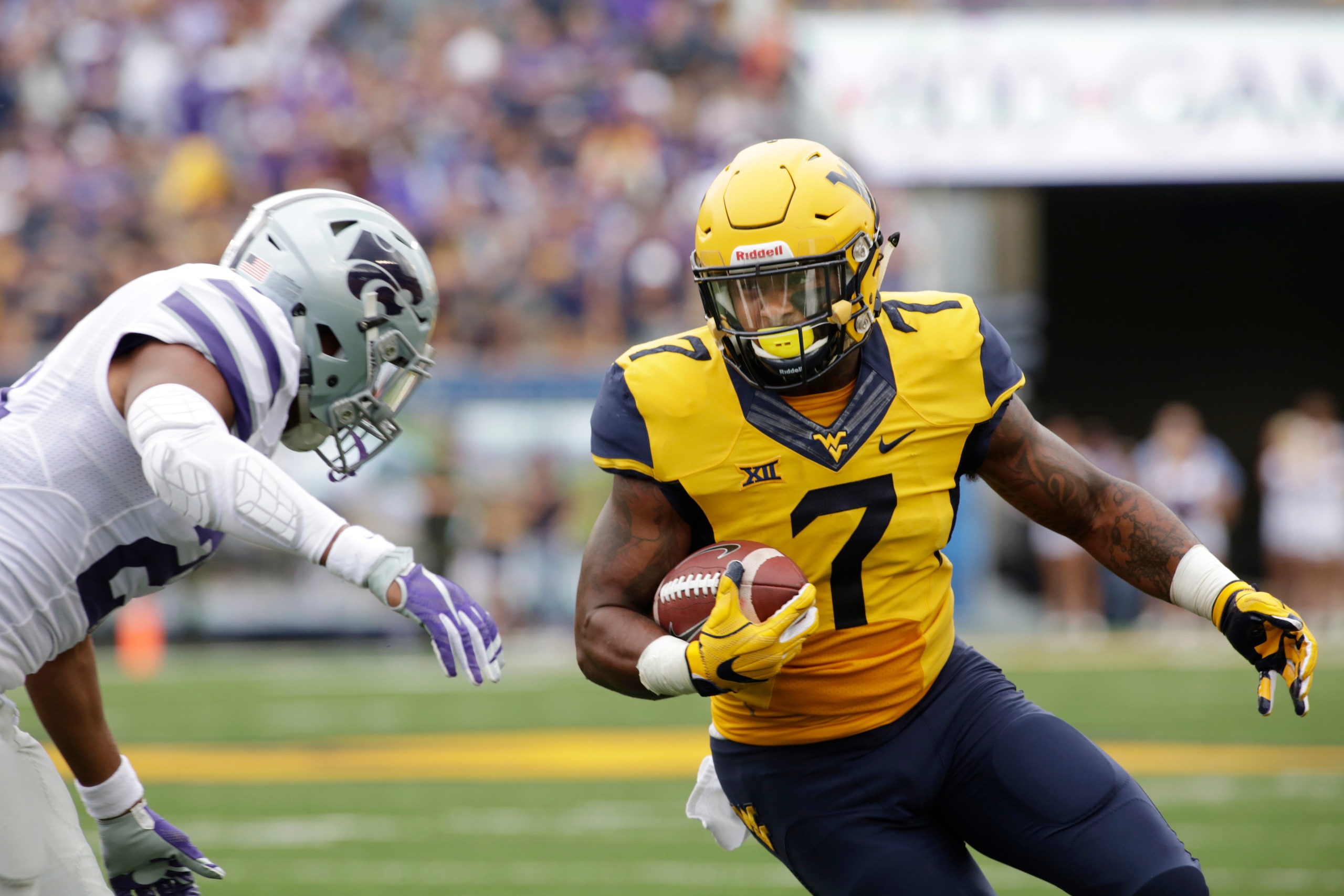
| Height | Weight | 40 Time | Arm Length | Hand Size | 3-Cone |
| 5'9 5/8" | 227 lbs | 4.69s | N/A | N/A | 7.09 |
POSITIVES
Rushel Shell is a big, bruising back with the athleticism you look for. Shell makes defenders miss in space and has the quick feet to plant and cut and get up field. He’s a handful to bring down in the open field and has a tendency to get low and punish a defender with a shoulder. Shell is an ideal fit in a zone rushing scheme where he can be a one-cut, downhill runner. He’s a durable, reliable back with limited wear and tear. The upside for Shell is much higher than his current stock suggests.
NEGATIVES
Shell’s time in the 40-yard dash at the combine (4.74 seconds) will immediately turn scouts away from his tape. At his size, that’s simply not good enough. Shell will turn 24 years old in September of his rookie season, which raises a red flag for age. Shell was never the full-time starter at West Virginia and always more of a role player for the Mountaineers. NFL clubs will see his lack of production and speed, as well as his age, and consider him a free-agent type.
PRO COMPARISON: Brandon Bolden, New England Patriots
FINAL GRADE: 4.99/9.00 (Undrafted Free Agent)
36. Chris Carson, Oklahoma State
6 of 41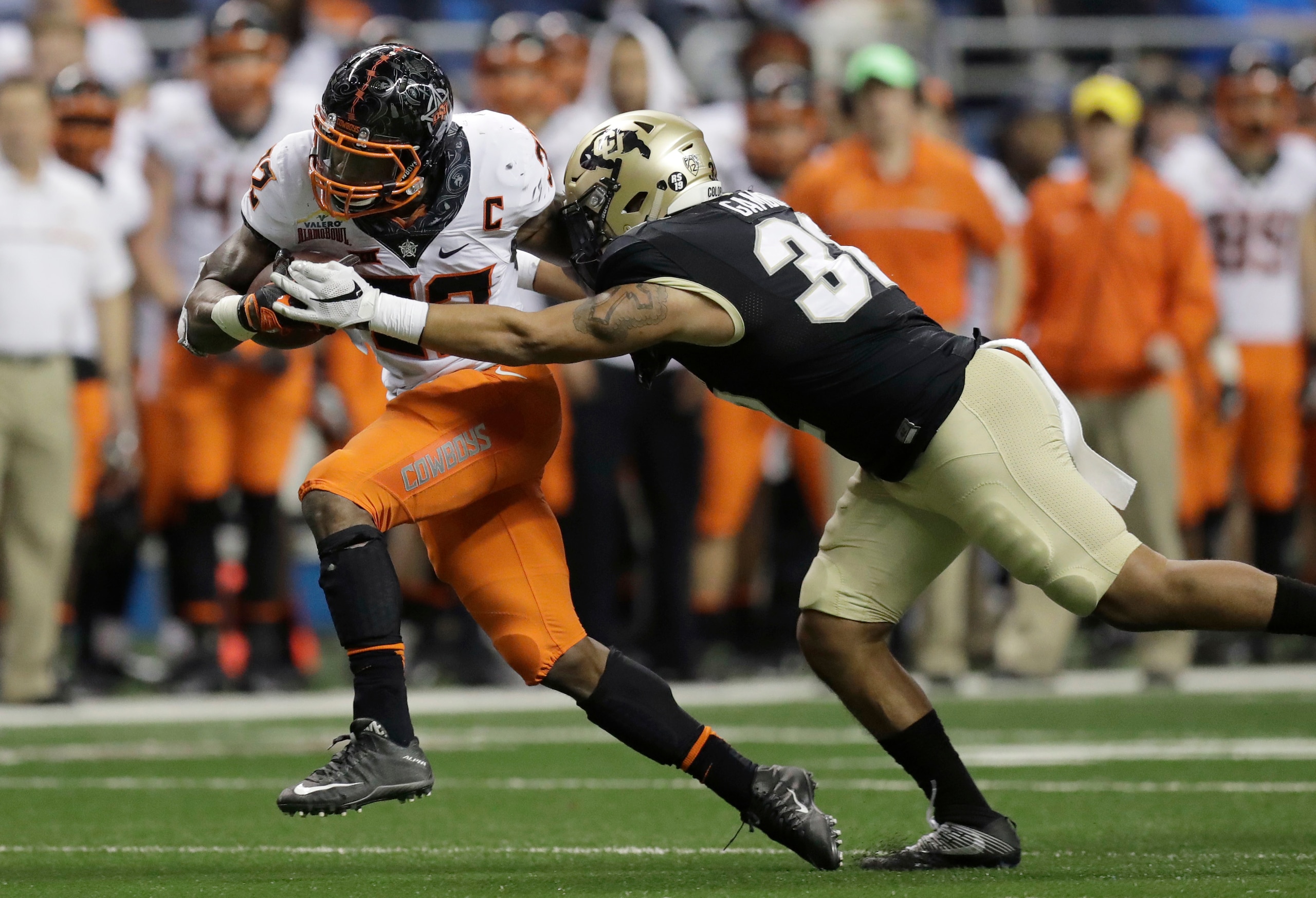
| Height | Weight | 40 Time | Arm Length | Hand Size | 3-Cone |
| 6'0 1/4" | 218 lbs | 4.58s | N/A | N/A | 7.53 |
POSITIVES
A transfer to Oklahoma State from Butler Community College in Kansas, Chris Carson is a big, strong, explosive back. Carson picks up tough yards with leg drive and the size to push tacklers. He’s a valuable receiver out of the backfield and can be an effective player with the ball in his hands in screen packages. He’s capable of making plays in short-yardage or goal-line situations. Carson won’t run away from defenders and looks like a limited between-the-tackles type who may have value as a short-yardage back.
NEGATIVES
Carson lacks the long speed and immediate shiftiness that NFL teams want in a back. He’s a one-cut, downhill runner only who tends to get too squared to the line of scrimmage and can’t slice through tighter running lanes. As a bigger back, Carson hasn’t shown the flexibility to run with low shoulders and can be tackled too easily due to his high leverage. He has to learn to win with low pads and use his strength better on the field. Carson lost the starting job at Oklahoma State as a senior.
PRO COMPARISON: David Cobb, Chicago Bears
FINAL GRADE: 4.99/9.00 (Undrafted Free Agent)
35. Jahad Thomas, Temple
7 of 41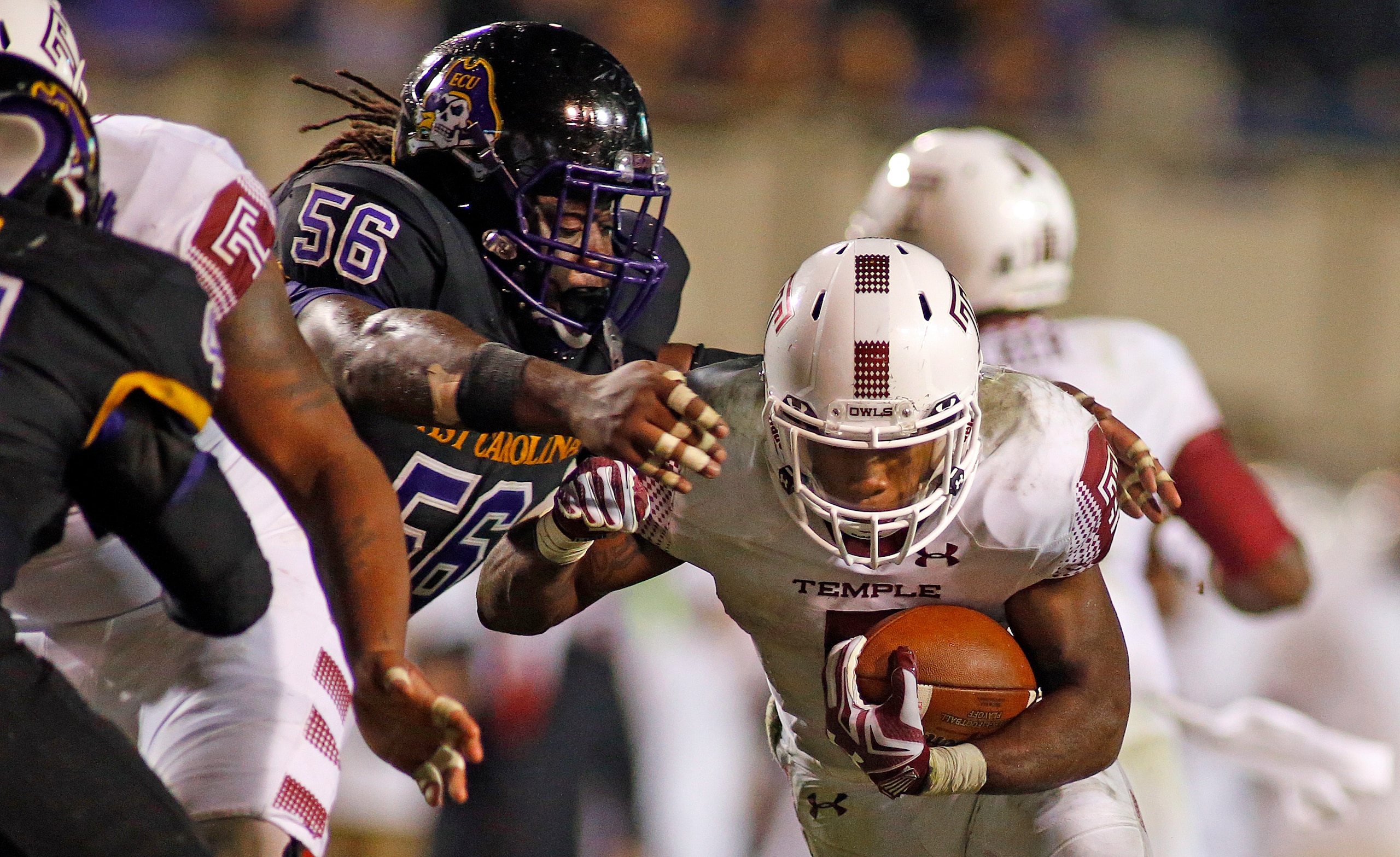
| Height | Weight | 40 Time | Arm Length | Hand Size | 3-Cone |
| 5'9 5/8" | 190 lbs | 4.62s | N/A | N/A | 7.26 |
POSITIVES
A senior running back, Jahad Thomas had NFL scouts talking last summer after he posted over 1,200 yards in his 2015 campaign. Thomas has experience on all four downs and has contributed as a runner, receiver and kick/punt returner. His versatility will be a major selling point for teams wanting a poor man’s Darren Sproles in the offense. He’s a quicker-than-fast back with the vision to scoot through tight spaces and enough juice to make the first defender miss.
NEGATIVES
Thomas lacks the speed and especially the short-area burst of an NFL running back. At his size, he has to beat defenders with quickness, and it’s lacking on his tape and in his workouts. Thomas lacks the strength to break tackles and isn’t a powerful runner through traffic. For a small back, he’s surprisingly ineffective at setting himself up as a runner and requires room to pick his spots. Thomas offers some upside as a third-down back and punt returner, but overall lacks the size and speed of a draftable back.
PRO COMPARISON: Daryl Richardson, Jacksonville Jaguars
FINAL GRADE: 4.99/9.00 (Undrafted Free Agent)
34. Joe Yearby, Miami (FL)
8 of 41
| Height | Weight | 40 Time | Arm Length | Hand Size | 3-Cone |
| 5'9" | 200 lbs | N/A | N/A | N/A | N/A |
POSITIVES
NFL teams looking for a bargain third-down back will want to check out Joe Yearby. The Miami product has the size, speed and hands to be a threat for teams wanting a pass-catcher out of the backfield. In his lone season as a starter, Yearby showed the balance and burst to beat defenders to space. He has the vision to pick a hole behind the line of scrimmage but can also read blocks at the second level. Yearby has very little wear and tear on his frame. His ball security was exceptional in college (one fumble), and he could become a dependable short-yardage carrier behind a power line given his penchant for running with anger.
NEGATIVES
Yearby was just a one-year starter at Miami (2015) and lost his hold on the job with a new coaching staff coming to town. He decided to enter the NFL draft a year early. Yearby had his issues with the team and was suspended for spring practice in 2015 and actually left the team for a spell. Yearby did not test well at the Miami pro day—especially in speed and agility drills—and can be viewed as a priority free agent and not a draftable prospect.
PRO COMPARISON: Lance Dunbar, Los Angeles Rams
FINAL GRADE: 4.99/9.00 (Undrafted Free Agent)
33. Tarean Folston, Notre Dame
9 of 41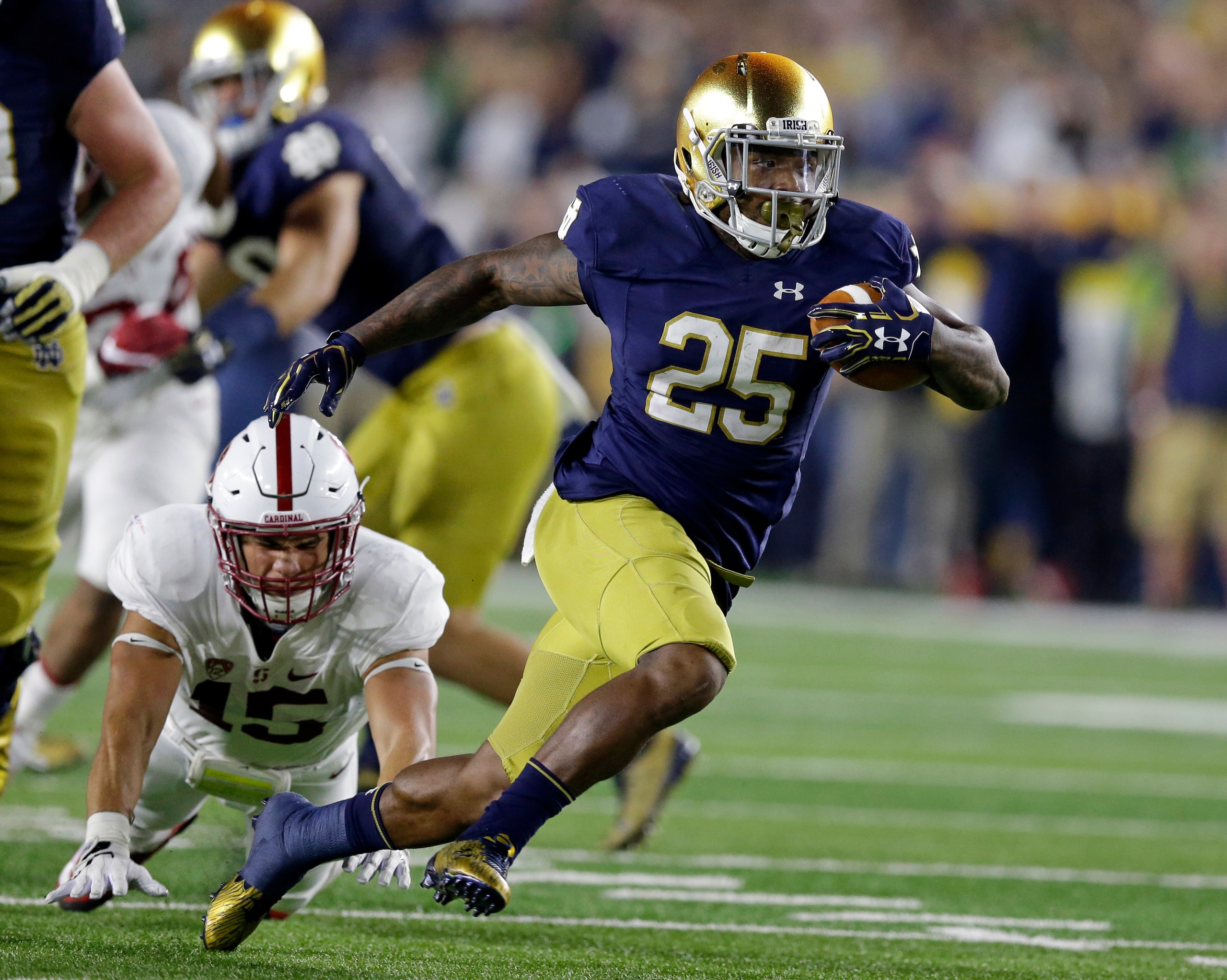
| Height | Weight | 40 Time | Arm Length | Hand Size | 3-Cone |
| 5'9 1/2" | 214 lbs | N/A | N/A | N/A | N/A |
POSITIVES
Tarean Folston started the 2015 season as the lead back at Notre Dame, but a torn ACL shut him down and allowed for the rise of C.J. Prosise. Folston got back onto the field in ‘16 but only saw 77 carries. Pre-injury, Folston was an explosive back with the frame and speed for the NFL. He was a quick cutter behind the line of scrimmage and could have been a monster in a zone scheme. Folston’s balance, burst and body lean all pointed to his at least being a contributor in a pro rotation. NFL teams will have to bet on Folston returning to his pre-injury form, which is why he’s considered a free-agent addition.
NEGATIVES
Folston never got back to his 2014 style of running and looked very cautious about putting much weight on his surgically repaired knee. The hope is that he’ll regain his confidence and balance. It’s questionable that Folston elected to enter the 2017 draft instead of returning to South Bend to further rehabilitate his knee and add to his game tape. Folston’s testing times were very poor for his size and position and may take him off many teams' priority free-agent boards. Unfortunately, he may never be the player he was before the torn ACL.
PRO COMPARISON: Charcandrick West, Kansas City Chiefs
FINAL GRADE: 4.99/9.00 (Undrafted Free Agent)
32. Devine Redding, Indiana
10 of 41
| Height | Weight | 40 Time | Arm Length | Hand Size | 3-Cone |
| 5'8 1/4" | 205 lbs | 4.66s | N/A | N/A | 6.96 |
POSITIVES
It’s not easy being the guy to replace Tevin Coleman and Jordan Howard, but that’s what Devine Redding had to do at Indiana. The one-year starter held his own with back-to-back 1,000-yard seasons before leaving a year early for the NFL. Redding has ideal balance with the lower-body strength to run through contact. He knows how to pick his spots at the line of scrimmage.
NEGATIVES
Redding is short with small hands and short arms. He doesn’t have the excellent burst or long stride to pull away from defenders in space, nor does he possess the pure power to be a short-yardage back and could even struggle to hold up in blocking situations. Redding’s lack of burst and quickness at the line of scrimmage makes him a poor fit in a scheme where he has to pick and choose a hole and quickly cut through traffic.
PRO COMPARISON: Josh Ferguson, Indianapolis Colts
FINAL GRADE: 4.99/9.00 (Undrafted Free Agent)
31. Elijah McGuire, Louisiana-Lafayette
11 of 41
| Height | Weight | 40 Time | Arm Length | Hand Size | 3-Cone |
| 5'9 3/4" | 214 lbs | 4.53s | N/A | N/A | 7.26s |
POSITIVES
Elijah McGuire was a highly productive player in college, rushing for over 1,000 yards in three straight seasons and 42 touchdowns over his career. He is at his best creating matchup issues in the passing game. He has a developed route tree, and he can break linebackers down in space and run routes down the field. He has soft hands, catching the ball away from his body, with a good catch radius and the ability to catch through contact. He is a solid blocker in pass protection, taking on defenders and delivering good cut blocks. With his lateral quickness, he is a dangerous runner in the open field, and while he lacks superior leg drive, he runs with great effort as he fights for every yard.
NEGATIVES
McGuire can be a valuable weapon out of the backfield, but he will struggle to be successful in any other role in the NFL. He has questionable vision, limited power and needs to improve his balance. He tested as a poor athlete, posting a disappointing three-cone time of 7.26 seconds. He runs with good acceleration, reaching his top-end speed, but he lacks a second gear to be a consistent big-play threat in the NFL. His longest runs come outside the tackles or through gaping holes, as his understanding of defensive leverage is questionable. His calling card is his route running and receiving ability, but he doesn’t profile as anything more than a third-down back in the NFL.
PRO COMPARISON: Shane Vereen, New York Giants
FINAL GRADE: 5.00/9.00 (Undrafted Free Agent)
30. Stanley Williams, Kentucky
12 of 41
| Height | Weight | 40 Time | Arm Length | Hand Size | 3-Cone |
| 5'7 1/8" | 190 lbs | 4.51s | N/A | N/A | 6.86s |
POSITIVES
Profiling as an explosive change-of-pace back, Stanley Williams averaged 6.8 yards on 367 carries over the course of his three-year Kentucky career. Williams’ best trait is his burst. He has good quickness and acceleration and ran a lot of plays outside the tackles. He is a nightmare for defenses in the open field, making opponents miss with his lateral quickness. He will offer upside as a pass-catching back with his ability in space even if he didn’t do much of it in college, only having caught 38 passes in his career.
NEGATIVES
His size will limit his ceiling. At 5’7” and 190 pounds, he is your prototypical change-of-pace running back. Teams often rely on backs like that to beat linebackers and make plays in the open field in the passing game. Williams has little experience in this area and will need to develop a route tree to reach his potential in this role. He struggles with running between the tackles, too often looking to bounce it outside. He tends to dance in the backfield on any play not designed to go outside. With his small stature, he lacks leg drive and lower-body strength and goes down on contact very easily. He will need to improve his hands, since he’s had issues with drops and fumbles. Williams’ ceiling is as a role player in an NFL backfield.
PRO COMPARISON: Kenjon Barner, Los Angeles Chargers
FINAL GRADE: 5.20/9.00 (Backup Caliber—Round 7)
29. I'Tavius Mathers, Middle Tennessee State
13 of 41
| Height | Weight | 40 Time | Arm Length | Hand Size | 3-Cone |
| 5'10 7/8" | 203 lbs | 4.46s | N/A | N/A | 7.17s |
POSITIVES
I'Tavius Mathers transferred from Ole Miss after his junior year and broke out in a big way in 2016. He rushed for 1,561 yards on 6.7 yards per carry and 17 touchdowns. He also added a ridiculous amount of production in the passing game, catching 66 passes for 633 yards and three touchdowns. He was consistently used on designed flare routes as an extension of the run game to get him in space. He has good open-field vision and wiggle to make defenders miss in addition to respectable top-end speed, running a 4.41-second 40-yard dash at his pro day. And on tape, he shows exceptional home run ability. He is a fearless receiver through traffic and quickly turns upfield after the catch. He is also a willing blocker in pass protection who picks up the right man and has good technique.
NEGATIVES
Coming from Middle Tennessee State, he ran most of his offense outside of the tackles. The entire offense is designed to get playmakers in space. He will likely struggle a great deal to run between the tackles in the NFL. He has issues with first contact, going down too easily and lacking the leg drive to move defenders. His vision is also a question mark, as far too often he bounces the run outside. His receiving ability is obvious, but his route tree is limited. His reception numbers were inflated by the offense, and he will need to work on developing a route tree at the next level. He profiles as a third-down, change-of-pace back who can create big plays for an offense.
PRO COMPARISON: Bobby Rainey, Free Agent
FINAL GRADE: 5.20/9.00 (Backup Caliber—Round 7)
28. Corey Clement, Wisconsin
14 of 41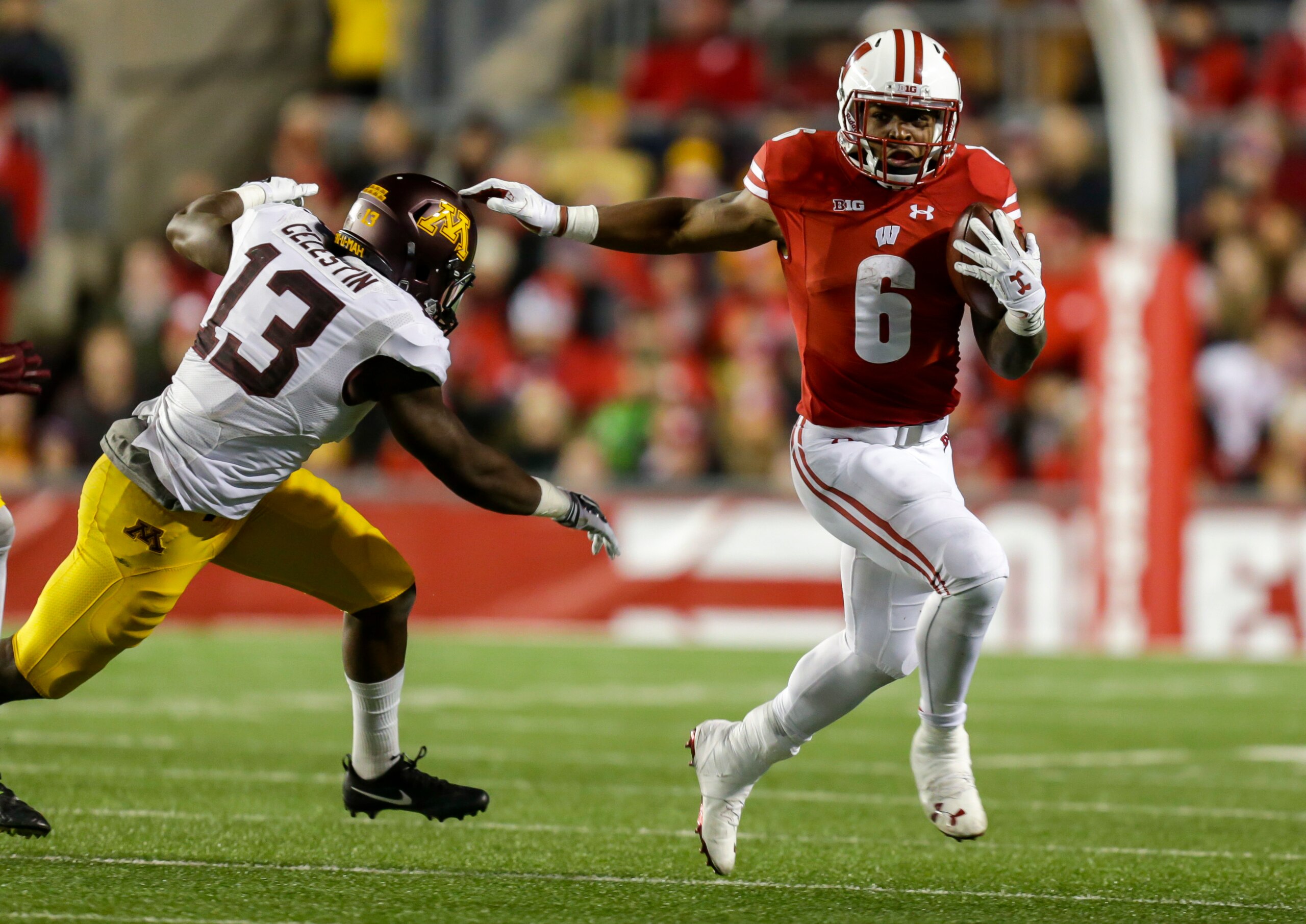
| Height | Weight | 40 Time | Arm Length | Hand Size | 3-Cone |
| 5'10 1/4" | 220 lbs | 4.59s | N/A | N/A | 6.71s |
POSITIVES
Corey Clement showed off big-play ability while at Wisconsin. His combine time of 4.68 in the 40-yard dash didn’t do his play speed any justice. He has good acceleration and doesn’t lose speed when cutting. He had an excellent three-cone time at his pro-day of 6.71 seconds. He can both run between the tackles and bounce it outside. He has good patience and understanding of his blocks, as well as a good understanding of defensive leverage. His greatest strength is his ability to cut. He moves very well between the tackles, not only to make defenders miss but to find cutback lanes. He had his best year in his sophomore season when he was the second option behind Melvin Gordon, averaging 6.5 yards per carry. He was a committee back in college and was at his best when he was the secondary option as a change-of-pace, in-between-the-tackles back.
NEGATIVES
Clement struggled with injuries and production after Gordon left and he was set to become Wisconsin’s feature back. He only played four games his junior year due to a hernia, and he was ineffective his senior year, averaging only 4.4 yards per carry. He tested very poorly at the combine, not only running a slow 40-yard dash, but his vertical jump of 28 ¼" was in the 1st percentile. He improved his numbers at his pro day, but teams will have questions about his upside. He lacks power to his game, too easily being stood up or tripped up at the line of scrimmage. He offers very little in the passing game, never having caught more than 14 passes in a season and not showing much as a blocker. When he was used as a receiver, it was on a very limited route tree. He profiles as a two-down back in the NFL and will likely be the third back on the depth chart.
PRO COMPARISON: Cameron Artis-Payne, Carolina Panthers
FINAL GRADE: 5.20/9.00 (Backup Caliber—Round 7)
27. Brandon Wilson, Houston
15 of 41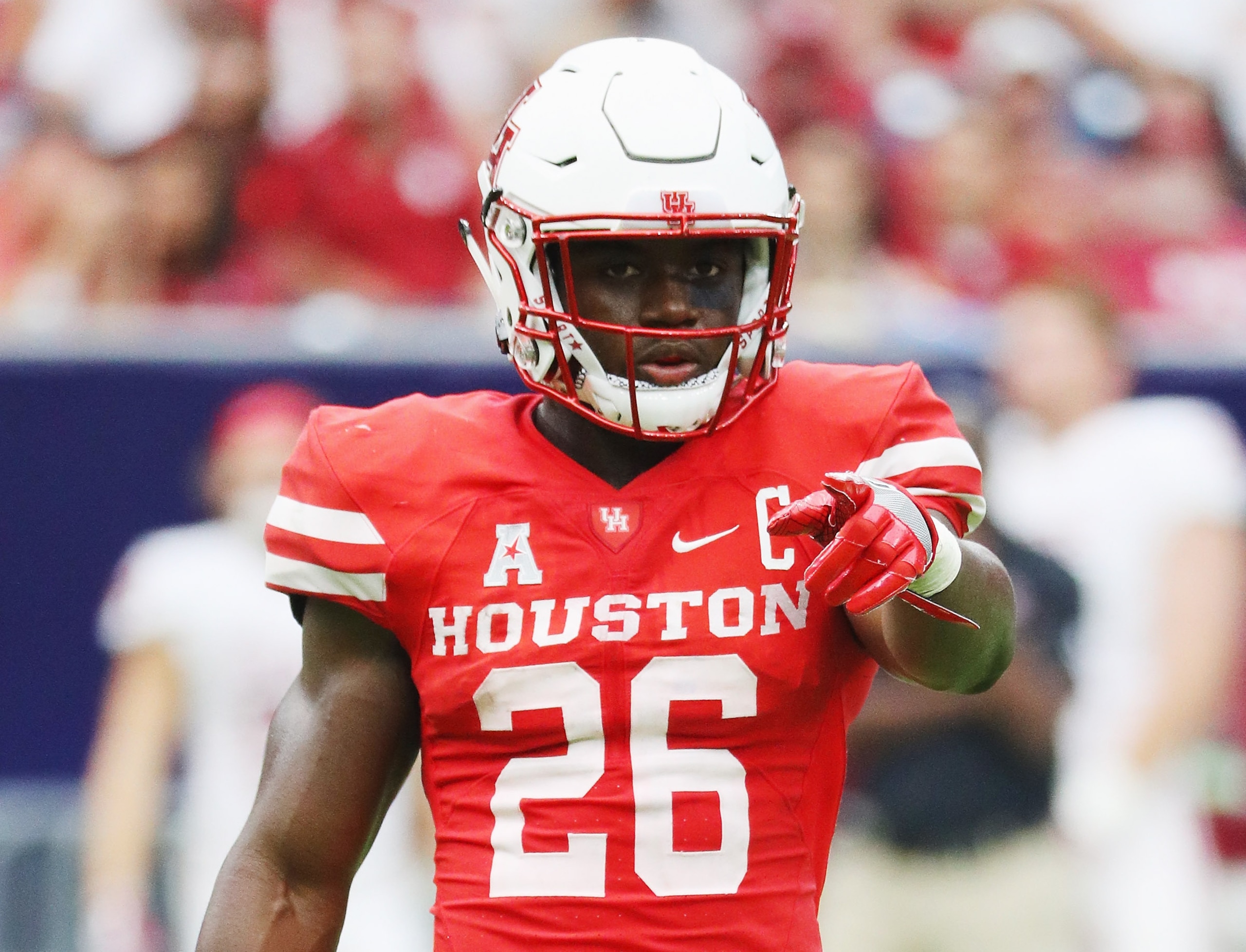
| Height | Weight | 40 Time | Arm Length | Hand Size | 3-Cone |
| 5'10 1/8"" | 198 lbs | 4.40s | N/A | N/A | 7.09 |
POSITIVES
Brandon Wilson did it all for the Houston Cougars in college, playing offense, defense and special teams. He was predominantly a corner in college but will be making the full-time transition to running back at the next level. Wilson had only 41 career carries at Houston, so teams will have to do a good deal of projecting. What Wilson has working for him is his pro day workout. At 5'10", 198 pounds, Wilson blazed a 4.40-second 40-yard dash and had an impressive broad jump of 11'1" and a 41-inch vertical. Those athletic numbers will generate buzz with teams. Wilson also brings dynamic kick return ability to whoever drafts him, averaging 25.5 yards per return and returning two kicks for touchdowns. With such a small workload in college, he won’t have the miles on his body that most other prospects have. His open-field vision, elusiveness and top-end speed make him an exciting raw prospect. His versatility is a bonus, not only his ability on special teams but the fact that he could be an emergency stopgap in the secondary as well.
NEGATIVES
Anytime you make a full-time transition from a position, there can be significant growing pains, especially when you are switching sides of the ball. Wilson is strictly an athletic upside pick at this point, though with his athleticism it’s a very high upside. He will need to learn to run between the tackles, succeed in pass protection and develop a route tree. There are a ton of hurdles in his way, and he is unlikely to make an early impact in the NFL.
PRO COMPARISON: Christine Michael, Green Bay Packers
FINAL GRADE: 5.25/9.00 (Backup Caliber—Round 7)
26. Aaron Jones, UTEP
16 of 41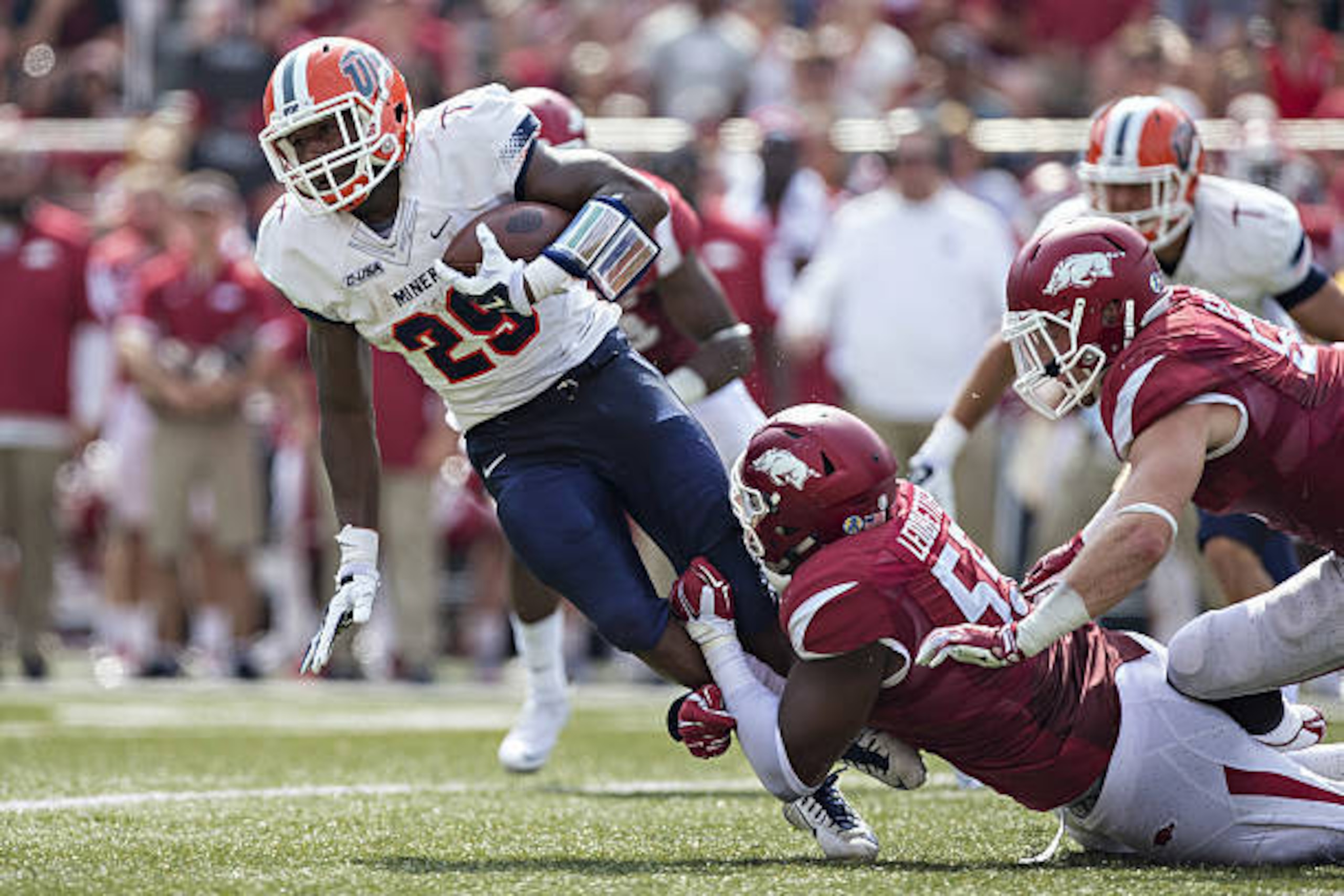
| Height | Weight | 40 Time | Arm Length | Hand Size | 3-Cone |
| 5'9 1/8" | 208 lbs | 4.56s | N/A | N/A | 6.82s |
POSITIVES
One of the most productive running backs in all of college football, Aaron Jones rushed for 1,773 yards and 17 touchdowns while averaging 7.7 yards per carry. Jones is a quicker-than-fast running back with good vision and home run ability. He is excellent at getting what is blocked for him and can make tacklers miss in the open field. He showed off his lateral quickness at the combine, running the three-cone in 6.82 seconds, which put him in the 86th percentile. Jones can be used between the tackles or on the outside, as well as in the receiving game. He has good vision both in the open field and at the line of scrimmage. He is only 5'9", but at 208 pounds, Jones is a compact back who can push the pile. He runs with great effort and leg drive, never giving up on the play and consistently getting hidden yardage. On top of his skills between the tackles, on the outside and receiving, Jones also holds his own in pass protection. He has all the tools to develop into a three-down back. If there is a Day 3 sleeper in this class who can develop into a starter, it's Jones.
NEGATIVES
Durability is an issue for Jones, as he missed 10 games in 2015 with a foot issue. With both a major injury and over 700 career touches, he could fall on team boards due to medicals. While he dominated at UTEP and showed traits that you look for in an NFL back, he will face a big jump in terms of level of competition in the NFL, although he did play well versus both Texas and Arkansas. While Jones has great quickness, he lacks ideal top-end speed, running a 4.56-second 40-yard dash, and may never be a home run threat for a team. Jones has the tools to develop into a productive NFL back but may lack the speed and durability to become a star.
PRO COMPARISON: Kenneth Dixon, Baltimore Ravens
FINAL GRADE: 5.25/9.00 (Backup Caliber—Round 7)
25. Dare Ogunbowale, Wisconsin
17 of 41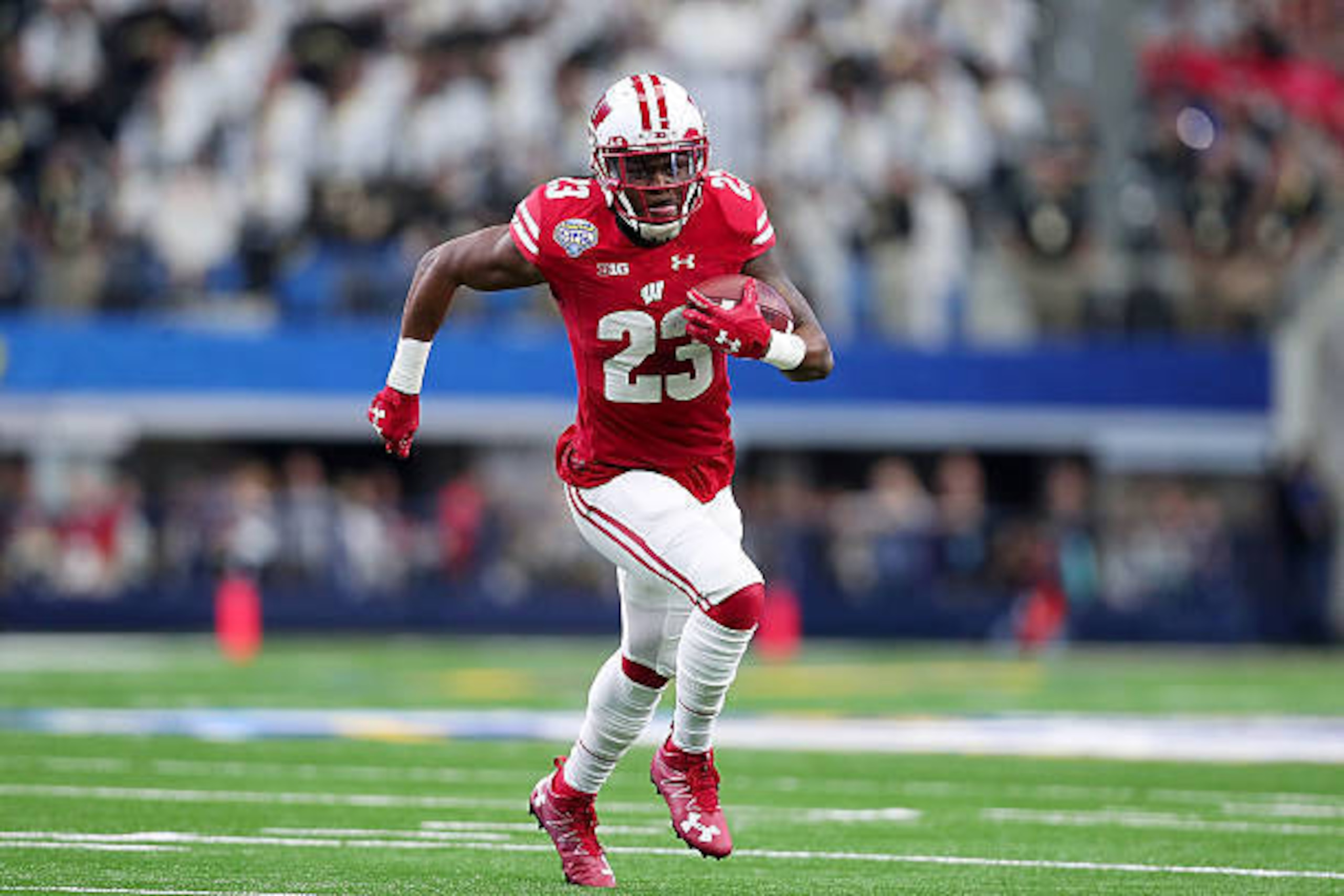
| Height | Weight | 40 Time | Arm Length | Hand Size | 3-Cone |
| 5'10 3/4" | 213 lbs | 4.65s | N/A | N/A | 6.99s |
POSITIVES
Dare Ogunbowale excelled in his third-down-back role at Wisconsin, catching a combined 60 passes in his last two seasons while averaging 8.5 yards per reception. He has soft hands and the ability to catch and run. Ogunbowale is at his best in the open field or on stretch plays getting outside of a defense, showing good lateral quickness. He will likely fit a zone run scheme best. He played faster than he tested, and while he is a raw athlete at this point, he offers nice upside for a team.
NEGATIVES
Ogunbowale walked onto the football team in 2012 as a former soccer player and defensive back. He changed positions in 2014 and is still learning the nuances of running back. He struggles running between the tackles, too often dancing at the line of scrimmage waiting for holes to open up. While his tape suggests he is a good athlete, he tested poorly at the combine, running a 4.65-second 40-yard dash and finishing the three-cone drill in 6.99 seconds. He has skills in the open field, but his route running is still a work in progress. Despite projecting as a third-down back, he struggles in pass protection and to be effective on third downs will need to be utilized as a weapon only. Ogunbowale has upside and potential, but at this point of his career, he is a raw talent who is just part of a committee.
PRO COMPARISON: Charles Sims, Tampa Bay Buccaneers
FINAL GRADE: 5.25/9.00 (Backup Caliber—Round 7)
24. Justin Davis, USC
18 of 41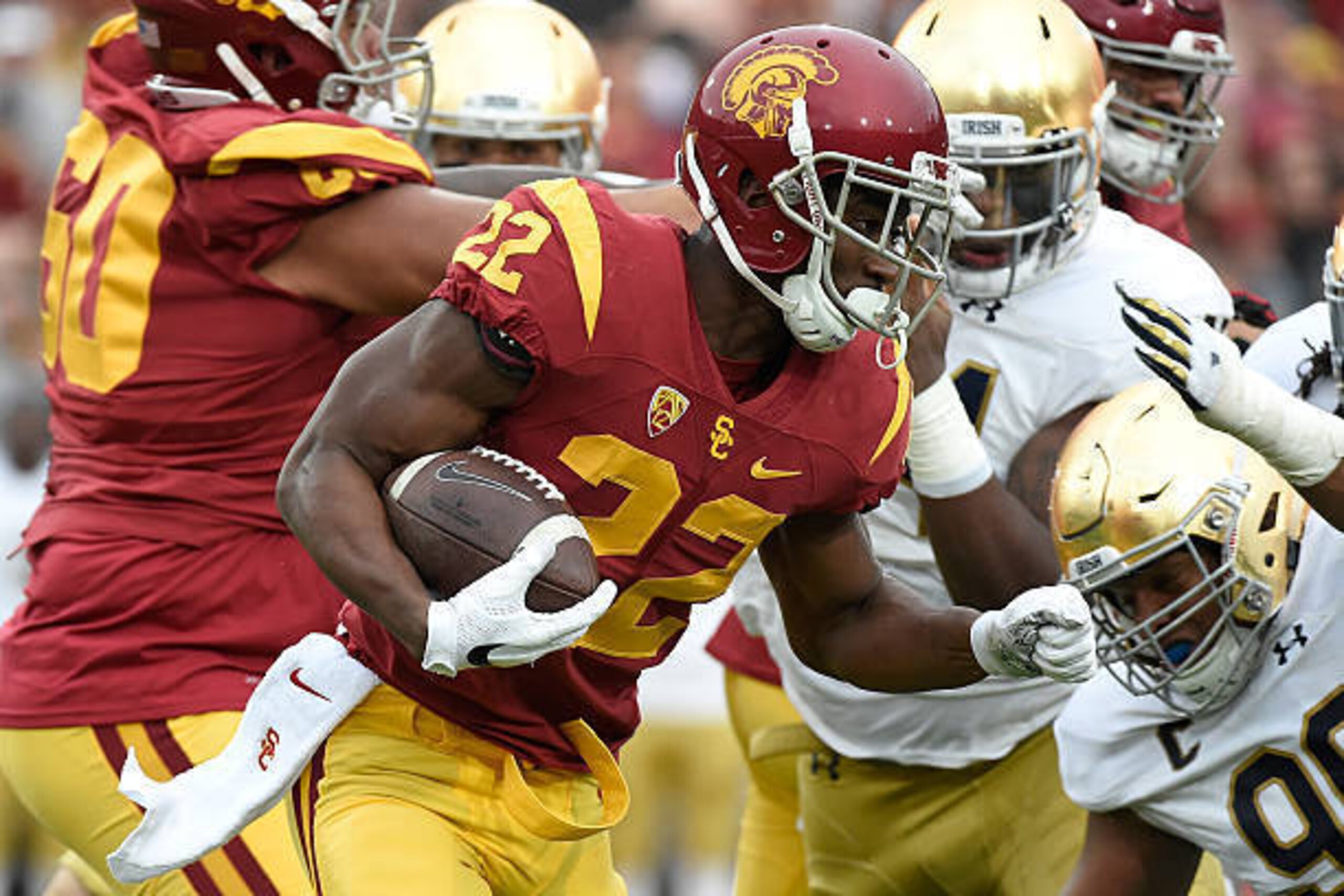
| Height | Weight | 40 Time | Arm Length | Hand Size | 3-Cone |
| 6'0 5/8" | 208 lbs | N/A | N/A | N/A | 6.75s |
POSITIVES
Justin Davis’ greatest strength is his elusiveness. He has great lateral quickness, with the ability to make defenders miss in the open field. He also flashes this when finding cutback lanes, showing off good vision. His lateral quickness is so impressive that he can combine moves, using multiple jump cuts and accelerating out of his cuts. He can make defenders look silly and is a nightmare for defenses in the second level. He played in a committee at USC but showed he can be successful in one. He averaged 5.3 yards per carry and 8.7 yards per catch. With his prowess in the open field, look for him to have more success at the NFL level receiving the ball than he did in college.
NEGATIVES
Davis’ calling card is his lateral quickness, but his game lacks power. He can be stood up at the line of scrimmage and needs to improve his ability to run through tackles. Despite his excellent ability to cut on a dime, it could be a struggle for Davis to stay on the field on third down due to his limitations. He is an awful pass-blocker, consistently getting beaten or out of position. While his open-field ability is ideal for the passing game, his hands are a weakness; he dropped 15.6 percent of his catchable targets. In order to take advantage of his lateral quickness, Davis will need to improve in other areas to stay on the field.
PRO COMPARISON: Ronnie Hillman, Los Angeles Chargers
FINAL GRADE: 5.25/9.00 (Backup Caliber—Round 7)
23. Elijah Hood, North Carolina
19 of 41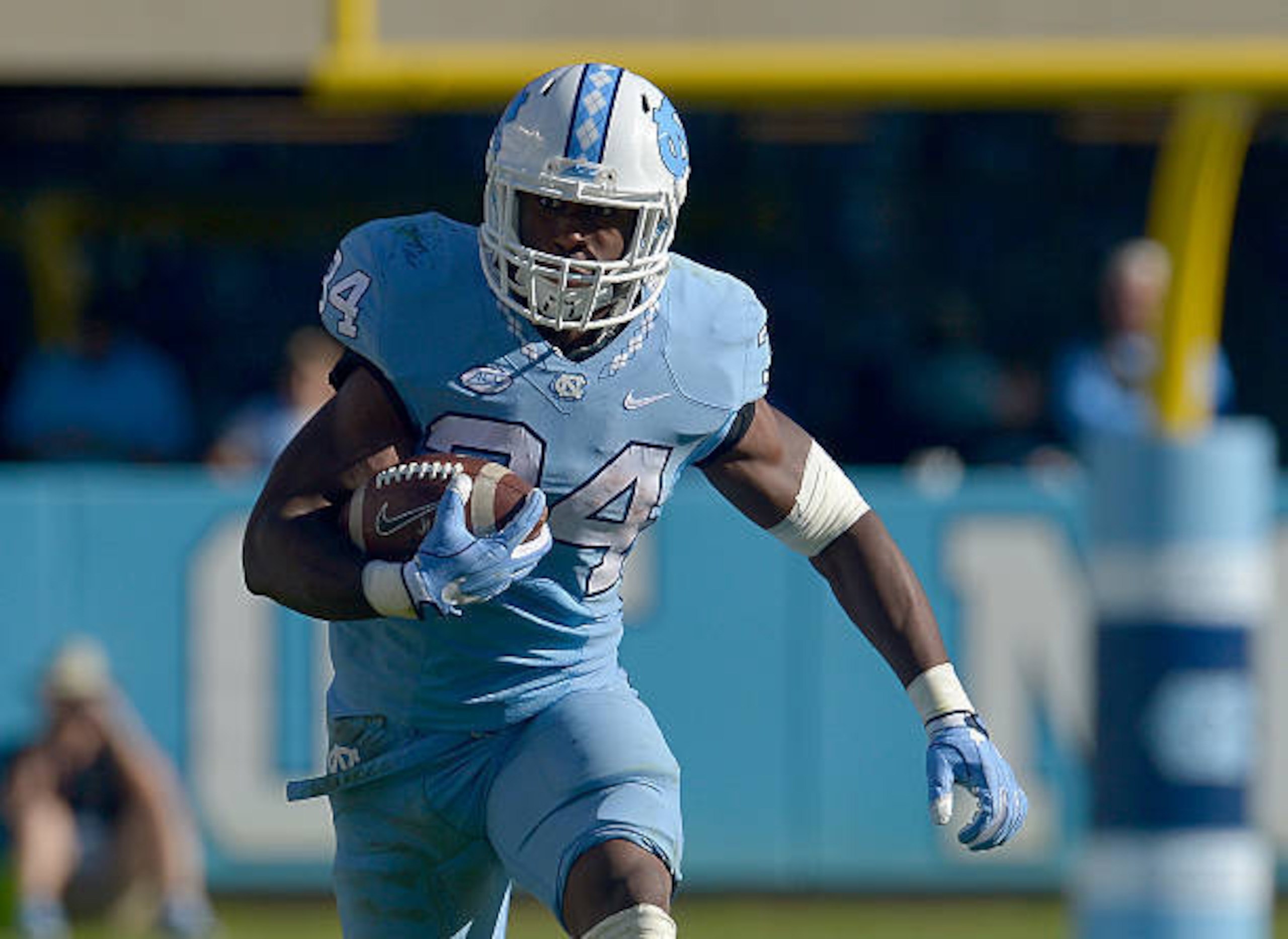
| Height | Weight | 40 Time | Arm Length | Hand Size | 3-Cone |
| 5'11" | 232 lbs | N/A | N/A | N/A | N/A |
POSITIVES
Elijah Hood is a big, powerful running back at 6'0", 232 pounds. He has tremendous leg drive, pushing the pile and getting hidden yardage. His sophomore season was excellent before injuries slowed him down this past year. In 2015, he ran for 1,463 yards, averaging 6.7 yards per carry and scoring 17 touchdowns. He profiles as a between-the-tackles runner with good vision, with the combination of size and speed to be a dangerous second-level runner. He runs with good patience and vision between the tackles, allowing his blocks to develop and not just relying on his power at the first level. His lateral quickness is a question mark, but at his size, he just needs defenders to be off target to break a tackle. He profiles as an effective two-down power back who can be a threat near the goal line.
NEGATIVES
While Hood was very impressive in his sophomore season, he took a major step back in his junior year. He missed multiple games and injuries limited his effectiveness, which will bring up durability concerns. At times, he looks slow on the field, especially on outside runs as his lack of speed can lead to strung-out plays. His balance can be an issue, and he is too easily tripped up for his size. Power is his game; while he can juke to affect defenders, he won’t make many miss in space. When he moves laterally, it can greatly alter his speed, and he doesn’t accelerate out of lateral moves. As a receiver, he struggles with route running, mostly catching dump-offs, and he doesn’t have the quickness to beat linebackers in space. He is a limited player who will likely only be a power back, with some scouts suggesting a move to fullback.
PRO COMPARISON: Stevan Ridley, Free Agent
FINAL GRADE: 5.25/9.00 (Backup Caliber—Round 7)
22. Austin Ekeler, Western State
20 of 41| Height | Weight | 40 Time | Arm Length | Hand Size | 3-Cone |
| 5'7 5/8" | 195 lbs | 4.43s | N/A | N/A | N/A |
POSITIVES
A small-school stud, Austin Ekeler has excellent balance, vision and the agility to leave defenders grasping for straws in the hole. Ekeler can run through contact and will finish his carries. He’s explosive out of the gate and can turn the corner with speed. Ekeler has the hands to impact the game as a receiver out of the backfield or potentially flexed into the slot. A team wanting a return man could also use Ekeler in that role, especially kick returns. At his pro day, Ekeler ran a 4.43-second 40, had a 40.5-inch vertical leap and a 10.8-foot broad jump—numbers that show his lower-body explosion.
NEGATIVES
Ekeler saw no NFL talent on the other side of the field at Western State and will have to adjust to the speed in which rushing lanes close in the pros. Ekeler is a little short by NFL standards and may only be seen as a scatback type. Ekeler’s long speed might not allow him to run away from tacklers. The biggest test will be if he can handle the role of a blocker on third downs given his value as a receiver. If Ekeler can’t learn to pick up blitzes or handle the size of NFL rushers, his greatest asset as a third-down back will be lost.
PRO COMPARISON: James White, New England Patriots
FINAL GRADE: 5.30/9.00 (Backup Caliber—Round 7)
21. De'Angelo Henderson, Coastal Carolina
21 of 41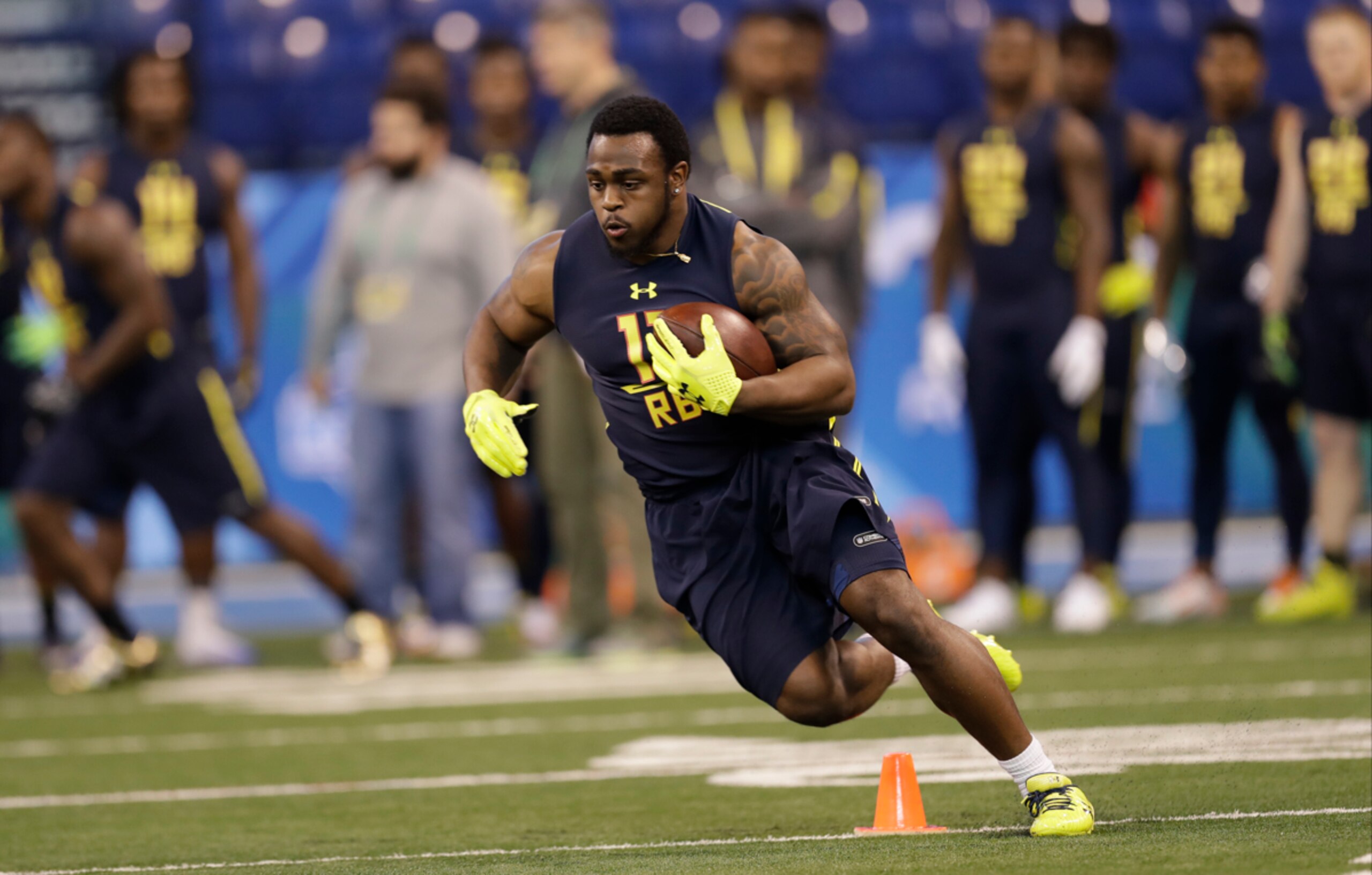
| Height | Weight | 40 Time | Arm Length | Hand Size | 3-Cone |
| 5'7 1/2" | 208 lbs | 4.48s | N/A | N/A | 7.26 |
POSITIVES
De'Angelo Henderson is small and compact at 5'7" and 208 pounds, built low to the ground and difficult to tackle. He has good speed, running a 4.48 40-yard dash, with lateral quickness to match. He was highly productive at the FCS level, rushing for 4,635 yards, and scoring 58 touchdowns on the ground. With his lower center of gravity, Henderson works well between the tackles. He shows good vision and has good leg drive to pick up hidden yardage. He is most comfortable on the edge and in the open field, making defenders miss and exploding for big plays. He also can catch the ball out of the backfield, snagging 97 passes in his career. Out of the backfield, he will create matchup issues for linebackers with his quickness and ability to break them down in space. He has a good catch radius and soft hands and is able to catch the ball away from his body despite his small stature.
NEGATIVES
The first question regarding Henderson will be the step up in competition going from an FCS school to the NFL. Henderson flashes potential between the tackles and has the build to be successful there, but his patience needs to improve. Too often, he bounces outside and looks for the big play. He has receiving ability but will need to improve his pass blocking in order to play on third downs. Given his smaller size, teams may question his durability since he comes into the NFL having touched the ball over 800 times in his career.
PRO COMPARISON: Branden Oliver, Los Angles Chargers
FINAL GRADE: 5.50/9.00 (Backup Caliber—Round 6)
20. Donnel Pumphrey, San Diego State
22 of 41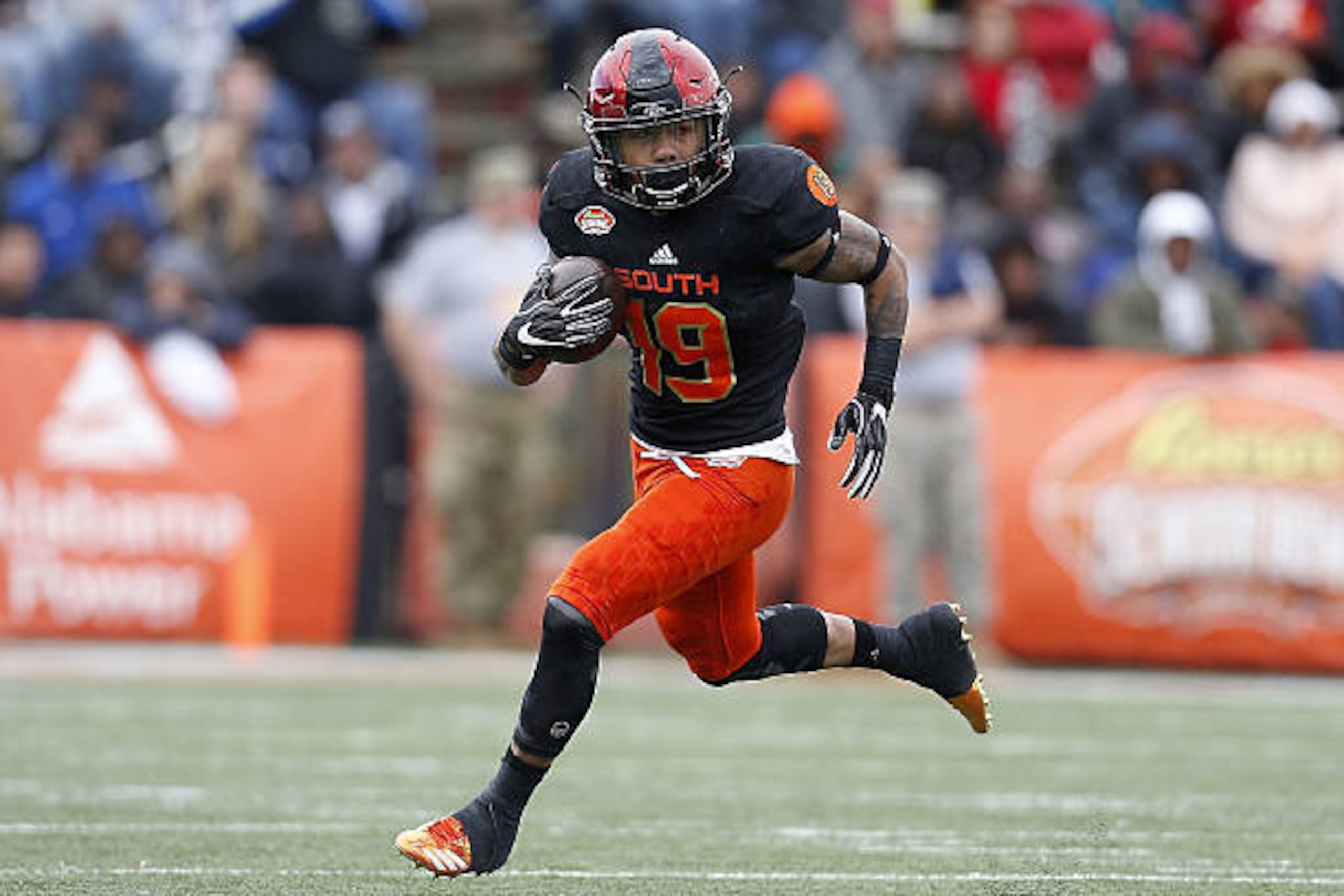
| Height | Weight | 40 Time | Arm Length | Hand Size | 3-Cone |
| 5'8 1/4" | 176 lbs | 4.48s | N/A | N/A | N/A |
POSITIVES
The NCAA’s all-time leading rusher, Donnel Pumphrey had tremendous collegiate production. He finished his career with 1,059 carries for 6,405 yards and 62 touchdowns, adding 99 catches for 1,039 yards and five receiving touchdowns. Pumphrey’s success comes from his speed and acceleration. He has excellent vision and understanding of defensive leverage, and he can burst through an open hole. He has good patience on his outside runs, allowing his blocks to develop before he explodes. He has the lateral quickness to make defenders miss, and that translates to his route-running ability as well. He shows soft hands and a good catch radius for his size, and he can catch the ball through contact. He consistently breaks linebackers down in space and can turn and run after catching the football. His receiving ability is good enough that a team may look to move him to the slot because of his size limitation at running back.
NEGATIVES
His durability will be a question for teams, as he has over 1,100 career touches at a slight frame of 5'8" and 176 pounds. While injuries haven’t been an issue for him yet, his body has already taken a lot of abuse and it will only increase in the NFL. He was a three-down back in college, but players his size simply aren’t three-down backs in the NFL. Pumphrey's game is void of any power because of his size. He is able to run between the tackles, but any solid contact stands him up. His balance can look worse than it is, because at times he is tripped up easily due to his small stature. On runs between the tackles, he can look to bounce outside too often and will be driven back by solid contact. He profiles as a third-down back in the NFL because of his receiving ability, but his blocking ability will need to improve. He lacks the functional strength to take on incoming rushers and hold them at bay for very long.
PRO COMPARISON: Duke Johnson, Cleveland Browns
FINAL GRADE: 5.50/9.00 (Backup Caliber—Round 6)
19. Joe Williams, Utah
23 of 41
| Height | Weight | 40 Time | Arm Length | Hand Size | 3-Cone |
| 5'10 3/4" | 210 lbs | 4.41s | N/A | N/A | 6.94s |
POSITIVES
Joe Williams has game-breaking speed and the frame (5'11", 210 lbs) to allow him to be an every-down back. At the combine, he showed off his speed with a 4.41-second 40-yard dash. Williams consistently broke big runs in his senior year, rushing for 1,407 yards and averaging 6.7 yards per carry. He uses his speed and acceleration to leave defenders in the dust in the open field, blowing by them and making it appear like they took bad angles. He isn’t just straight-line fast, as he has lateral quickness as well, helping him make opponents miss in space. Williams has good vision and balance and gets skinny through the hole. He is a big-play runner who can get what is blocked for him, and once he is in the open field, his blazing speed makes him a nightmare.
NEGATIVES
Above all else, teams will question Williams' love for the game. In 2016, he walked away from football and had to be convinced to come back. He says the break reinvigorated him, and his passion for the game is stronger than it ever was. However, his level of commitment won’t be the only question teams have for him. Williams struggles to create at the first level. He can get what is blocked for him but doesn’t become dangerous until he hits the open field. He doesn’t exhibit much power, and he can get stood up on initial contact. He will also need to improve his ball security, fumbling seven times on 322 career carries. What Williams does well is hit the home run, and while that is exciting, he lacks the receiving ability teams look for out of big-play threats. He only caught nine passes in his senior year and dropped five of his 30 career targets. Teams will question his role as a third-down player, since he isn’t a great blocker and lacks the receiving ability they look for.
PRO COMPARISON: Damien Williams, Miami Dolphins
FINAL GRADE: 5.55/9.00 (Backup Caliber—Round 6)
18. De'Veon Smith, Michigan
24 of 41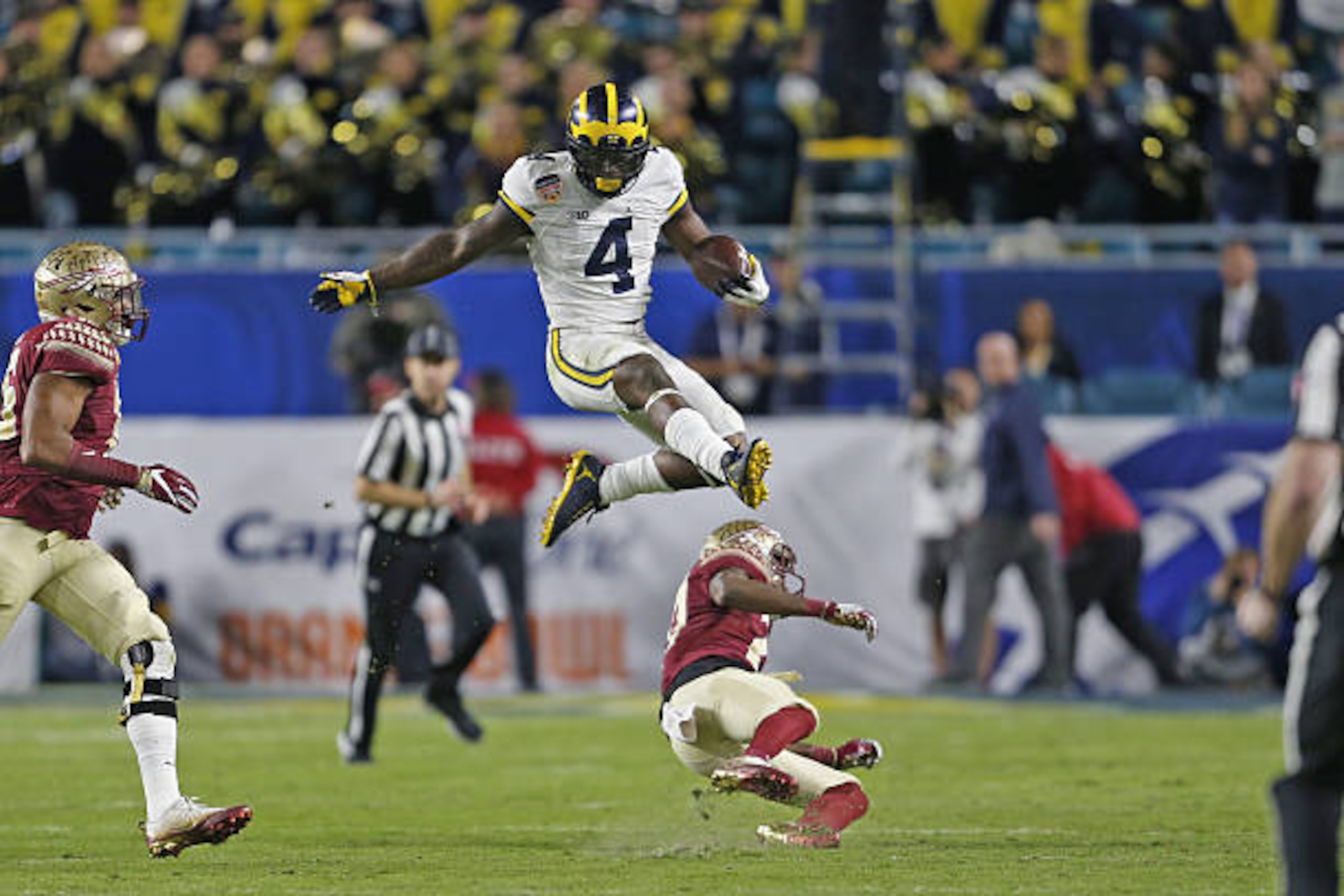
| Height | Weight | 40 Time | Arm Length | Hand Size | 3-Cone |
| 5'10 7/8" | 223 lbs | 4.85s | N/A | N/A | 7.00s |
POSITIVES
De'Veon Smith is a big, powerful back who can excel in a goal-line role. He has a strong, compact frame at 5'11", 223 pounds—the perfect size for a power back. He has good vision and ability between the tackles, and he has enough leg drive to occasionally push the pile. Smith understands his strengths and weaknesses and looks to attack from the start. He is a north-south runner who won’t dance at the line of scrimmage, and he will lower his shoulder and run through people. While elusiveness is not his strength, he has enough wiggle for it to be a helpful addition to his game. He can make defenders miss their target point and then utilize his strengths to his advantage.
NEGATIVES
Smith tested very poorly at the combine, performing in the 4th percentile or worse in the vertical jump, broad jump, three-cone drill and 20-yard shuttle. On top of his shortcomings as an athlete, he averaged only 4.5 yards per carry in his college career, scoring 22 touchdowns in 41 career games. While Smith showed leg drive, you would like to see it more consistently from a power back like him. Smith will struggle to be anything more than a two-down back with his limits as both a receiver and in protection. He has a tendency to struggle to pick up defenders on blitzes and needs to improve his hand technique while blocking. He had a very limited route tree while at Michigan, and he will need to improve his ability to catch and turn the ball up the field.
PRO COMPARISON: Matt Jones, Washington
FINAL GRADE: 5.59/9.00 (Backup Caliber—Round 5)
17. T.J. Logan, North Carolina
25 of 41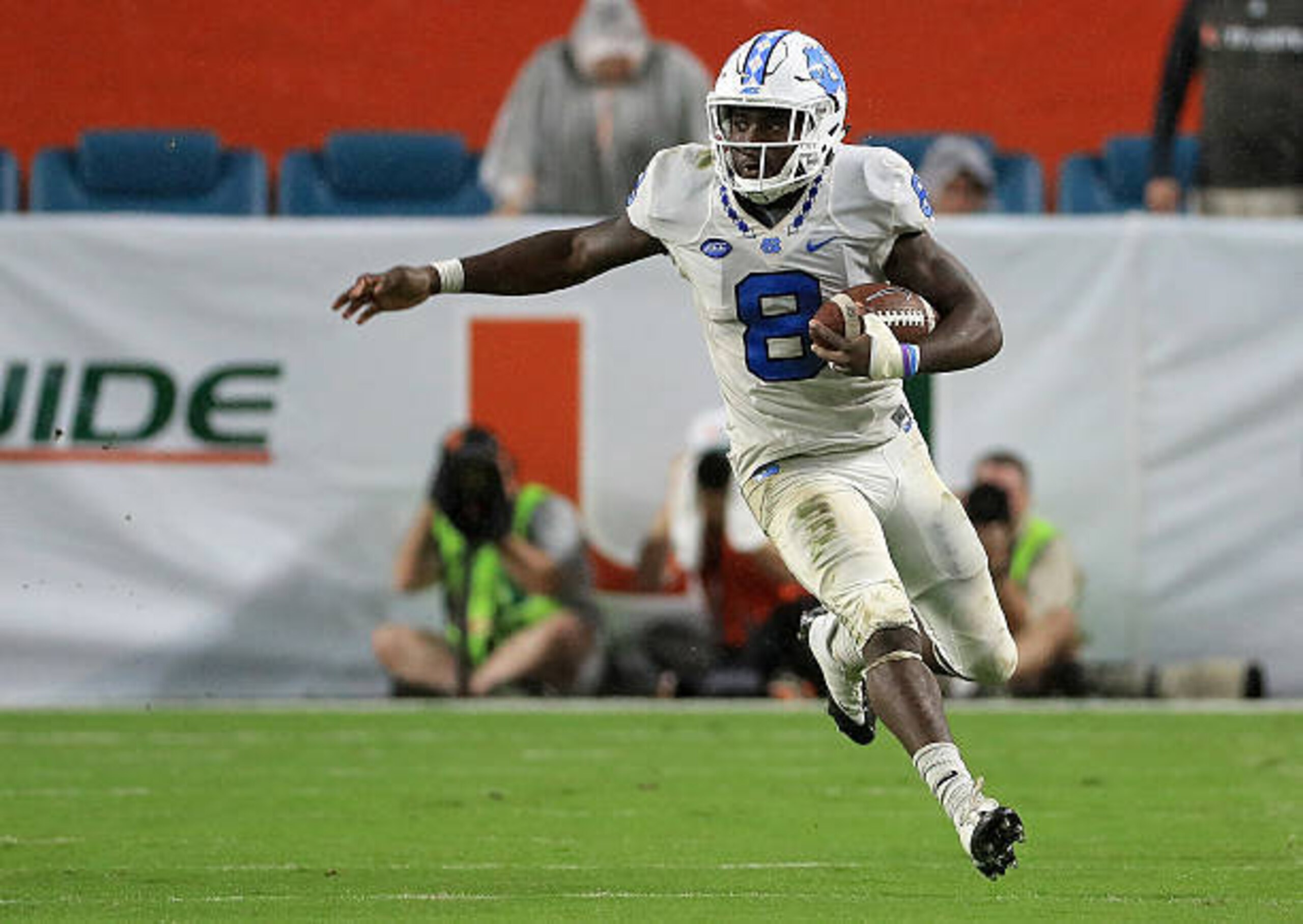
| Height | Weight | 40 Time | Arm Length | Hand Size | 3-Cone |
| 5'9 1/8" | 196 lbs | 4.37s | N/A | N/A | 6.61s |
POSITIVES
Explosiveness is the first thing that comes to mind when talking about T.J. Logan. His 4.37 40-yard dash was the fastest among all running backs at the combine (assuming Curtis Samuel is a wide receiver). He can play running back and return kicks, bringing big-time playmaking ability to an NFL team. In his career, he averaged 27.2 yards per kick return, including five for touchdowns. As a running back, he is a threat to get to the edge on every play and can catch the ball out of the backfield. He has good vision and uses his quickness to hit the hole hard and explode into the second level. As a receiver, he only dropped one pass, and teams can use his open-field ability easily out of the backfield. Unlike a lot of other explosive playmakers, he shows good blocking ability and will hold his own in pass protection on third down.
NEGATIVES
Like a lot of explosive backs, Logan can struggle between the tackles. Most of his successful runs come when the defense is spread out. Running in a pro-style offense versus loaded boxes may cause issues for him. While at North Carolina, he was part of a committee and that is likely his role in the NFL; he never had more than 120 carries in any season in his college career. While he shows his explosive ability on returns and in the open field, he is not consistent enough as a runner. As a home run hitter, he only averaged 5.4 yards per carry during his career. Logan has the potential to make an impact as part of a committee, but he is unlikely to ever be utilized as a three-down back.
PRO COMPARISON: Jalen Richard, Oakland Raiders
FINAL GRADE: 5.70/9.00 (Rotational Back—Round 4)
16. Tarik Cohen, North Carolina A&T
26 of 41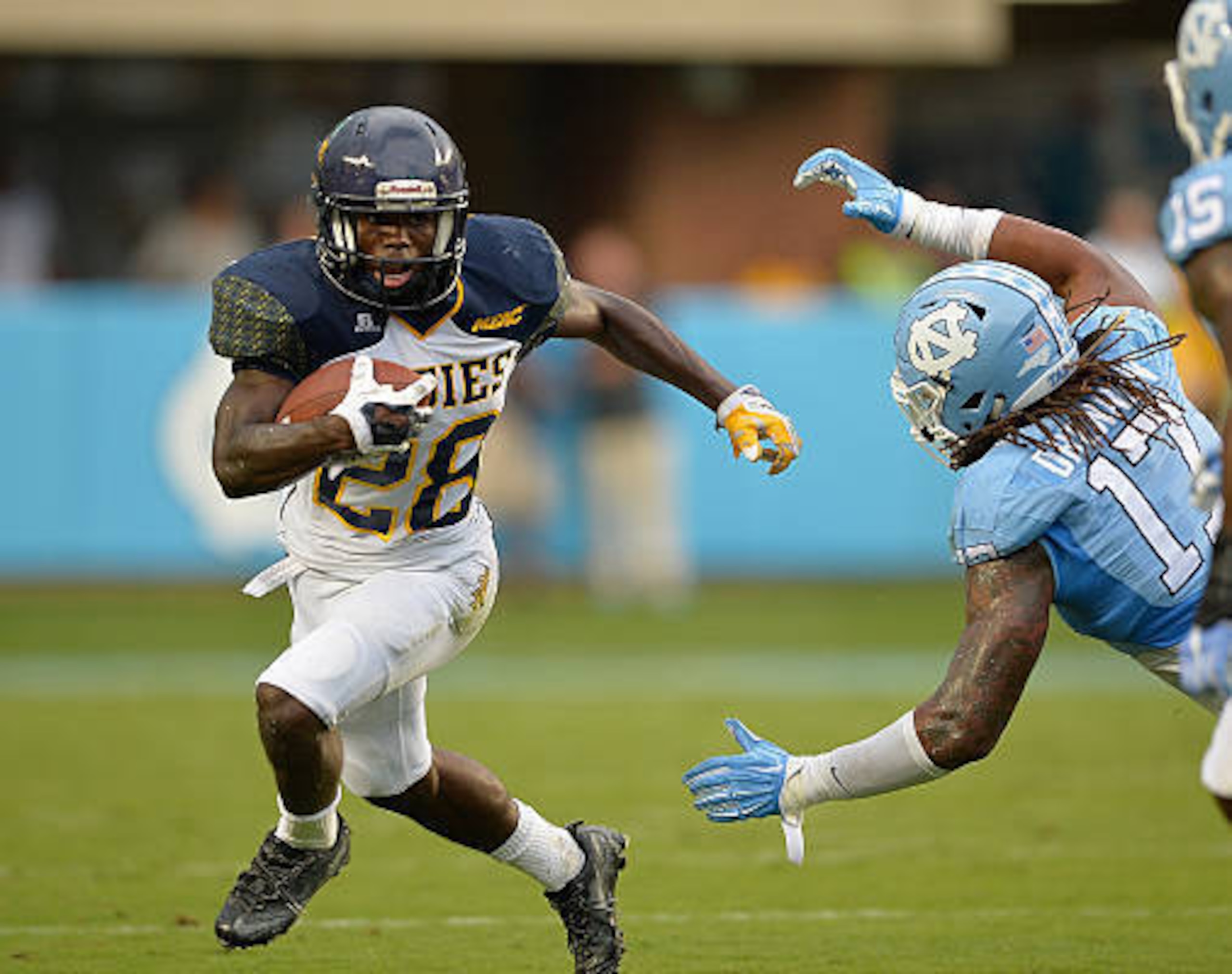
| Height | Weight | 40 Time | Arm Length | Hand Size | 3-Cone |
| 5'6 3/8" | 179 lbs | 4.42s | N/A | N/A | 7.22s |
POSITIVES
Tarik Cohen earned his nickname: “the human joystick.” He has great speed, running a 4.42 40-yard dash, and has excellent lateral quickness to match. He profiles as a third-down back at his size of 5'6", 179 pounds; he may never be more than that, but he can excel in that role. He shows good toughness on his runs. Despite his small frame, he never gives up, continuing to drive his legs and try for extra yardage. He can make defenders miss in space and use his speed to explode by them. He averaged 7.5 yards per carry his senior year, consistently showing his big-play ability. He is also lethal out of the backfield, using his lateral quickness to break linebackers down in space and consistently get open. Additionally, Cohen projects as a dangerous returner given his speed and lateral quickness, even though he did not fill that role in college.
NEGATIVES
His size will likely drop his stock on draft day. He isn’t big enough to be an every-down back despite being one in college. His production came at the FCS level, where he was a better athlete than everyone else. The NFL will be a big step up in competition, and some of his breakaway runs won’t be possible. When he runs, he too often looks to bounce it outside, lacking vision in between the tackles. He has a big-play mentality that leads to runs getting strung out. His size will not only hinder him from being an every-down back, but in pass-blocking situations as well. His toughness is apparent on tape, but in the NFL, linebackers and linemen will run through him on their way to the quarterback.
PRO COMPARISON: Darren Sproles, Philadelphia Eagles
FINAL GRADE: 5.75/9.00 (Rotational Back—Round 4)
15. Jamaal Williams, Brigham Young University
27 of 41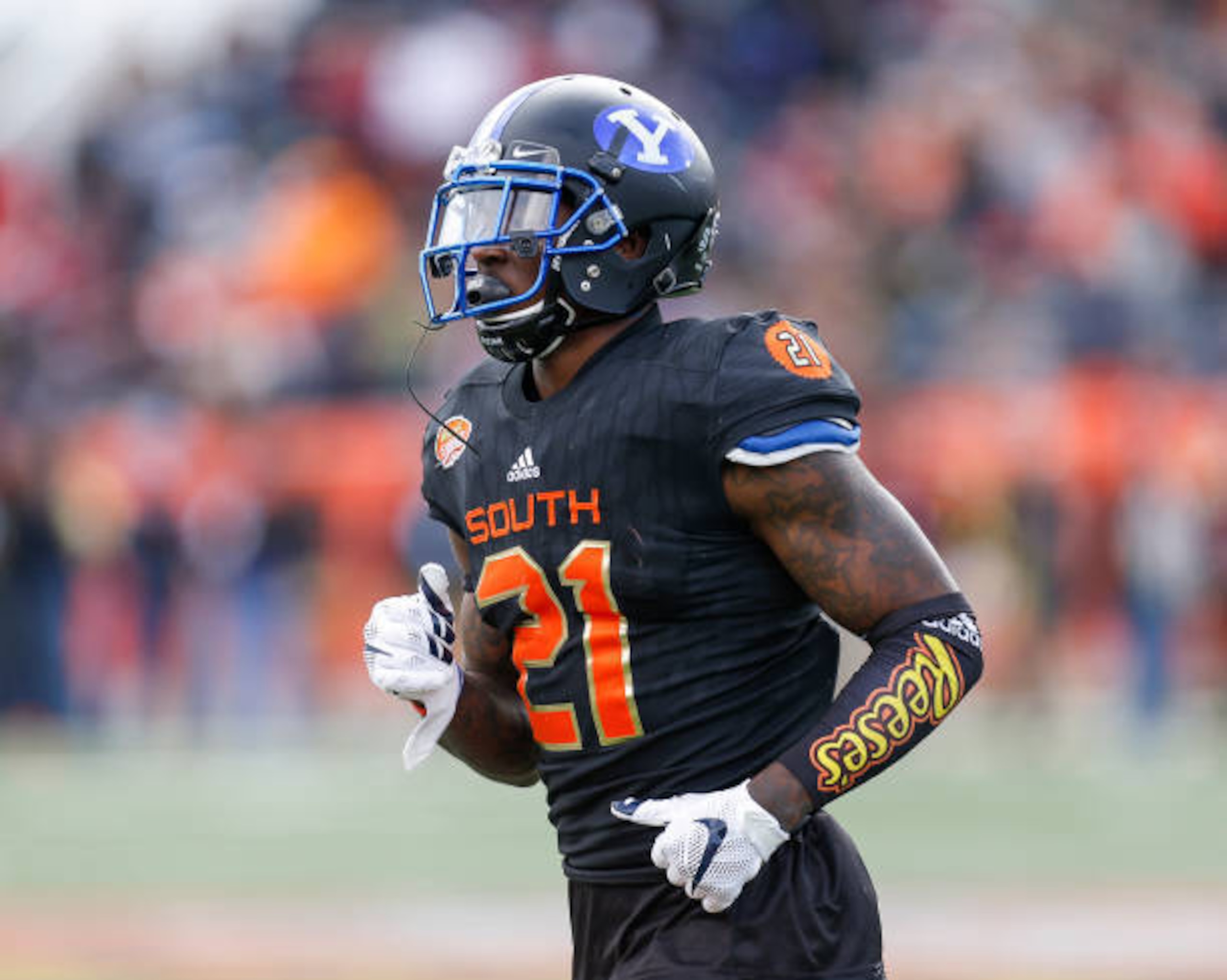
| Height | Weight | 40 Time | Arm Length | Hand Size | 3-Cone |
| 6'0" | 212 lbs | 4.53s | N/A | N/A | 7.12s |
POSITIVES
Jamaal Williams is a high-effort, powerful runner who never gives up on plays. He has good leg drive combined with great determination that allows him to get hidden yardage on most plays. This led to his 5.9 yards per carry average during his senior year. He has a powerful cut that he can explode out of, and he uses it well both at the line of scrimmage and down the field. He has great cutback vision. His down-the-field cuts get defenders off balance, and he can use his power to run through off target tackles. He is too strong to allow arm tackles to bring him down, and he has a strong stiff-arm to keep defenders at bay. He has good balance through contact, helping him gain extra yardage. Williams only caught 15 total passes in his last 18 career games, but he showed soft hands and the ability to catch the ball away from his body. His massive 10” hands will likely make it easy for him to catch the ball going forward. His hand size also played a role in his ability to hold onto the football, only fumbling once out of every 184.5 touches.
NEGATIVES
Williams lacks breakaway speed and consistently got caught from behind. While he can explode out of his cut, his cuts won’t make many defenders miss, which is reflected in his 7.25 second three-cone time (14th percentile). His lack of top-end speed and limited acceleration likely cap his ceiling in the NFL. While he can develop into a pass-catching back, teams will likely have their doubts as he did little of it in college. His pass-blocking was adequate, but not a strength. He attacks defenders and has good vision, but his technique will need to be improved. He may be viewed as a two-down power back and part of an NFL committee.
PRO COMPARISON: Kevin Smith, retired
FINAL GRADE: 5.79/9.00 (Rotational Back—Round 4)
14. Matthew Dayes, North Carolina State
28 of 41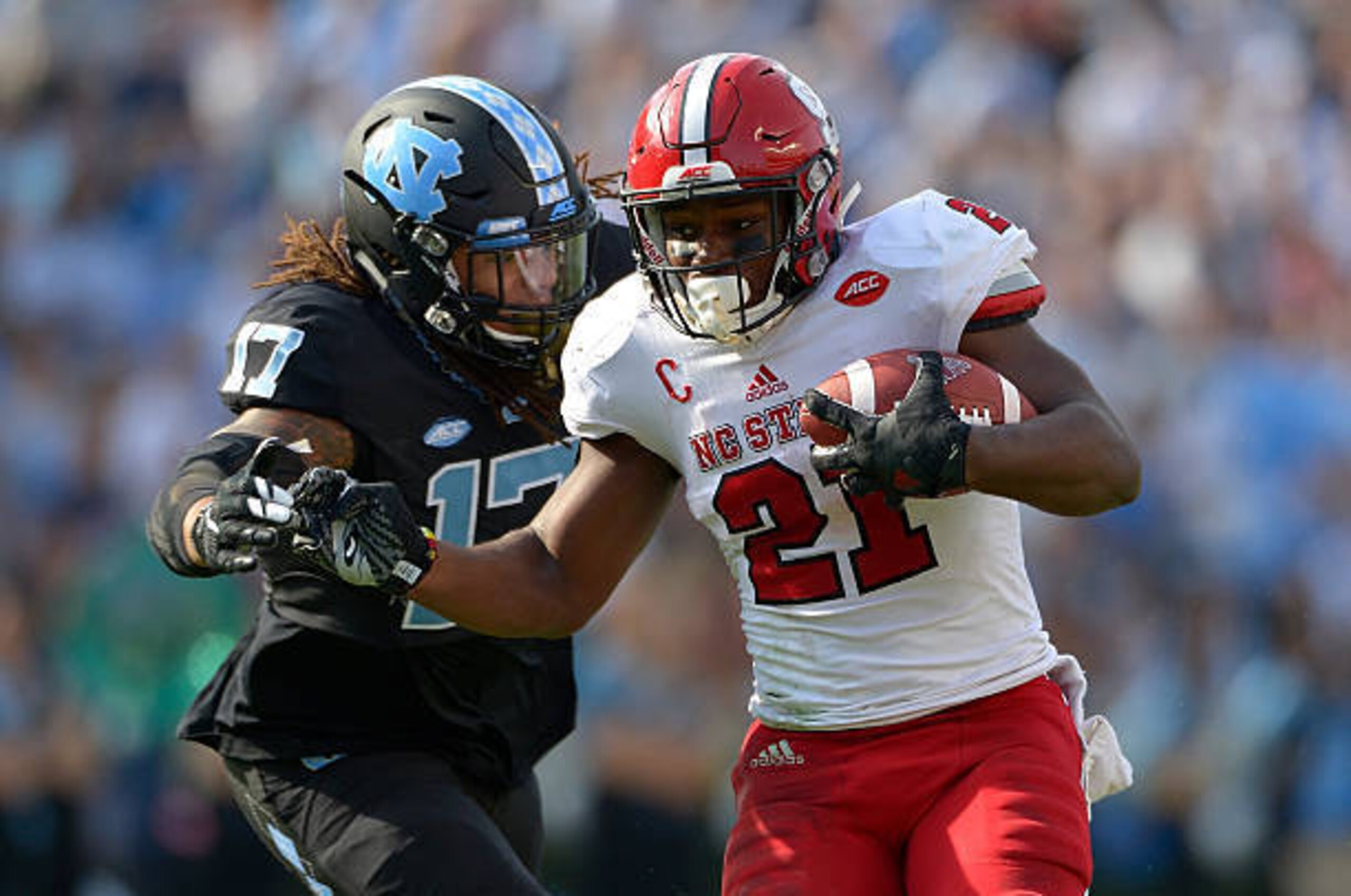
| Height | Weight | 40 Time | Arm Length | Hand Size | 3-Cone |
| 5'8 5/8" | 205 lbs | 4.66s | N/A | N/A | 7.26s |
POSITIVES
Matthew Dayes’ quickness and acceleration are his greatest attributes. He gets to his top speed quickly, and can decelerate just as fast. He has great lateral quickness combined with a powerful one-cut-and-go mentality. Dayes has good vision to find cutback lanes, and he excels running behind pulling guards. He runs with great patience, anticipates holes that will open and understands his blockers’ assignments. He is difficult to tackle in the open field, consistently making defenders miss with his cutting ability. His lateral quickness in the open field translates well into his route-running ability. He has a developed route tree and leaves linebackers in the dust, creating separation and easy throwing windows for his quarterback. He shows good patience running screens, draws the defenders in and leaks out to create more open field for himself. Dayes consistently used his abilities to create big plays in the passing game. He averaged 9.5 yard per reception in his career.
NEGATIVES
Dayes lacks power and too often gets stood up by defenses. This is not from a lack of effort, but rather from a lack of ability to drive the pile with his leg strength. Dayes has great quickness, but he lacks top-end speed, and without power, he doesn’t profile as an every-down back. Dayes has great cutting ability, but he gets away from it too often. He falls in love with his spin move, which rarely works on defenders. He needs to improve his balance and run with higher knees as he gets tripped up too often by ankle tackles. While he is an excellent receiving back, he needs to improve in pass protection. He looked uncomfortable stepping in when blocking and much more comfortable when helping a tackle on the edge. He will need to improve in this area for teams to make him a third-down back and take advantage of his receiving ability. With holes in his game that he is unlikely to fix, Dayes is likely limited to a being part of a committee.
PRO COMPARISON: Bilal Powell, New York Jets
FINAL GRADE: 5.80/9.00 (Future Starter—Round 3/4)
13. Wayne Gallman, Clemson
29 of 41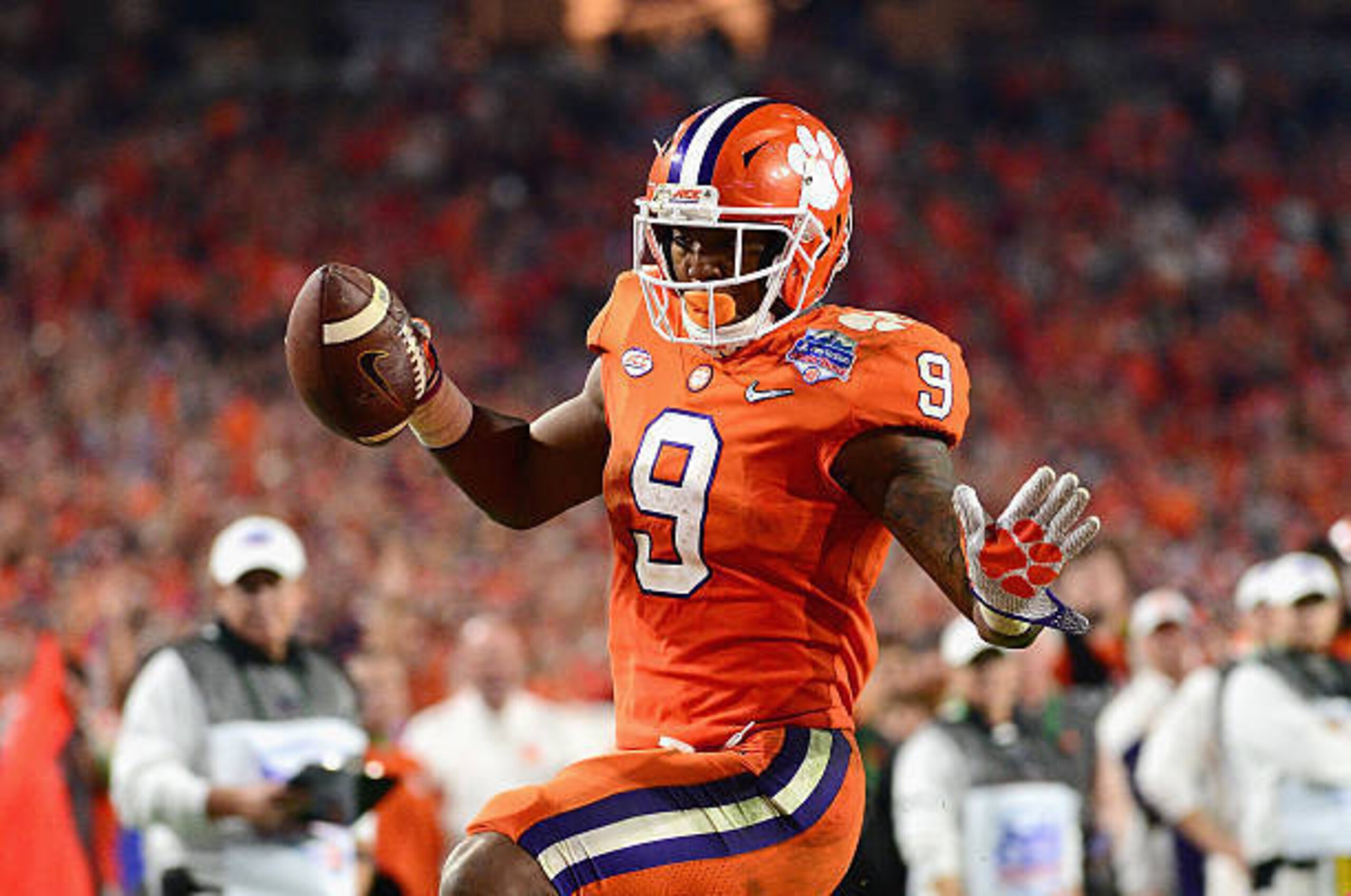
| Height | Weight | 40 Time | Arm Length | Hand Size | 3-Cone |
| 6'0" | 215 lbs | 4.60s | N/A | N/A | 7.17s |
POSITIVES
Wayne Gallman runs with as much attitude as any player in the class. He lacks top-end speed, but has great acceleration to make up for it. He is a powerful one-cut runner, who is decisive at the line of scrimmage. He isn’t a dancer; instead, he sees a hole and hits it hard. He can get skinny through the hole and runs with great balance, shrugging off contact and staying upright. He runs with power and leg drive, and can move the pile or run right through defenders. Gallman’s calling card is his jump cut. He uses it in the open field both to make defenders miss and with special skill to find cutback lanes. He anticipates holes opening before they do, which allows him to get to the second level. Gallman is excellent around the goal line.
NEGATIVES
While Gallman can develop into a three-down back, he has work to do in that area. He has soft hands, but was asked to run a limited route tree at Clemson, almost exclusively screens and flares. His blocking style will get him in trouble, since relying strictly on power will have him get blown up and miss blocks entirely. His vision is there to be a successful blocker, but his technique will need to greatly improve. As a runner, Gallman is too upright. He runs with great power, but his pad level can get him in trouble at times. Lowering his center of gravity could make his play style that much more lethal. His high pad level led to some of his numbers not matching his true power. Gallman has the tools you look for out of a complete back, but will need to put them together to end up as more than a committee back.
PRO COMPARISON: DeMarco Murray, Tennessee Titans
FINAL GRADE: 5.80/9.00 (Future Starter—Round 3/4)
12. Marlon Mack, South Florida
30 of 41
| Height | Weight | 40 Time | Arm Length | Hand Size | 3-Cone |
| 5'10 3/4" | 213 lbs | 4.50s | N/A | N/A | N/A |
POSITIVES
Marlon Mack is fantastic, and an exciting football player to watch. He performed well at the combine, but his play speed is even faster. One of the biggest home-run threats in the draft, Mack averaged 6.8 yards per carry and 8.1 yards per catch in his junior season. He plays football like he was shot out of a cannon, combining his speed with explosive lateral cuts. He has good balance, and his power comes from his top-end speed. He moves faster than anyone else, so he can shrug off weaker arm tackles and run through them. He shows good leg drive, with the ability to push the pile. Mack is also a threat to catch the ball out of the backfield. South Florida used him both out of the backfield and at wide receiver to try and get him the ball in space where he is most dangerous. Mack has all the tools teams look for to develop into a big-time playmaker at the next level.
NEGATIVES
At this point of his career, Mack the athlete is better than Mack the football player. Mack plays like a pinball shot. Sometimes he can rack up a ton of points, other times he goes straight to the gutter and loses. His lack of vision is apparent on his runs, as he often passes up sure bets for yardage to go for the home run. He needs to learn to take what is given to him instead of looking looking to bounce the ball outside. Mack will also need to hold onto the football better in the NFL if he wants to consistently see the field. He had 12 fumbles in three seasons, with a fumble rate of one out of every 54 touches. While Mack is explosive in the open field and can catch the ball, he needs to improve his third-down capabilities
PRO COMPARISON: Jerick McKinnon, Minnesota Vikings
FINAL GRADE: 5.99/9.00 (Future Starter—Round 3/4)
11. James Conner, Pittsburgh
31 of 41
| Height | Weight | 40 Time | Arm Length | Hand Size | 3-Cone |
| 6'1" | 233 lbs | 4.65s | N/A | N/A | N/A |
POSITIVES
James Conner tore his ACL in 2015, and while going through rehab, he was diagnosed with Hodgkin’s lymphoma. After recovering from his ACL tear and being declared cancer-free, Conner took the field in the 2016 season and performed well, rushing for 1,092 yards and 16 touchdowns and showing he could bounce back from any adversity. On the field, Conner proved to be a great power back. He has great leg drive, moves the pile after first contact and gains hidden yardage. He is also able to deliver a powerful stiff-arm to oncoming defenders, either keeping them at bay or throwing them aside completely. Conner runs with good balance and can get skinny through the hole despite his big frame. He has the ability to play three downs and be effective at whatever role a team uses him in.
NEGATIVES
Conner lacks top-end speed. On tape, he wasn’t the same level of athlete as he was pre-ACL tear and illness. Conner has solid acceleration, but his lack of speed can limit his outside runs, as the plays can often be strung out. Despite his excellent route running, teams may worry if he will be able to get open versus NFL linebackers who can match his speed. He lacks lateral quickness and relies on his power in the open field. He won’t make many defenders miss, instead looking for them to miss their target point and having strength to run through the weaker tackle attempt. With his lack of speed and wiggle, he may be limited to a power back role in a committee backfield.
PRO COMPARISON: C.J. Anderson, Denver Broncos
FINAL GRADE: 5.99/9.00 (Future Starter—Round 3/4)
10. Brian Hill, Wyoming
32 of 41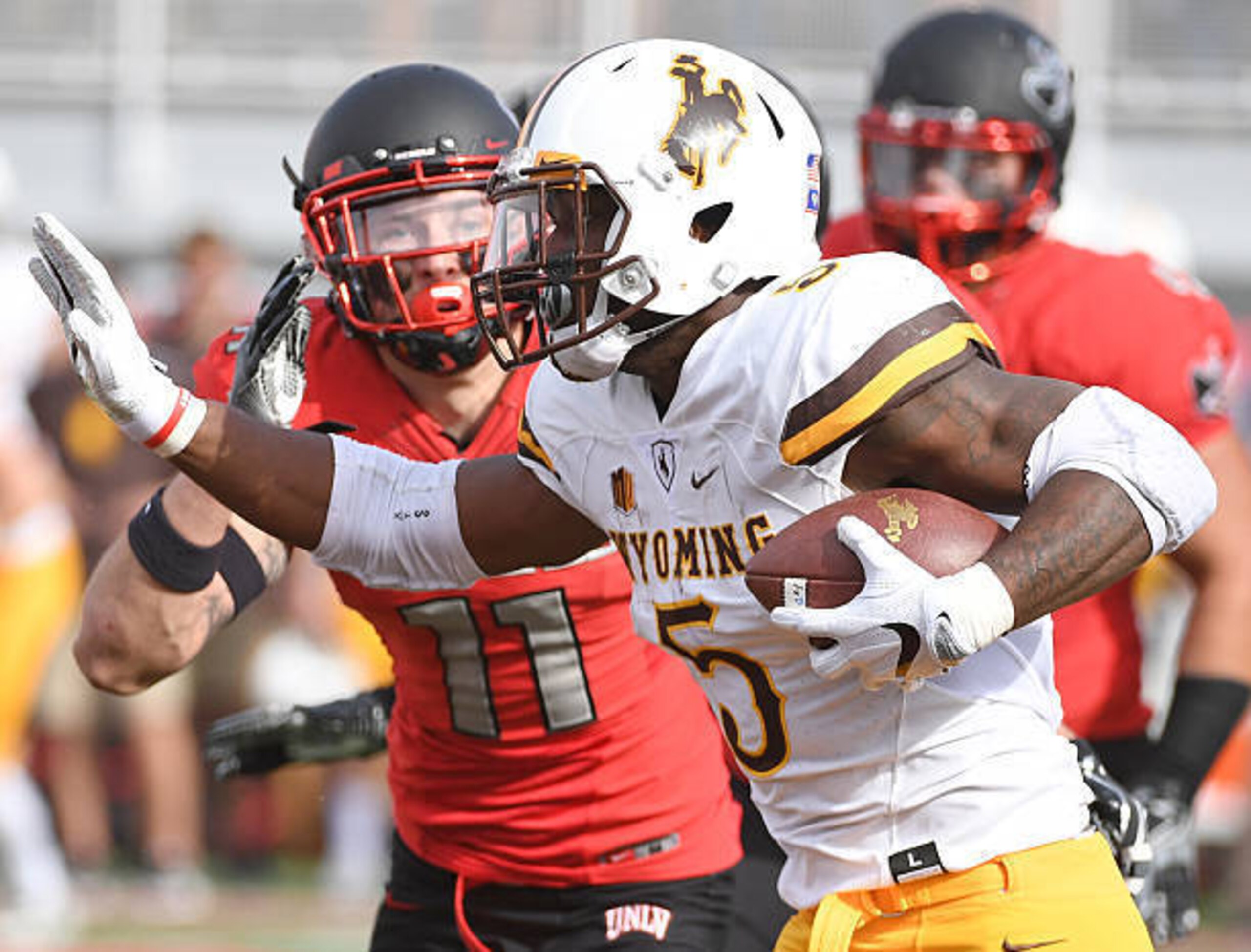
| Height | Weight | 40 Time | Arm Length | Hand Size | 3-Cone |
| 6'0 5/8" | 219 lbs | 4.54s | N/A | N/A | 7.03s |
POSITIVES
A two-year starter at Wyoming, Brian Hill is a physical, punishing runner with a finisher's mentality. In two full years as the No. 1 back, Hill totaled over 1,600 yards both seasons (1,631 in 2015, 1,860 in 2016) and saw the end zone 22 times in the last season alone. Hill has great downhill speed and picks up momentum and he rolls down the field. He has the power in his frame to run through tacklers and can be an intimidating force on the runway. Hill runs with good balance and a forward pad lean that will help him pick up yards after contact.
NEGATIVES
Hill was suspended for the first quarter of his last game for breaking team curfew. In the passing game, he wasn’t called on as often in 2016 with a stronger-armed quarterback (Josh Allen) under center. Hill can be slow to attack a rushing lane and wants to let the play develop before he makes his move. In the NFL, the rushing holes will close faster and be smaller, so he has to become more urgent and aggressive as a decision-maker.
PRO COMPARISON: T.J. Yeldon, Jacksonville Jaguars
FINAL GRADE: 6.00/9.00 (Rookie Impact—Round 3)
9. Jeremy McNichols, Boise State
33 of 41
| Height | Weight | 40 Time | Arm Length | Hand Size | 3-Cone |
| 5'9" | 214 lbs | 4.49s | N/A | N/A | 6.93s |
POSITIVES
A two-year starter at Boise State, Jeremy McNichols entered the 2017 draft as a junior. For the Broncos, McNichols established himself as a dual-threat, caught 103 passes and rushed for 44 touchdowns. He has the open-field speed to run away from defenders and the fancy footwork to make a tackler miss in space. He has the lower-body power to run through contact and finish runs. McNichols is short but has big 10” hands that show up when he’s catching the ball. Vision is one his best traits. He has great instincts to find running room.
NEGATIVES
McNichols wants to take every run outside the tackle box and loves to turn the corner. He’s not a physical between-the-tackles runner and has nine fumbles in two seasons, which points to a struggle with ball security. McNichols is a finesse runner who, as one scout put it, “wants to tip-toe through the tulips”. McNichols had a torn labrum repaired after the combine and could miss some time early.
PRO COMPARISON: Giovani Bernard, Cincinnati Bengals
FINAL GRADE: 6.00/9.00 (Rookie Impact—Round 3)
8. Samaje Perine, Oklahoma
34 of 41
| Height | Weight | 40 Time | Arm Length | Hand Size | 3-Cone |
| 5'10 5/8" | 233 lbs | 4.60s | N/A | N/A | 7.26s |
POSITIVES
Samaje Perine is a thick, compact, bruising runner with good feet. Perine stays low to the ground and can build up big speed out of the gate. Perine has an exceptional work ethic and is a weight-room warrior. He consistently grinds out short-to-intermediate runs working through contact. Perine sets up smaller defenders with a stiff-arm to bounce runs outside. He was highly productive over the last three seasons at Oklahoma, posting 4,122 yards and 49 touchdowns. Perine is a powerful blocker and an excellent short-yardage power back. In the right scheme, he’ll see plenty of touches early in his rookie season.
NEGATIVES
Perine carried a heavy workload at Oklahoma—totaling nearly 700 carries over the last three seasons. His body has taken a bit of a beating, including ankle problems that limited him to nine starts in 2016. Perine has below average straight-line speed and overall quickness. He won’t run away from any defenders in the open field. He’s a short-armed player who will struggle to reach blocks and has a limited range when catching the ball.
PRO COMPARISON: Jeremy Hill, Cincinnati Bengals.
FINAL GRADE: 6.25/9.00 (Rookie Impact—Round 3)
7. Kareem Hunt, Toledo
35 of 41
| Height | Weight | 40 Time | Arm Length | Hand Size | 3-Cone |
| 5'10 1/2" | 216 lbs | 4.60s | N/A | N/A | 7.22s |
POSITIVES
The top-ranked senior running back in the class, Kareem Hunt put on a show at Toledo over the last four seasons. He collected almost 5,000 rushing yards and added 73 catches while scoring 45 touchdowns in that time span. Hunt is a quick, shifty back with the burst to pull away from defenders around the corner. He has tree-trunk thighs and gets low to fight for yards. Hunt’s balance and quickness make him tough to catch in the open field. His ball security is near perfect with just one career fumble. Hunt can be a valuable receiver and blocker in passing situations.
NEGATIVES
Hunt doesn’t have ideal breakaway speed and can be caught from behind. His poor times in the 40-yard dash and three-cone drill show the same issues that his film does in his struggle to explode and get a fast start. The tape shows a bad habit of Hunt stopping his feet and pausing behind the line of scrimmage, which will need to be addressed at the next level. Hunt was suspended in 2015 for a violation of team rules (two games).
PRO COMPARISON: Jay Ajayi, Miami Dolphins
FINAL GRADE: 6.40/9.00 (Rookie Impact—Round 3)
6. D'Onta Foreman, Texas
36 of 41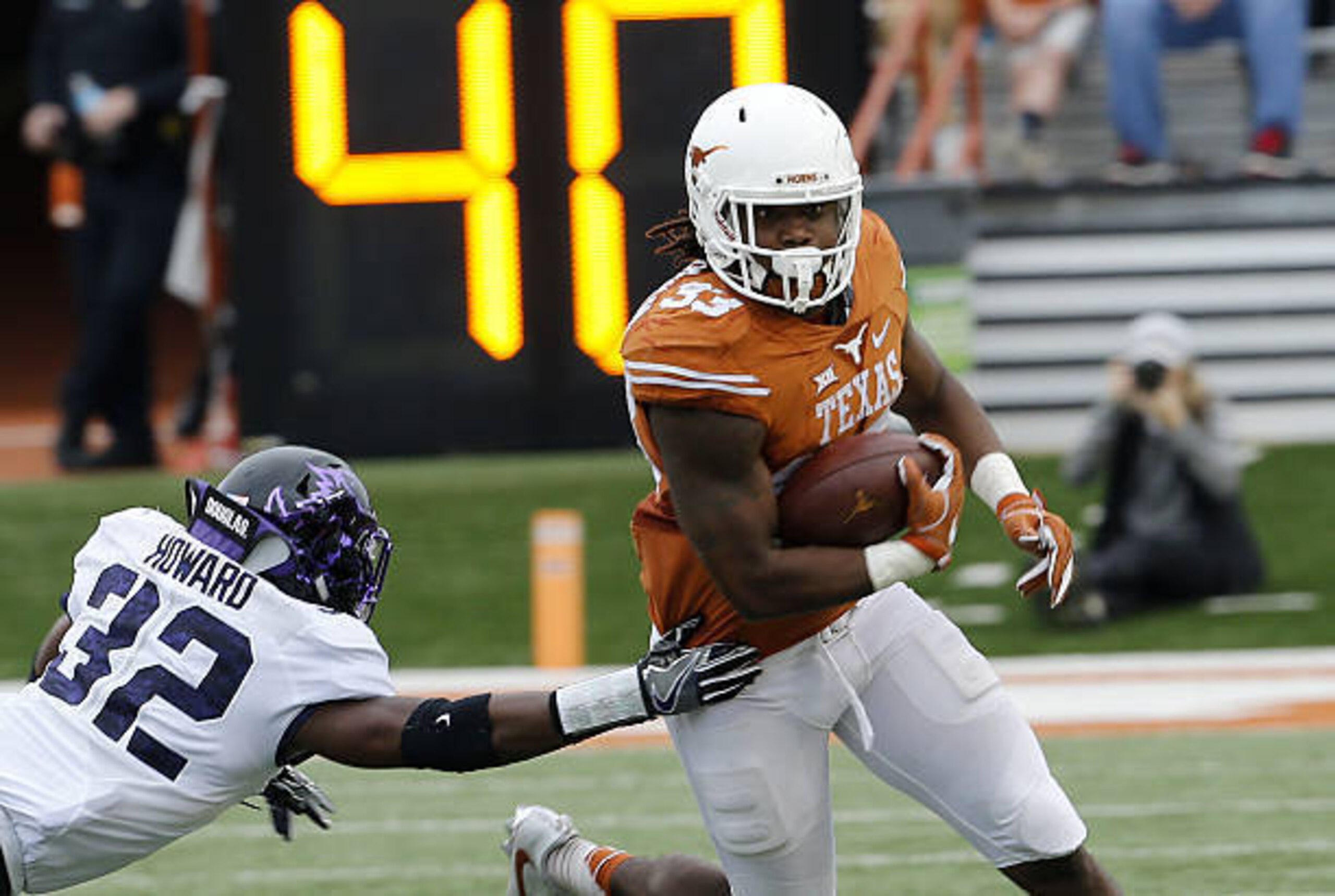
| Height | Weight | 40 Time | Arm Length | Hand Size | 3-Cone |
| 6'0 1/4" | 233 lbs | 4.46s | N/A | N/A | 7.21s |
POSITIVES
Just a one-year starter at Texas, D’Onta Foreman has excellent size, speed and limited wear-and-tear after seeing only 431 career carries. Foreman has great size and straight-line speed. He gets a good initial burst off the handoff, is a decisive runner with quick feet and keeps his legs churning to finish runs. Foreman forced 64 missed tackles while averaging 3.5 yards after contact on 323 carries in 2016. He doesn't tire out—even with heavy workload—and was asked to be a bell cow in the Longhorns offense. He’s a violent blocker in pass protection and can see the field as a rookie on third down.
NEGATIVES
Foreman’s running style does not scare defenders. He prefers to elude tacklers rather than run through them, even while carrying a gigantic frame. Ball security can be an issue with a 74.3 fumble rate—many of which came from Foreman fighting for extra yards at the end of a run. He was not utilized in the Texas passing game. A stress fracture found in his foot at the combine kept Foreman from working out.
PRO COMPARISON: Marshawn Lynch, retired
FINAL GRADE: 6.60/9.00 (Rookie Starter—Round 2)
5. Dalvin Cook, Florida State
37 of 41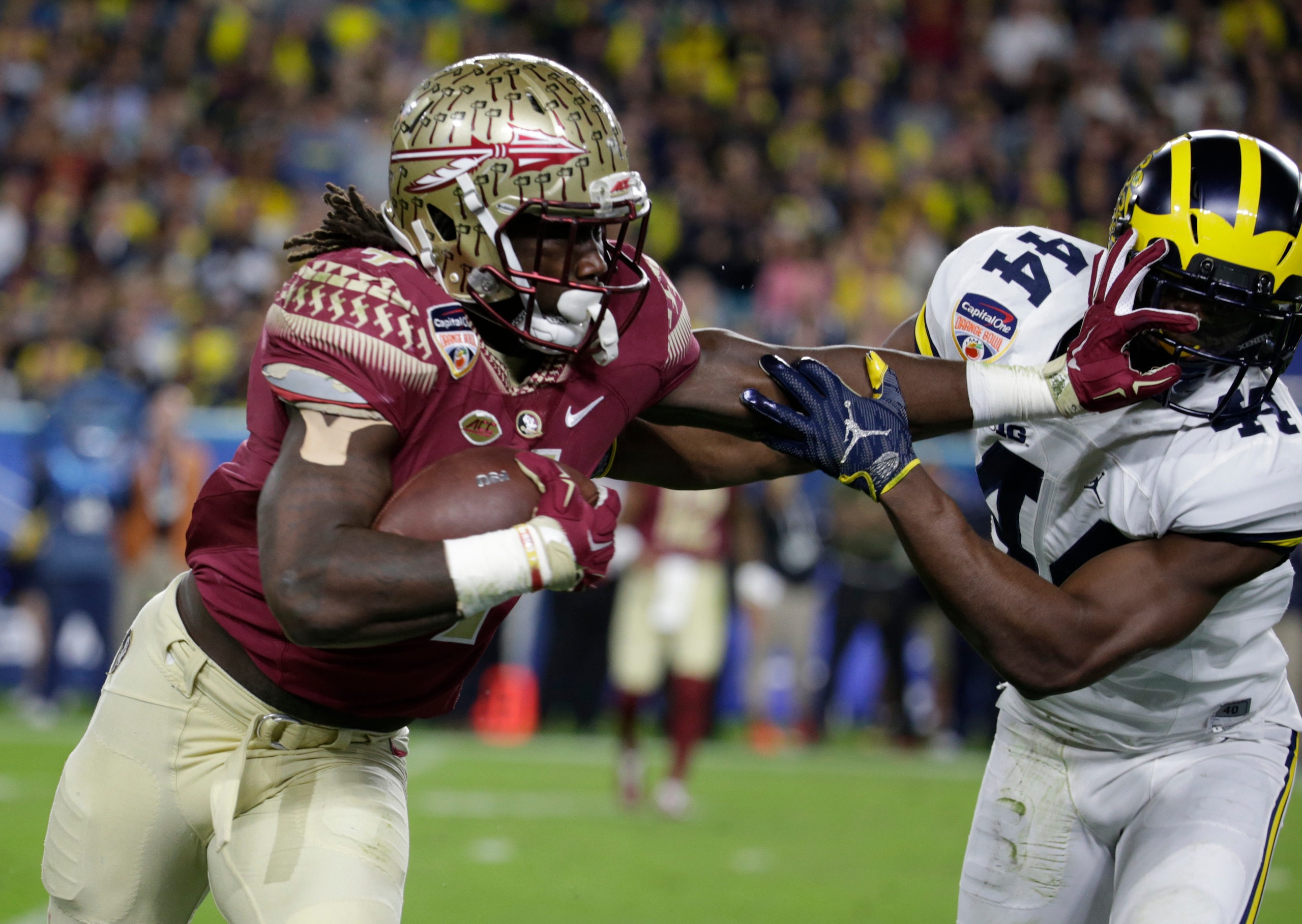
| Height | Weight | 40 Time | Arm Length | Hand Size | 3-Cone |
| 5'11 1/8" | 210 lbs | 4.49s | N/A | N/A | 7.27s |
POSITIVES
Dalvin Cook rushed for over 4,400 yards in three seasons at FSU, quickly proving himself to be one of the best backs in the nation. He’s an elusive, quick-cut runner who is deadly in space. Cook can stop on a dime and slice and dice through defenders. He has an extra gear to break runs outside and displays good recognition of when to do so. Cook glides in the second level of the field and often makes defensive backs look silly. He’s a threat to take it for six every time the ball is in his hands. Cook has the tools to immediately step into an NFL offense and make plays as a runner and receiver (79 career catches).
NEGATIVES
Off-field concerns with Cook are a major question mark, stemming from multiple incidents dating from 2009 all the way throughout his college career. Cook was arrested for allegedly striking a woman outside a bar in 2015 (found not guilty); charged with criminal mischief in 2014 after shooting out windows with a BB-gun; cited for violation of animal care for chaining several puppies up together in his backyard in 2014; arrested and charged with firing a weapon on school property in high school (charges dropped); arrested and charged with robbery (2009) with the charges dropped. Cook has never been convicted of a crime, but his pattern of issues must be vetted.
There are long-term health concerns from three shoulder surgeries. Cook had nagging hamstring issues while at FSU. His smaller frame could prevent him from becoming a primary back. Cook’s disappointing showing at the NFL combine raised questions about his preparation—he tested below 10 percent in the 3-cone, vertical jump and short shuttle. Cook has severe ball-security issues with a disastrous 63.8 fumble rate. He has inconsistent hands with nine career drops on 99 targets. Cook's struggles in pass protection could limit his workload as a rookie.
PRO COMPARISON: Clinton Portis, retired
FINAL GRADE: 6.75/9.00 (Rookie Starter—Round 2)
4. Alvin Kamara, Tennessee
38 of 41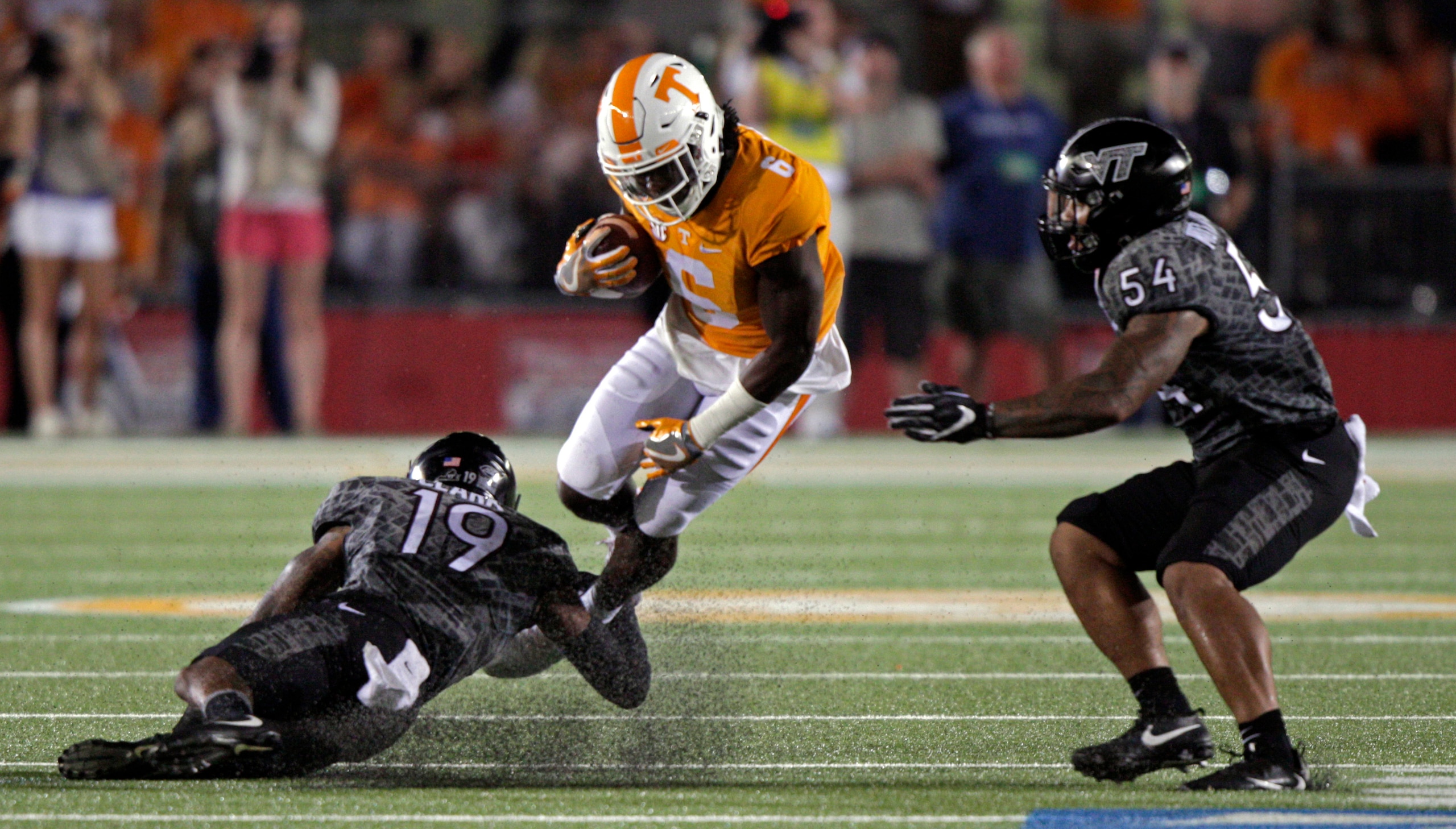
| Height | Weight | 40 Time | Arm Length | Hand Size | 3-Cone |
| 5'9 3/4" | 214 lbs | 4.56s | N/A | N/A | 7.10s |
POSITIVES
Alvin Kamara started just one season at Tennessee after splitting time with Jalen Hurd, but it’s easy to see his ability as a three-down back thanks to excellent balance, burst and receiving skills. Kamara was a touchdown machine at Tennessee, scoring 23 over the last two years in spot duty. He’s also a dynamic return man with good open-field speed and moves. His fight as a ball-carrier is impressive (see the Vanderbilt game) and he’s a go-to-the-whistle kind of back. NFL teams will want to vet Kamara’s background, but he was named a team captain in 2016 and a coach we spoke with said he helped hold the locker room together after Jalen Hurd quit the team.
NEGATIVES
Kamara originally signed at Alabama and redshirted as a freshman. He left following a lack of playing time, a knee injury and two suspensions for violation of team rules in 2013. Kamara was arrested in 2014 for driving without a license and failure to appear. Kamara suffered subsequent knee injuries in 2014 (MCL) and 2016 that cost him games. As a punt returner, Kamara has three fumbles in two seasons and might not be a great fit there in the NFL.
PRO COMPARISON: Devonta Freeman, Atlanta Falcons
FINAL GRADE: 6.99/9.00 (Rookie Starter—Round 2)
3. Christian McCaffrey, Stanford
39 of 41
| Height | Weight | 40 Time | Arm Length | Hand Size | 3-Cone |
| 5'11 1/4" | 202 lbs | 4.48s | N/A | N/A | 6.57s |
POSITIVES
The son of Denver Broncos legend Ed McCaffrey, Christian is a true four-down threat. McCaffrey has excellent vision. He’s a patient runner who can plant his foot and change direction as well as any running back prospect from the past five years. McCaffrey can run skinny and explode through tight lanes. He has an extra gear as a home-run hitter in open field. On special teams, McCaffrey is a dangerous punt and kick returner. He’s more than willing in pass protection and knows his assignments. Teams will love his versatility, as McCaffrey can split out wide and work underneath routes with good hands. He had only five career drops on 117 targets. Despite a smaller frame, McCaffrey proved he can handle a heavy workload by protecting himself from big hits.
NEGATIVES
McCaffrey carries a lighter frame. He’s not a traditional between-the-tackles workhorse. In the hole or open field, he won't overwhelm a defender with contact. As a third-down back, teams may knock him because he can be overpowered in pass protection.
PRO COMPARISON: Reggie Bush, free agent
FINAL GRADE: 7.00/9.00 (Top-15 Player Potential—Round 1)
2. Joe Mixon, Oklahoma
40 of 41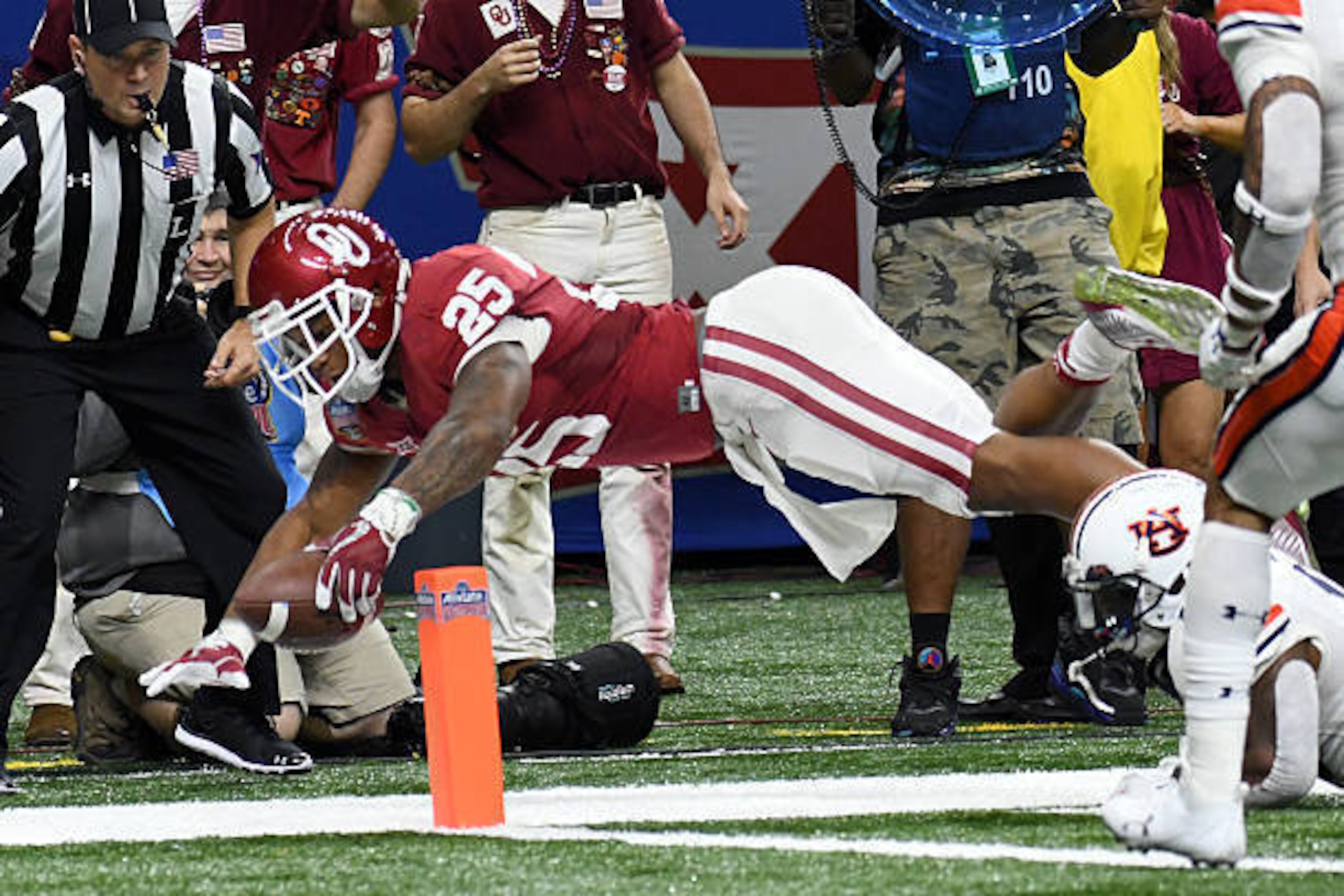
| Height | Weight | 40 Time | Arm Length | Hand Size | 3-Cone |
| 6'0 5/8" | 228 lbs | 4.45s | N/A | N/A | 7.10s |
POSITIVES
There are few running backs in the country—pro or college—with the tools of Joe Mixon. Mixon has power, speed, instincts and super soft hands. While sharing the load with Samaje Perine, Mixon rushed for 1,274 yards in 2016 while adding another 538 on 37 catches. His 15 touchdowns showed what he can do with the ball in his hands. Mixon has excellent agility, balance and the body control to shake a defender and then accelerate for a huge gain. He has the lower-body strength to run through tacklers and will get low to take on defenders one-on-one. Mixon has the frame and power to step right into an NFL lineup and immediately be the best back on the field. From a talent perspective, Mixon has the tools of a future All-Pro. When asked to comment on his background, Oklahoma coaches asked to remain anonymous, but praised Mixon’s growth and leadership.
NEGATIVES
The off-field history is obviously an issue here. Mixon was caught on camera punching a woman in the face following a brief altercation. The punch broke her jaw and cheekbone. He received a one-year deferred sentence, 100 hours community service and had to attend counseling. Mixon was suspended for the 2014 season. He was also suspended for one game in 2016 for tearing up a parking ticket and allegedly throwing it into the face of a female campus security officer. Mixon was not allowed to participate in the combine.
On the field, Mixon can be a little too patient behind the line of scrimmage and will allow defenders to get close before he takes off. His five fumbles in 2016 bring up concerns about ball security.
PRO COMPARISON: Le'Veon Bell, Pittsburgh Steelers
FINAL GRADE: 7.05/9.00 (Top-15 Player Potential—Round 1)
1. Leonard Fournette, LSU
41 of 41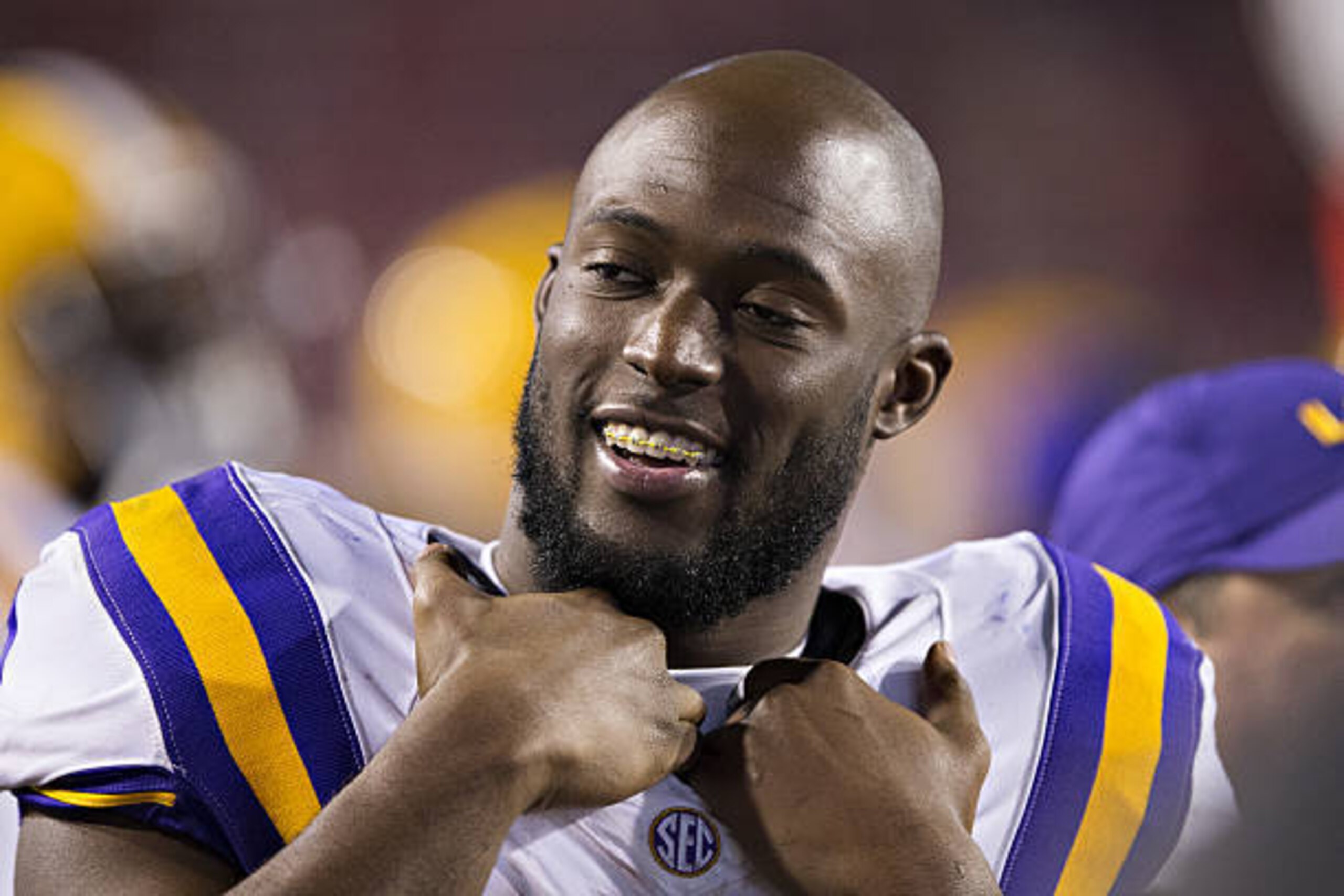
| Height | Weight | 40 Time | Arm Length | Hand Size | 3-Cone |
| 6'0 1/8" | 240 lbs | 4.51s | N/A | N/A | N/A |
POSITIVES
Leonard Fournette is a rare athlete at the running back position. He has a big, strong frame built to take on NFL defenders. Fournette is blessed with excellent balance and the feet to pick his way through traffic to daylight. At the second-level, he has the speed to run away from linebackers and the power to explode through defensive backs. He’s a violent runner with the loose hips to change direction and accelerate quickly. Fournette is a classic downhill runner who is best served lining up behind the quarterback. The combination of his speed, size, strength, balance and violent demeanor is rare. Fournette’s ability to push the pile, explode for big gains down the field and punish a defense make him a clear-cut Day 1 starter. His athleticism makes him much more scheme-versatile than he’s been given credit for.
NEGATIVES
LSU didn’t ask Fournette to be an asset in the passing game, making his receiving skills untested. Some will question that his backup (Derrius Guice) produced just as well as he did when given opportunities. Fournette was hurt with an ankle ligament injury throughout the 2016 season and only played in seven games (six starts) all season. His vision can be a weakness at times, as Fournette bounces off blockers at the line and can struggle to find his way to daylight. Fournette’s eight fumbles on 600-plus carries could cause concerns.
.jpg?w=2560)