

NFL Combine 2017: What to Watch for on Sunday
The NFL is forever in pursuit of a freak.
No, not the kind with lasers shooting from his eyes. And not the wolverine with claws coming out of his hands, instead of the football-playing kind from Michigan.
The NFL has an unquenchable thirst for freak athletes. So much that the word itself has lost some of its bite in recent years while becoming another source of draft-speak white noise.
Some of the freaks who seemingly break all laws of body science are among the fast-moving human hammers who roam defensive fronts. That's who we'll be watching Sunday as the likes of Jabrill Peppers and Myles Garrett—widely projected as the draft's top pick—take their turns sprinting, cutting and whacking tackling dummies in Indianapolis, Indiana.
It's a position group that could generate several top-10 picks on April 27. And if that happens it'll be because of both the talent available, and the desperate need for that talent at positions anchoring defenses.
The NFL is a passing league, which is a reality you've been reminded of weekly for about the last five years. What's the ultimate antidote when an opposing quarterback is roasting a defense? A spry young pass-rusher who can keep bringing pressure for years, like the Broncos' Von Miller or the Raiders' Khalil Mack. Or even better, a dual-purpose defender who excels up front against both the run and pass.
There will be prospects who meet those descriptions on the field Sunday looking to solidify their draft status. Let's dive deeper into the most notable names and storylines to keep an eye on.
Where Is Jabrill Peppers' Best Position Fit?
1 of 7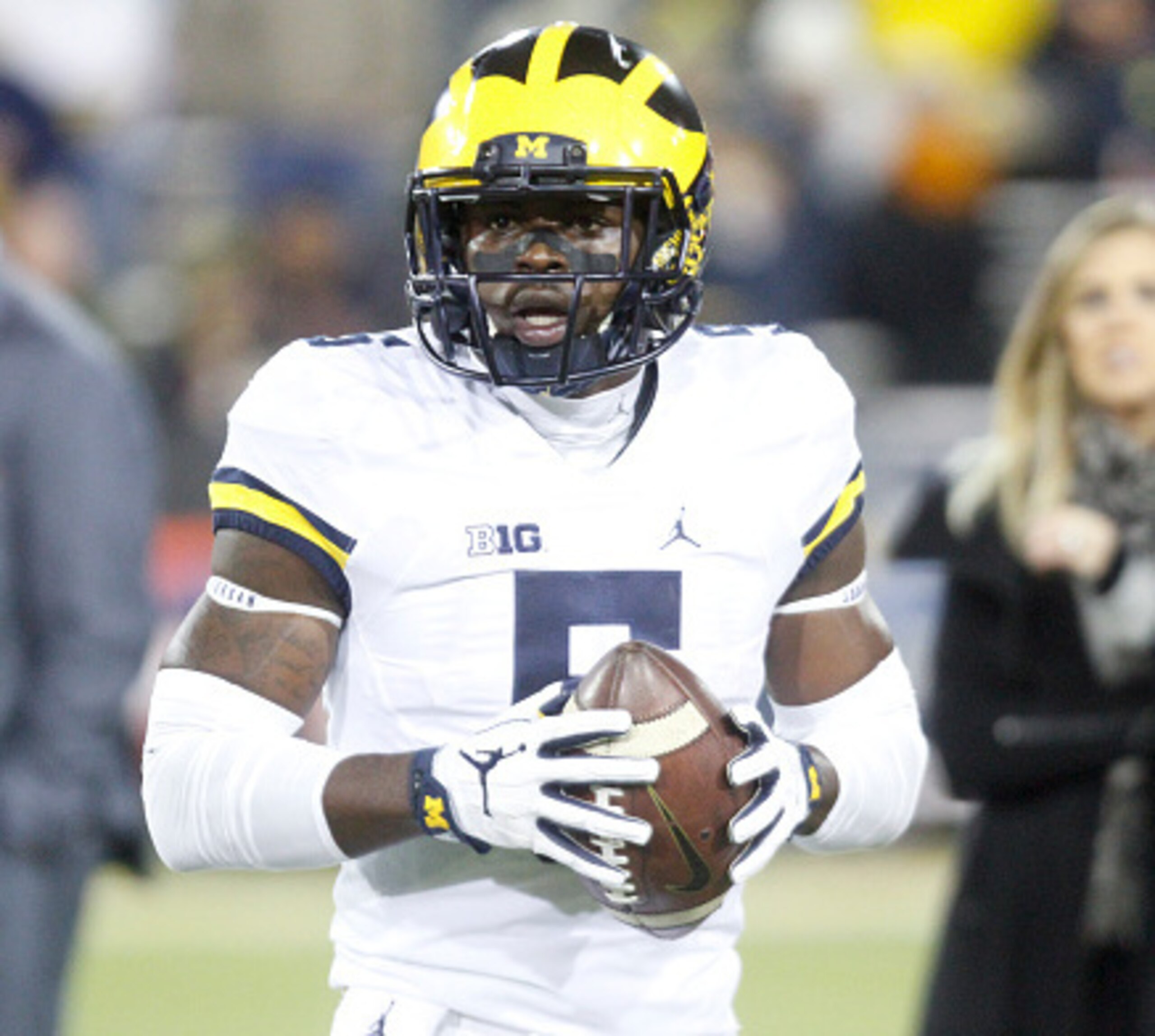
It doesn't take long to find yourself involuntarily drooling over Jabrill Peppers' athleticism. The former Michigan standout showcased plenty of unfair speed and agility both as a defender and, especially, as a kick returner.
In the latter role he averaged 26.8 yards per kickoff return as a Wolverine, and his 14.8 yards per punt return ranked seventh in the nation during the 2016 season.
That's just the bonus athletic side dish Peppers can provide on special teams, though. The main dish will look delicious, too, and it'll be even more tasty if Peppers shines in the combine drills as expected. But how should that meal be served?
Peppers will work out with the linebackers on Sunday, and then again with the defensive backs Monday. In 2016 he spent most of his time in the defensive backfield, and the ideal fit defensively will likely be as a box safety. In that assignment Peppers' speed can be utilized both in run defense as he morphs into a human torpedo while launching toward the ball, and in coverage.
The concern is that, for now at least, his coverage skills are lacking a bit. Peppers was targeted as the primary man in coverage 93 times during the 2016 season, according to Pro Football Focus, and he gave up 58 receptions while recording only six passes defensed.
Peppers oozes with athletic potential, a status set to grow Sunday barring a major let down. That alone will also likely be enough to make him a first-round pick. But ideally Peppers will land in a situation where he can be brought along slowly, and naturally adapt at the next level to find his role.
Myles Garrett Should Showcase His Lethal Blend of Size and Speed
2 of 7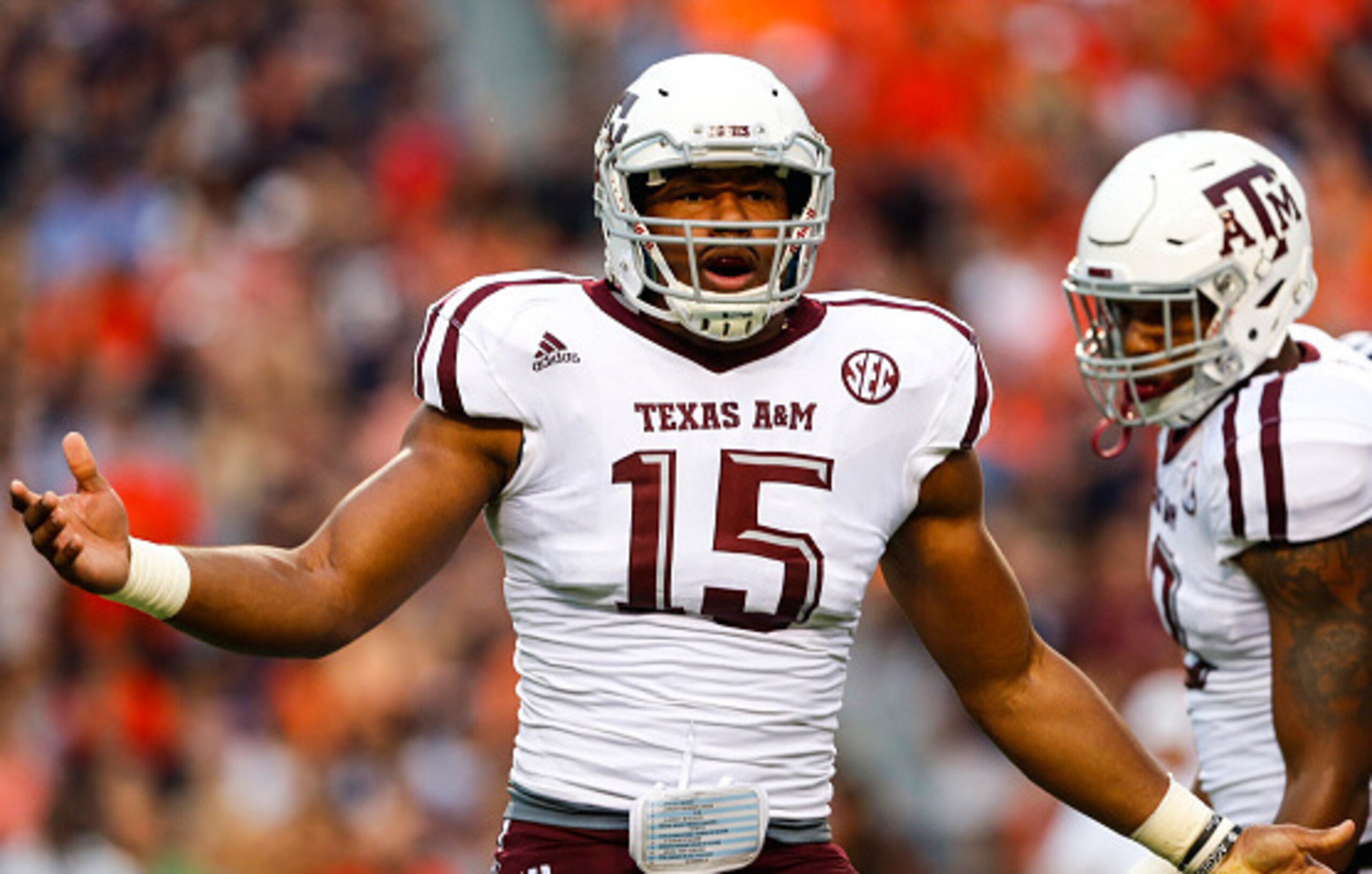
Have your household pets submitted mock drafts yet? They all surely have defensive end Myles Garrett slotted in as the top pick. And, just like everyone else on the internet, they likely won't be wrong.
For a small taste of that consensus we can look to Bleacher Report's Matt Miller and the five draft analysts at NFL.com. All six mock drafts have Garrett coming off the board first overall.
Miller compared him to Andrew Luck in 2012 in the sense that Garrett is so far ahead of his draft class.
"Passing on Garrett is like passing on a young Bruce Smith," a direct of player personnel told Miller. "You don't pass on a kid like that."
That's either high praise, or the product of laughably unrealistic expectations. We're about to find out over the coming weeks, and lighting up the combine will be Garrett's first step toward locking in his grip on the top spot.
The dynamic pass-rusher who bends around the corner with ease should straight up napalm the combine, then torch it again. Oh, and eviscerate it for good measure.
We can expect that for reasons beyond just the two double-digit sack seasons he produced at Texas A&M, and the 15 tackles for a loss in 2016. Garrett told George Schroeder of USA Today back in October that he has a 40-inch vertical and runs the 40-yard dash in less than 4.5 seconds.
He apparently did that while standing 6'4" and weighing 272 pounds. For perspective, Houston Texans defensive end Jadeveon Clowney earned super-freak status after posting a time of 4.53 in the 40-yard dash, and he weighed 266 pounds during his combine.
Is Derek Barnett on the Same Level as Garrett?
3 of 7
If the Garrett-Luck comparison is even close to true, fellow defensive end Derek Barnett won't have success in his mission to become the first overall pick. But the Tennessee Volunteers standout likely won't be far behind Garrett in the second tier of pass-rushers, and that alone says plenty.
If you only judged a player by his combine results (side note: don't ever, ever do that), you might not know Barnett is widely viewed as one of the draft's best prospects at his position.
Maybe he'll surprise with his performance. But it's likely Barnett will have perfectly fine speed, and more than enough to zoom around opposing tackles. He just won't have the sort of speed that will make stopwatches malfunction on Sunday. And there's nothing wrong with that.
"He's not going to run a fast 40, but if you like tough, violent, high-motor players with production, you'll love him," said an AFC executive when speaking to NFL.com's Bucky Brooks. "He kind of reminds me of a young Terrell Suggs coming out of Arizona State."
It gets pretty easy to look past somewhat slower top-end speed after Barnett became the only player in SEC history to finish with double-digit sacks in three straight seasons. He ended his Volunteers career with 33 sacks, breaking Reggie White's school record.
He reached the quarterback so often by relying on sound technique after mastering a variety of pass-rush moves to keep blockers off balance.
"Barnett is one of the best hand-to-hand combat fighters that I've watched in years, and his ability to win with a variety of slick maneuvers makes him nearly impossible to slow down off the edge," wrote Brooks. "In addition to his superior hand skills, Barnett has the rare ability to win with finesse or power off the edge."
The key area to watch Barnett shine won't be in the 40-yard dash, the combine's rock-star event that attracts the brightest spotlight. He'll demonstrate his agility in the three-cone drill and 20-yard shuttle, and show off his well-honed fundamentals during position drills.

Takkarist McKinley Is Doing Something Unique
4 of 7
It's common for previously injured players to use the combine as a medical proving ground. They need to show everything is just fine with a bone they broke or muscle that was shredded.
There are years when the combine has plenty of prospects who fall under that umbrella, and the most notable on Day 3 of on-field testing is Alabama's Jonathan Allen (more on him in a minute).
But UCLA defensive end Takkarist McKinley is different because he's doing it backwards.
Injured players in Indianapolis are usually recovering from surgery, often to the point they're only partial participants in the workouts. McKinley will be seen doing all or at least most of the drills Sunday, and then shortly after that he'll be underneath a knife as doctors repair his shoulder.
McKinley has a torn labrum and a broken glenoid, and the potential first-round pick will undergo surgery to fix those injuries after his workout in Indy. The recovery will be delicate and lengthy, as is typically the case whenever a shoulder is carved up on the operating table. McKinley is expected to be sidelined for five-to-six months, according to Bleacher Report's Jason Cole.
That injury and recovery time may have an impact on McKinley's draft value, though it likely won't be significant. McKinley is healthy enough right now to go through rigorous physical testing, and the worst-case scenario for his recovery timetable isn't devastating anyway. If he needs six months to recover that will take him into September, in which case McKinley will likely miss a handful of games in his rookie year and then still play much of the season.
Please recall that we're just one year removed from linebacker Jaylon Smith only narrowly missing being a first-round pick when he was selected 34th overall. He still hasn't been on the field for an NFL snap while recovering from a severe knee injury.
So McKinley's draft value shouldn't take a massive hit unless something unforeseen pops up in his medical evaluation. And it's expected that even with an injury the surging pass-rusher who recorded 10 sacks in 2016 after only 3.5 in 2015 will still impress with superhuman athleticism.
Draft Analyst's Tony Pauline spoke to his sources, and he predicts "sensational" testing from McKinley.
"McKinley is expected to run 4.5 seconds in the 40 and could get as low as 4.45," Pauline reported. "The athletic defender ran the 100 meters in under 10.70 seconds in high school. His vertical jump is expected to be at least 37 inches."
So McKinley's shoulder will be fine eventually, and his test results should be much better than fine.
Jonathan Allen Needs to Show He's Injury Free
5 of 7
We go from one injured pass-rusher, to another one looking to prove he's not injured at all.
It will take a mighty charge to unseat Garrett as the top pick, though if Alabama's Jonathan Allen didn't have health questions the seeds for his rise may have already been planted. The defensive end was consistently disruptive throughout his time with the Crimson Tide, especially over the past two seasons when he recorded 22.5 sacks along with 30.5 tackles for a loss.
If the Cleveland Browns could be assured they'll get that player both now and in the future, Allen would at least have to be considered for the first overall pick. Bleacher Report's Brent Sobleski has him slotted in at No. 3 in his latest mock draft.
But there are lingering concerns about Allen's short- and long-term health.
Allen suffered labral tears in both shoulders over the course of his college career. As a result both shoulders are mildly arthritic now. That's why Alabama team doctor Lyle Cain told NFL.com's Ian Rapoport that when teams examined Allen's shoulders at the combine their first reaction was probably to conclude he's been pretty beat up over a short period of time.
Looking at Allen's shoulders will make teams cringe and blink a few times. Or many times, but then once they hear the full story Cain said fears will be put to rest.
"Jonathan has really played without symptoms in his shoulders, and it's something that has not affected his performance or function," Cain told Rapoport. "It doesn't have to be treated during the season. And he's had a couple of great years."
Translation: You saw the high-end production from Allen over the past two years, right? You know, the production that included a nation-leading 67 pressures in 2016, per PFF. Well, Allen did most of that with the battered shoulders teams have seen under the combine magnifying glasses.
And his banged up shoulders sure didn't seem to hold him back much during a 2016 season that ended with winning the Bronko Nagurski Award given to the nation's best defender.
However, former NFL scout Greg Gabriel has a different and more ominous outlook on Allen's long-term future.
"News that Allen has moderate arthritis in both shoulders is huge," he tweeted. "Fact is arthritic conditions never improve, they only get worse."
The combine on-field drills will be Allen's final hurdle to show that, yes, he's a sack machine humming along just fine and is worth a top-five pick right now.
But only time will tell if other problems arise down the road.
Can T.J. Watt Climb into the First Round?
6 of 7
T.J. Watt's older brother is known as one of the league's most feared pass-rushers when healthy. Now the younger Watt will try to stand on his own in the NFL, and potentially do it as a first-round pick.
His best path to rising and becoming a first-rounder is for Watt to show he's a multi-faceted defender. He needs to be more than just a pass-rusher, which is a label the Wisconsin outside linebacker has earned easily after recording 11.5 sacks in 2016.
If Watt makes the ascent into the draft's opening night he'll likely do it based on the defensive versatility that shows up on his tape, and should again in the testing numbers he produces at the combine.
He can bring pressure, and that was clearly evident in 2016 when his sack production ranked among the nation's top 10. But Watt also flows to the ball well with sideline-to-sideline speed, and he excels in run defense.
That's what prompted NFL Network's Mike Mayock to make a comparison to the Packers' Clay Matthews, who is used in a variety of ways and has had success as an inside linebacker in addition to being a scary edge-rusher.
"The easy comparison is [Green Bay’s] Clay Matthews," Mayock told MMQB's Peter King. "He's an edge-rusher who fits best into a 3-4 system. He has a similar game to Clay—an edge who can drop in coverage and has a motor that just won’t stop."
To be considered a Matthews-like prospect at linebacker, Watt needs to demonstrate not just his speed, but also the agility to react with explosiveness both against the run, and in coverage.
As Rotoworld's Josh Norris noted, during his combine appearance Matthews logged a grass-burning 10-second split of 1.49 seconds, which showed his quick-twitch burst. He also stood out in the three-cone drill, recording one of the best times in his position group.
Solomon Thomas Also Needs to Answer Position Questions...or Does He?
7 of 7
The most common facial expression while watching Stanford's Soloman Thomas at the combine will be one with eyebrows raised as high as possible, and for as long as possible. The PAC-12 defensive player of the year in 2016 is expected to light fireworks during his workouts.
"Thomas is going to put on a show," a team executive told NFL Network's Daniel Jeremiah. "He's incredibly explosive, and he'll destroy the change-of-direction drills. I wouldn't be shocked if he ran (the 40-yard dash) in the 4.6s and jumped in the high 30s (inches)."
If Thomas shows explosiveness on that level he'll push himself further up draft boards. And chart-topping athleticism will also go a long way toward erasing, or at least limiting, any doubts about scheme and position fit.
But those concerns are real, because while his athletic ability is widely acknowledged and raved about, there's some hesitancy around how Thomas will transition to the NFL with his tweener frame (6'3" and 273 lbs).
"He's not big enough for the inside, and he's not as long as you like on the outside," an AFC director of scouting told NFL.com's Lance Zierlein. "You have to figure out where you will play him, but he won't stop. He's going to be really productive."
His tweener status is why projections for Thomas are so scattered, even after a wrecking-ball show during a bowl game against North Carolina when he finished with seven tackles (two for a loss) and a sack. He's listed as a top-10 pick by four of the draft analysts at NFL.com. But six of the seven NFL teams that Charlie Campbell of WalterFootball.com spoke with pegged him as more of a mid-to-late first-rounder.
"Solomon is explosive, but at 276-280 pounds he's got some tweener," an NFC scout told Campbell. "He's not a true defensive end but a hybrid, jack of all trades/master of none type."
Being a hybrid defender isn't an insult in today's NFL. There are many, many roster spots and eventually a lot of money available for defensive linemen who can thrive both on the outside and inside, depending on the situation.
Now it's Thomas' job to show he can be that movable chess piece.

.jpg?w=2560 "Commanders Eagles Football")
.jpg?w=2560 "Grading WWE Raw 🔠")


.jpg?w=2560 "Viral Rams Coach Vid 🖕")
